


< Back to Sample & Prototype Production
Author: Johnny Liu, CEO at Dowway Vehicle
Published: March 9, 2026
Field: Automotive Engineering and Additive Manufacturing Strategy
Author Note
Johnny Liu is the CEO at Dowway Vehicle and works close to vehicle parts engineering, manufacturing planning, and product delivery. From prototype work to low-volume production and after-sales support, he has followed how additive manufacturing is moving from lab testing into real automotive use. This article is written for engineers, suppliers, product teams, and managers who need a practical and detailed view of 3D printing in automotive parts.
Introduction
The automotive industry is moving toward lightweight vehicles, custom products, electrification, and smarter systems. That shift puts pressure on old manufacturing methods. Traditional processes such as mold forming and machining still work well for large-volume production, but they come with long lead times, high tooling cost, and limits on part shape and design freedom. Those limits become more obvious in new energy vehicles, smart cabins, motorsport programs, and low-volume service parts.
3D printing in automotive parts gives engineers a different path. Instead of cutting material away or waiting for molds, it builds parts layer by layer from a digital model. That makes it possible to move from CAD data to a physical part much faster. It also opens the door to one-piece structures, internal channels, lattice designs, and part shapes that are hard to make with casting, molding, or machining.
In real automotive work, this matters for several reasons. 3D printing can shorten development cycles, reduce tooling cost, support part integration, improve lightweight design, and help companies supply spare parts on demand. It is already being used by BMW, Ford, BYD, NIO, and other automotive players across prototypes, fixtures, metal components, customized interior parts, and after-sales parts supply.
This article explains the full engineering picture behind 3D printing in automotive parts. It covers process basics, process selection, technical pain points, fixes used in practice, case studies, future direction, and key questions that engineers and buyers often ask.
1. Core Principles of 3D Printing in Automotive Parts
At the engineering level, 3D printing in automotive parts is a form of data-driven layered manufacturing. A 3D CAD model is broken into 2D slice data. The machine then builds the part layer by layer by depositing, curing, sintering, or melting material until the final shape is formed.
The standard workflow in automotive use is:
CAD model design and optimization -> model slicing and parameter setting -> 3D printing -> post-processing -> performance inspection
Each step matters.
* CAD model design and optimization decides whether the part is easy to print and whether it can meet strength, fit, and weight targets.
* Model slicing and parameter setting control layer thickness, support strategy, print direction, scan path, and other factors tied to accuracy and build time.
* 3D printing creates the raw part body.
* Post-processing improves surface finish, part strength, stress state, and fit.
* Performance inspection checks size, assembly fit, mechanical behavior, and environmental resistance.
For automotive teams, the machine is only one part of the story. Good results depend on the full link between design, materials, parameters, printing, post-processing, and testing.
2. Core 3D Printing Technologies and Process Selection
In automotive engineering, the most common 3D printing routes fall into non-metal printing and metal printing. Four core processes are used most often: FDM, SLA, SLS, and SLM. Each one has a different forming method, material range, accuracy level, surface quality, strength level, cost profile, and part fit.
2.1 FDM (Fused Deposition Modeling)
FDM uses a heated nozzle to melt thermoplastic filament such as PLA, ABS, and Nylon. The melted material is pushed out along the slice path and cools into shape layer by layer.
Engineering features:
* Lower equipment cost
* Easy to operate
* Wide material supply
* Fast for simple parts
* Useful for prototypes and low-volume parts
* Typical accuracy around +/-0.2 mm
* Surface finish is rougher than SLA and often needs extra finishing
Best-fit automotive uses:
* Interior parts
* Assembly jigs and fixtures
* Non-load-bearing structural parts
* Fast prototype models
* Battery module installation tooling
Real engineering case:
NIO has used FDM to make battery module installation fixtures. Compared with traditional metal fixtures, the printed fixtures reduced weight by 40 kg, cut the design cycle by two-thirds, and brought cost down to one-fifth of the old method.
Where FDM works well:
FDM is a good choice when speed, low cost, and design flexibility matter more than very high surface quality or high structural demand. It is well suited for workshop support tools, fit-check parts, low-risk plastic pieces, and early development work.
2.2 SLA (Stereolithography)
SLA uses ultraviolet light to cure liquid photopolymer resin layer by layer. It is known for high accuracy and smooth surface finish.
Engineering features:
* Accuracy up to +/-0.05 mm
* Good surface quality
* Works well for fine details and complex curved surfaces
* Good for visual models and precision validation
* Resin materials often have limited high-temperature and impact resistance compared with engineering metals or molded engineering plastics
Best-fit automotive uses:
* Lamp lenses
* Decorative interior parts
* Precision prototypes
* Engine part prototypes
* Fit and appearance validation
Real engineering case:
Zhongrui Technology has used SLA to print high-transparency automotive lamp parts. These parts met the assembly accuracy needs of automotive lighting systems and also shortened the prototype development cycle.
Where SLA works well:
SLA is a strong option when the part needs sharp detail, smooth surface finish, or accurate fit checking. It is less suitable for core load-bearing parts or long-term high-temperature service without special material support.
2.3 SLS (Selective Laser Sintering)
SLS uses powder material, such as Nylon or glass-fiber-reinforced Nylon, and a laser to fuse the powder layer by layer. Because the unsintered powder supports the part during building, no extra support structure is needed.
Engineering features:
* No support structures needed
* Good for hollow forms, lattice structures, and inner cavities
* High design freedom
* Material use can be above 90%
* Accuracy is usually a bit lower than SLA
* Powder cost can be high, especially in advanced material systems
Best-fit automotive uses:
* Air-conditioning ducts
* Battery pack insulation covers
* Complex functional plastic parts
* Lightweight structural pieces
* Racing development parts
Real engineering case:
Ford has used SLS to improve brake caliper design, cutting weight by 20% while keeping enough structural strength for automotive use. Tongji University’s electric racing team has also used SLS to make racing parts quickly and speed up development work.
Where SLS works well:
SLS is very useful when engineers need functional plastic parts with complex geometry, inner channels, low-volume output, and no support-removal burden.
2.4 SLM (Selective Laser Melting)
SLM is one of the main metal 3D printing processes used in automotive work. It uses a high-power laser to fully melt metal powder such as titanium alloy, aluminum alloy, and Inconel 718 layer by layer.
Engineering features:
* Accuracy up to +/-0.05 mm
* Strength can come close to forged parts
* Good for complex metal parts made as one piece
* Fits core load-bearing components
* Machine and powder cost are high
* Print speed is slower than traditional high-volume methods
Best-fit automotive uses:
* Engine cylinder body sections
* Turbocharger blades
* Chassis link parts
* Intake manifolds
* Connecting rods
* Motorsport metal parts
Real engineering case:
In one racing modification project, SLM was used to make a titanium alloy connecting rod as a one-piece part. Compared with the old forging-plus-welding route, the printed part reduced weight by 40% and raised fatigue strength by 15%, meeting track-use needs.
Where SLM works well:
SLM fits small-batch, high-value, high-performance metal parts where design freedom and part integration can justify the higher cost.
This figure should compare the four main processes across these engineering points: forming method, material type, accuracy, surface finish, strength, support need, common automotive uses, cost and production fit. The visual message should be clear: FDM fits low-cost tools and non-critical plastic parts; SLA fits high-detail and smooth-surface prototype work; SLS fits complex polymer functional parts; SLM fits high-value metal parts with structural demand.
3. Process Selection Rules for Automotive Engineers
Picking the right process is one of the biggest decisions in 3D printing in automotive parts. The best choice depends on the part’s function, mechanical load, thermal load, surface need, dimensional tolerance, material needs, and production volume.
3.1 Appearance Validation and Non-Load-Bearing Parts
Preferred processes: SLA, FDM.
Typical parts: interior trim parts, appearance models, non-load-bearing brackets, workshop fixtures, assembly aids. SLA is better for fine detail and smooth finish. FDM is better for lower cost and quick output.
3.2 Complex Functional Parts
Preferred processes: SLS for non-metal parts, SLM for metal parts.
Typical parts: air ducts, battery insulation covers, intake manifolds, hollow or lattice structures, functional parts with inner cavities. These parts benefit from design freedom and one-piece forming.
3.3 Core Load-Bearing and High-Temperature Parts
Preferred processes: SLM, EBM (Electron Beam Melting).
Typical parts: turbo blades, engine cylinder body sections, chassis arms, metal parts exposed to high temperature and high load. These applications require enough strength, heat resistance, and long-term durability.
3.4 Small-Batch Customization and After-Sales Spare Parts
Preferred processes: FDM, SLS.
Typical parts: custom interior parts, replacement parts for old vehicle models, small-batch service parts, low-volume seals and support parts. The main value here is mold-free production and on-demand manufacturing, which cuts inventory and storage cost.
4. Key Technical Problems and Engineering Fixes
Automotive parts face strict demands in size control, strength, heat resistance, corrosion resistance, aging behavior, and long-term reliability. That means additive manufacturing must solve more than just shape creation. The following sections cover the main technical problems and the fixes used in practice.
4.1 Dimensional Accuracy Control
Short answer: Accuracy problems usually come from slicing, shrinkage, support design, and heat stress, but they can be reduced with better slicing, DfAM, support planning, and stress relief.
During printing, part size can shift because of slice error, nozzle or laser instability, material shrinkage, poor support structure, local heat stress, thin-wall or curved geometry. A good example is an engine bracket with a 1-2 mm wall thickness. During printing, heat stress can cause warping, which then hurts assembly fit.
Engineering fixes:
1. Adaptive slicing: Use variable layer thickness (0.05 mm in complex areas, 0.1 mm in simpler areas). This lowers local slice error while keeping print time under control.
2. DfAM: Use design for additive manufacturing to avoid big differences in wall thickness, reduce sharp corners, lower stress concentration, and replace old casting-style large radii with smoother gradient fillets.
3. Support design: Support type should match the process (tree supports for metal printing to make removal easier, grid supports for non-metal printing to save material). Recommended support spacing is 1-2 mm for metal parts and 0.5-1 mm for non-metal parts.
4. Post-print stress relief: After printing, metal parts can go through annealing or quenching-based heat treatment, and non-metal parts can go through curing treatment. This cuts internal stress and helps hold size.
4.2 Mechanical Performance Improvement
Short answer: Layer bonding is often the weak point, so better parameters, stronger materials, and proper post-processing are needed to raise part strength.
Because the part is built layer by layer, interlayer bonding can be weaker than in molded or forged parts. That can lead to interlayer separation, cracking, lower fatigue life, or weaker behavior under vibration or load. For example, 3D-printed Nylon interior parts may have interlayer tensile strength that is 20% to 30% lower than that of regular injection-molded parts.
Engineering fixes:
1. Process parameter tuning: For SLM titanium alloy printing, a working parameter range is laser power 200-400 W and scan speed 600-1200 mm/s. This gives enough fusion between layers.
2. Stronger materials and reinforcement: Useful material systems include Nylon + carbon fiber and ABS + glass fiber. These raise stiffness, strength, and impact resistance. Shanghai Baolu has used Raise3D Tough 2K Gray V1 resin to print wire harness fixing parts and clips, improving impact resistance enough for automotive use.
3. Post-processing: For metal parts, use grinding, polishing, and HIP (Hot Isostatic Pressing). For non-metal parts, use grinding, coating, and curing. These steps improve surface quality and reduce internal defects.
4.3 Material Fit and Environmental Resistance
Short answer: Automotive parts work in harsh conditions, so material choice must match heat, vibration, corrosion, and aging needs.
Inside an engine bay, temperature can rise above 150°C. Many standard printing materials cannot handle that for long. At the same time, high-end metal powders such as titanium alloy are still expensive, which limits large-scale use.
Engineering fixes:
1. Automotive-grade materials: The industry needs more materials designed for real vehicle conditions. Zhongrui Technology’s iSLA series works with dedicated high-temperature resin that can be used for engine-bay functional parts. The resin can reach 180°C or higher in heat resistance.
2. Material recycling: Dianwei Technology has introduced an industrial-grade consumable recycling system that can recover unused photopolymer resin and metal powder. That cuts waste and helps lower cost.
3. Gradient material printing: Some parts need different properties in different zones. For example, a turbo blade tip can use a more heat-resistant alloy, while the blade root can use a higher-strength alloy.
4.4 Batch Production Speed and Consistency
Short answer: Print speed and batch consistency are still weak points, but multi-laser systems, AI path planning, standard workflows, and hybrid production can help.
Traditional 3D printing, especially metal printing, is still slower than molding or stamping. A single part can take a long time to build, and repeated production may show consistency issues if the process is not tightly controlled.
Engineering fixes:
1. Multi-laser parallel printing: Zhongrui Technology’s iSLA series uses multi-laser parallel printing and can raise output speed by 3 times.
2. AI path optimization: AI can optimize scan paths and material layout. Wiwynn used AI-generated micro-channel cold plate design, which raised heat dissipation efficiency by 48% and also reduced printing time.
3. Closed-loop production workflow: Shanghai Baolu used the Raise3D DF2+ photopolymer workstation together with ideaMaker slicing software and an RFID smart identification system to build a closed loop from printing to curing. This reduced sample delivery time from two weeks to one day.
4. Hybrid manufacturing: A practical route is to combine 3D printing for complex core structures with injection molding, forging, or machining for simple or standard features.
This figure should show a metal automotive engine-related part made by SLM, followed by the main post-processing steps: support removal, heat treatment, surface grinding, polishing, inspection and assembly check. The key point is simple: printing the raw part is only one step. In automotive work, post-processing is needed to reach final fit, surface condition, and mechanical reliability.
5. Real Engineering Cases in Automotive Use
Real cases show where 3D printing in automotive parts is already being used and what kind of results it can produce.
5.1 BMW: Prototype Development and Production Tooling
Short answer: BMW uses additive manufacturing to speed up vehicle development and improve production-line tools.
BMW has applied 3D printing in both new vehicle development and production line support. Main uses include engine part prototypes, body structure prototypes, and tooling and assembly aids. Results: new vehicle development cycle shortened by more than 30%, and single prototype cost reduced by 80%. BMW has also used FDM to make ergonomically shaped assembly tools. Compared with metal tools, these printed tools are lighter, easier to handle, and quicker to adapt to line-side changes.
5.2 Shanghai Baolu: Precision Plastic Parts and Fast Validation
Short answer: Shanghai Baolu used in-house 3D printing to cut outsourcing time, lower sampling cost, and speed up validation.
Shanghai Baolu is a known maker of automotive plastic parts. To deal with slow outside suppliers and high cost, the company brought in the Raise3D DF2+ DLP photopolymer 3D printing workstation. Main uses include clips, pipe clamps, cooling system pot valve parts, prototype validation, and small-batch plastic parts. The machine prints at up to 100 mm/h with accuracy up to +/-0.05 mm. Results: 4 sets of parts delivered within 3.5 hours, average early-stage sampling cost reduced by 33%, validation-part delivery cycle shortened by 3 to 5 days, and overall part performance improved by 15%.
5.3 Ford: Lightweight Metal Parts and Flow Optimization
Short answer: Ford has used metal 3D printing to cut weight and improve part geometry for better performance.
Ford has focused on lightweight design and part integration. Using SLM metal 3D printing, Ford optimized brake caliper design with topology optimization and one-piece structural forming. Results: brake caliper weight reduced by 20% while structural strength and braking performance were maintained. Ford also used additive manufacturing for engine intake manifolds. Results: intake efficiency improved, airflow smoothness improved by 15%, and development cycle shortened by 40%.
5.4 BYD: On-Demand After-Sales Spare Parts
Short answer: BYD uses 3D printing to supply low-volume service parts faster and with less inventory pressure.
BYD has used additive manufacturing to deal with high spare-parts inventory cost and the problem of supplying parts for discontinued vehicle models. Some BYD 4S stores have used mobile 3D printing equipment based on FDM and SLA. Typical parts include engine cylinder head sealing rings, interior trim parts, and other low-volume service parts. For a model that had been out of production for 10 years, BYD used SLA to print a high-temperature resin spare part for the engine cylinder head sealing ring. Results: delivery cycle shortened by 80%, cost reduced by 50%, and faster repair support for older vehicles.
This figure should show custom interior parts made by FDM, such as dashboard trim inserts, vent bezels, cup holder or device holder parts, and decorative cabin parts. The figure should show how 3D printing supports personalized design, quick styling changes, low-volume cost control, and less need for expensive tooling.
6. Future Direction of 3D Printing in Automotive Parts
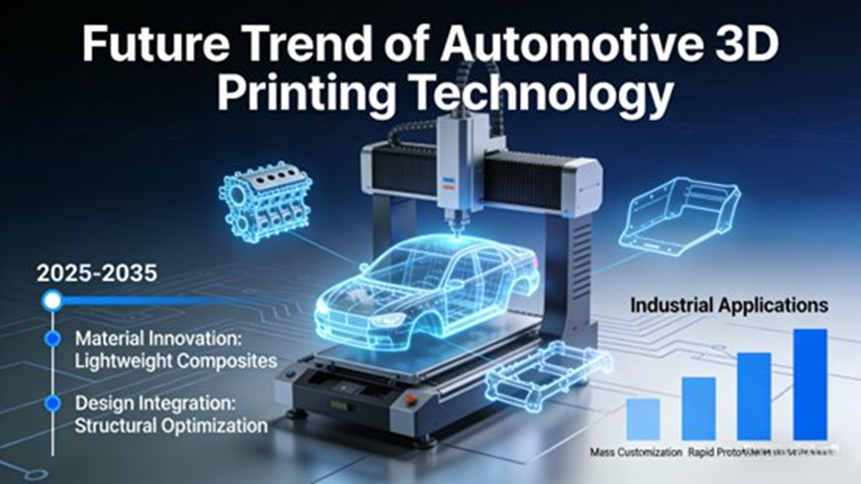
The next stage of 3D printing in automotive parts will be shaped by better materials, AI tools, faster machines, and a more connected digital workflow.
6.1 AI and 3D Printing Will Work More Closely
Short answer: AI will help design parts, set parameters, shorten print time, and improve production control.
AI can help with CAD model generation, topology optimization, path planning, parameter setting, and quality monitoring. Wiwynn’s AI-generated micro-channel cold plate design raised cooling efficiency by 48%. In automotive use, the same type of AI support can help thermal parts, battery parts, and lightweight brackets.
6.2 Materials Will Get Better and More Diverse
Short answer: Wider material choice is needed for more real automotive use.
Future growth depends on more material options, including lightweight composites, high-temperature alloys, corrosion-resistant resins, and recycled engineering materials. Lowering the cost of high-end powders and resins will also matter a lot.
6.3 Scale Production Will Improve
Short answer: 3D printing will move from trial work and low-volume output toward wider production in selected parts.
To make that shift, the industry needs faster print systems, larger build chambers, better multi-laser coordination, and more stable process control. By 2030, 3D printing is expected to cover more automotive parts and move deeper into production use.
6.4 Full Lifecycle Use Will Expand
Short answer: 3D printing will connect design, testing, production, service, and remanufacturing in one digital chain.
Future use will spread across design, development, prototyping, testing, production, spare parts, remanufacturing, and recycling. This forms a closed loop: design -> print -> inspect -> optimize. Use is also likely to grow in vehicle modification and motorsport.
This figure should combine two visual ideas: 1. AI-based design support (topology optimization, automated toolpath generation, simulation-linked design updates); 2. Scale production (multi-laser systems, digital quality control, standard manufacturing cells, smart production management). The main message is that the future is a more digital and connected production system.
7. Main Benefits of 3D Printing in Automotive Parts
* Tooling-free production: No mold is needed, lowering upfront cost and shortening development.
* Complex geometry: Engineers can make inner channels and lattice structures hard to make with old processes.
* Higher material use: Waste can be lower than in subtractive methods.
* Rapid prototyping: CAD files can become physical parts quickly.
* Better fit for low-volume work: Useful for pilot builds, motorsport, custom parts, and service parts.
* On-demand spare parts: Parts can be made when needed instead of stored in large numbers.
* More design freedom: DfAM and topology optimization improve packaging and weight.
8. Current Limits of 3D Printing in Automotive Parts
Current limits include high machine cost (especially for metal systems), slower speed than injection molding or stamping, higher cost for advanced powders and resins, anisotropy in some printed parts, extra post-processing work, and consistency control in scale production. For now, the most practical route is hybrid manufacturing.
9. When 3D Printing Makes Sense for Automotive Parts
Ask these five questions:
1. Does the part have cavities, lattice zones, or internal channels that are hard to machine or mold?
2. Is the production volume too low to justify tooling cost?
3. Does the project need fast iteration or urgent prototype delivery?
4. Is lower weight or part integration a key target?
5. Is the part part of an after-sales or old-model support program with uncertain demand?
If the answer is yes to several of these, 3D printing in automotive parts is usually worth serious review.
10. FAQ About 3D Printing in Automotive Parts
Q1. Can 3D-printed automotive parts meet strength and safety needs?
Short answer: Yes, but only when process, material, and post-processing are matched correctly.
Metal routes such as SLM can produce parts with properties close to forged parts when they are paired with heat treatment, finishing, and strict inspection. Polymer routes such as FDM and SLA are more often used for prototypes, fixtures, interior parts, and non-load-bearing parts unless high-performance materials are used.
Q2. Why is 3D printing useful in the automotive industry?
Short answer: It cuts tooling cost, speeds up validation, and makes complex low-volume parts easier to produce.
It helps teams move faster from CAD to test part, build more complex shapes, support lightweight design, and make spare parts on demand for old models.
Q3. What are the main technical limits?
Short answer: Speed, material cost, consistency, and post-processing are still the main limits.
3D printing is usually slower than molding or stamping. Some materials are still expensive, and many printed parts need extra finishing, heat treatment, or curing.
Q4. Can 3D printing lower manufacturing cost?
Short answer: Yes, especially in low-volume or high-complexity cases.
It removes mold cost, lowers waste, reduces inventory through on-demand production, and shortens validation time. For simple high-volume parts, traditional manufacturing is still often cheaper.
Q5. Will 3D printing replace casting, forging, stamping, or injection molding?
Short answer: No, not across the whole industry.
The more likely path is a mixed production model. 3D printing will be used where it offers clear value, such as custom parts, complex shapes, and service parts. Traditional processes will still handle standard, high-volume parts.
Q6. Which 3D printing process is best for automotive prototypes?
Short answer: It depends on what the prototype needs to prove.
SLA is better for fine detail and appearance checks. FDM is better for fast, low-cost prototype work and tooling. SLS is good for functional polymer prototypes. SLM is used for metal prototype validation.
Q7. Is 3D printing useful for aftermarket spare parts?
Short answer: Yes, this is one of the strongest use cases today.
For discontinued models or parts with low demand, additive manufacturing allows on-demand output without keeping large physical inventory.
Q8. Which materials matter most in automotive additive manufacturing?
Short answer: The key materials depend on the process and the service condition.
Common material groups include PLA, ABS, and Nylon for FDM; photopolymer resins for SLA; Nylon and glass-fiber-reinforced powders for SLS; titanium alloy, aluminum alloy, stainless steel, and Inconel 718 for SLM.
11. Final Thoughts
3D printing in automotive parts has already moved into real engineering use. It is now used in prototype development, low-volume production, tooling and fixtures, custom interior parts, and after-sales spare parts. Its main strengths are clear: mold-free production, better material use, fast response in development, freedom for complex structures, and support for lightweight and integrated design.
This article has covered the full technical picture: process basics, selection rules, technical problems, engineering fixes, real case studies, and future direction. The cases from BMW, Ford, BYD, Shanghai Baolu, NIO, Zhongrui Technology, and Wiwynn show that additive manufacturing is already solving real problems in automotive development, production support, and service supply.
