



Author: Johnny Liu, CEO at Dowway Vehicle
Update time: 2026, 15th Feb
Table of Contents
- The Core DNA: Unifying Aesthetics and Functionality
- Engineering Constraints: Where Art Meets Science
- Technological Pillars: Tools for Realization
- Standardized Design Workflow: From Incubation to Mass Production
- Future Trends & Case Studies
- Frequently Asked Questions (FAQ)
- Conclusion
As the automotive industry undergoes a profound transformation towards electrification, intelligence, and connectivity, the core attribute of a vehicle is evolving from a simple “transportation tool” to a “mobile intelligent space.” In this context, Automotive Creative Styling Design is no longer just about exterior decoration; it has evolved into a core carrier that bears brand DNA, conveys user emotions, optimizes the driving experience, and demonstrates technical prowess.
Traditional styling design often relied heavily on a designer’s personal experience and flashes of inspiration. In contrast, modern Automotive Creative Styling Design builds a complete closed-loop system defined by “creative drive, technical support, engineering realization, and user orientation.” This article delves into this system, exploring how to create automotive products that possess both aesthetic value and rigorous engineering standards through the dialectical unity of emotional creativity and rational technology.
The Core DNA: Unifying Aesthetics and Functionality
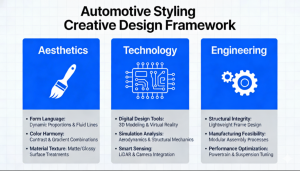
Automotive Creative Styling Design is a systematic engineering process revolving around three core elements: Form, Color, and Material. It is not unconstrained artistic creation but a precise expression under clear brand strategies and user needs.
1. Brand Identity
Styling is a brand’s first calling card. Excellent design must reinforce brand memory points through a unified visual language.
- Family Characteristics: Examples include BMW’s “Double Kidney Grille,” Jeep’s “Seven-Slot Grille,” and BYD’s “Dragon Face” aesthetic.
- Design Consistency: Ensuring that brand DNA consistently permeates from flagship models to entry-level models, conveying consistent brand values.
2. Functionality
In engineering logic, Form Follows Function.
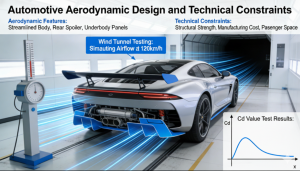
- Aerodynamics: Streamlined design is not just for aesthetics but primarily to reduce drag coefficient (Cd) and energy consumption.
- Human-Machine Interaction: Interior layouts must serve the driver’s intuitive operation and the passengers’ comfort.
- Thermal Management: The design of intakes and cooling channels must meet the cooling requirements of the powertrain.
3. Emotional Resonance
Through the tension of lines, the play of light and shadow on surfaces, and the coordination of proportions, vehicles are endowed with unique characters—whether aggressive and sporty, elegant and composed, or tough and technological. This emotional expression is key to achieving a deep connection between the product and the user.
Engineering Constraints: Where Art Meets Science
The core challenge of Automotive Creative Styling Design lies in maximizing creativity within strict technical boundaries. This is also the central difficulty in the collaboration between styling design and engineering technology.
1. Aerodynamic Constraints
For New Energy Vehicles (NEVs), the drag coefficient (Cd value) is directly related to range. Studies show that for every 0.01 reduction in Cd, the range can increase by 1-2%.
- Design Optimization: By introducing “Air Curtains,” designing teardrop-shaped side mirrors, and optimizing rear diffusers, aerodynamic functions are transformed into styling highlights (as seen in the Porsche Taycan and BYD Han).
2. Safety Regulation Constraints
Design must comply with mandatory standards worldwide:
- Crash Safety: The styling of front and rear bumpers must reserve sufficient crush zones for energy absorption; the layout of door impact beams affects side body lines.
- Vision Safety: The width and angle of A-pillars must strictly control blind spots; windshield design must meet field-of-view regulations.
- Pedestrian Protection: Hood height and stiffness must consider head impact protection for pedestrians.
3. Manufacturing Feasibility Constraints
Styling must be “manufacturable.”
- Stamping Process: Body surface design must avoid negative angles or overly sharp edges. Surface continuity must reach Class-A Surface Standards (G3 curvature continuity) to ensure stamping feasibility and surface light quality.
- Assembly Tolerances: The design of parting lines for components must consider tolerance control in actual assembly.
4. Ergonomic Constraints
Interior design must strictly follow ergonomic principles (e.g., SAE J287 standards):
- Operational Convenience: The layout of the steering wheel angle, center screen position, and physical buttons must be within the driver’s “reach zone.”
- Safety: The design of the dashboard and interior trim must comply with ECE R21 standards, ensuring no hard objects in the head impact area to reduce secondary injuries.
Technological Pillars: Tools for Realization
The efficient realization of modern automotive styling relies on the synergy of three major technical pillars: Digital Design, Simulation Analysis, and Materials & Processes.
1. Digital Design Technology
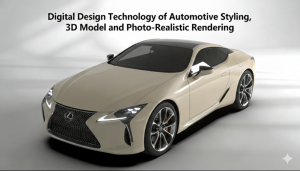
- Parametric Design: Using software like Grasshopper and Catia, based on “parameter-driven model” logic, designers can automatically update models by adjusting key parameters like line curvature and proportions. This is crucial for designing complex grille textures or parametric headlight styling.
- 3D Scanning & Reverse Engineering: Using high-precision 3D scanners (accuracy up to 0.01mm) to quickly convert manual clay models into digital point cloud data, then using Geomagic Design X to reconstruct surfaces, achieving a lossless conversion from “physical creativity” to “digital assets.”
- Virtual Rendering: Using tools like Keyshot and V-Ray to generate photo-realistic images, simulating visual effects under different lighting and materials, significantly reducing reliance on physical prototypes.
2. Simulation Analysis Technology
- CFD (Computational Fluid Dynamics): Simulating airflow states early in design to identify separation zones, optimizing grille size and body streamlines to balance drag and cooling.
- FEA (Finite Element Analysis): Simulating structural deformation and stress distribution during crashes, optimizing A-pillar cross-sections and body structures to ensure styling meets safety standards.
- Ergonomic Simulation: Using Siemens Jack to build digital human models (from 5th percentile female to 95th percentile male) to verify seat comfort, field of view, and operational reachability.
3. Materials & Process Technology
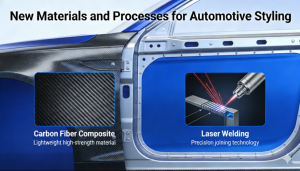
- Lightweight Materials: The application of carbon fiber composites and aluminum alloys makes more exaggerated surfaces and sharper lines possible (common in supercar design).
- Advanced Processes: Laser welding technology reduces body seams, enabling integrated surface design; 3D printing provides low-cost mass production solutions for personalized trim parts (like custom wheels).
Standardized Design Workflow: From Incubation to Mass Production
Automotive styling design is a systematic project. We follow a strict five-phase standardized workflow to ensure a seamless connection between creativity and engineering.
Phase 1: Incubation & Positioning
- Research: Analyzing trends, competitor features, and technology applications.
- Positioning: Unearthing user emotional needs combined with brand DNA to establish a design language (e.g., “Sporty,” “Minimalist”).
- Output: Incubating massive creative ideas through sketches and selecting 3-5 core directions.
Phase 2: Digital Modeling (CAS)
- CAS (Concept A-Surface): Converting 2D sketches into 3D digital models.
- Deepening: Using parametric tools to refine surfaces, lights, and interior details.
- Collaboration: Engineers intervene to prevent conflicts with engineering Hard Points early on.
Phase 3: Simulation & Optimization
- Multi-dimensional Check: Synchronously conducting aerodynamics, crash safety, ergonomics, and feasibility simulations.
- Iteration: Adjusting styling based on data feedback to find the optimal solution between aesthetics and performance, finally locking in a single design.
Phase 4: Physical Verification
- Clay Modeling: This is a step digital technology cannot fully replace. By creating 1:4 and 1:1 full-scale clay models, designers hand-sculpt surface nuances to verify the vehicle’s volume and texture.
- Prototype: Building functional prototypes combined with engineering structures to verify the realization effect.
Phase 5: Market Iteration
- Collecting user feedback and market data after launch serves as the basis for styling optimization in facelift models, realizing a closed loop in the design lifecycle.
Future Trends & Case Studies
Amidst the wave of electrification and intelligence, automotive styling design presents four new trends:
1. Minimalism & Tech
NEVs generally eliminate intake grilles, shifting towards closed front faces, hidden door handles, and continuous light strips.
- Case Study: Tesla Model S
Its design revolutionized tradition. Through a closed front face and streamlined body, it achieved an ultra-low drag coefficient of 208 Cd. The interior eliminated physical buttons, retaining only a 17-inch screen, establishing the industry benchmark for “Technological Minimalism.”
2. Symbolization of Smart Elements
Sensors are no longer hidden but become part of the design.
- Trend: “Watchtower” layouts or integrated designs for LiDAR; programmable smart headlights (like HiPhi X’s PML lights) enabling light language interaction.
3. Personalization
Based on 3D printing and parametric design, users can customize wheels and interior textures, realizing unique designs for every vehicle.
4. Heritage & Innovation
- Case Study: Mercedes-Benz S-Class (W223)
While continuing the classic luxury proportions of a long wheelbase and short front overhang, it integrates “Digital Light” and the MBUX Hyperscreen. G3-level continuous surfaces built via ICEM Surf perfectly interpret “Luxury in the Digital Age.”
Frequently Asked Questions (FAQ)
Here are the top 5 most discussed questions regarding Automotive Creative Design, providing authoritative insights into the industry.
1. What is Automotive Creative Design in the automotive industry?
Answer:
Automotive Creative Design refers to the creative, multidisciplinary process of developing the appearance and functional design of vehicles — including exterior styling, interior ergonomics, technology integration, and emotional value. It merges artistic expression with engineering practicality to create vehicles that are visually appealing, aerodynamically efficient, and user-centric. Designers use sketching, CAD tools, and prototyping methods to balance aesthetics with performance, safety, and market requirements. (Source: Thomasnet)
2. What are the key stages in the automotive design process that enable creativity?
Answer:
The automotive design process typically involves:
- Research and Concept Ideation: Gathering inspiration, consumer trends, and concept goals.
- Sketching & Digital Rendering: Visualizing ideas in 2D and 3D form.
- Prototyping: Creating physical or virtual representations (e.g., clay models, digital prototypes).
- Engineering Integration & Testing: Ensuring design meets functional and safety criteria.
- Refinement & Production Preparation: Finalizing details before manufacturing.
Throughout these stages, designers must creatively solve problems such as brand identity, ergonomics, aerodynamics, and sustainability. (Source: AutoProtoWay)
3. What principles drive innovation and creativity in automotive design?
Answer:
The main principles that shape innovation and creative design in the automotive industry are:
- User-centric design: Meeting evolving consumer needs.
- Function + aesthetic harmony: Integrating performance with visual appeal.
- Sustainability and material innovation: Using lightweight, recyclable materials.
- Technology integration: Electrification, autonomous systems, and digital interfaces.
- Collaborative innovation: Cross-discipline teams of engineers and designers working together.
These principles ensure vehicles not only look good but also perform efficiently and satisfy regulatory requirements. (Source: Automotive Reference)
4. How does creativity balance with engineering constraints in automotive design?
Answer:
Creativity in automotive design must always be balanced with engineering and regulatory constraints. Designers and engineers collaborate to:
- Ensure the design complies with safety, emissions, and manufacturing standards.
- Integrate necessary mechanical and electrical components without compromising aesthetics.
- Use feedback loops (e.g., prototyping/testing) to refine concepts that are both visually innovative and technically feasible.
This collaboration transforms artistic concepts into producible vehicles that perform reliably on the road. (Source: Jobya)
5. How do technology and digital tools enhance creativity in automotive design today?
Answer:
Advanced digital tools and technologies have expanded the creative capacity of automotive designers by enabling:
- Digital prototyping and VR: Designers can visualize and iterate designs virtually before building physical models.
- CAD and digital surfacing: Precise control of vehicle aesthetics (e.g., Class A surfaces).
- Generative and AI-assisted design tools: Suggesting creative options based on parameters while freeing designers to focus on higher-level creativity.
While technology streamlines technical aspects, it empowers designers to push creative boundaries and explore new visual languages in vehicle design. (Source: designlinkai.com)
Conclusion
Automotive Creative Styling Design is ultimately a game and fusion of sensibility and rationality. Excellent styling design must be “beautiful” to touch hearts, “functional” to satisfy needs, and “feasible” to adapt to mass production.
Looking ahead, with the intervention of AI-Generated Content (AIGC) and Metaverse Virtual Experience technologies, design boundaries will be further broken. We are committed to exploring greener, smarter, and more emotionally resonant design languages, endowing the next generation of mobility with brand-new forms and souls.
Ready to bring your vehicle concept to life? Contact our engineering team for a comprehensive styling and feasibility consultation.