




< Back to Performance Development
By Johnny Liu, CEO at Dowway Vehicle
Published: March 2, 2026
- 1. Introduction: The Evolution of Car Crash Safety
- 2. Core Analysis Methods in Car Crash Safety
- Finite Element Analysis (FEA) Simulation Technology
- Physical Crash Test Verification
- Physical tests check our simulation math and prove the car meets real safety laws. Common setups include frontal hits (100% rigid, 50% moving, 25% small overlap), side impacts (rigid barrier, pole), rear-end, and pedestrian hits. The 25% small overlap test is now a primary requirement because it concentrates massive force into complex load paths.
- Key Indicator System for Crash Safety
- 3. The Full Development Process for Crash Safety Performance
- 4. Key Technologies Driving Car Crash Safety
- 5. Future Trends and Industry Challenges
- 6. The Bottom Line
- 7. FAQ: Frequently Asked Questions About Car Crash Safety
Key Takeaways for Quick Reading:
- Active-Passive Integration: Modern car safety goes beyond rigid bodies. Engineers now blend driver-assistance systems with structural toughness.
- Testing Standards: Global groups like C-NCAP, Euro NCAP, and C-IASI keep pushing for higher speeds and tougher scenarios, like the 25% small overlap test.
- NEV Focus: New Energy Vehicles demand specific safety protocols. We look closely at high-voltage power-off (within 50ms) and battery frame strength.
- AI in R&D: Using Artificial Intelligence and Digital Twins cuts simulation cycles by over 30% and significantly drops R&D costs.
1. Introduction: The Evolution of Car Crash Safety
As the CEO of Dowway Vehicle, I spend my days working with engineering teams to figure out how to keep people safe on the road. Car crashes happen more often than any other traffic accident. A collision lasts just a few dozen milliseconds, but it triggers massive structural damage, rapid energy transfer, and secondary hits between passengers and the car’s interior. These moments directly decide the severity of injuries.
Safety rules like C-NCAP, C-IASI, and Euro NCAP keep getting stricter. We now see higher frontal crash speeds, specific offset scenarios, and strict high-voltage protections for New Energy Vehicles (NEVs). Because of this, we are moving from basic passive protection to a blended active-passive safety system.
Crash safety analysis and performance development form a massive engineering task. By using tested analysis methods and strict development workflows, engineers improve body structures and restraint systems. We want to distribute and dissipate crash energy to minimize injuries. We do all this while balancing vehicle weight, costs, and R&D efficiency.
2. Core Analysis Methods in Car Crash Safety
Before we build anything, we have to analyze how a car will crash. We blend computer simulations with real-world physical tests to track exactly how the metal bends and what happens to the crash test dummies.
Finite Element Analysis (FEA) Simulation Technology
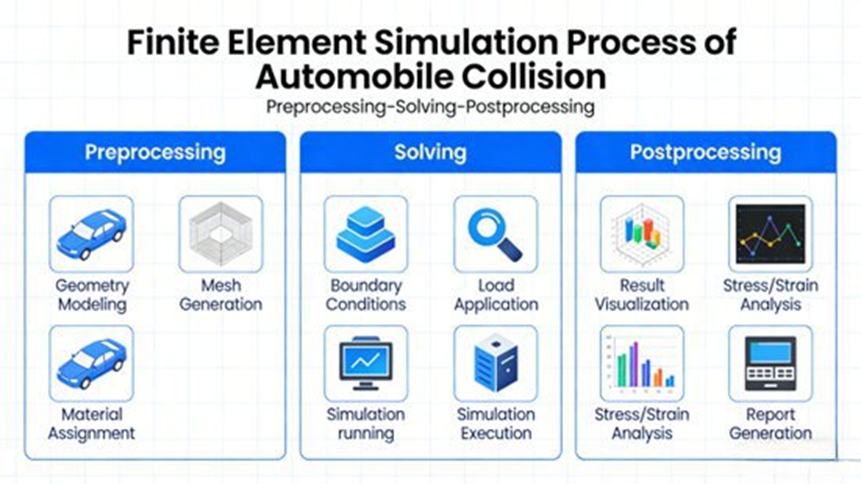
FEA serves as our primary tool. It breaks complex vehicle structures down into massive numbers of shell and solid elements to simulate sudden dynamic behaviors.
- Preprocessing: We keep load-bearing parts with millimeter-level accuracy. The team uses 2-3mm thick shell elements, while critical load paths (like front rail joints and B-pillars) get dense solid elements to keep the distortion rate at ≤5%. For high-strength steel, we apply the Johnson-Cook failure criterion. For composites, we rely on the Hashin damage model. We also map connections precisely: CWELD elements handle spot welds, and COH3D8 elements simulate adhesives.
- Solving: We run explicit dynamics solvers like LS-DYNA and Abaqus/Explicit. They handle extreme non-linearities for tests like the C-NCAP 100% frontal (55 km/h) or side impacts (60 km/h). We manage parts contacting each other via penalty functions or modified Hertz contact models to stop energy loss during the math simulation.
- Post-processing: Engineers pull acceleration curves, structural intrusions, and dummy injury numbers to check energy absorption and cabin safety.
Physical Crash Test Verification
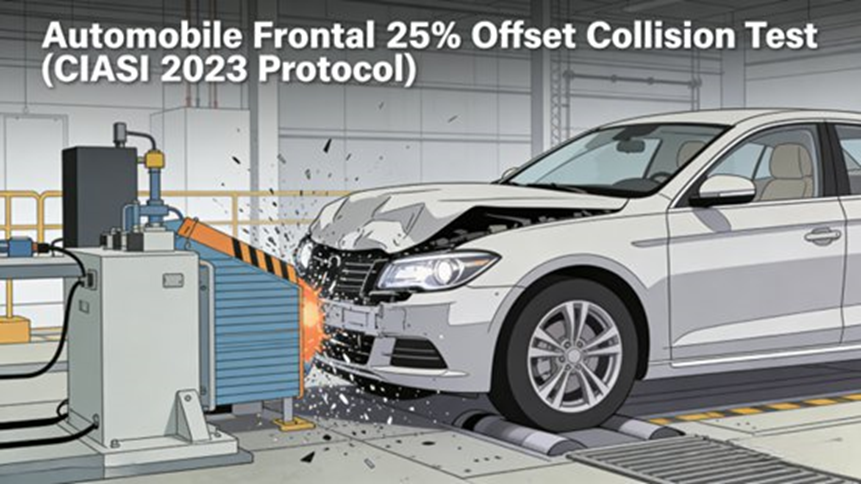
Physical tests check our simulation math and prove the car meets real safety laws. Common setups include frontal hits (100% rigid, 50% moving, 25% small overlap), side impacts (rigid barrier, pole), rear-end, and pedestrian hits. The 25% small overlap test is now a primary requirement because it concentrates massive force into complex load paths.
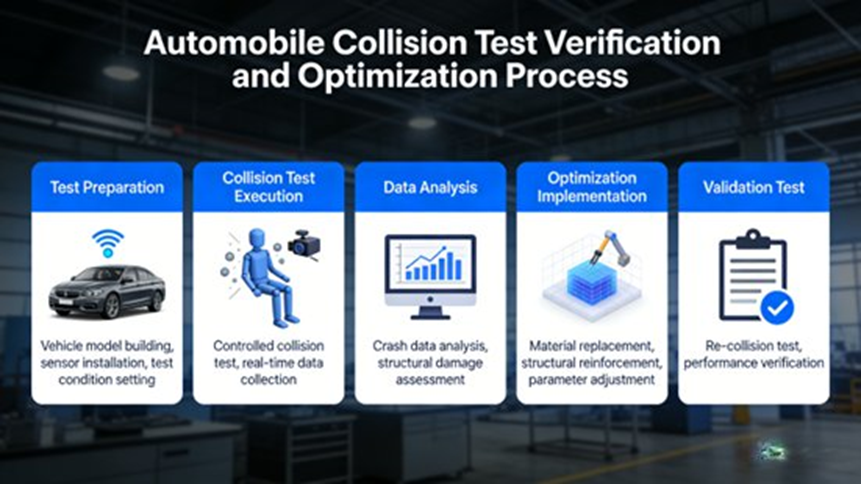
During these tests, high-speed cameras running at ≥500fps record structural bending. Sensors collect acceleration and strain data. We then calibrate our computer models to keep error margins within ≤5%.
Key Indicator System for Crash Safety
- Body Structure Safety: We look for peak acceleration (frontal ≤30g), cabin intrusion (A-pillar ≤100mm, B-pillar ≤150mm), energy absorption (front longitudinal rails taking >60%), and zero weld failures in critical load paths.
- Occupant Protection: The Head Injury Criterion (HIC15) must be ≤700. We also measure chest compression (≤50mm), chest acceleration (≤60g), thigh force (≤10kN), and lower leg force (≤20kN). For NEVs, we strictly require a power-off time of ≤50ms post-crash and total battery integrity (no leaks or fire).
- Pedestrian Protection: We track the Pedestrian HIC10 (≤1000), leg bending angle (≤30°), and leg shear force (≤15kN).
3. The Full Development Process for Crash Safety Performance
Concept Design Phase
We start by setting targets based on global standards. For instance, we anticipate rules like the C-NCAP 2024 requirement for a 55 km/h frontal crash speed. We run benchmark checks using CAE and draft the initial design using topology optimization to plan the best load paths.
Detailed Design Phase
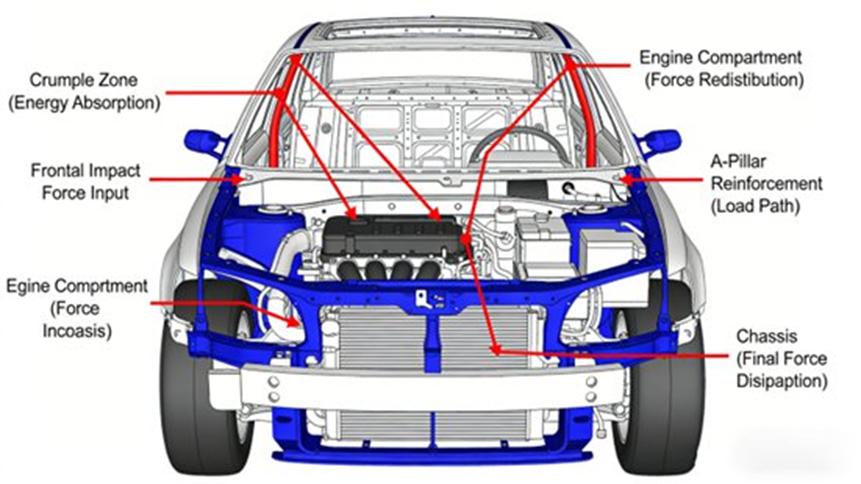
- Structural Design: Engineers improve section shapes (like giving front rails a corrugated or conical shape) and apply hot-stamped high-strength steel for B-pillars. Smart lightweighting strategies—like using >70% high-strength steel—can drop vehicle weight by 10% while bumping up strength by 20%+.
- Restraint System Matching: We tune seatbelt pretensioners and limiters, and map out airbag deployment timing (like side airbags paired with curtain combinations). We also adjust seat backrest stiffness and headrest positions to stop whiplash.
- CAE Iteration: We run high-precision models through no less than 10 rounds of iterative simulation to fix any design weak spots.
Prototype Manufacturing & Test Verification
The team builds prototypes under tight quality controls in stamping, robotic welding, and assembly. Debugging covers dimensional checks and NEV high-voltage insulation tests. We require a minimum of 5 prototypes for this phase. A single standard crash test costs around 80,000 to 150,000 RMB, while handmade prototypes cost hundreds of thousands, so detailed test plans save money. We execute tests strictly—like running the 25% offset at 64 km/h with a 25%±25mm overlap—and fix structures until we hit every target.
4. Key Technologies Driving Car Crash Safety
Auto Body Structural Crashworthiness Optimization
We use Topology Optimization and Parametric Optimization (DOE). Multi-objective optimization balances safety with weight. Using hot-stamped steel (tensile strength >1500MPa) for B-pillars, energy-absorbing aluminum for hoods, and carbon fiber composites for the frame drops weight by >30% while making the car tougher.
Restraint System Collaborative Control Technology
- Hierarchical Airbag Control: This system adjusts inflation speed and volume based on the hit (like 50% inflation for mild crashes and 100% for severe ones).
- Pretensioner & Limiter Synergy: Pretensioners lock the passenger in place within 10ms, while limiters keep belt tension to 3-5kN to stop chest injuries.
- Adaptive Posture Control: Real-time cameras recognize a passenger’s height, weight, and posture. It even identifies children to adjust airbag volumes for personal protection.
Specialized Crash Safety for New Energy Vehicles (NEVs)
- High-Voltage Protection: Relays shut down the power within 50ms upon impact to guarantee electrical isolation. We shield high-voltage parts and keep them out of crush zones.
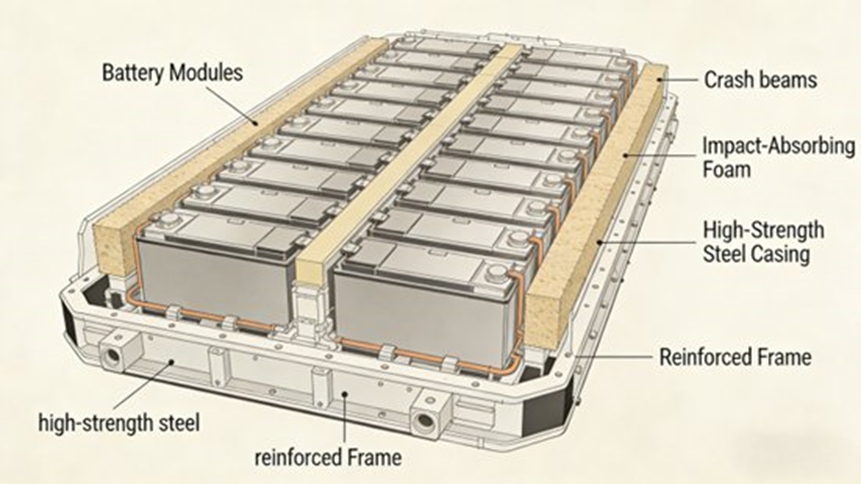
- Battery Pack Safety: We use high-strength aluminum shells, thermal runaway prevention (like insulation and fire extinguishing setups), and strict sealing against electrolyte leaks. Integrated optimization can boost battery crash resistance by 40% while stripping 8% of body weight.
AI-Driven Simulation and Prediction Technologies
Neural networks spot error sources automatically, dropping simulation error margins from 10% to <5% and cutting iteration cycles by over 30%. AI predicts test numbers fast, turning a 24-hour evaluation into less than a 1-hour job. Also, genetic algorithms automatically generate the best structural cross-sections and material choices to balance energy absorption and weight.
5. Future Trends and Industry Challenges
Emerging Development Trends
- Active-Passive Integration: Deeply fusing AEB/FCW with structural toughness for a seamless prevention-protection loop.
- Intelligent Development: Using Digital Twins to run real-time crashes, closing the digital loop from drawing board to testing facility.
- Lightweighting Synergy: Wider use of advanced composites to keep EVs light for maximum range without dropping safety.
- Global Regulatory Adaptation: Moving early to meet strict upcoming standards like Euro NCAP 2025.
Core Industry Challenges
- Meeting tougher, highly detailed collision rules without adding heavy materials or huge R&D costs.
- Stopping high-voltage leaks and NEV battery thermal runaway remains a tough engineering problem.
- Protecting people in strange, unpredictable real-world crashes (like multi-angle hits or chain reactions) that go beyond standard testing.
6. The Bottom Line
The combination of FEA simulation and real physical testing stands as the industry standard. The strict four-stage development process finds a middle ground between safety, cost, and weight. Fresh tech—from AI-driven R&D to specific NEV battery defenses—keeps the automotive world moving forward. By blending active and passive safety and pushing for better multi-scenario crash protection, we accelerate our journey toward “zero casualties.”
7. FAQ: Frequently Asked Questions About Car Crash Safety
Q1: What is the single most effective way to reduce injury or death in a car crash?
Answer: Wearing a properly fastened seat belt is the absolute best way to lower the chance of serious injuries and fatalities in a crash.
- Data from the Centers for Disease Control and Prevention (CDC) shows that seat belts cut serious crash-related injuries and deaths by about 50% for adults and older children.
- Research from the Insurance Institute for Highway Safety (IIHS) confirms that lap-and-shoulder belts heavily lower the risk of fatal injuries in front and rear seats. Always buckle up, even for a quick drive.
Q2: What should I do immediately after a car crash?
Answer: Your immediate priority is safety and record-keeping. General steps include:
- Check for injuries: Look at yourself and your passengers. Call emergency medical services right away if anyone is hurt.
- Move to safety: If the cars can drive and it is safe, move them out of traffic to stop secondary crashes.
- Exchange information: Get names, phone numbers, and insurance details from the other drivers.
- Report the crash: Call local law enforcement to file an official report. This step is vital for insurance and legal reasons. (Specific rules vary depending on local laws).
Q3: How can I tell if a car is safe before buying?
Answer: Check official safety ratings from government and independent testing groups.
- In the United States, the National Highway Traffic Safety Administration (NHTSA) gives 5-Star Safety Ratings based on frontal, side, and rollover tests.
- Independent groups around the world, like the IIHS and Euro NCAP, provide tough evaluations of crash performance and structural strength.
Q4: What car safety features help prevent crashes?
Answer: Modern vehicles use Active Safety Systems (usually part of ADAS) to stop crashes before they happen. Key features include:
- Autonomous Emergency Braking (AEB): Detects a forward crash and hits the brakes automatically.
- Electronic Stability Control (ESC): Helps you keep control during wild steering.
- Lane-Keep Assist: Gently steers the car back if it drifts out of its lane.
- Blind-Spot Monitoring: Warns you about cars in lanes you cannot see in your mirrors.
Q5: Why do crash test programs matter?
Answer: Crash tests matter because they recreate real-world collisions using precise crash test dummies to track injury risks and structural strength. They are important because they:
- Improve vehicle designs (like better crumple zones, airbags, and seat belts).
- Give buyers clear, standard safety data to make smart choices.
- Push car makers to upgrade their safety tech so they stay competitive in the market.
? Global Safety Perspective:
Road traffic crashes account for about 1.2 million fatalities every year worldwide, injuring millions more. The World Health Organization (WHO) makes it clear that enforcing protective rules—such as seat belts, helmets, and tougher vehicle safety standards—can drastically cut these numbers down.
