



< Back to Performance Development
By Johnny Liu, CEO at Dowway Vehicle
Published: March 2, 2026 | Expertise: Vehicle Dynamics, Simulation Engineering, Automotive R&D
- What Defines Driving Performance in Modern Vehicles?
- The Evaluation System for Driving Performance
- Key Simulation Technologies for Optimizing Driving Performance
- The Simulation-Based Development Path
- Engineering Case Study: 1.5L + 6AT Compact Sedan
- Future Trends in Driving Performance Engineering
- Frequently Asked Questions (FAQ) About Driving Performance
As the auto industry moves toward electrification and smart tech, the old “build-test-tune” model is fading out. This old loop often hides flaws until engineers build physical prototypes. That leaves little room for fixes and drives up costs. Today, simulation analysis is the core method for forward-engineering vehicles. It cuts R&D costs and keeps products consistent.
Drawing on years of engineering experience, this guide breaks down the definitions, key simulation tools, development paths, and future trends of automotive driving performance.
What Defines Driving Performance in Modern Vehicles?
Vehicle driving performance is the direct result of human-vehicle interaction. It is how the vehicle responds to driver commands (acceleration, braking, steering, shifting) combined with how the driver feels about that response.
It relies on multiple subsystems working together: the powertrain (engine/motor), drivetrain, chassis, and electronic controls. Keep in mind that performance goals must match the vehicle’s specific design:
- Family Sedans: Focus on smoothness and easy handling.
- Sports Cars: Need quick power response and sharp steering.
- SUVs: Focus on stability and handling bad terrain well.
The Evaluation System for Driving Performance
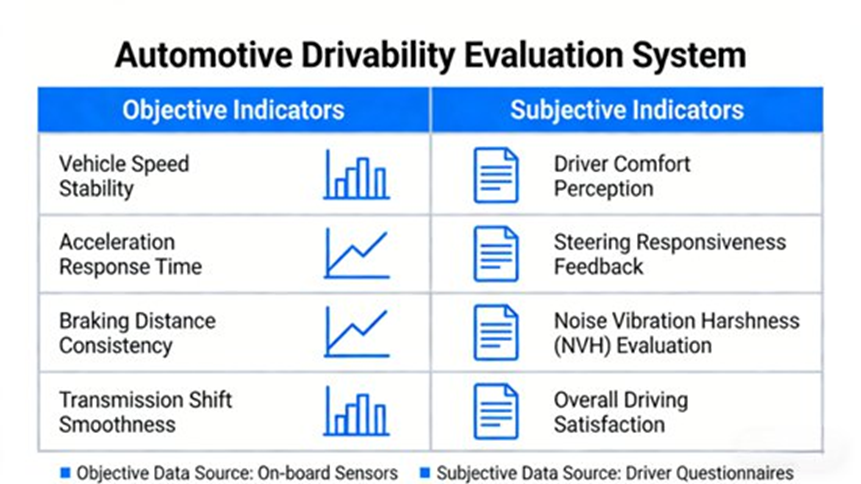
A solid evaluation system mixes hard data with human feeling.
Objective Indicators of Driving Performance
Objective metrics give us the hard numbers for simulation. Based on standard engineering practices, the main indicators cover four areas:
- Powertrain Response: * Response time to accelerator step input: ≤0.3s (excellent).
- Speed overshoot for engine/motor: ≤5%.
- VDV (Vibration Dose Value): A key metric during Tip-in/Tip-out to measure smoothness. Engineers also track acceleration changes under Partial Throttle (POT) and Wide Open Throttle (WOT).
- Braking Response:
- Response time to brake step input: ≤0.2s.
- Braking distance (100km/h to 0): ≤38m.
- Vehicle pitch angle (dive): ≤2.5°. (Smooth ABS action is a must, without brake pulling).
- Steering Response:
- Steering response time: ≤0.15s.
- Steering gain error (ratio of steering wheel angle to wheel angle): ≤3%.
- Returnability error: ≤5°.
- Steering feel simulation accuracy needs to hit 0.2Nm or higher.
- Shifting Response (for AT/DCT):
- Shift time: ≤0.5s (Manual), ≤0.8s (Automatic).
- Speed drop during shift: ≤150rpm.
- Torque interruption: ≤0.2s.
- Shift shock/jerk: ≤10m/s³.
Subjective Evaluation
Drivers rate the car on a 10-point scale (1 is worst, 10 is best). Key areas include power speed, smooth braking, sharp steering, easy shifting, and control. The industry is moving toward predictive models that link hard simulation data with these subjective scores. This cuts down the need for human testing.
Key Simulation Technologies for Optimizing Driving Performance
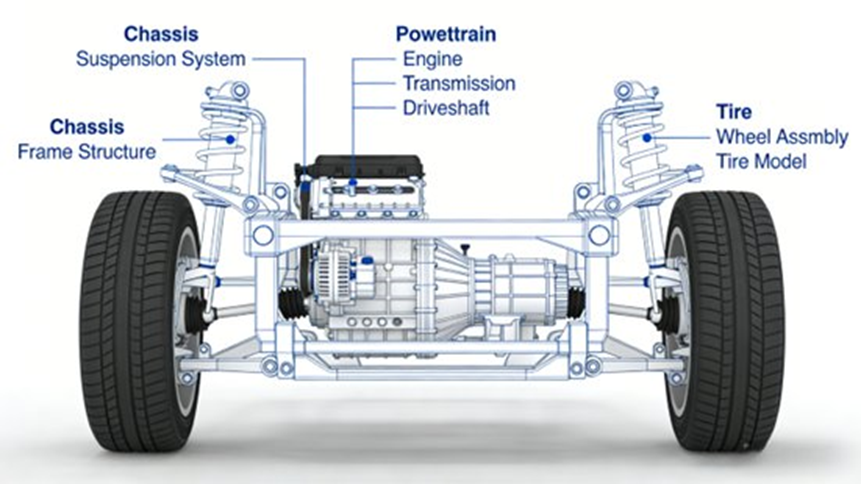
Building accurate virtual models requires specific tools like Adams, CarSim, Carmaker, PanoSim, and AVL Cruise. The core setup breaks down into four main parts.
1. Multibody Dynamics Modeling
This is the baseline. Engineers must balance detail with computing speed.
- Body: Using flexible body models based on Finite Element Analysis (FEA) stops errors caused by rigid assumptions.
- Chassis: Exact settings for suspension stiffness, damping, and EPS assist curves.
- Tires: High-precision models like the Magic Formula or UniTire capture longitudinal/lateral stiffness and cornering.
- Note: Tools like PanoSim’s PanoCar run a 27-DOF high-precision vehicle dynamics model for multi-physics hardware-in-the-loop (HIL) testing.
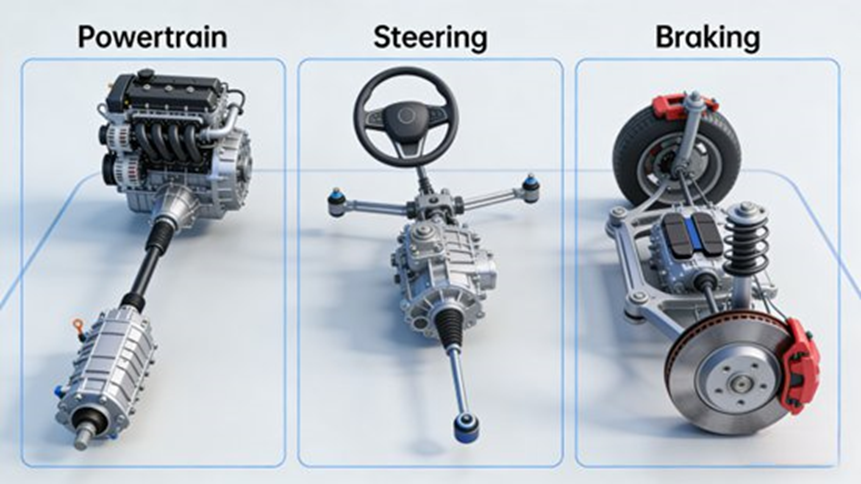
2. Core Subsystem Simulation Modeling
- Powertrain (AVL Cruise, GT-Power): For gas cars, modeling clutches and dual-mass flywheels (DMFW) is vital. Lowering DMFW stiffness can drop the VDV during hard acceleration or deceleration. For EVs, modeling battery SOC and motor lag stops jerky regenerative braking.
- Steering (EPS): Simulating torque assist curves and return traits. PanoDrive (by PanoSim) uses AI to build steering models with lag under 3ms and accuracy up to 0.2Nm.
- Braking: Simulating hydraulic/EBS pressure build-up and ABS logic.
- Electronic Control Systems: Co-simulating ECU, TCU, and ESP logic (often using Matlab/Simulink) with mechanical models to stop shift shock or sharpen steering.
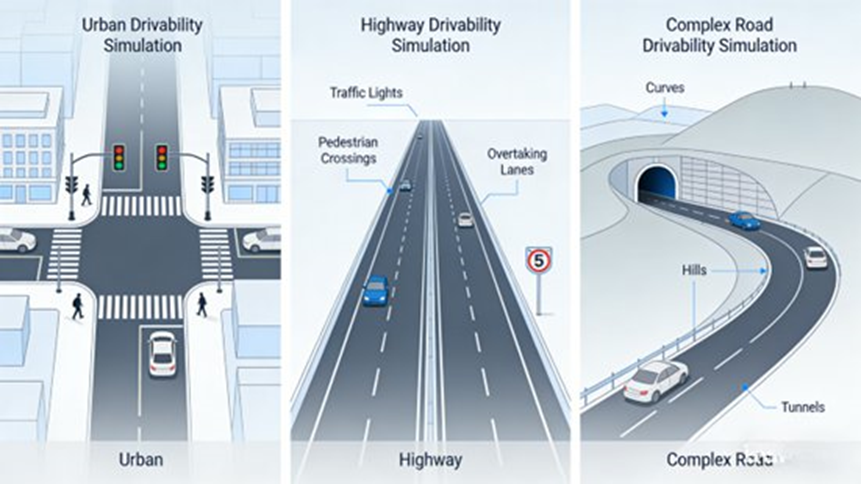
3. Designing Realistic Simulation Scenarios
Simulations need to cover basic moves (POT/WOT, step inputs, shifting) and tough real-world scenes. For example, during the Geely Galaxy A7 development, the team simulated over 200 global road conditions—including the Nürburgring Nordschleife and Swedish ice tracks—using PanoSim’s FieldBuilder/WorldBuilder.
4. Validating Simulation Accuracy
Simulations must match the real world. Physical testing data must line up with virtual results, keeping errors generally ≤5%. The Geely Galaxy A7 team ran 120,000 iteration calculations to tune suspension damping curves. They hit an error rate of just 1.7% between virtual tuning and physical testing. Optimization toolkits like Adams Insight help with parameter sensitivity analysis.
The Simulation-Based Development Path
The forward-engineering process runs in a 5-stage loop:
- Defining Targets: Benchmarking competitors to set hard goals (e.g., ≤38m braking, ≥8/10 subjective score).
- Concept Design Phase: Building simple models to check ideas and catch early flaws.
- Detailed Design and Optimization: The core phase using highly accurate models. Tuning happens via subsystem tweaks (like friction traits) or control logic (like TCU shift strategies). Geely’s “Heartbeat Fitting Technology” uses biomechanics to match vehicle dynamics with human perception.
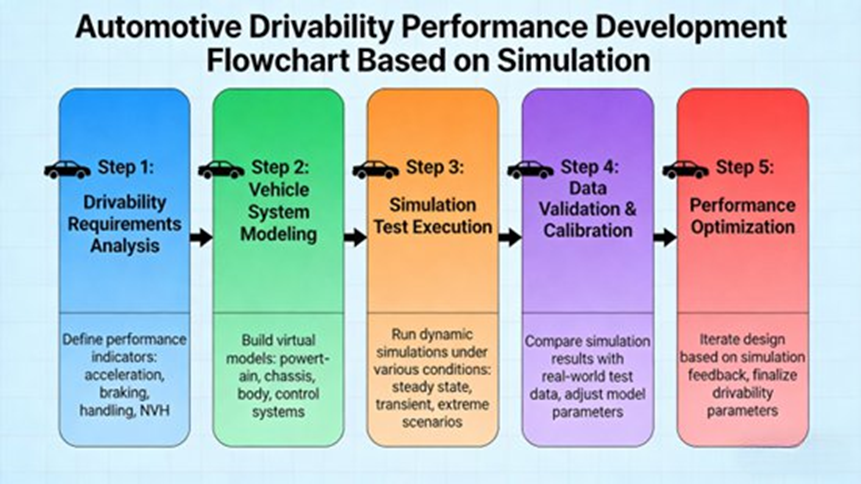
- Trial Validation: Using physical prototypes to catch hidden problems. Tools like Porsche’s FaSiP test rig simulate speeds up to 250km/h in the lab, cutting down real-road testing.
- Mass Production Consistency: Simulating part fluctuations (like tire friction changes) to set manufacturing limits.
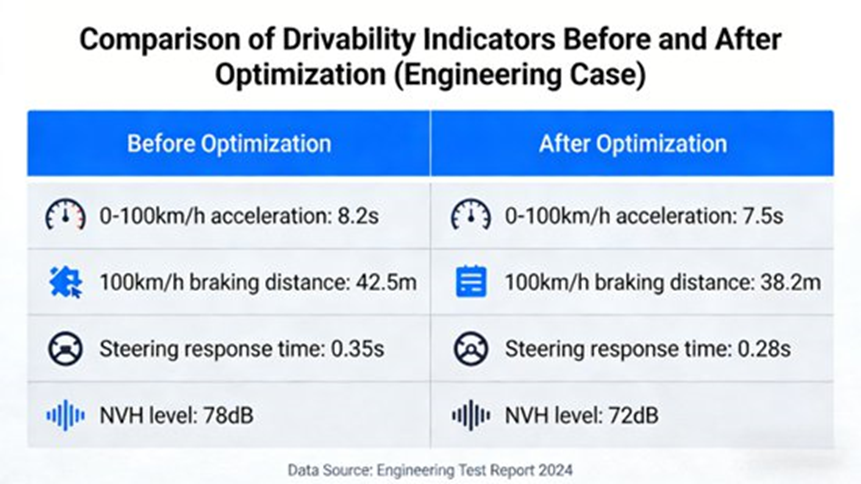
Engineering Case Study: 1.5L + 6AT Compact Sedan
To test this approach, look at a recent R&D project for a compact family sedan (1.5L engine + 6AT).
Initial Targets:
- Power response ≤0.3s; 0-100km/h ≤12s; Braking ≤38m; Shift time ≤0.8s; Shift shock ≤10m/s³; VDV ≤1.2m/s².2.5. Subjective score ≥8.
Defect Identification (Adams + AVL Cruise Co-simulation, ≤4% error):
- Power: 0.4s throttle delay (sluggish feel).
- Shifting: 12m/s³ shock and 200rpm drop between 2nd-3rd and 3rd-4th gears (subjective score: 7).
- Braking: Heavy dive with a 3.0° pitch angle.
Targeted Optimization & Results:
- Power: Tuned engine ECU logic cut response time to 0.28s.
- Shifting: Tweaked TCU logic and clutch friction dropped shift shock to 9.5m/s³ and speed drop to 140rpm. Subjective score jumped to 8.2.
- Braking: Stiffer front suspension and tuned damping dropped pitch angle to 2.3° (score: 8.3).
- Overall Result: The development cycle shrank by 2 months, needed 2 fewer physical prototypes, and cut R&D costs by roughly 15%.
Future Trends in Driving Performance Engineering
As the industry grows, simulation pushes toward a faster, smarter model:
- Ultra-High Fidelity (“Digital Twin”): Companies like PanoSim and NVIDIA are moving toward zero-prototype development. They use machine learning to auto-tune non-linear parts based on big data.
- Intelligent Simulation Optimization: AI and reinforcement learning will auto-find defects and fix control logic. MIL/SIL/HIL/DIL/VIL testing will become standard practice.
- Personalized Customization: Cars will feature software-defined performance matched to age groups or driving styles, similar to Geely’s early “Dynamic Balance Tuning System.”
- Multi-Domain Co-Simulation: For EVs and Autonomous Vehicles, fixing driving performance means linking the powertrain, electronic controls, and ADAS for smooth human-machine driving.
Frequently Asked Questions (FAQ) About Driving Performance
1. What is vehicle driving performance?
Vehicle driving performance refers to how well a vehicle responds to driver inputs and road conditions, including acceleration, speed, handling, braking, stability, and energy efficiency. It is a mix of mechanical systems—like the engine, drivetrain, suspension, tires, and aerodynamics—working together to deliver controlled motion.
2. What factors change vehicle driving performance?
Key factors include:
- Engine output (power & torque): Sets acceleration and speed.
- Vehicle weight & power-to-weight ratio: Lighter cars accelerate and handle better.
- Tires & traction: Grip directly changes handling and stopping distances.
- Suspension & chassis design: Alters stability, comfort, and steering.
- Aerodynamics: Changes top speed and efficiency on the highway.
- Driving conditions and driver habits: Road surface, weather, and driving style heavily alter the car’s behavior.
3. How do we measure driving performance?
Performance is measured using physical testing and simulation software. Common metrics include:
- Acceleration metrics (e.g., 0–60 mph or 0-100 km/h times).
- Top speed and power output.
- Braking distances and deceleration rates.
- Handling tests (such as slalom or skidpad lateral acceleration).
- Fuel economy or energy efficiency tests.
These numbers reflect the vehicle’s hard capabilities and the driver’s control style.
4. How does driving style alter performance and efficiency?
Driving style heavily changes both performance and energy use. Hard driving—rapid acceleration, heavy braking, and high speeds—burns more fuel and drops vehicle stability. On the flip side, smooth, forward-looking driving boosts efficiency and safety. Bad habits like speed volatility directly correlate with higher energy use and worse overall performance.
5. Do advanced vehicle technologies help or hurt driving performance?
Advanced tech like anti-lock braking systems (ABS), traction and stability control (ESP), adaptive suspension, and electronic steering assist (EPS) mostly improve driving performance and safety. They help a driver keep control during tight spots. While some automated features might cause over-reliance if drivers misunderstand the system limits, well-integrated tech ultimately boosts performance consistency and safety margins.
