


< Back to Performance Development
By Johnny Liu, CEO at Dowway Vehicle
Published: March 3, 2026
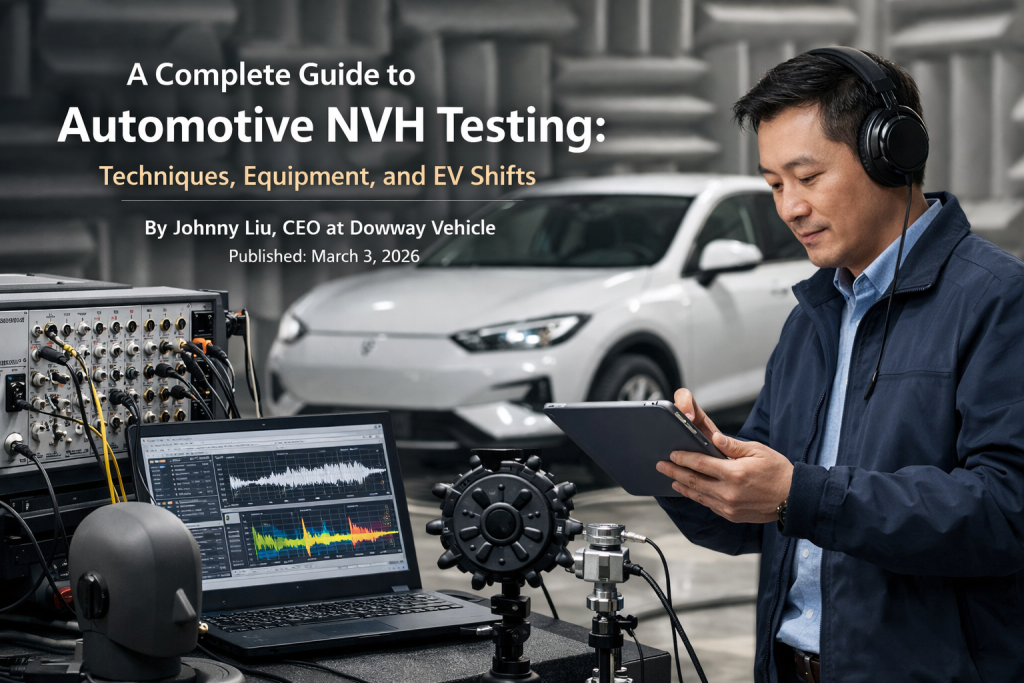
In my years working with vehicle acoustics, I’ve noticed a major shift. Car buyers care about a quiet, smooth ride more than almost anything else. NVH (Noise, Vibration, and Harshness) performance used to be an afterthought. Now, it makes or breaks a car’s market success. This guide looks at what NVH means, how we test it across different levels, the specific gear we use, and the fresh hurdles brought by electric vehicles (EVs).
1. Introduction to Automotive NVH Testing
Automotive NVH testing uses strict methods and highly sensitive gear to track down noises and vibrations while a car drives. Engineers study these signals to find the exact sources, measure how harsh they feel to a passenger, and fix structural designs.
The Core Concept of NVH
NVH covers three connected areas that judge a car’s sound and vibration:
- Noise: The sounds you hear through the air while driving. This covers powertrain noise (engine or motor whine), wind noise, tire noise, and sounds radiating from vibrating sheet metal. We measure it using Sound Pressure Level (dB) and frequency spectrums.
- Vibration: The physical shaking you feel through the seats, floor, or steering wheel. Powertrains, rough roads, and aerodynamic loads cause this. We track it using acceleration, displacement, or velocity. Its frequency and size directly change how comfortable the ride feels.
- Harshness: This is how people actually feel the noise and vibration. It describes the sudden shock or impact feeling, especially in the mid-frequency range (15-300Hz). Think of the hard bumpiness on a rough road or the sudden jerk when a motor starts.
NVH testing ties hard data to human feelings. Vibration causes most of the noise, and harshness is simply how our bodies react to both.
2. Classification of Automotive NVH Testing Methods
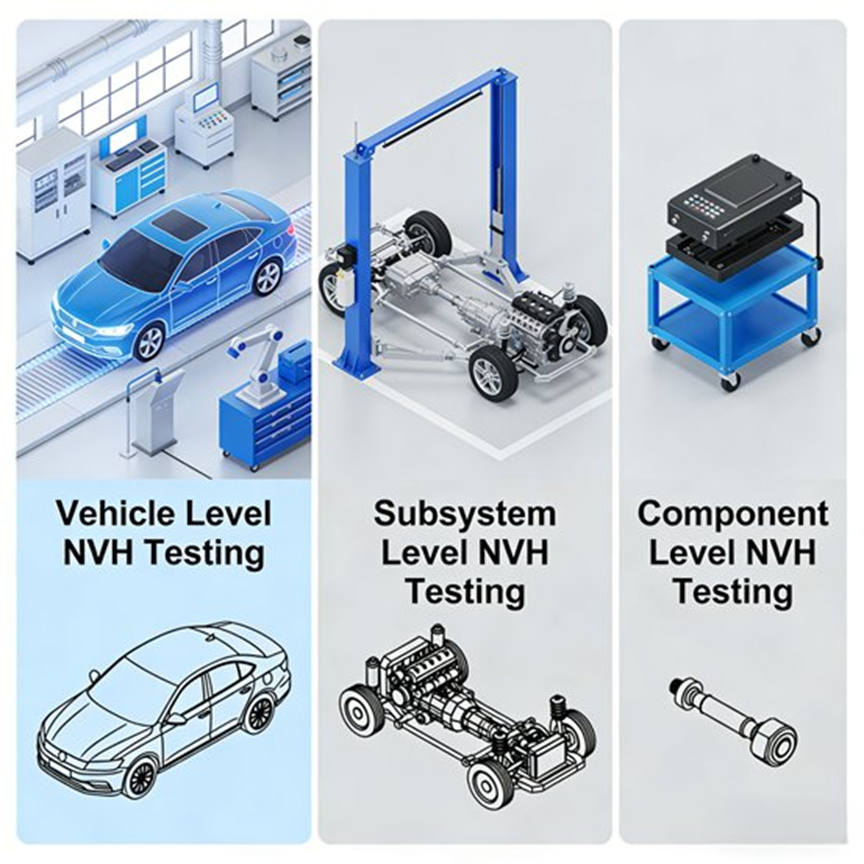
To fix sound issues from top to bottom, engineers break NVH testing into three distinct levels:
- Vehicle-Level NVH Testing: We test full prototype or mass-production cars in real-world driving situations. This catches big-picture problems like high-speed wind noise, body resonance, and annoying interior rattles.
- Subsystem-Level NVH Testing: We look at specific groups of parts, like the powertrain, chassis, and body. This pins down exact sources (such as chassis suspension NVH or body acoustic packages) so we can match the subsystem perfectly to the rest of the car.
- Component-Level NVH Testing: We test individual parts alone. Checking tires, engine mounts, door seals, or motor housings lets us stop noise and vibration right at the source.
3. Essential Environment and Equipment for NVH Testing
Good NVH testing relies on one simple rule: capture accurate signals, block outside interference, and copy real driving conditions.
Strict Testing Environment Requirements
- Acoustic Chambers: Noise tests happen in semi-anechoic chambers (which act like open spaces with background noise <20dB(A)) or full anechoic chambers to find exact sound locations (background noise <10dB(A)).
- Vibration Control: Test rigs isolate the car from the ground, keeping floor vibration acceleration below 0.01m/s².
- Climate Control: Rooms stay at 23±2℃ with 50±5% relative humidity to keep sensors working perfectly.
- Vehicle Prep: We make sure tire pressure, oil, and coolant levels are correct. The powertrain must be fully warmed up, and we remove any loose items from the cabin.
Core Testing Equipment & Sensors
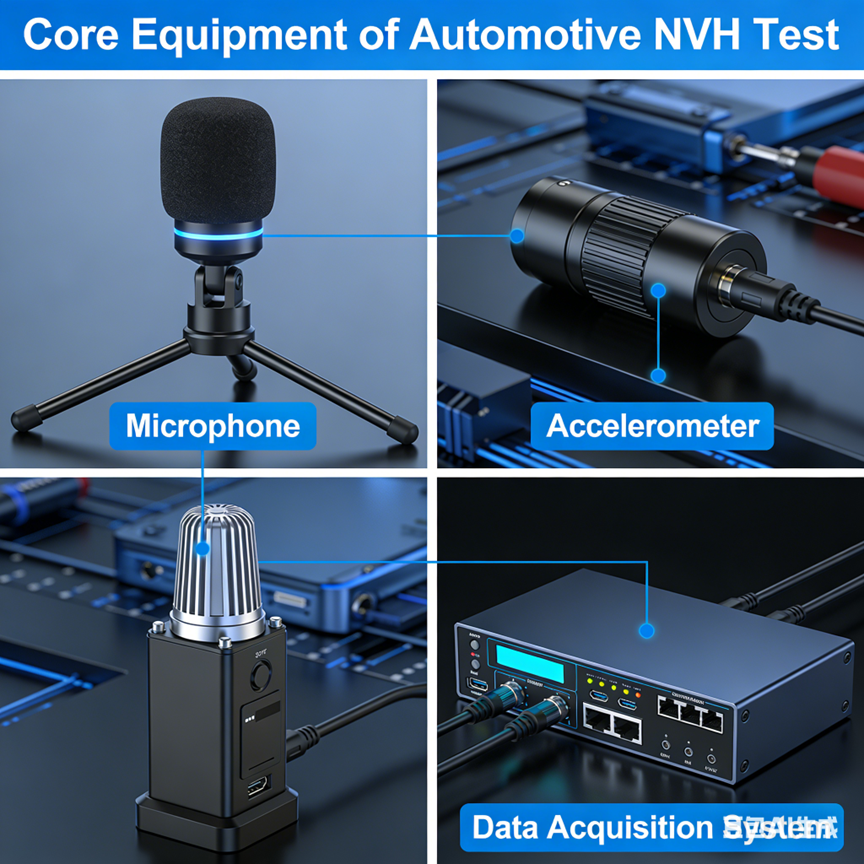
- Data Acquisition (DAQ) Systems: The brain of the operation. Top-tier systems like Siemens LMS SCADAS or HBK QuantumX handle 32 to over 256 channels. They boast a sampling rate of ≥51.2 kS/s and a dynamic range of ≥160 dB. They also include IEPE power, automatic TEDS recognition, and GPS syncing.
- Microphones: Precision 1/4 or 1/2-inch microphones listen in (sensitivity ≥50mV/Pa, 20Hz-20kHz). Acoustic cameras use phase-matched microphone arrays, while artificial heads record 3D binaural sound.
- Accelerometers & Vibrometers: IEPE piezoelectric sensors measure physical shaking (±50g to ±500g, 0.5Hz-10kHz) on steering wheels and mounts. Laser vibrometers scan hot exhausts or spinning motor housings without touching them.
- Auxiliary Sensors: Tachometers and encoders track spinning parts, while force sensors handle Transfer Path Analysis (TPA).
- Software and Test Rigs: Programs like Siemens Testlab, HEAD ArtemiS, or B&K PULSE run live FFT, order tracking, and psychoacoustics (loudness, sharpness, roughness). Physical hardware includes chassis dynamometers, powertrain rigs, and shaker tables.
4. Standard Procedures and Global Regulations
Step-by-Step Testing Methodologies
- Vehicle-Level: We check cabin noise while idling, cruising at 40/80/120km/h, accelerating, and coasting. A highly tuned car keeps 120km/h interior noise below 62dB. We also measure pass-by noise outside the car. For BSR (Buzz, Squeak, and Rattle), acoustic cameras track down friction sounds on rough test tracks.
- Subsystem-Level: * Powertrain: Dynamometers catch gear or motor whine. Great EVs keep high-speed motor whine below 30dB.
- Chassis: TPA finds exactly how vibration travels through the frame over speed bumps or gravel.
- Body: Impact hammers and shakers test the natural frequency and damping of the metal to stop resonance.
- Component-Level: We look at 20-200Hz low-frequency tire boom, test how well engine mounts absorb shocks, and check the noise coming off motor housings.
Global Testing Standards
Engineers follow strict rules to keep data consistent worldwide:
- International: ISO 362 & ECE R51 (Exterior Noise), ISO 5128 (In-cabin Noise), ISO 2631 (Whole-body vibration), and ISO 5349 (Hand-transmitted vibration).
- National (China): GB 1495 (Matches ECE R51), GB/T 18697 (Matches ISO 5128), and GB/T 4970 (Ride comfort).
5. New Challenges in EV Automotive NVH Testing
Moving to electric power changes the whole NVH rulebook:
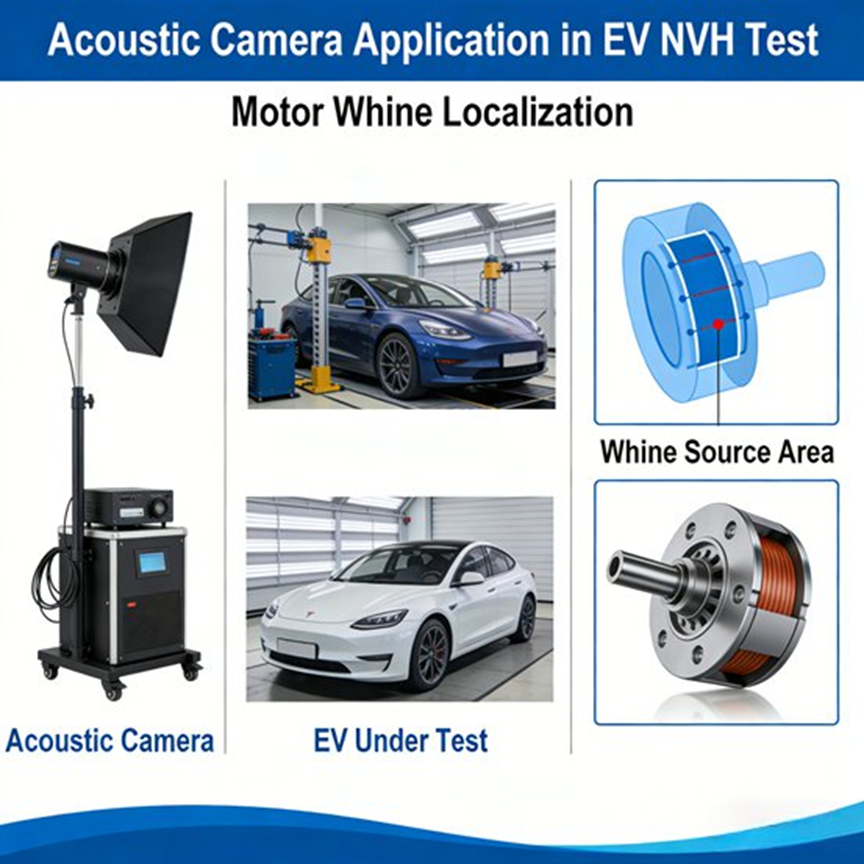
- Shift in Noise Sources: The loud gas engine no longer masks other sounds. High-frequency electric motor whine (2000-8000Hz) takes over as the main annoyance, requiring exact pinpointing to fix.
- Prominent Low-Frequency Boom: Slower EV vibrations naturally match the car body’s frequency. This causes a 20-200Hz low-frequency drone that hurts passenger comfort.
- Expanded EV Scenarios: Testers now check the physical jolt of motor start-stops, the sound of regenerative braking, and cooling fan noise during high-power fast charging.
6. Advanced Technologies Transforming NVH Testing
To beat EV noise problems, testers use new tools:
- Acoustic Cameras & Beamforming: Modules like the NTS.LAB ACX group microphones together. They use delay-and-sum algorithms (matching plane or spherical wave models) to build “sound heatmaps” that show exactly where high-frequency motor whine lives.
- Transfer Path Analysis (TPA): Fast TPA and Operational TPA (OTPA) let engineers calculate exactly how sound travels through the frame, all without taking the car apart.
- AI-Assisted BSR Recognition: AI programs sort through sound files automatically. They catch tiny squeaks and rattles much better than a human listening by ear.
- Virtual Simulation Integration: Teams merge early computer CAE simulation with real-world tests to create a fast loop of testing and fixing.
7. Key Quality Control Points and Troubleshooting
Reliable data demands strict habits:
- Sensor Setup: Point microphones straight at the surface. Bolt or glue accelerometers down hard so they do not drop the signal.
- Sampling Parameters: Run sampling rates at least 2.56 times higher than the maximum signal frequency to stop aliasing. Record for more than 10 seconds, and run every test 3 or more times.
- Troubleshooting:
- Signal Distortion: Check the mounts and block electromagnetic interference (EMI) from the electric motors.
- Inaccurate Localization: Widen the microphone array, use Near-field Acoustic Holography (NAH), or bring in high-resolution acoustic cameras.
- Low-Frequency Inaccuracy: Switch to special low-frequency accelerometers, record data for a longer time, and add better isolation to the test rig.
8. Future Outlook
Car NVH testing keeps getting smarter. AI and Big Data will soon find faults and suggest fixes automatically. Testers will run cars through new situations, like autonomous driving paths and extreme weather. As EV-specific rules become standard, mixing computer simulations with physical tests will cut down development time and deliver the quiet rides people want.
Frequently Asked Questions (FAQ) About Automotive NVH Testing
Q1: What is automotive NVH testing?
NVH means Noise, Vibration, and Harshness. This testing measures the unwanted sounds and shaking in a vehicle to make it more comfortable and higher quality. It finds the exact locations and sizes of these issues so engineers can silence them.
Q2: Why is automotive NVH testing important?
It matters for several reasons:
- Passenger Comfort: Too much noise and shaking causes fatigue.
- Quality Perception: A quiet car feels like a better, more expensive car.
- Regulatory Compliance: Cars must pass strict laws for inside and outside noise.
- EV Needs: Without a loud gas engine, wind and road noise become obvious. EVs need extra NVH work to stay peaceful.
Q3: What are the primary methods used in automotive NVH testing?
Common methods include Sound Pressure Level (SPL) checks for cabin noise, Vibration Analysis with accelerometers, Transfer Path Analysis (TPA) to track how sound moves through the frame, and Modal Analysis to find where the metal rings. We run these on the road, on dynamometers, or in semi-anechoic rooms.
Q4: When should NVH testing happen during vehicle development?
It helps from start to finish. Teams start with computer simulations, move to Component Validation for single parts, build Full Vehicle Prototypes for closed-track tests, and finish with Pre-production Validation to guarantee the car meets all design targets and global laws.
Q5: What are the main hurdles in modern automotive NVH testing?
Testers struggle with changing weather on road tests, separating mixed noise sources, and catching accurate high-frequency data. EVs add new hurdles, like hunting down high-frequency motor whine (2000-8000Hz) and stopping low-frequency structural boom (20-200Hz).
