




| Parameter | Specification |
|---|---|
| Sensor Type | Vacuum Pressure Sensor |
| Technology | MEMS-based pressure transducer |
| Pressure Range | 0–100 kPa (customizable) |
| Accuracy | ±1.0% FS (-40°C to +125°C) |
| Operating Temperature | -40°C to +125°C |
| Storage Temperature | -40°C to +130°C |
| Output Signal | 0.4–4.65V or 0.5–4.5V (configurable) |
| Supply Voltage | 4.75–5.25 VDC |
| Overvoltage Protection | 18 VDC |
| Reverse Polarity Protection | -14 VDC |
| Burst Pressure | 3×P max |
| Overpressure Tolerance | 2×P max |
| Output Load (Capacitive) | Max 470nF |
| Output Load (Resistive) | Min 4.7kΩ |
| Short Circuit Protection | Yes |
| Supply Current | ≤10 mA |
| Cycling Test | 200,000 cycles |
| Housing Material | PBT+30%GF (Polybutylene Terephthalate with Glass Fiber) |
| Protection Rating | IP67 |
| Mounting Interface | Threaded connection, custom connector available |
| Dimensions | Compact design, optimized for tight engine bay spaces |
| Compliance | RoHS, REACH, ISO 7637-2 |
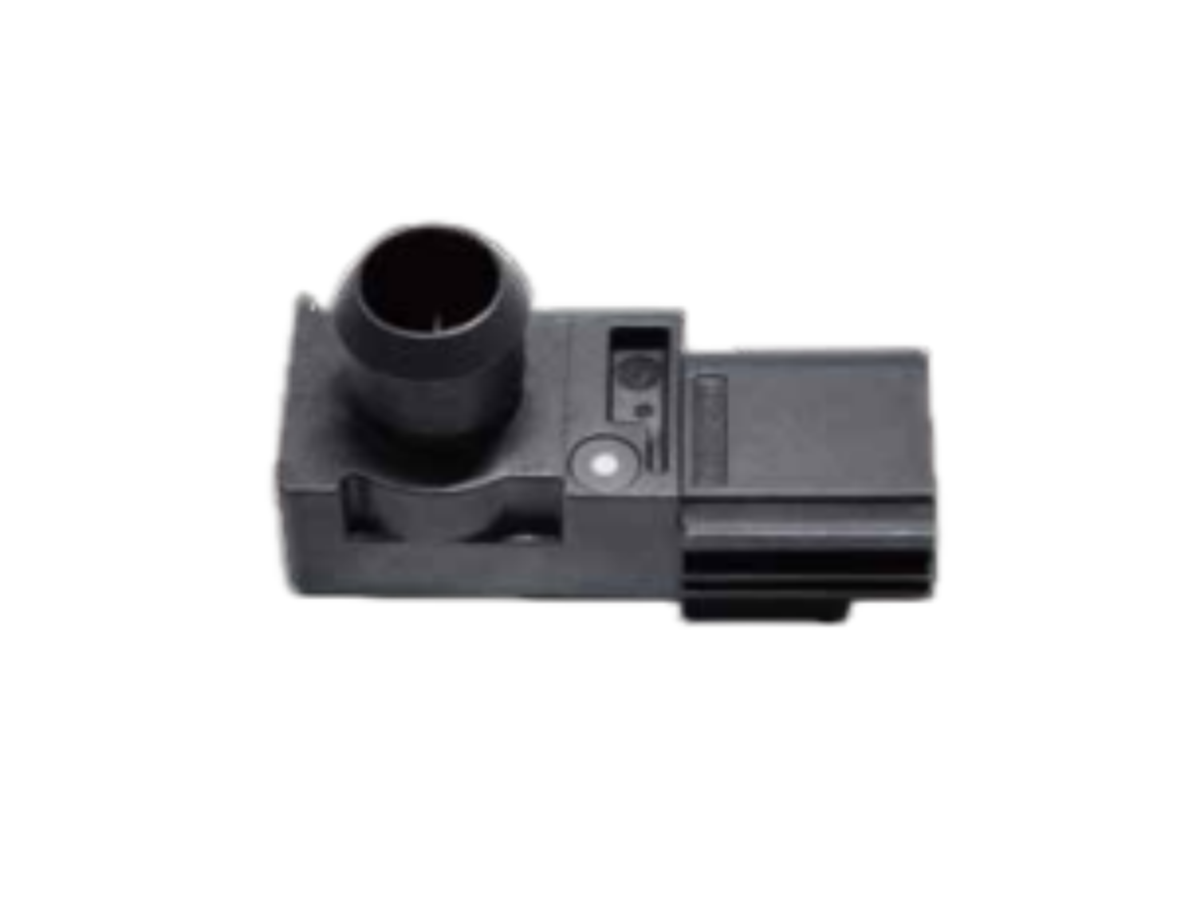
The Automotive Vacuum Pressure Sensor is a critical component in modern vehicle brake systems, designed to monitor the vacuum level within the brake booster’s vacuum line and provide real-time feedback to the vehicle’s electronic control unit (ECU). Installed directly on the vacuum hose or manifold of the brake vacuum system, this sensor measures the absolute pressure (typically ranging from 0 to 100 kPa) and converts it into an electrical signal that enables precise evaluation of brake assist performance. This data is essential for diagnosing vacuum leaks, detecting insufficient vacuum levels due to engine issues, and triggering warning systems or adaptive braking logic in hybrid and electric vehicles where traditional engine-generated vacuum may be limited.
Utilizing advanced MEMS (Micro-Electro-Mechanical Systems) technology, this sensor delivers high accuracy, long-term stability, and exceptional reliability under harsh operating conditions. It maintains ±1.0% full-scale accuracy across a wide temperature range (-40°C to +125°C), ensuring consistent performance in extreme climates and during extended operation. The intelligent zero-point and temperature compensation algorithms automatically correct for thermal drift and environmental variations, minimizing measurement errors over time. With excellent EMC/ESD performance, it resists electromagnetic interference and electrostatic discharge common in automotive environments, ensuring stable signal transmission even in high-noise conditions.
The sensor features comprehensive protection mechanisms: overvoltage (18V DC), reverse polarity (-14V DC), short-circuit resistance, and burst pressure tolerance of 3×P max, ensuring durability in complex electrical systems. Its IP67-rated housing provides complete sealing against moisture, dust, and oil contamination, making it ideal for use in under-hood applications exposed to engine heat, vibrations, and chemical exposure. The compact size and modular design allow for easy integration into existing brake system architectures, with customizable options for pressure range, output signal (0.4–4.65V or 0.5–4.5V), and physical dimensions to meet OEM-specific requirements




Reviews
There are no reviews yet.