




< Back to Sample & Prototype Production
By Johnny Liu, CEO at Dowway Vehicle
Updated: March 2026
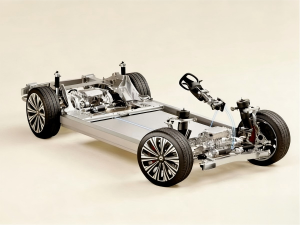
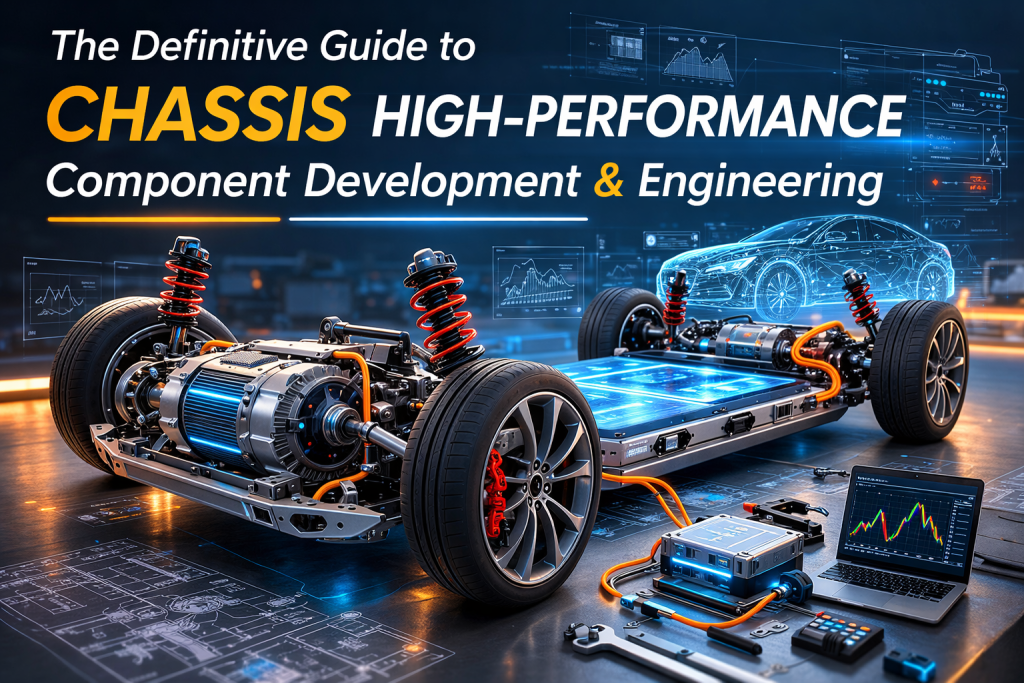
Think of the automotive chassis as a vehicle’s skeleton and joints. It bears the weight, transfers power, steers, stops, and keeps the ride smooth. Today, the engineering behind chassis high-performance components dictates a car’s driving quality, handling, and active safety.
As the auto industry shifts rapidly toward electric and smart vehicles, chassis design is changing. We are moving away from purely mechanical setups to an integrated “Mechanical-Electronic-Control” approach. Traditional internal combustion engine (ICE) cars relied heavily on mechanical gears and passive shocks. But today’s electric vehicles (EVs) and connected cars need lightweight, smart, and highly integrated parts. Technologies like Cell-to-Chassis (CTC) integration, brake-by-wire, and steer-by-wire set completely new standards for how we build and test cars.
To balance ride comfort, handling, braking, and NVH (Noise, Vibration, Harshness), engineers follow a strict V-model development process: Requirement Analysis → Architecture Design → System Development → Component Design → Simulation Validation → Physical Testing → Iterative Optimization.
Core Development Principles & Engineering Metrics
A modern high-performance chassis relies on four main mechanical groups—Suspension, Steering, Braking, and Transmission. The Chassis ECU (Electronic Control Unit) controls them all. When building these parts, engineers stick to four main rules:
- Performance Synergy: Balance stiffness with comfort, so tweaking the suspension does not ruin the handling.
- Engineering Adaptation: Match the structure to the vehicle type (economy, off-road, or EV) so you never over-engineer the parts.
- Regulatory Compliance: Follow strict safety rules like the ISO 26262 functional safety standard.
- Iterative Optimization: Test, simulate, find weak spots, and repeat.
To ensure objective engineering excellence, we evaluate chassis high-performance components against a rigorous metric system:
- Handling Stability: Steering lag ≤ 10ms; Moose test body roll angle ≤ 8°; Suppression of understeer and oversteer.
- Ride Comfort: Vertical vibration acceleration ≤ 0.3g; Road shock attenuation ≥ 80%; Damper force decay ≤ 20% after 100,000 km.
- Braking Safety: 100-0 km/h braking distance ≤ 38m; Thermal fade limits distance increases to ≤ 15% after 10 stops at 600°C; ABS/ESP response ≤ 100ms.
- Lightweight Targets: Component lightweight coefficient ≤ 2.5 kg/kN; Heavy use of aluminum alloys.
- Reliability: Component fatigue life ≥ 100,000 cycles; Extreme temp tolerance from -40°C to 120°C; Wiring harness protection ≥ IP67.
Technical Deep-Dive: Component Engineering
Advanced Suspension Systems
The suspension absorbs road bumps and keeps tires firmly on the ground. Cost and performance dictate the design. Economy cars usually run MacPherson struts up front and a torsion beam in the rear. Here, the goal is simply matching coil spring stiffness with damper tuning.
Mid-to-high-end cars and SUVs use Double Wishbone (front) or Multi-link (rear) independent setups. These multi-link designs let engineers precisely control wheel alignment—keeping the Caster angle between 2° and 5°, and Toe angle errors under ±3′. This precision keeps the car stable at high speeds and cuts uneven tire wear to 10% or less. EVs demand a low center of gravity. They use hollow anti-roll bars and aluminum control arms to cut unsprung mass. Furthermore, the suspension geometry must fit perfectly around the CTC battery pack without interfering.
Engineers use twin-tube or mono-tube gas-charged shock absorbers. They tweak damping forces using bumpy and highway driving simulations. Using ADAMS or HyperWorks for multi-body dynamics, rig tests demand less than a 5% spring height change after 500,000 compression cycles. Real-world tuning matters. In one recent sedan project, tweaking the suspension bushing hardness dropped cabin vibration acceleration by 35%.
Precision Steering Systems
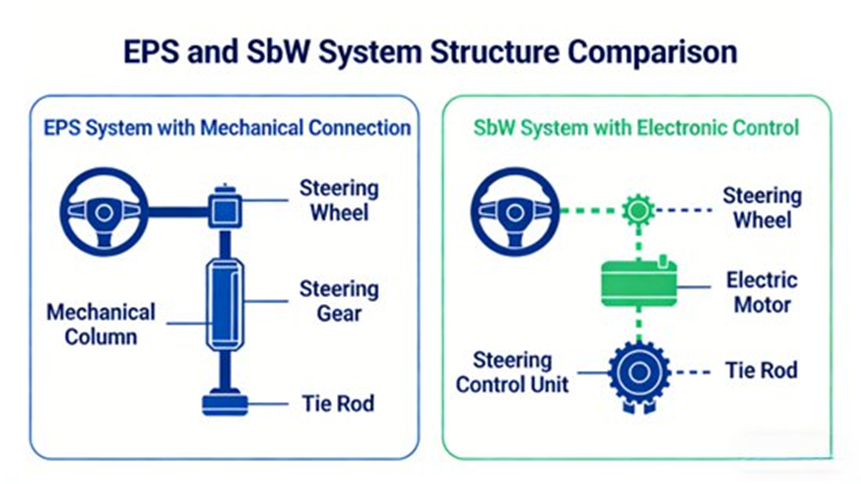
Electric Power Steering (EPS) comes in a few layouts: C-EPS (column), DP-EPS (dual-pinion), and BD-EPS (belt-drive). The design gives drivers light steering at low speeds and heavy steering at high speeds. It also includes safety backups to keep 50% mechanical assist if the power cuts out.
Steer-by-Wire (SbW) removes the physical steering column, as seen in the Toyota bZ4X and Lexus RZ (which still keep mechanical backups). This setup needs dual-ECUs and dual-motors. It must mimic real physical road feel so the driver does not experience “tactile distortion.” For tolerances, rack-and-pinion gear backlash must stay under 0.1mm to eliminate dead zones. The system needs to respond in 50ms or less, keeping steering angle errors under 0.5°. Durability tests simulate 10 years of driving, limiting rack wear to just 0.1mm.
High-Safety Braking Systems
Traditional gas cars use hydraulic brakes—usually discs on the front for heat dissipation and drums on the back to save money. EVs use a mix of mechanical friction and regenerative braking through Electronic Hydraulic Braking (EHB) or Electro-Mechanical Braking (EMB). Systems like the Bosch iBooster + ESP hev (a Two-Box setup) separate the pedal feel from the actual brake pressure. This allows a smooth blend of physical and regenerative braking, pushing energy recovery efficiency up to 30%. Deceleration must hit at least 8m/s² with a vehicle pull deviation of 50mm or less per 100 meters. The parts must survive brutal thermal fade tests, enduring disc temperatures over 600°C without failing.
High-Efficiency Transmission Systems
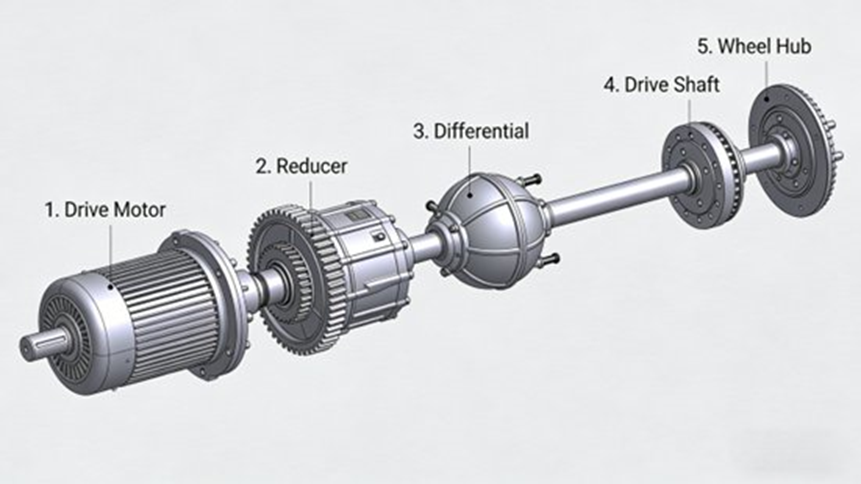
Gas cars rely on smooth shifts and long lifespans. Engineers tweak AT/DCT logic to stop low-speed jerks and toughen up CVT steel belts. EVs use tight “Motor + Reducer” units. Single-speed reducers rule the mass market, while dual-speed versions go into high-end performance EVs. Transmission efficiency must beat 95%. Engineers keep noise below 70dB by reshaping the gear teeth using drum gear shaping. They validate these parts to last over 200,000 kilometers.
The Chassis ECU
The Chassis Electronic Control Unit acts as the brain. It reads wheel speed, steering angles, and gyroscopic sensors, demanding an error margin of 1% or less. Built via MATLAB/Simulink, the code runs a continuous “Sense-Decide-Act” loop. It talks directly to ADAS for autonomous steering and braking. We test these ECUs hard—shaking them and soaking them to meet IP67 waterproof standards so they survive extreme environments from -40°C to 120°C.
New Technologies on the Horizon
- Cell-to-Chassis (CTC) Integration: Tesla and BYD build battery cells directly into the chassis. This drops traditional battery modules, saves space, and makes the frame stiffer.
- Digital Twin Technology: By running tests in a virtual world, one EV startup cut real-world driving tests from 500,000 km to 100,000 km. This slashed R&D costs by 40%.
- AI Predictive Maintenance: AI tools look at vibration frequencies to guess when a part will break. One logistics fleet used this to cut chassis failure rates by 55%.
- Active Variable Structure Suspensions: Electric motors change the suspension shape on the fly, saving energy while keeping the ride smooth and sharp.
The Wrap-Up
Building high-performance chassis parts takes a strict V-model process to get the mechanical strength, electronics, and software working together perfectly. Looking ahead, the auto industry is clearly moving toward highly integrated, smart by-wire systems built on lightweight, modular platforms.
Frequently Asked Questions
Q1: What are high-performance chassis components?
Answer: They are structural and mechanical parts that make a car handle better and stay safe at high speeds.
These parts include the suspension, steering, brakes, and main frame elements. The chassis is the main load-bearing structure. It holds the engine, suspension, and body together while handling driving stress (Source: Shixinproto). Engineers balance the weight and stiffness of these parts to keep the car stable in sharp corners (Source: Assurelio).
Q2: Why do these components matter?
Answer: They decide how well a car drives, turns, and stops.
A good chassis gives drivers sharp steering, high-speed stability, and a smooth ride. Engineers care about chassis stiffness because it cuts down body roll and speeds up steering reactions (Source: Autoprototypes). Modern electronic controls link the steering, braking, and suspension together to keep the car safe on the road (Source: MDPI).
Q3: What materials do builders use?
Answer: Engineers mainly use high-strength steel, aluminum alloys, and carbon fiber.
High-strength steel is tough and cost-effective. Aluminum is light and helps the car handle better. Carbon fiber offers massive strength for very little weight. The right material handles heavy loads without breaking (Source: Assurelio). Builders use these advanced materials to make cars lighter, fight rust, and stretch fuel or battery range (Source: Science Direct).
Q4: How do they change the way a car drives?
Answer: They manage weight distribution, structural stiffness, and the center of gravity.
Better weight balance helps a car corner safely. A stiffer frame makes the suspension work better and the steering feel sharper. A lower center of mass keeps the car planted and stops it from rolling over. Performance cars tweak these details so the driver always knows exactly how the car will react (Source: Autoprototypes).
Q5: What is next for chassis tech?
Answer: The next steps include lighter materials, electronic by-wire controls, and flat EV platforms.
Lighter materials save energy and fuel (Source: Energy.gov). Smart electronic systems adjust the brakes and suspension on the fly based on the road (Source: Autoprototypes). Finally, new “skateboard” designs build the battery directly into the floor, giving EVs a lower center of gravity and much better balance (Source: Autoprototypes).
