




< Back to Sample & Prototype Production
By Johnny Liu, CEO at Dowway Vehicle
Published/Updated: March 9, 2026
Author Note: With decades of hands-on experience in automotive chassis engineering and manufacturing at Dowway Vehicle, this guide gives engineers, designers, and automotive professionals a deep, technical look at the development cycle of chassis arm links—from structural design to mass-production testing.
- Introduction to Chassis Arm Links in Vehicle Suspensions
- Anatomy and Structural Design of Chassis Arm Links
- Material Selection for Chassis Arm Links
- Engineering Simulation and Analysis (CAE)
- Manufacturing Processes for Chassis Arm Links
- Testing and Validation Protocols
- Future Trends in Chassis Arm Link Development
- Frequently Asked Questions About Chassis Arm Links
- Wrapping Up
Introduction to Chassis Arm Links in Vehicle Suspensions
Automotive suspension systems connect the vehicle body to the wheels. Within this system, chassis arm links (commonly referred to as control arms) act as the main load-bearing and guiding parts. They transfer longitudinal and lateral loads between the wheels and the vehicle body, limit the wheel’s exact path, and work with shock absorbers and springs to buffer road impacts. In short, chassis arm links keep the wheels in the right contact posture with the ground.
Car makers want lighter, more energy-efficient, and smarter vehicles. Because of this, engineering chassis arm links is hard work. Engineers need to reduce unsprung mass without losing basic strength, rigidity, and durability, all while keeping costs and development cycles low.
Anatomy and Structural Design of Chassis Arm Links
Key Components of a Suspension Link
The setup of chassis arm links usually includes three main parts that work together to guarantee reliable load transfer and kinematic flexibility:
- The Arm Body: The main load-bearing structure. Its shape decides the strength, stiffness, and weight limit of the link.
- Connection Bushings: Placed where the arm meets the vehicle body (or subframe). Made of rubber or hydraulic materials, their main job is to block high-frequency road vibrations, stop NVH (Noise, Vibration, and Harshness) transfer, and let the arm rotate along the bushing axis.
- Ball Joints: Put where the arm meets the steering knuckle. Ball joints allow multi-dimensional rotation, making sure the wheel keeps correct alignment angles (camber, toe) during steering and vertical suspension travel.
Common Types of Chassis Arm Links and Their Applications
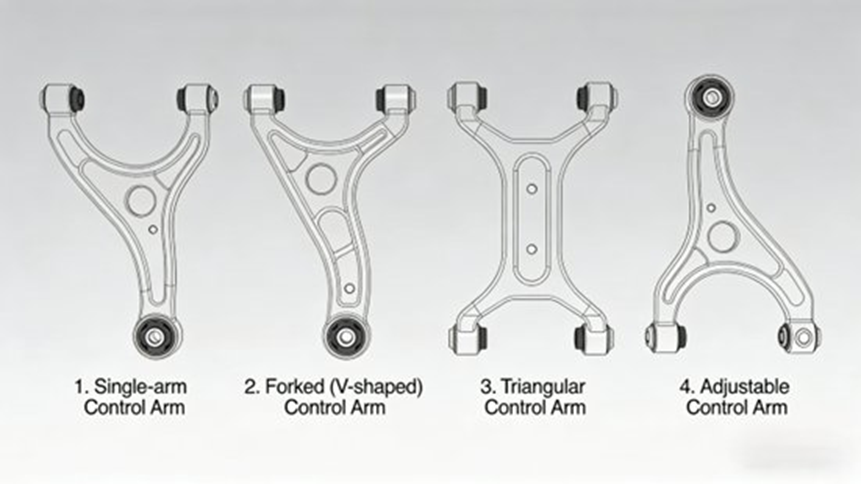
Based on suspension geometry and load needs, chassis arm links fall into four main structural types:
- Single-arm Links: With a simple, straight, or slightly curved shape, these mostly handle unidirectional loads. They cost less and take up little space, making them perfect for lower arms in MacPherson strut setups on economy cars.
- Forked (V-shaped) Links: This layout spreads out loads and greatly improves lateral stiffness. Used heavily as upper and lower links in Double Wishbone suspensions, they are standard in mid-to-high-end sedans and SUVs for better wheel alignment control.
- Triangular Links: Offering great geometric stability and torsional rigidity, triangular links can transfer both longitudinal and lateral loads at the same time. They are the top choice for heavy-duty vehicles and off-road SUVs facing rough, high-impact terrain.
- Adjustable Links: Having a threaded central adjustment mechanism (accurate to 0.1mm), these let technicians change the link’s length to precisely tune wheel alignment. Made from heat-treated, high-strength alloys, they appear mostly in racing and performance tuning.
Core Structural Design Principles
The engineering of chassis arm links follows a strict “Performance First, Lightweight Adaptation, Manufacturing Feasibility” rule:
- Load Matching: Designs must handle specific longitudinal, lateral, and alternating loads based on the vehicle’s mass to stop fracture or deformation under extreme conditions.
- Wheel Alignment Constraints: The length, installation angle, and joint positions must strictly match alignment parameters (camber, toe, caster) to lower tire wear and better handling.
- Lightweighting vs. Process Compatibility: Cutting unsprung mass gives huge performance boosts. For every 1kg drop in unsprung mass, the result equals dropping 5kg of sprung body weight, quickening wheel response speed by roughly 8%. However, lightweight designs (like topological hollowing) must still work with stamping, welding, or forging processes.
Material Selection for Chassis Arm Links
The choice of material decides a link’s strength, fatigue life, and manufacturing cost. The industry relies on three main categories:
High-Strength Steel (The Mainstream Choice)
Making up over 70% of current chassis arm links, high-strength steel brings a great mix of strength, cost, and process maturity.
- Common Grades: HR800CP, FB450, and 60Si2MnA (for localized stiffening).
- Engineering Data: HR800CP steel has a yield strength of 716MPa (60% higher than standard steel), letting engineers drop arm thickness from 3.5mm to 3.0mm. This causes an 11.8% weight drop while at the same time raising the safety factor from 1.05 to 2.27. FB450 can absorb instantaneous impacts over 8 tons.
- Application: Usually made using dual-layer stamped steel plates (e.g., 3.5mm upper, 2.0mm lower) welded via laser to build a stiff “shell” structure. Double nickel plating guarantees an anti-corrosion lifecycle of over 5 years.
Aluminum Alloys (The Lightweight Choice)
With a density just 1/3 that of steel, aluminum sharply cuts unsprung mass, improving fuel economy and EV range (a 10% drop in an EV’s weight can push range up by 5% to 10%).
- Common Grades: 6061, 6082, and 7075.
- Engineering Data: 6061 aluminum (solution heat-treated and aged) reaches a tensile strength of 380MPa. 7075 can cross 500MPa but costs more. In high-end SUVs, multi-cavity enclosed aluminum lower links can drop weight by over 30% compared to steel, quickening wheel response by 15%. However, since aluminum’s low-temperature impact toughness is only 60% of steel’s, designs must make up for this structurally.
Advanced Composites (High-End & Special Scenarios)
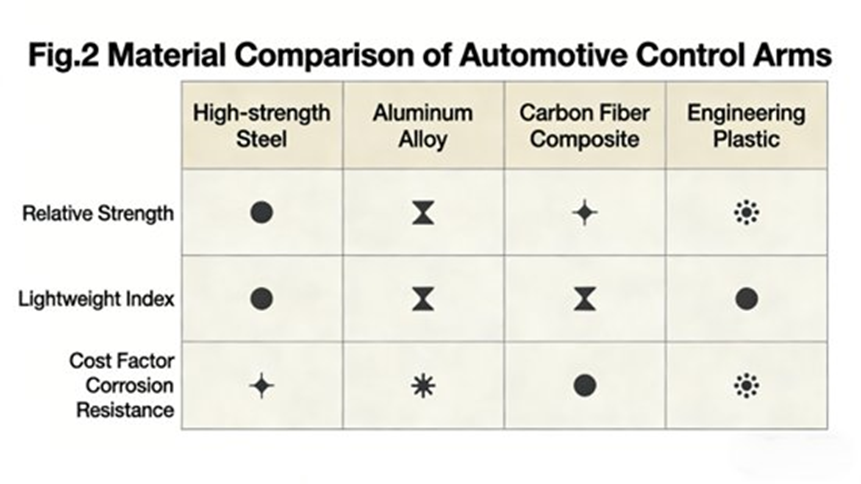
- Carbon Fiber (CFRP): With a specific strength 5 times that of steel, CFRP is the ultimate in lightweight engineering (currently limited to F1 and hypercars).
- Engineering Plastics (PA66+30%GF): Weighing only 20% of steel, honeycomb sandwich structures made from this material can absorb over 50% of road vibrations. When paired with non-metallic bearings, they can reach zero wear over 150,000 km, making them perfect for micro-EVs.
Engineering Simulation and Analysis (CAE)
Computer-Aided Engineering (CAE) simulation happens right before making physical prototypes, using software like ANSYS, Abaqus, or SolidWorks.
Static Stress Analysis
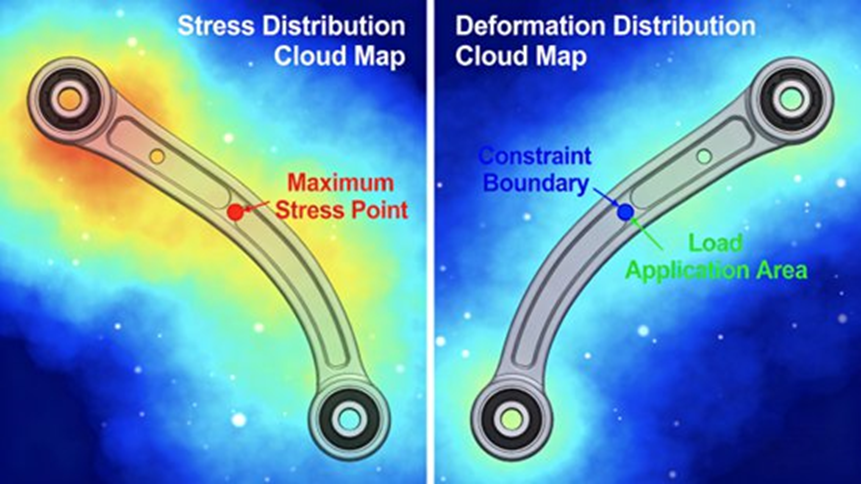
- Parameters: Inputs include extreme vertical loads (e.g., up to 13428.45N for grounding force) and lateral loads during cornering (up to 6714.23N). Maximum deformation is strictly limited to ≤0.5mm.
- Engineering Example: A simulated HR800CP lower link subjected to maximum vertical load showed a maximum stress of 96.784MPa (well below the 716MPa yield limit) and a deformation of only 0.32mm, validating the design.
Dynamic Kinematic Analysis
- Parameters: Engineers monitor the link’s first-order natural frequency to avoid overlap and resonance with environmental frequencies: wheel/driveshaft imbalance (<15Hz), road surface irregularities (<20Hz), and engine vibrations (<25Hz).
Fatigue Life Simulation
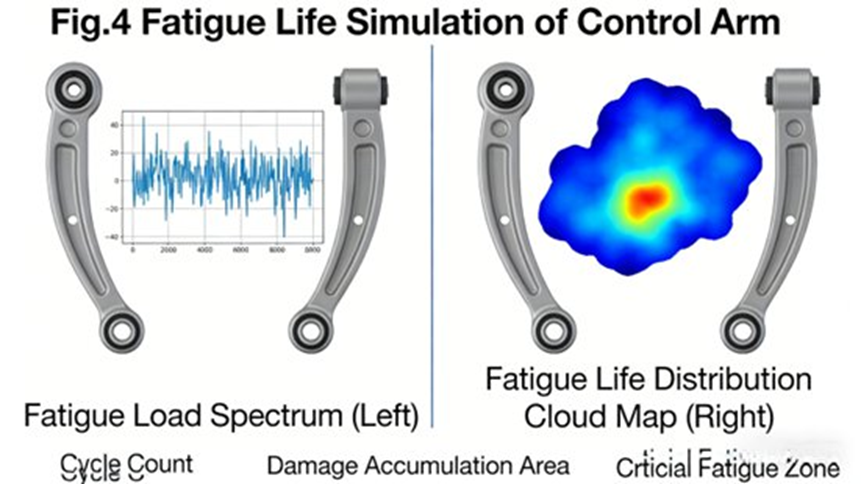
- Optimization Example: Using S-N (Stress-Number of cycles) curves, an initial SUV link design showed a fatigue life of only 150,000 km at the ball joint connection. By changing the fillet radius from R3mm to R5mm and adding localized stiffeners, the simulated lifespan went up to 250,000 km, meeting design targets.
Manufacturing Processes for Chassis Arm Links
- Stamping and Welding (Mainstream): Great for high-strength steel. Needs high-precision dies (tolerances tightly held within ±0.1mm). Processes use CO2 gas-shielded or laser welding, followed by stress-relief annealing and e-coating for corrosion resistance.
- Forging (Mid-to-High-End): Great for aluminum (heated to 450–550°C) and steel (800–1000°C). Die forging creates a dense grain structure. Critical connection points undergo precise machining to reach a surface roughness of Ra≤1.6μm.
- Die Casting (Complex Structures): Used for complex aluminum links. Needs strict control over injection temperature, speed, and holding time to stop porosity, followed by solution aging.
- Quality Control: Strict checks cover raw material chemical analysis, in-process weld checks, and final product mechanical testing.
Testing and Validation Protocols
Validation follows industry standards strictly (e.g., GB/T 30038-2013).
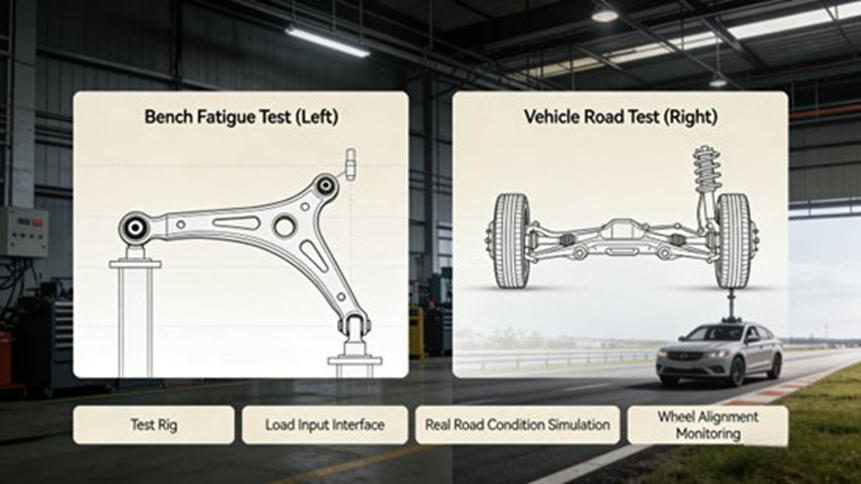
- Laboratory Bench Testing: Includes applying extreme static loads for 30 seconds to confirm zero plastic deformation, stiffness testing, and applying physical fatigue load spectrums until failure.
- Real-World Road Testing: Fully assembled vehicles undergo testing over 100,000 km across different terrains to check NVH, handling stability, and make sure there is no abnormal tire wear or trajectory deviation.
- Mass Production Acceptance Criteria: Limit loads with ≤0.5mm deformation; fatigue life ≥200,000 km (passenger) or ≥150,000 km (commercial); no fatigue cracks; dimensional tolerances of ±0.1mm; surface roughness Ra≤1.6μm.
Future Trends in Chassis Arm Link Development
- Extreme Lightweighting: By 2030, aluminum arm penetration should reach 30%, while the cost of CFRP should drop by 50%.
- Integrated Modularity: Modular kits with a universal body and dedicated joints could soon cover over 80% of vehicle models, cutting down parts and assembly complexity heavily.
- Smart Chassis Integration: Putting displacement and stress sensors directly into the links to send real-time data to active suspension systems and allow predictive maintenance.
- Process Innovation: Using 3D printing for rapid prototyping, able to produce topologically optimized structures that weigh 40% less than traditional designs.
Frequently Asked Questions About Chassis Arm Links
Q: What are chassis arm links in a car?
Short Answer: They are the metal suspension components connecting the wheel assembly to the vehicle’s frame.
Detailed Answer: Chassis arm links are vital structural parts in a vehicle’s suspension system that connect the wheel hub to the chassis or subframe. They help control wheel movement and maintain proper suspension geometry. Common types include control arms, trailing arms, and stabilizer (sway bar) links.
Q: What exactly does a chassis arm link do?
Short Answer: It controls vertical wheel movement and maintains proper wheel alignment.
Detailed Answer: Chassis arm links manage several core functions for vehicle handling. They connect the wheel hub to the chassis, maintain correct wheel alignment parameters, control wheel movement over bumps, and support the vehicle’s weight. They ensure the tires maintain direct contact with the road while the suspension absorbs physical impacts.
Q: What are the symptoms of a bad or failing chassis arm link?
Short Answer: Look for clunking noises, poor handling, and uneven tire wear.
Detailed Answer: Because worn bushings or ball joints create excessive play in the suspension linkage, common signs of a failing link include clunking or knocking noises when driving over bumps (NVH issues). Drivers might also notice a loose steering feel, excessive body roll during turns, uneven tire wear, and noticeable vibrations in the cabin.
Q: Can you drive with a broken chassis arm link?
Short Answer: It is technically possible but highly dangerous.
Detailed Answer: A vehicle may still move with a damaged link, but mechanics strongly advise against it. A broken or severely worn link causes a heavy drop in steering control, increased body roll, and a high risk of damaging other suspension parts. This creates severe safety hazards, especially at higher speeds.
Q: How long do chassis arm links actually last?
Short Answer: They usually last between 80,000 and 160,000 km (50,000 – 100,000 miles) in real-world driving.
Detailed Answer: While engineers design and test OEM passenger vehicle links to last ≥200,000 km in laboratory conditions, real-world lifespan depends heavily on driving conditions. Factors that speed up wear include rough roads, heavy loads, poor-quality components, and corrosion from road salt. Regular suspension inspections are the best way to catch wear early.
FAQ Summary Quick Reference
| Question | Key Takeaway |
| What are chassis arm links? | Suspension structural components connecting wheels to the chassis. |
| What do they do? | Control vertical wheel movement and maintain precise alignment. |
| Symptoms of failure? | Clunking noises, poor handling, and uneven tire wear. |
| Can you drive with broken links? | Technically possible but highly unsafe; immediate repair is required. |
| How long do they last? | Engineered for 200k+ km, but practically require checks at 80k–160k km. |
Wrapping Up
The engineering of automotive chassis arm links is a highly detailed systems task. It demands a tight balance of structural design, precise material science, strict CAE simulation, modern manufacturing, and hard physical validation. Car makers are moving toward lighter and more efficient vehicles, so refining chassis arm link technology will remain a core part of automotive safety and dynamic excellence.
