




< Back to Data Management System
Author: Johnny Liu, CEO at Dowway Vehicle
Published: March 11, 2026
Content Type: Cluster Page
Reviewed For: Automotive engineering, PLM, digital manufacturing, and product data governance
- Why Automotive Companies Need a Specialized PLM Platform
- What Hua Tian Inforcenter PLM Means in Automotive Engineering
- Core Technical Architecture of Hua Tian Inforcenter PLM
- Foundation Support Layer: The Digital Base for Automotive Work
- Data Management Layer: Unified Control of Full-Lifecycle Automotive Data
- Business Application Layer: Modules Built for Automotive Workflows
- Project Management Module: Full Control of Vehicle R&D Projects
- PDM Module: Standardized Control of Automotive Core Data
- CAPP Module: The Link Between Design and Manufacturing
- Supply Chain Collaboration Module: Linking OEMs and Suppliers
- Collaboration and Integration Layer: Breaking Information Silos
- Local Fit and Implementation Strength Compared with Foreign PLM Software
- Practical Value in Automotive Engineering
- Representative Enterprise Cases from the Report
- Frequently Asked Questions About Automotive PLM
- 1. How do you manage the transition and synchronization from EBOM to MBOM?
- 2. What are the real-world challenges of integrating a PLM system with ERP and MES?
- 3. Cloud/SaaS PLM vs. on-premises: which is better for heavy automotive CAD assemblies?
- 4. How does MBD and 3D visualization improve shop-floor efficiency?
- 5. What is the best way to handle OEM-supplier collaboration without exposing proprietary IP?
- Why Hua Tian PLM Matters in the Next Stage of Automotive Digital Work
- Closing View
The automotive industry is moving from traditional mechanical products to intelligent products built on mechanics, electronics, and software. That change is pushing product complexity much higher. A vehicle program now covers product design, electrical and electronic systems, software content, manufacturing, supplier coordination, quality traceability, and compliance control across the full lifecycle.
That shift puts heavy pressure on enterprise systems. A modern vehicle program produces large volumes of drawings, 3D models, BOM structures, process files, simulation reports, change records, and supplier-linked data. It also requires many teams to work together across design, process planning, production, procurement, and after-sales service. In this setting, product lifecycle management in the automotive industry is the core hub of the digital toolchain. It handles unified data control, standardized workflows, and cross-domain collaboration.
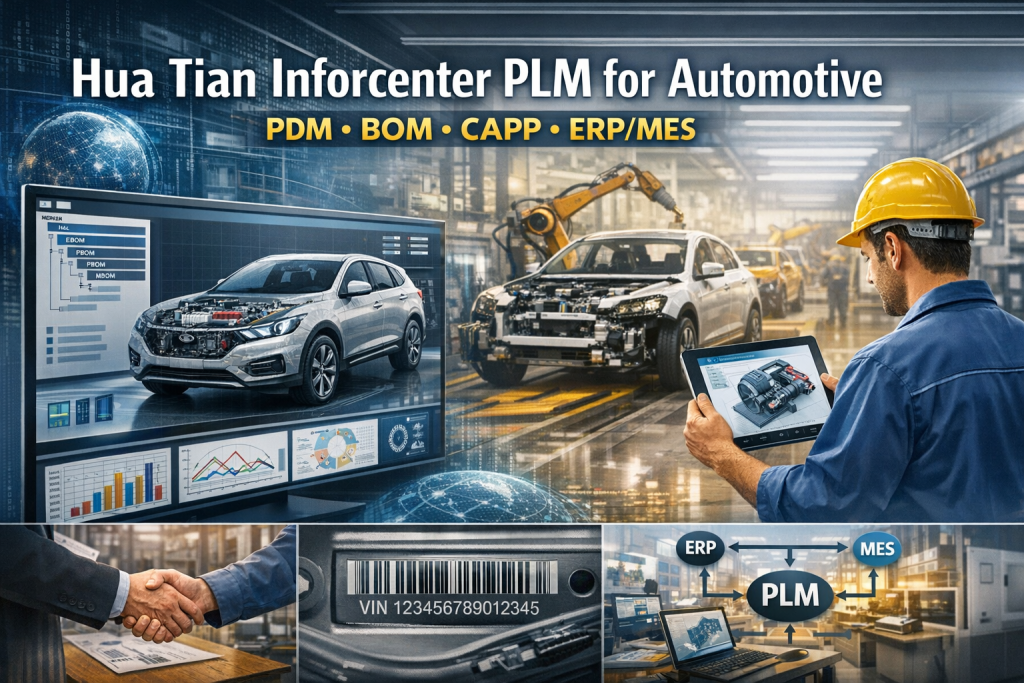
Hua Tian Inforcenter PLM, referred to here as Hua Tian PLM, is a domestic PLM platform built for Chinese industrial use. In automotive engineering, it is positioned as an integrated digital management system for OEMs and auto-parts companies. It supports lifecycle data control, engineering project execution, PDM, CAPP, supplier collaboration, and system integration. It also gives Chinese automotive enterprises a local alternative to foreign PLM software, with better language fit, faster service response, and stronger support for local engineering practice.
This article covers the full scope of the source report through four main angles:
- technical architecture
- core modules
- engineering use in real automotive workflows
- practical value and local fit
The article keeps all major details from the source report, including architecture layers, module functions, traceability logic, integration scope, quantified results, and named enterprise cases.
Why Automotive Companies Need a Specialized PLM Platform
Vehicle development is no longer only about mechanical structures. Electrification, intelligent functions, connectivity, and software-driven features have changed how products are defined and managed. New vehicle programs often involve battery systems, chassis systems, electronic and electrical architecture, software-linked features, connected services, and many variant configurations.
That creates several hard problems:
- large amounts of mixed engineering data
- frequent cross-team collaboration
- strict version control needs
- repeated design and process changes
- close supplier involvement
- growing compliance pressure
Without a strong PLM system, data becomes scattered. Teams work from different versions. BOM structures drift apart. Process and production teams lose sync with design. Supplier coordination becomes harder. Traceability weakens. Rework and delay follow.
That is why PLM is the central system in the automotive digital toolchain. It is not just a file repository. It must connect design, process planning, manufacturing, purchasing, and after-sales support through shared data and controlled workflows.
What Hua Tian Inforcenter PLM Means in Automotive Engineering
Hua Tian PLM is a Chinese-language product lifecycle management platform with strong local deployment and customization capability. In automotive engineering, it supports the full path from requirement intake and design development to process planning, production release, supply chain coordination, and after-sales traceability.
It fits several common enterprise types:
- passenger vehicle OEMs
- commercial vehicle manufacturers
- EV and powertrain developers
- transmission and drivetrain suppliers
- seating system suppliers
- component manufacturers such as pistons, housings, castings, and structural parts
This matters because the automotive sector needs more than generic lifecycle control. It needs BOM governance, version discipline, structured change control, engineering-to-manufacturing linkage, supplier portals, and links to ERP and MES systems.
Core Technical Architecture of Hua Tian Inforcenter PLM
Hua Tian PLM uses a B/S architecture. That means browser-based access, which reduces client installation work and supports broader use across engineering and manufacturing teams. The system is built on a component-based, atomic architecture, which supports expansion, flexible module use, and long-term scaling.
It supports two deployment models:
- cloud SaaS deployment
- on-premises deployment
This is useful in automotive settings because companies do not all have the same IT policy. Some want cloud flexibility. Others need local deployment because of internal data security rules, IP protection, or enterprise infrastructure choices.
The platform is built for:
- high scalability
- high reliability
- high performance
Those qualities matter in automotive programs because the environment is complex: many product variants, many batches, many users, many approvals, and many large CAD files.
The technical architecture has four layers:
- foundation support layer
- data management layer
- business application layer
- collaboration and integration layer
These layers work together to support the full automotive product lifecycle.
Foundation Support Layer: The Digital Base for Automotive Work
The foundation support layer integrates the operating system, database, middleware, and Hua Tian’s own core engines. It is tuned for automotive environments where concurrency is high and data volume is large.
One important built-in tool is SView, Hua Tian’s lightweight 3D browser. It supports major automotive CAD formats, including:
- CATIA
- UG/NX
- Pro/E
With SView, users can load automotive 3D models quickly, review them online, add comments, and compare versions. This helps solve common engineering pain points:
- CAD format mismatch between teams
- slow model loading and review
- low review efficiency across departments
The foundation layer also includes a full permission management system. Data access can be assigned by organizational role and position. That helps protect sensitive data related to:
- engines
- chassis
- battery packs
- other core parts and systems
For automotive companies, this is important because engineering data security is tied to IP protection, platform secrecy, supplier boundaries, and internal confidentiality rules.
Data Management Layer: Unified Control of Full-Lifecycle Automotive Data
Automotive lifecycle data includes many types of content:
- design drawings
- BOM lists
- process files
- simulation reports
- change records
Hua Tian PLM uses metadata management, version control, data traceability, and structured storage to bring these items under one control model. The goal is not only to store files, but to manage them as controlled engineering data.
BOM Governance Across the Lifecycle
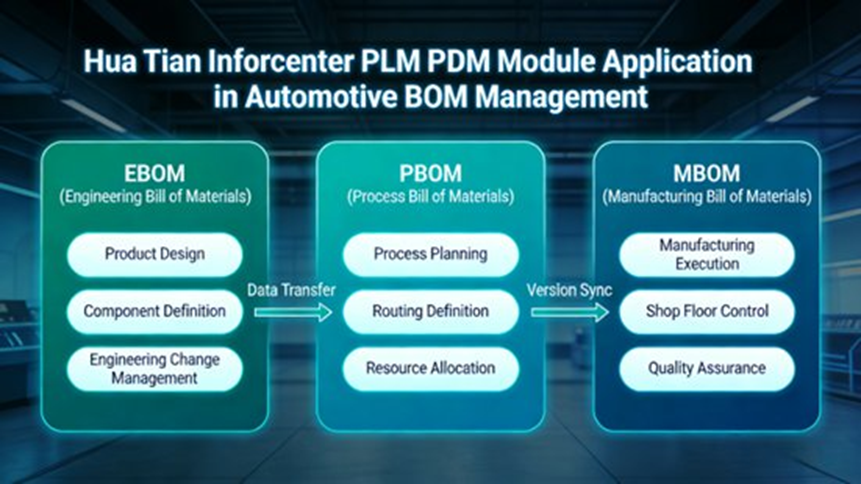
The most important automotive data object is the BOM. Hua Tian PLM supports full linkage and automatic conversion between:
- EBOM
- PBOM
- MBOM
This keeps data consistent from design through process planning and manufacturing. It reduces the risk of rework and cost waste caused by BOM mismatch. It is also a major reason why companies such as Suzhou Green Control Transmission used Hua Tian PLM to replace foreign software.
Full Traceability
The platform supports lifecycle traceability through a one-item-one-code logic. It can link:
- vehicle VIN
- part serial number
- design version
- supplier information
This gives companies a strong data base for product recall management and quality tracing. In automotive work, that means a company can trace a physical vehicle to a specific part, supplier, and design state.
Business Application Layer: Modules Built for Automotive Workflows
The business application layer is where Hua Tian PLM matches real automotive engineering work most closely. It supports development, process planning, production support, and supplier collaboration through four core modules:
- project management
- product data management (PDM)
- process design and management (CAPP)
- supply chain collaboration management
These modules cover the full lifecycle from demand intake and design development to production delivery and after-sales support.
Project Management Module: Full Control of Vehicle R&D Projects
Automotive R&D programs are long and complex. A new vehicle program usually takes 18 to 24 months and involves many teams across body, chassis, electronics, and powertrain.
Hua Tian PLM uses the project plan as the main control line and supports the full process:
- project initiation
- plan breakdown
- task execution
- dynamic monitoring
- project acceptance
It fits the automotive IPD model well.
Project managers can create templates based on standard vehicle development flows, such as:
- a new energy vehicle battery pack development template
- a traditional fuel vehicle chassis development template
These templates define:
- task nodes by phase
- responsible teams
- deliverable requirements
- time milestones
The system also supports layered task breakdown. A total project can be broken down into:
- system-level tasks
- component-level tasks
- part-level tasks
That gives every development step a clear owner.
The module includes a visual dashboard that can show:
- project progress
- task completion rate
- risk warnings
If an engine component design task is delayed, the system can issue a warning automatically and notify the related engineers and project manager. This helps avoid chain delays across the full project.
The module also supports performance tracking and deliverable management. It can count task completion by team and role, and it checks the completeness and standardization of deliverables such as design drawings and simulation reports. The report states that this can shorten automotive R&D cycles by about 30%.
PDM Module: Standardized Control of Automotive Core Data
Product data is one of the most important assets in automotive engineering. Hua Tian PLM’s PDM module covers four key areas:
- document and drawing management
- full-process BOM management
- version control
- change management
These functions address common problems such as data disorder, version confusion, and slow change handling.
Document and Drawing Management
The platform stores and controls:
- automotive part drawings
- 3D models
- technical specifications
- simulation reports
- other related files
It supports classification by:
- vehicle model
- subsystem
- part family
- single component
Users can search by keyword and structure, which avoids the problems caused by paper storage or scattered digital folders.
Version Control
Every change creates a new version while keeping historical records. Users can go back to any earlier version. For example, if a vehicle door design changes, the system records the before-and-after difference and keeps the process traceable. This helps prevent engineering errors caused by version mix-ups.
Full-Process BOM Management
This is one of the most important automotive functions in the whole platform. The system supports automatic transformation and linked updates across EBOM, PBOM, and MBOM.
A typical example is an automotive seat. Design engineers build the EBOM. Process engineers then use that EBOM to generate the PBOM and add:
- process routes
- tooling and equipment information
- other process data
Production teams can then build the MBOM from the PBOM for shop-floor use.
If a seat part changes in design, Hua Tian PLM can update the related EBOM, PBOM, and MBOM in a linked way. This reduces rework caused by inconsistent BOM data. The report notes that this can improve R&D efficiency by about 35%.
Change Management
Automotive programs often need design and process changes because of:
- market demand changes
- design defects
- regulatory updates
The system standardizes the change process through:
- change request
- review
- approval
- execution
- traceability
When a change request is raised, it is routed to related departments such as design, process engineering, and production. After approval, all affected teams and people are notified. The full process is recorded so the company can trace what changed, why, and who approved it.
This fixes common problems found in manual change handling:
- slow information flow
- incomplete impact coverage
- weak traceability
CAPP Module: The Link Between Design and Manufacturing
A good design is not always easy to manufacture. That is a long-standing issue in automotive engineering. Hua Tian PLM’s CAPP module is built to connect design work and manufacturing work more closely.
Its main functions include:
- process BOM management
- process route planning
- 3D process design
- tooling management
This supports a real design-manufacturing integration workflow.
Process BOM Management
The system can generate a process BOM from the PDM-managed EBOM. Process engineers then add manufacturing data such as:
- process responsibility split
- process-step information
- material consumption
That keeps the process BOM consistent with the design BOM.
Process Route Planning
For automotive parts such as:
- engine blocks
- transmission housings
the platform supports visual process route design. Engineers can drag and drop process steps, assign workstations, and select tooling and equipment. They can also simulate the process route, improve the sequence, remove extra operations, and lower manufacturing cost by about 25%.
3D Process Design and MBD
As MBD becomes more common in automotive engineering, the CAPP module supports 3D process planning directly from the PLM-managed 3D model.
Process engineers can create 3D work instructions and mark:
- process key points
- assembly requirements
- other operating details
These instructions can be sent to the workshop and shown on:
- mobile terminals
- shop-floor display screens
Because the guidance is visual and direct, front-line operator errors can drop and production efficiency can rise.
Tooling Management
The CAPP module also manages the full lifecycle of production tooling used in automotive manufacturing, including:
- tools
- fixtures
- molds
The system records:
- procurement
- use
- maintenance
- retirement
This helps keep tooling ready for production and supports schedule stability.
Supply Chain Collaboration Module: Linking OEMs and Suppliers
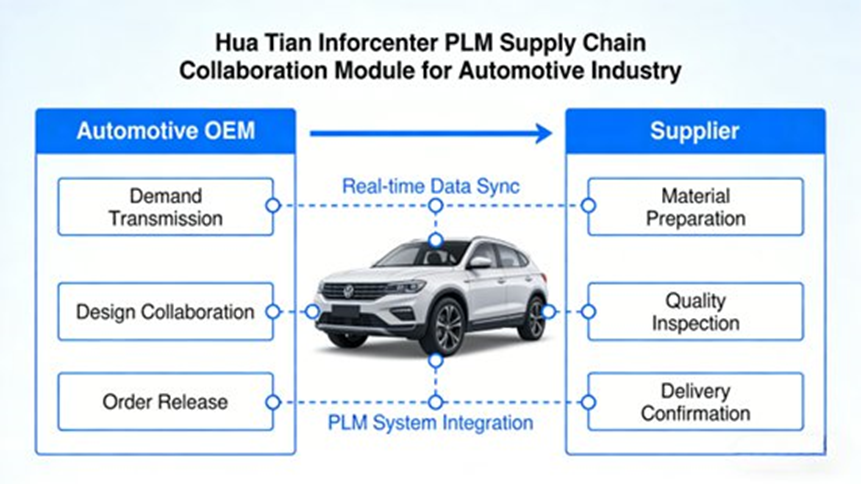
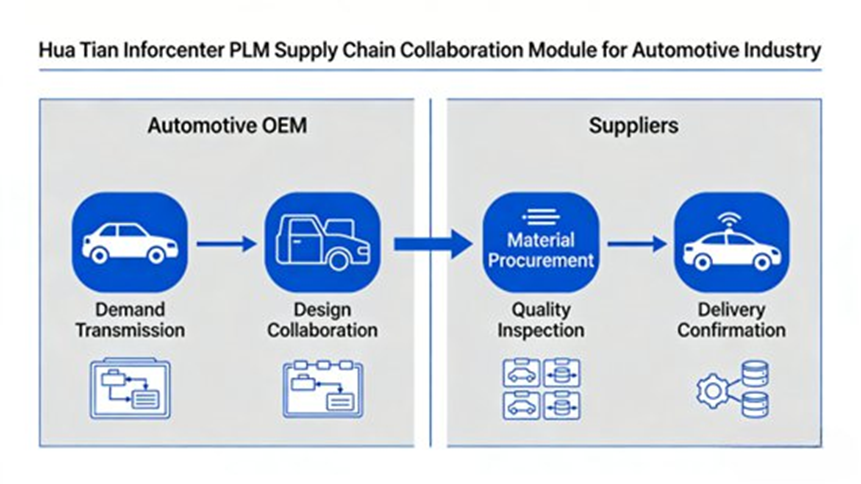
A vehicle depends on a large supplier network. Cost, quality, and delivery are all tied closely to how well that network is managed.
Hua Tian PLM includes a supplier collaboration management module that builds a supplier portal and extends the collaboration boundary beyond the enterprise.
Through permission control, an OEM can share selected data with selected suppliers, such as:
- part design drawings
- technical specifications
- specific design models
Suppliers can then:
- receive tasks online
- report issues
- submit deliverables
- take part in synchronized design and data exchange
A clear example is a seat system development project. The OEM can invite the seat supplier to take part early. The supplier can review the seat model and submit suggestions based on manufacturing experience, such as easier-to-build or lower-cost design choices. Those suggestions go back to the OEM design team through the system, which helps reduce late-stage design changes.
The module also supports supplier evaluation and management. It can record:
- delivery quality
- delivery cycle
- after-sales service
That gives the OEM data support for supplier selection and helps build a faster, more resilient automotive supply chain.
Collaboration and Integration Layer: Breaking Information Silos
Automotive digital environments include more than PLM. They also include:
- ERP
- MES
- FMEA
- OA
If these systems do not connect well, the result is information silos. Hua Tian PLM uses a collaboration and integration layer with standard interfaces to connect these systems and create data flow across the full chain from R&D, process, production, purchasing, and after-sales.
Examples include:
- BOM data from PLM can sync to ERP for purchasing plans
- process route data can go to MES for workshop execution
- FMEA reports can connect to PLM change workflows for earlier risk control
This helps turn PLM into the control center of the automotive digital toolchain rather than a simple document library.
Local Fit and Implementation Strength Compared with Foreign PLM Software
The report points to three main strengths of Hua Tian PLM compared with foreign PLM systems in automotive use.
1. Strong Local Fit
The platform supports a Chinese-language interface and local compliance needs, including:
- ISO 26262 functional safety
- ELV environmental regulations
It can also be customized for enterprise-specific needs. The report names these examples:
- a structured process CAPP system for Chery Automobile
- a super BOM management platform for Hubei Dayun Automobile
This addresses common complaints about foreign systems: weak local fit, hard customization, and slow response.
2. Lightweight and Efficient Use
The system runs through a pure web interface, with no local client installation required. It also supports mobile access, so engineers and process staff can browse data, approve tasks, and work together from different places.
A named case is Bohai Piston, where the paperless workshop function allowed process files to be released and viewed online. This reduced printing consumables by 80% and cut production management cost by 20%.
3. Better Cost Performance and Service
As a domestic software product, Hua Tian PLM has a price advantage. It also offers local implementation and after-sales service, which helps automotive enterprises solve rollout and use problems faster.
The report gives Suzhou Green Control Transmission as an example. After replacing foreign software, the company used Hua Tian PLM and its service support to complete the digital shift of its R&D process and solve difficult parts-development management problems.
Practical Value in Automotive Engineering
Hua Tian PLM brings clear value to automotive companies across R&D, manufacturing, supply chain work, and compliance control.
R&D Value
Unified data control and cross-team collaboration break information silos, shorten development time, raise efficiency, and reduce design changes and rework.
The report cites Chengdu Dayun, which used Hua Tian PLM to build a super BOM management platform. That cut the order submission time for expanded-configuration vehicle models from more than 4 hours to immediate order release.
Manufacturing Value
Digital and standardized process planning helps connect design and manufacturing, lowers manufacturing cost, and raises product quality.
The report cites Shandong Binzhou Bohai Piston, where paperless workshop functions created close process-to-production linkage and improved the quality and efficiency of workshop process work.
Supply Chain Value
Supplier collaboration helps OEMs and suppliers work together more smoothly. That improves supply chain agility and resilience, supports delivery stability, and lowers supply chain management cost.
Compliance and Risk Control Value
Lifecycle traceability and compliance-oriented management help make sure products meet industry rules, while lowering recall risk and legal risk.
Representative Enterprise Cases from the Report
The report names several companies and use cases that show Hua Tian PLM has already been applied in real automotive settings:
- Suzhou Green Control Transmission: replaced foreign software and upgraded parts R&D management
- Chery Automobile: implemented a customized structured process CAPP system
- Hubei Dayun Automobile: implemented a customized super BOM management platform
- Chengdu Dayun: used a super BOM platform to reduce expanded-configuration vehicle order time from more than 4 hours to immediate release
- Bohai Piston / Shandong Binzhou Bohai Piston: used paperless workshop functions to reduce printing consumables by 80% and save 20% of production management cost
These cases matter because they show adoption across different automotive business types and process stages.
Frequently Asked Questions About Automotive PLM
1. How do you manage the transition and synchronization from EBOM to MBOM?
Short answer: Use a PLM system that links EBOM, PBOM, and MBOM in one controlled flow.
In automotive programs, BOM consistency is a major issue. Engineering builds the design structure first, but process and manufacturing teams need a different structure based on routing, tooling, workstations, and production logic. If teams handle this by hand, they often run into data errors, repeat work, and version conflicts.
Hua Tian PLM supports full-process BOM linkage and automatic conversion across EBOM, PBOM, and MBOM. For example, after engineers finish the EBOM for an automotive seat, process engineers can create the PBOM from that structure and add process-related details such as routing and tooling. Manufacturing teams can then derive the MBOM for shop-floor use.
Because these BOM layers stay linked, design changes can flow through the related structures. That helps reduce manual re-entry, lower error risk, and keep the product definition consistent across design, process, and manufacturing.
2. What are the real-world challenges of integrating a PLM system with ERP and MES?
Short answer: The hard part is not only the interface. It is keeping data logic, versions, and process flow consistent across systems built for different jobs.
PLM handles engineering definition and lifecycle control. ERP handles enterprise planning and purchasing. MES handles manufacturing execution. If they do not connect well, companies get information silos, wrong BOM mapping, old data in production, and poor response on the shop floor.
Hua Tian PLM uses its collaboration and integration layer to connect with ERP, MES, FMEA, and OA through standard interfaces. In practice:
- BOM data can move from PLM to ERP for purchasing plans
- process route data can move from PLM/CAPP to MES for workshop work
- FMEA outputs can connect with design change workflows
This gives companies a better digital chain from engineering through production and after-sales support.
3. Cloud/SaaS PLM vs. on-premises: which is better for heavy automotive CAD assemblies?
Short answer: It depends on the company’s security rules, IT model, and collaboration needs.
Hua Tian PLM supports both cloud SaaS and on-premises deployment. That is useful because automotive companies vary a lot. Some want cloud access for faster rollout and distributed work. Others want on-premises control because of strict data security requirements for high-value engineering data such as battery packs, chassis systems, or powertrain designs.
For large CAD assemblies, teams usually care about three things:
- model loading performance
- data security
- access flexibility for multi-site teams
Hua Tian PLM’s B/S structure and SView lightweight 3D browser help with model loading and online review. SView supports CATIA, UG/NX, and Pro/E, and it allows fast viewing, markup, and version comparison. That makes both deployment models workable, with the final choice driven by enterprise needs.
4. How does MBD and 3D visualization improve shop-floor efficiency?
Short answer: It gives operators clearer instructions and cuts mistakes caused by reading complex 2D drawings.
Hua Tian PLM supports MBD-based 3D process planning through its CAPP module. Process engineers can use PLM-managed 3D models to create 3D work instructions with key process points, assembly requirements, and operating details marked directly on the model.
These instructions can be shown on:
- workshop display screens
- mobile terminals
That gives front-line workers more direct guidance, improves communication between engineering and production, lowers the chance of reading errors, and supports faster execution. The same CAPP environment also supports route simulation and process optimization, which can help reduce extra operations and lower manufacturing cost.
5. What is the best way to handle OEM-supplier collaboration without exposing proprietary IP?
Short answer: Share only the data a supplier needs, and control access by role and permission.
Automotive development needs close supplier cooperation, but OEMs still need to protect design IP, platform knowledge, and sensitive engineering information. Hua Tian PLM addresses this through its supplier collaboration portal and permission control system.
An OEM can give a supplier access only to selected content, such as:
- specific drawings
- technical specifications
- limited design models
Suppliers can then receive tasks, submit feedback, report issues, and upload deliverables without seeing broader data they do not need. A seat-system example in the report shows how a supplier can review a model early and suggest easier-to-build or lower-cost changes while the OEM keeps data boundaries in place.
Why Hua Tian PLM Matters in the Next Stage of Automotive Digital Work
The automotive industry is still moving deeper into electrification, intelligence, connectivity, and software-heavy product development. That raises the need for:
- tighter engineering collaboration
- stronger BOM control
- faster change handling
- closer design-to-manufacturing linkage
- safer supplier collaboration
- wider system integration
Hua Tian Inforcenter PLM supports this shift with a local product model that fits Chinese automotive enterprise needs in language, customization, cost, and support speed. It helps companies move toward:
- digital R&D
- standardized process work
- smarter production
- faster collaboration
It also helps reduce dependence on foreign PLM products in a field where local responsiveness matters.
Closing View
PLM sits at the center of the automotive digital toolchain. In the current industry shift, the quality of that PLM platform affects engineering speed, manufacturing control, supplier coordination, compliance support, and long-term competitiveness.
Hua Tian Inforcenter PLM covers the key pieces needed in automotive work:
- four-layer technical architecture
- browser-based access
- cloud and on-premises deployment
- SView lightweight 3D review
- role-based security control
- unified lifecycle data management
- EBOM, PBOM, and MBOM linkage
- VIN and serial-based traceability
- IPD-style project control
- PDM for drawings, models, versions, BOMs, and changes
- CAPP for process BOM, route planning, 3D work instructions, and tooling
- supplier collaboration portal
- integration with ERP, MES, FMEA, and OA
- local compliance fit and custom development support
- case-backed results across real automotive enterprises
From Suzhou Green Control Transmission to Chery Automobile, from Hubei Dayun to Chengdu Dayun, and from Bohai Piston to Shandong Binzhou Bohai Piston, the platform has already been used in multiple automotive settings. Those projects show that Hua Tian PLM is not just a software label. It is a working engineering system used to manage data, process, manufacturing links, and collaboration across the vehicle lifecycle.
