




< Back to Automotive Simulation Toolchain
Last Updated: March 12, 2026
Author: Johnny Liu
CEO, Dowway Vehicle
- Quick Answer
- Why Safety Simulation Matters in Vehicle Development
- What Is Simcenter Madymo?
- Core Simulation Architecture of Simcenter Madymo
- Human Body and Crash Dummy Models
- Simulating Vehicle Safety Systems
- Modeling and Optimizing Restraint Systems
- Integration with Automotive Engineering Tools
- Automated Simulation and Optimization
- Engineering Case Studies
- Latest Updates in Simcenter Madymo 2506
- Future Trends in Vehicle Safety Simulation
- Frequently Asked Questions About Simcenter Madymo
- Author
Quick Answer
Simcenter Madymo is a safety simulation software used in automotive engineering to model how people, crash dummies, airbags, and restraint systems behave during vehicle crashes. The software combines multibody dynamics, finite element simulation, and gas flow modeling in one solver so engineers can simulate occupant motion, airbag inflation, and injury risk during collisions.
- Simcenter Madymo is widely used for vehicle occupant safety simulation.
- The software combines multibody dynamics, finite element models, and gas flow simulation.
- Engineers use it to design airbags, seatbelts, seats, and head restraints.
- Madymo supports safety metrics used in NCAP crash tests.
- New versions improve injury prediction and simulation speed.
Why Safety Simulation Matters in Vehicle Development
Vehicle safety is one of the most important areas in automotive engineering. Manufacturers must meet strict safety regulations while keeping development time under control.
In the past, engineers relied mostly on physical crash tests. Each test required building a vehicle prototype and destroying it in a collision test. These tests are expensive and slow.
Today, many safety checks happen earlier in development through computer simulation.
One of the most widely used tools for this purpose is Simcenter Madymo, part of the Siemens engineering simulation portfolio.
Madymo allows engineers to simulate how human bodies and safety systems behave during collisions, which helps teams improve vehicle safety while reducing the number of physical crash tests.
What Is Simcenter Madymo?
Simcenter Madymo is a specialized engineering software used to simulate occupant and pedestrian safety during vehicle crashes.
The software began as MADYMO (Mathematical Dynamic Models) and later became part of the Siemens Simcenter simulation platform.
Madymo focuses on analyzing:
- human body motion during crashes
- crash dummy behavior
- vehicle restraint systems
- pedestrian impact safety
The software is widely used by:
- vehicle manufacturers
- safety system suppliers
- engineering research teams
Because its models are validated against real crash tests, Madymo has become a standard tool for restraint system development.
Core Simulation Architecture of Simcenter Madymo
Vehicle crashes involve several physical processes happening at the same time.
These include:
- rigid body motion
- structural deformation
- gas expansion in airbags
- contact and friction between components
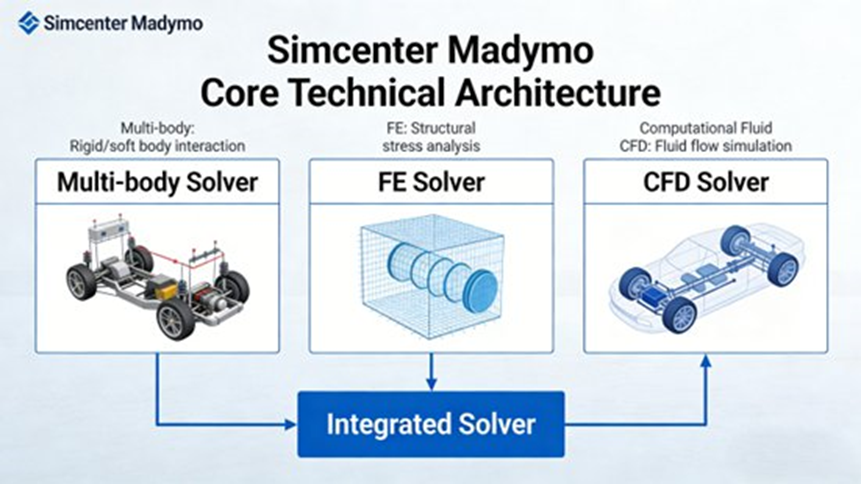
Madymo simulates these processes by combining three modeling approaches.
Multi-Body Dynamics (MB)
Multi-body dynamics models human body motion during crashes.
In this approach, the human body or crash dummy is represented as rigid body segments connected by joints.
This method allows engineers to simulate:
- occupant motion during impact
- head and torso movement
- interaction with seatbelts and airbags
Multi-body models are efficient to compute and useful for system-level safety analysis.
Finite Element Modeling (FE)
Finite element modeling represents structures that deform during a crash.
In Madymo this includes:
- airbag fabric
- seats and seat structures
- interior vehicle components
Finite element models capture:
- large deformation
- material response
- impact forces
This helps engineers understand how structures behave during a collision.
Gas Flow Simulation for Airbags (CFD)
Airbags inflate through rapid gas expansion.
Madymo simulates this process using gas flow modeling.
The software calculates:
- gas flow inside the airbag
- pressure distribution
- airbag inflation timing
These results show how airbags interact with the occupant during deployment.
Integrated Multiphysics Solver
Madymo combines MB, FE, and gas flow simulation in one solver.
During a crash simulation:
- MB calculates occupant motion
- FE calculates deformation of structures
- gas flow models calculate airbag inflation
Because all three run together, engineers can simulate complex crash scenarios with high realism.
Human Body and Crash Dummy Models
Predicting injury risk requires accurate human models.
Madymo includes a large database of validated crash dummy models and human body models.
Crash Dummy Models
Common dummy models in Madymo include:
- Hybrid-III (5th, 50th, 95th percentile)
- WorldSID side-impact dummy
- BioRID rear-impact dummy
- ES-2 side impact dummy
- child dummies such as Q-series and CRABI
These are the same dummy models used in global safety regulations and NCAP testing.
Human Body Biomechanical Models
Madymo also includes detailed human body models.
These simulate:
- joint motion
- muscle stiffness
- body segment interaction
The models help predict injury metrics such as:
- Head Injury Criterion (HIC)
- chest compression
- femur load
- neck injury risk
Adapting Human Models to Vehicle Interiors
Engineers can modify human models to match real vehicle conditions.
Adjustable parameters include:
- seat position
- seating posture
- joint stiffness
- seatbelt routing
This ensures the simulation reflects actual vehicle design conditions.
Simulating Vehicle Safety Systems
Madymo is widely used to study how safety systems interact with occupants during crashes.
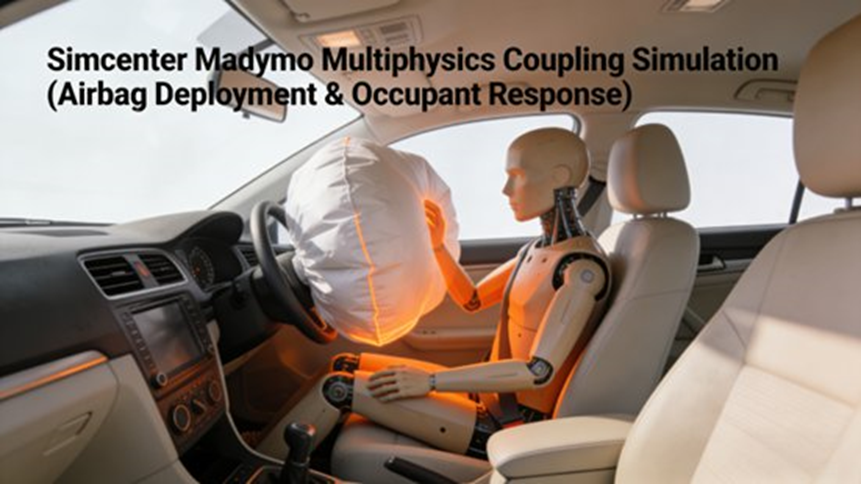
Airbag Deployment Simulation
Airbag simulation includes several steps:
- gas flow simulation for inflation
- finite element modeling for fabric deformation
- multi-body modeling for occupant interaction
Engineers analyze:
- inflation timing
- pressure levels
- contact position with occupants
Occupant Motion During Impact
Madymo tracks how occupants move inside the vehicle during a crash.
Key variables include:
- head motion
- chest movement
- leg motion
- secondary impact with interior structures
These results help engineers reduce injury risk.
Pedestrian Protection Simulation
Pedestrian safety is an important requirement in many regions.
Madymo simulations analyze:
- pedestrian motion during vehicle impact
- head contact with the hood
- leg contact with the bumper
Engineers evaluate injury indicators such as HIC and leg fracture risk.
Modeling and Optimizing Restraint Systems
Vehicle restraint systems help reduce injuries during crashes.
Madymo allows engineers to simulate these systems and improve their performance.
Seatbelt Simulation
Seatbelt models simulate:
- belt elongation
- force transfer
- occupant restraint forces
Pretensioners and Load Limiters
Modern seatbelts include:
- pretensioners that tighten belts at the start of a crash
- load limiters that control the force applied to the occupant
Madymo helps engineers determine optimal settings.
Airbag and Seat Interaction
Airbags must work together with seatbelts and seat geometry.
Simulations analyze:
- airbag inflation curves
- occupant posture interaction
- overall restraint performance
Headrest and Whiplash Protection
Rear-end collisions can cause whiplash injuries.
Madymo helps engineers evaluate headrest design and position to reduce neck injuries.
Integration with Automotive Engineering Tools
Vehicle safety development uses multiple simulation tools.
Madymo supports integration with many engineering platforms.
CAD Integration
Vehicle geometry can be imported from:
- Siemens NX
- CATIA
This reduces modeling time.
Coupling with Crash Solvers
Madymo can work with structural crash solvers such as:
- LS-DYNA
- PAM-CRASH
- Radioss
- Abaqus
Vehicle structure deformation can be simulated in these tools while Madymo simulates occupant behavior.
MATLAB and Simulink Integration
Madymo can also connect with MATLAB and Simulink.
This allows engineers to simulate:
- braking systems
- automatic emergency braking (AEB)
- activation timing of safety systems
Automated Simulation and Optimization
Madymo supports automated simulation workflows.
Parametric Modeling
Engineers can define parameters such as:
- airbag inflation speed
- seatbelt force limits
- occupant position
Design of Experiments (DOE)
DOE methods allow engineers to test many design configurations quickly.
Batch Simulation
Madymo can run large sets of simulations automatically.
For example, EDAG reduced human motion simulation time from several days to a few hours using automated workflows.
Engineering Case Studies
Active Hood for Pedestrian Protection
Active hood systems lift the hood during a pedestrian collision to reduce head injury risk.
Madymo simulations analyzed:
- pedestrian motion
- head impact timing
- hood activation mechanism
The hood had to deploy within 40–50 milliseconds before head contact.
Optimization reduced HIC values to meet Euro NCAP safety targets.
Intelligent Restraint System Optimization
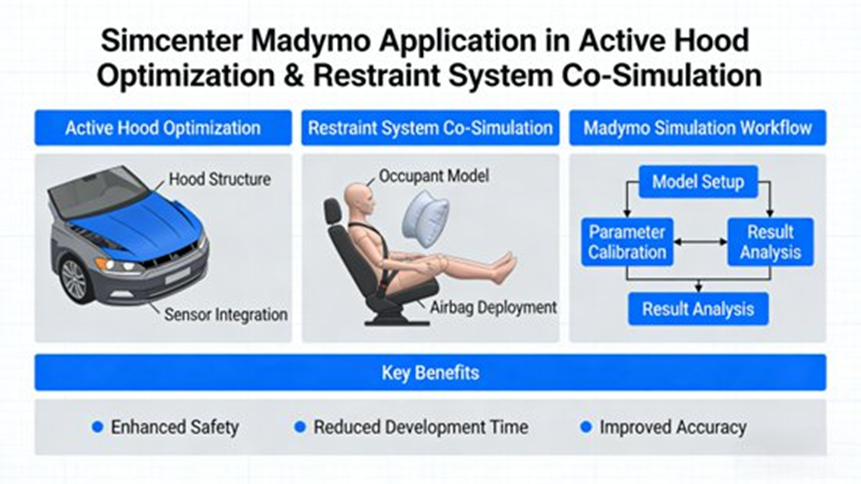
A vehicle manufacturer used Madymo to improve a coordinated restraint system including:
- seatbelts
- front airbags
- side airbags
- seats and headrests
Simulation results helped engineers adjust:
- seatbelt load limiter values
- airbag inflation curves
- headrest height and angle
Results included:
- C-NCAP five-star rating
- 80% fewer physical crash tests
- three months shorter development time
Latest Updates in Simcenter Madymo 2506
The newest version introduced several improvements.
Key updates include:
- updated injury risk models
- improved human body models
- faster solver algorithms
- GPU acceleration support
Madymo now uses a token-based licensing system that allows flexible access to software modules.
Future Trends in Vehicle Safety Simulation
Vehicle safety simulation continues to evolve.
Key directions include:
- AI-assisted simulation optimization
- digital twin models for vehicle safety systems
- electric vehicle battery crash safety analysis
- automated driving crash scenario evaluation
Frequently Asked Questions About Simcenter Madymo
What is Simcenter Madymo mainly used for?
Short answer:
Simcenter Madymo is mainly used to simulate how occupants and safety systems behave during vehicle crashes.
Engineers use the software to analyze airbag deployment, seatbelt forces, crash dummy motion, pedestrian impacts, and occupant injury risk. The integrated MB-FE-CFD solver allows realistic simulation of complex crash scenarios.
How does Madymo differ from tools like LS-DYNA or PAM-CRASH?
Short answer:
Madymo focuses on human body motion and restraint systems, while traditional crash solvers focus on vehicle structure deformation.
Madymo models occupant biomechanics and airbag deployment, while tools like LS-DYNA simulate structural crash behavior. Engineers often combine the two tools to simulate both vehicle deformation and occupant response.
How are crash dummy and human models used?
Short answer:
Madymo includes validated crash dummy and human body models used to predict injury risk.
These models simulate posture, joint stiffness, and interaction with safety systems. Engineers evaluate injury metrics such as HIC, chest compression, and femur load using these models.
How does licensing work in Simcenter Madymo?
Short answer:
Madymo uses a token-based licensing system.
Instead of buying separate licenses for each module, companies purchase a shared pool of tokens. Tokens are used for preprocessing, simulation runs, and post-processing tasks.
Can Madymo work with other engineering tools?
Short answer:
Yes. Madymo supports integration with several simulation tools.
These include LS-DYNA, PAM-CRASH, Radioss, Abaqus, MATLAB, and Simulink. Engineers can simulate vehicle structure, occupant biomechanics, and safety control systems within one workflow.
Author
Johnny Liu
CEO, Dowway Vehicle
Johnny Liu works in vehicle safety engineering and CAE simulation. His work focuses on automotive safety technologies, crash simulation workflows, and digital engineering tools used in vehicle development.
