



< Back to Automotive Simulation Toolchain
- 1. Introduction to Automotive NVH and Sound Simulation
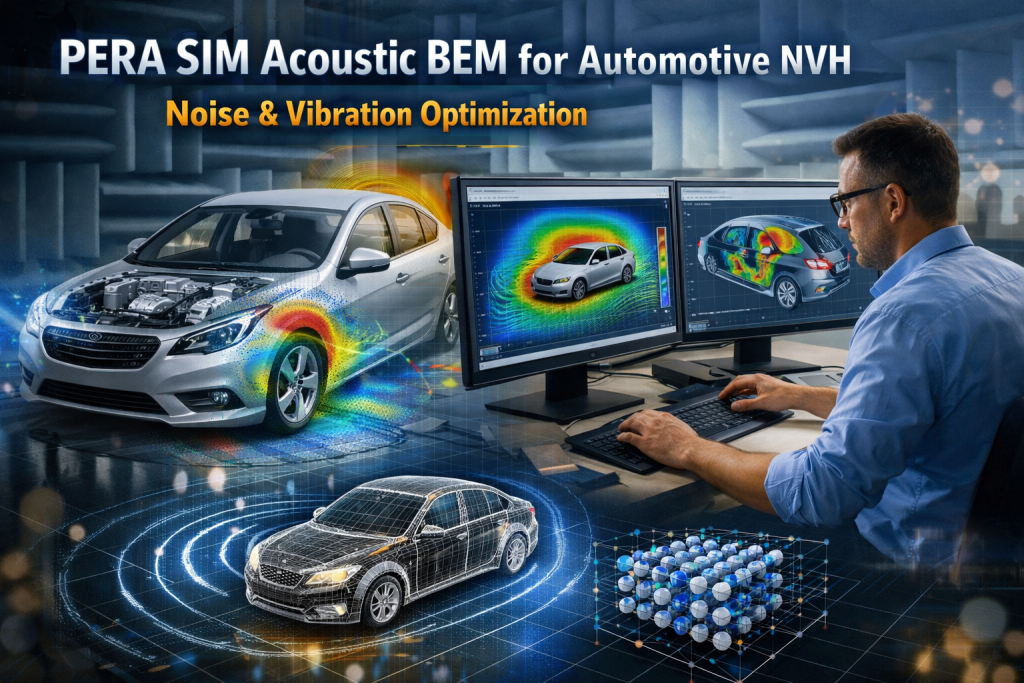
- 2. The Role of PERA SIM Acoustic BEM in Automotive NVH
- 3. Technical Principles Behind PERA SIM Acoustic BEM
- 4. Core Technologies and Features of PERA SIM Acoustic BEM
- 5. Applications of PERA SIM Acoustic BEM in Automotive Engineering
- 6. Engineering Case Studies and Results
- 7. Key Advantages of Using PERA SIM Acoustic BEM for NVH Engineering
- 8. Future Trends in Acoustic Simulation for Automotive NVH
- 9. Conclusion and Final Thoughts
- 10. FAQ (Frequently Asked Questions)
- 1. What is PERA SIM Acoustic BEM and how does it differ from traditional acoustic simulation tools?
- 2. How is PERA SIM Acoustic BEM applied in car NVH (Noise, Vibration & Harshness) analysis workflows?
- 3. What are common boundary conditions used with Acoustic BEM in automotive NVH simulations?
- 4. What is the relationship between PERA SIM Acoustic BEM and PERA SIM SimNVH?
- 5. What are current engineering community questions about NVH and acoustic simulation with tools like PERA SIM?
- 11. Author Bio
1. Introduction to Automotive NVH and Sound Simulation
Overview of NVH in the Automotive Industry
Noise, Vibration, and Harshness (NVH) play a major role in a vehicle’s overall comfort. As electric vehicles (EVs) become more common, achieving a quiet, smooth ride is becoming even more important. Manufacturers face pressure to reduce unwanted noise while maintaining efficiency and meeting regulatory standards.
Technological Advancements in Automotive Sound Simulation
To address these challenges, automotive engineers are turning to advanced simulation tools like PERA SIM Acoustic BEM. These tools replace traditional methods that rely on physical prototypes and road tests, helping engineers simulate, predict, and optimize sound levels early in the design process. This shift saves time, costs, and ensures better results.
2. The Role of PERA SIM Acoustic BEM in Automotive NVH
Introduction to PERA SIM Acoustic BEM
PERA SIM Acoustic BEM is a simulation tool developed by ANSYS Asia Pacific. It uses the Boundary Element Method (BEM) to predict and optimize noise and vibration in automotive designs. The tool allows engineers to simulate sound propagation, helping them design quieter vehicles.
Importance of BEM in Automotive Sound Design
Unlike traditional methods that mesh the entire vehicle model, BEM focuses only on the boundaries of the model, reducing computational complexity. This makes BEM especially useful for problems involving infinite spaces, such as external vehicle noise. It’s an ideal tool for managing the unique challenges of automotive NVH.
3. Technical Principles Behind PERA SIM Acoustic BEM
Understanding Acoustic Boundary Element Method (BEM)
The Helmholtz wave equation serves as the foundation for BEM, allowing for sound wave propagation and acoustic radiation to be modeled by analyzing only the boundaries of the vehicle. This leads to more efficient simulations compared to traditional methods.
The Role of Fast Algorithms in BEM Optimization
To speed up simulations, PERA SIM Acoustic BEM uses advanced algorithms like Fast Multipole Method (FMM) and Adaptive Cross Approximation (ACA). These algorithms reduce the time it takes to simulate complex noise problems, enabling engineers to handle larger models with more detail and accuracy than ever before.
4. Core Technologies and Features of PERA SIM Acoustic BEM
Advanced Features and Functionalities
The tool’s features include the ability to simulate low and high-frequency sounds in various automotive components, such as the engine, motor, and tires. Engineers can analyze sound pressure and frequency spectra, helping them refine vehicle designs.
Coupling with Other Physical Fields
One key feature of PERA SIM Acoustic BEM is its ability to work with other physical simulations, such as structural and electromagnetic simulations. This allows for holistic NVH analysis, where all factors influencing noise and vibration are considered, including vibrations in the car’s structure.
Pre-processing and Post-processing Capabilities
The tool supports the import of CAD models in formats like STEP and IGES, and integrates with major CAE software such as ANSYS and ABAQUS. Post-processing features enable engineers to visualize sound pressure levels, sound intensity, and frequency distributions, making it easier to identify noise sources and make design adjustments.
Acoustic Result Analysis and Optimization
Once simulations are complete, engineers can analyze results and make targeted adjustments to reduce noise. The post-processing tools help visualize and evaluate noise reduction strategies, such as altering the vehicle’s exterior design or adding acoustic dampening materials.
5. Applications of PERA SIM Acoustic BEM in Automotive Engineering
External Sound Field Noise Simulation and Optimization
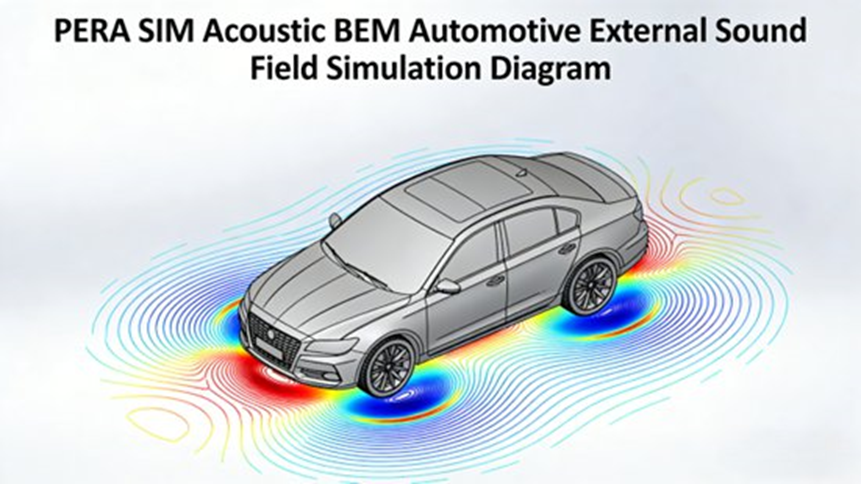
External noise from components like tires, engines, and wind affects overall vehicle NVH. PERA SIM Acoustic BEM helps engineers simulate the radiated noise from these components. This allows for early identification of noise sources and provides a basis for design optimizations to reduce unwanted sounds.
Vehicle Interior Acoustic Analysis
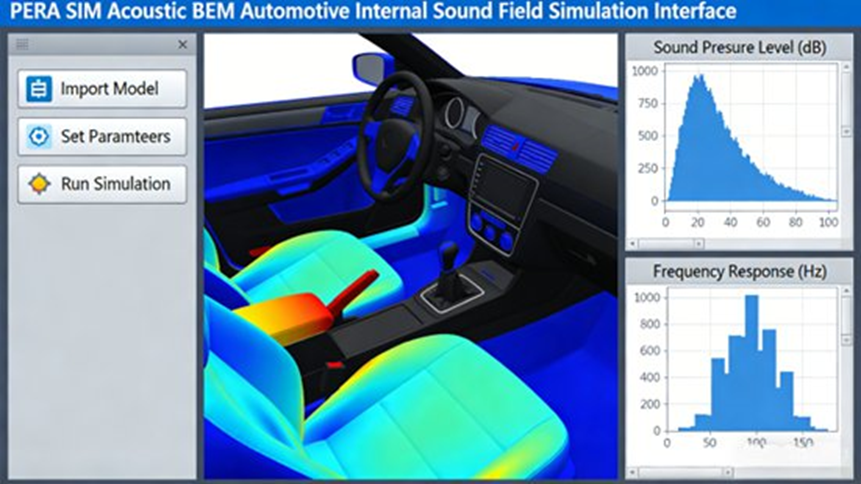
For electric vehicles (EVs), which have fewer internal noise sources compared to traditional cars, managing interior noise is even more critical. PERA SIM Acoustic BEM simulates how sound waves travel through the cabin, allowing for design adjustments that improve passenger comfort by reducing unwanted cabin noise.
Optimizing Automotive Components for Acoustic Performance
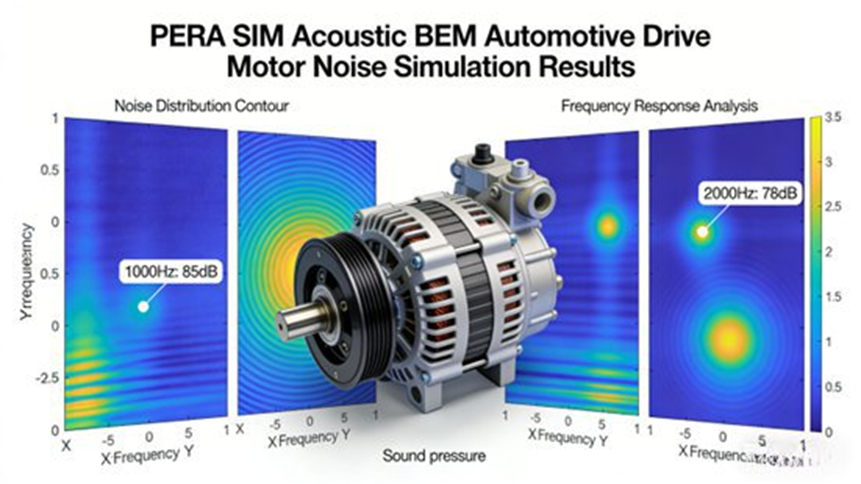
The tool can also simulate and optimize individual components, such as motors, exhaust systems, and wheel hubs. For example, when analyzing electric motor noise, the software helps engineers modify components to reduce noise levels, crucial in the EV market.
Performance of the Tool in Real-World Scenarios
The tool’s accuracy has been validated by comparing simulation results with real-world tests, with deviations typically less than 1 dB. This ensures that the tool provides reliable predictions that align closely with physical test data.
6. Engineering Case Studies and Results
Case Study 1: External Noise Simulation for Passenger Vehicle
During a 60 km/h test, PERA SIM Acoustic BEM helped engineers identify that the noise peak came from the engine bay. After optimizing the engine intake design and adding sound-damping materials, the noise was reduced by 5 dB, bringing it within regulatory limits.
Case Study 2: Optimizing Electric Motor Noise
For an electric vehicle, the tool helped optimize the motor casing and vibration damping, resulting in a significant reduction in motor noise, ensuring a quieter ride.
7. Key Advantages of Using PERA SIM Acoustic BEM for NVH Engineering
Superior Computational Efficiency
Thanks to FMM and ACA, PERA SIM Acoustic BEM offers fast computation speeds, enabling engineers to handle more complex simulations in less time. This makes it a cost-effective solution for automotive NVH optimization.
Flexibility in Multiphysics Simulation
The ability to couple acoustic simulations with structural and electromagnetic simulations makes PERA SIM Acoustic BEM an ideal solution for multiphysics NVH challenges, ensuring a comprehensive approach to vehicle noise optimization.
Cost-Effectiveness in Reducing Physical Prototyping
With virtual simulations, the need for physical prototypes is reduced, which translates to savings in both time and money. Engineers can test and optimize designs virtually, cutting down the cost of physical testing.
8. Future Trends in Acoustic Simulation for Automotive NVH
Advancements in AI and Real-Time Simulation
In the future, AI integration could enable real-time simulation adjustments, allowing engineers to optimize designs instantly and reduce the need for lengthy iterations.
Integration with Digital Twin Technology
Digital twins will allow for continuous data exchange between physical prototypes and digital models, ensuring that simulations stay aligned with real-world data for continuous optimization.
The Impact of Electrification on NVH Challenges
As the automotive industry shifts toward electric mobility, new NVH challenges are emerging. PERA SIM Acoustic BEM is continually evolving to address these challenges, helping ensure EVs meet noise comfort standards.
9. Conclusion and Final Thoughts
PERA SIM Acoustic BEM is an essential tool for automotive engineers looking to optimize NVH performance. It provides highly accurate simulations that help engineers create quieter, more comfortable vehicles. As the industry evolves, PERA SIM Acoustic BEM will continue to be a key player in improving vehicle acoustics.
10. FAQ (Frequently Asked Questions)
1. What is PERA SIM Acoustic BEM and how does it differ from traditional acoustic simulation tools?
Answer:
PERA SIM Acoustic BEM is an advanced simulation tool that uses Boundary Element Method (BEM) to predict and optimize noise and vibration. Unlike traditional methods, it focuses only on the boundaries of the problem, making it more efficient for large-scale automotive NVH challenges.
2. How is PERA SIM Acoustic BEM applied in car NVH (Noise, Vibration & Harshness) analysis workflows?
Answer:
PERA SIM Acoustic BEM is used in workflows for exterior noise prediction, interior acoustic response simulations, and component-level analysis. It allows engineers to simulate, analyze, and optimize noise from tires, engines, and other components.
3. What are common boundary conditions used with Acoustic BEM in automotive NVH simulations?
Answer:
The most common boundary conditions used are Dirichlet (pressure), Neumann (normal velocity), and Robin (impedance), which represent various sources like engine vibrations, tire surface motions, and material impedance layers.
4. What is the relationship between PERA SIM Acoustic BEM and PERA SIM SimNVH?
Answer:
While PERA SIM Acoustic BEM focuses on acoustic simulation, PERA SIM SimNVH provides a broader NVH solution that includes vibration and noise propagation analysis. Both tools are often used together for comprehensive NVH analysis.
5. What are current engineering community questions about NVH and acoustic simulation with tools like PERA SIM?
Answer:
Common questions include optimizing NVH models for EV drivetrains, coupling structural vibration results with acoustic simulations, and validating simulation outcomes using real-world data.
11. Author Bio
Johnny Liu, CEO at Dowway Vehicle
With over 20 years of experience in the automotive industry, Johnny Liu is a recognized expert in vehicle design and NVH optimization. As the CEO of Dowway Vehicle, Johnny leads a team of engineers who are at the forefront of acoustic innovation in the automotive industry.
Last Updated: March 2026
