





< Back to Automotive Simulation Toolchain
Author: Johnny Liu, CEO at Dowway Vehicle
Published: March 16, 2026
Last Updated: March 16, 2026
Reviewer Stamp: Reviewed for technical consistency and automotive engineering applicability
Jurisdiction / Industry Context: Automotive engineering and CAE workflow context, with emphasis on domestic automotive R&D adoption in China
High-frequency electromagnetic simulation software has become essential in automotive engineering because modern vehicles now depend on radar, onboard antennas, connected communication systems, EMC performance, high-frequency heating modules, and RF connectors that all operate in increasingly complex electromagnetic environments. MxSim.HFEM, the high-frequency electromagnetic module in the MxSim CAE suite, is designed to solve these problems with high-order finite element technology, adaptive mesh refinement, full-wave Maxwell solving, and multiphysics coupling tailored to real automotive workflows.
- MxSim.HFEM is a full-wave high-frequency electromagnetic simulation tool built for automotive engineering scenarios.
- It uses high-order finite element methods, including high-order vector basis functions up to 8th order, to improve accuracy and reduce computational cost.
- It supports 100 MHz to 100 GHz simulation for automotive applications such as vehicle antennas, EMC, high-frequency heating, and high-frequency connectors.
- It includes adaptive local mesh refinement, field-circuit coupling, and integration with other MxSim modules for electromagnetic-thermal-structural collaboration.
- Its Chinese interface, localized material library, automotive workflow fit, and cost-effectiveness make it a strong domestic CAE option.
- A detailed 77 GHz millimeter-wave radar antenna case shows how the software helps validate gain, VSWR, and installation performance before repeated physical prototyping.
Modern automotive R&D is no longer limited to structural durability, thermal management, and low-voltage electronics. High-frequency electromagnetic behavior now shapes safety, connectivity, comfort, and product validation cost. That shift is exactly why antenna simulation software and high-frequency EM analysis tools are becoming central to the automotive CAE toolchain.
- Why Are High-Frequency Electromagnetic Problems Now a Core Automotive R&D Issue?
- What Is MxSim.HFEM?
- Why Does MxSim.HFEM Matter in the Automotive Toolchain?
- How Does MxSim.HFEM Work?
- What Makes the High-Order Finite Element Method So Important?
- How Does Adaptive Local Mesh Refinement Improve Automotive EM Simulation?
- How Does MxSim.HFEM Support Field-Circuit Coupling and Multiphysics Collaboration?
- What Core Functions Does the Chinese Version of MxSim.HFEM Offer?
- Does it support the full automotive high-frequency range?
- Does it support parametric and frequency sweep analysis?
- What boundary conditions and excitation types are supported?
- What makes the Chinese interface important?
- Does it include an automotive material library?
- What post-processing outputs are available?
- What Automotive Engineering Problems Can MxSim.HFEM Solve?
- 1) How Does MxSim.HFEM Support Vehicle Antenna Design and Performance Simulation?
- 2) How Does MxSim.HFEM Support Automotive EMC Simulation?
- 3) How Does MxSim.HFEM Support High-Frequency Heating Module Simulation?
- 4) How Does MxSim.HFEM Support High-Frequency Connector Electrical Performance Simulation?
- Why Is MxSim.HFEM Especially Suitable for Automotive Engineering?
- What Does a Real Automotive Engineering Workflow in MxSim.HFEM Look Like?
- Case Study: 77 GHz Automotive Millimeter-Wave Radar Antenna Simulation
- Step 1: How Are the Model and Geometry Prepared?
- Step 2: How Are Mesh and Boundary Conditions Set Up?
- Step 3: How Is the Solver Configured?
- Step 4: How Are Results Post-Processed and Evaluated?
- What Were the Final Case Results?
- How Does MxSim.HFEM Compare with Imported Tools Such as HFSS and CST?
- What Is the Broader Engineering and Business Value for Automotive Companies?
- What Are the Most Common Questions About MxSim.HFEM?
- 1) What makes HFEM better for high-frequency electromagnetic simulation?
- 2) How does MxSim.HFEM compare with Ansys HFSS or CST?
- 3) What automotive engineering problems can MxSim.HFEM solve?
- 4) How does adaptive mesh refinement improve efficiency?
- 5) How does MxSim.HFEM support multiphysics simulation in automotive design?
- Key Takeaways
- What Does the Report Conclude About MxSim.HFEM?
- What Is the Future Outlook for MxSim.HFEM?
- Final Conclusion
- Author Bio
Why Are High-Frequency Electromagnetic Problems Now a Core Automotive R&D Issue?
High-frequency electromagnetic problems have become a core bottleneck in modern automotive development because the industry is moving rapidly toward electrification and intelligence. As vehicles integrate more radar systems, 5G and V2X antennas, infotainment modules, high-voltage fast-charging components, and high-speed connectors, electromagnetic wave propagation, radiation, scattering, and coupling all become harder to predict through physical testing alone.
In practical automotive engineering, these problems directly affect:
- communication quality
- sensing accuracy
- electromagnetic compatibility
- passenger comfort
- system reliability
- development cycle time
- validation cost
Traditional imported simulation workflows have helped address many of these issues, but they also introduce familiar pain points: high software licensing cost, limited localization, weak fit with domestic automotive development standards, and slower adaptation to local engineering processes. That is one reason domestic CAE tools such as MxSim.HFEM are gaining strategic importance.
What Is MxSim.HFEM?
MxSim.HFEM is the high-frequency electromagnetic simulation module in the broader MxSim CAE platform. Its core positioning is very clear: it is a high-precision full-wave simulation tool for high-frequency electromagnetic analysis in automotive engineering.
Unlike generic simulation tools that require heavy manual adaptation, MxSim.HFEM is presented as part of an automotive toolchain, with particular focus on:
- communication antenna design
- electromagnetic compatibility analysis
- waveguide and resonant device simulation
- high-frequency heating simulation
- connector electrical performance analysis
The Chinese version is especially important because it is not merely a translated interface. It is a localized engineering product designed to better match domestic automotive R&D workflows, engineering review processes, and reporting needs.
Why Does MxSim.HFEM Matter in the Automotive Toolchain?
MxSim.HFEM matters because high-frequency electromagnetic issues are no longer secondary design concerns. They now sit at the center of multiple vehicle subsystems.
In automotive development, the software can help teams:
- validate RF and radar performance earlier
- optimize antenna and connector design before hardware testing
- reduce EMC risks before certification or validation
- improve installation decisions for body-integrated components
- shorten iteration cycles
- lower prototype and testing cost
- reduce dependence on imported CAE tools
This is why the report positions MxSim.HFEM as a core domestic support technology for solving high-frequency electromagnetic problems in automotive engineering.
How Does MxSim.HFEM Work?
The technical system of MxSim.HFEM is built around three main pillars:
- high-order finite element solving
- adaptive local mesh refinement
- field-circuit coupling and multiphysics collaboration
These are the technical foundations that allow the tool to solve complex automotive high-frequency EM problems efficiently and accurately.
What Makes the High-Order Finite Element Method So Important?
MxSim.HFEM is based on the High-Order Finite Element Method (HFEM), which is particularly suited for high-frequency electromagnetic problems, typically 100 MHz and above.
This is a major distinction. Traditional low-frequency electromagnetic simulation often relies on low-order finite element formulations, which can struggle to maintain both efficiency and accuracy in high-frequency wave problems. Automotive radar, onboard antennas, and RF connectors require full-wave treatment because they involve:
- electromagnetic wave propagation
- scattering
- radiation
- coupling
- resonance behavior
MxSim.HFEM solves these problems using a full-wave discretized form of Maxwell’s equations, making it appropriate for realistic vehicle RF and electromagnetic scenarios.
How do high-order vector basis functions improve accuracy?
One of the report’s most important technical details is that MxSim.HFEM uses high-order vector basis functions, with support up to 8th order.
This matters because high-order basis functions can represent complex electromagnetic field variation more accurately with fewer mesh elements than traditional low-order formulations. That is especially useful in automotive engineering, where components such as radar antennas, body structures, connectors, and dielectric covers create highly nonuniform field behavior.
What are the performance benefits of the high-order approach?
According to the report, compared with traditional low-order methods, MxSim.HFEM can deliver the following under the same simulation accuracy target:
- more than 60% fewer elements
- 5–10× faster convergence
That means engineers can solve large, complex automotive high-frequency models with lower computational burden while still maintaining industrial-grade accuracy.
What supports the solver at the mathematical level?
The report also states that MxSim.HFEM uses a self-developed large sparse matrix direct solver library. This is important because it positions the software as having an independent numerical foundation rather than relying entirely on third-party solver infrastructure.
In engineering terms, this supports:
- better solver autonomy
- lower technical risk compared with imported dependencies
- strong large-scale equation solving performance
- higher confidence for industrial deployment
How Does Adaptive Local Mesh Refinement Improve Automotive EM Simulation?
Automotive high-frequency EM models are rarely simple. They often contain:
- antenna arrays
- thin body gaps
- complex connector details
- electronic packaging
- plastic covers
- bumper surfaces
- locally sharp geometric features
A uniform mesh across the whole model would either be too coarse in critical regions or too expensive overall.
MxSim.HFEM addresses this with adaptive local mesh refinement. The software automatically refines the mesh in regions where electromagnetic field gradients are large, such as:
- antenna radiation sources
- body gaps
- connector interfaces
- localized structural features
At the same time, it coarsens the mesh where field distribution is smoother. This creates a better balance between accuracy and efficiency.
Why is this important for engineers?
This automatic refinement reduces the need for manual mesh tuning. It lowers the barrier for engineers, shortens setup time, and reduces the risk of human error caused by inefficient or inconsistent mesh strategies.
The report also notes that MxSim.HFEM supports:
- automatic high-order mesh generation
- mesh editing
- compatibility with multiple mainstream mesh formats
This is important because automotive CAE work often begins with imperfect CAD or intermediate simulation models that need cleanup and adaptation before solving.
How Does MxSim.HFEM Support Field-Circuit Coupling and Multiphysics Collaboration?
Automotive high-frequency electromagnetic problems rarely exist in isolation.
For example:
- antenna radiation depends on circuit excitation
- electromagnetic loss can create heat
- temperature changes can affect performance and reliability
- structural packaging can influence EM distribution
That is why MxSim.HFEM includes field-circuit coupling capability and integrates with other MxSim modules, including:
- MxSim.Emag
- MxSim.Multiphy
This allows engineers to perform high-frequency electromagnetic–circuit–thermal–structural collaborative simulation.
What does this mean in practical automotive use?
It allows the software to model real operating conditions, such as:
- coupling between radar antenna radiation and circuit excitation
- electromagnetic-thermal coupling in high-frequency heating modules
- realistic behavior of high-frequency devices in vehicle environments
- broader system-level assessment before hardware testing
This multiphysics capability is one of the reasons the software fits automotive workflows better than narrow single-domain solvers.
What Core Functions Does the Chinese Version of MxSim.HFEM Offer?
The Chinese version of MxSim.HFEM is optimized for automotive engineering workflows while preserving the underlying solver capability. Its value is not only technical but also operational.
Does it support the full automotive high-frequency range?
Yes. The report states that MxSim.HFEM supports 100 MHz to 100 GHz simulation. This covers all major automotive high-frequency scenarios, including:
- 24 GHz automotive radar
- 77 GHz automotive radar
- Sub-6 GHz 5G / connected vehicle systems
- FM / AM in-vehicle communication and infotainment RF analysis
- other high-frequency electronic applications in automotive programs
Does it support parametric and frequency sweep analysis?
Yes. The software supports multi-frequency analysis and parametric solving, allowing engineers to study how simulation results change with:
- frequency
- geometric parameters
- material parameters
This is essential during automotive R&D because many design decisions are iterative. Engineers often need to compare small changes in:
- antenna dimensions
- installation position
- dielectric covers
- connector geometry
- material selection
Parametric sweep capability helps speed up this optimization process.
What boundary conditions and excitation types are supported?
MxSim.HFEM includes high-frequency simulation boundary conditions that fit automotive applications, including:
- absorbing boundary
- radiation boundary
- periodic boundary
It also supports multiple excitation types:
- voltage excitation
- current excitation
- plane-wave excitation
This allows the tool to model realistic high-frequency automotive environments involving:
- onboard antennas
- radar modules
- electromagnetic interference sources
- body-integrated RF components
What makes the Chinese interface important?
The report emphasizes the value of the fully Chinese interface because it reduces the learning barrier for domestic engineers and aligns better with local operating habits.
This matters in practice because it improves:
- training efficiency
- adoption speed
- day-to-day usability
- cross-team communication
The software also supports simulation report generation aligned with domestic automotive industry workflows, making results easier to use in development acceptance, review, and decision-making.
Does it include an automotive material library?
Yes. The Chinese version includes common automotive material data such as:
- body steel sheet
- glass
- plastics
- high-frequency dielectric materials
This helps engineers avoid repetitive manual material entry and speeds up model setup.
What post-processing outputs are available?
The report lists strong post-processing capability with outputs including:
- electric field distribution
- magnetic field distribution
- power density
- S-parameters
- radiation patterns
These can be displayed in:
- contour maps
- curves
- animations
This makes it easier for engineers to interpret high-frequency electromagnetic phenomena and compare simulation output with measurement data.
The report further states that comparison with commercial software can stay within 5% error, which it presents as sufficient for industrial automotive calculation requirements.
What Automotive Engineering Problems Can MxSim.HFEM Solve?
The report highlights four core automotive application scenarios. These are essential because they show where the software creates direct engineering value.
1) How Does MxSim.HFEM Support Vehicle Antenna Design and Performance Simulation?
MxSim.HFEM supports the design and simulation of many automotive antenna types, including:
- 5G onboard antennas
- GPS antennas
- FM antennas
- radar antennas
It can analyze key performance parameters such as:
- radiation pattern
- gain
- VSWR
- efficiency
It can also optimize antenna installation location on the vehicle body, helping engineers reduce performance degradation caused by:
- body structure
- surrounding components
- installation angle
- installation distance
- integrated package constraints
This helps solve common engineering issues such as weak signal quality or excessive interference caused by poor antenna placement.
2) How Does MxSim.HFEM Support Automotive EMC Simulation?
Automotive EMC problems are expensive when discovered late. High-frequency modules such as radar, antennas, and fast-charging systems can create unexpected electromagnetic coupling paths across the vehicle.
MxSim.HFEM can simulate:
- electromagnetic interference between high-frequency components
- electromagnetic susceptibility behavior
- impact of body gaps on EMC performance
- impact of harness or cable layout on EMC behavior
- hidden EMC risks before physical testing
This allows engineering teams to optimize structure and component layout earlier, reducing the chance of failing automotive EMC validation later in the program.
The report specifically notes that this is useful for supporting domestic EMC testing standard needs.
3) How Does MxSim.HFEM Support High-Frequency Heating Module Simulation?
The software can also be used for automotive high-frequency heating modules, including:
- seat heating
- steering wheel heating
In these scenarios, MxSim.HFEM can analyze:
- electromagnetic field distribution
- heating efficiency
- temperature distribution
This helps engineers optimize module structure and power parameters so they can balance:
- heating uniformity
- energy efficiency
- comfort
- control of high-frequency electromagnetic radiation
This is also a good example of why EM-thermal coupling matters in automotive design.
4) How Does MxSim.HFEM Support High-Frequency Connector Electrical Performance Simulation?
Modern vehicles increasingly rely on high-frequency connectors for intelligent and connected functions. MxSim.HFEM can simulate the electrical behavior of:
- automotive Ethernet connectors
- RF connectors
The report says it can analyze:
- contact sensitivity
- signal transmission loss
- electromagnetic leakage
This supports better connector structure design, helping engineers reduce attenuation and interference during high-frequency signal transmission and protect signal stability in increasingly data-heavy vehicle systems.
Why Is MxSim.HFEM Especially Suitable for Automotive Engineering?
The report consistently shows that MxSim.HFEM is not just technically capable. It is specifically adapted to automotive engineering needs.
Its suitability comes from four combined strengths:
1. Automotive scenario alignment
The software is built around real automotive use cases rather than generic RF theory alone.
2. Engineering workflow localization
Its Chinese-language interface, material library, and domestic workflow fit reduce friction for engineering teams.
3. Cost and service advantage
As a domestic CAE tool, it avoids the heavy licensing cost and slower offshore support structure common with imported tools.
4. Ecosystem continuity
Because it works with the wider MxSim platform, it supports smoother multiphysics and toolchain continuity.
This makes it particularly valuable not only for large OEMs, but also for small and medium-sized automotive enterprises and parts suppliers, which the report specifically highlights as likely beneficiaries.
What Does a Real Automotive Engineering Workflow in MxSim.HFEM Look Like?
To validate the engineering practicality of MxSim.HFEM, the report provides a detailed case study involving a 77 GHz automotive millimeter-wave radar antenna. This case is especially useful because it shows the actual workflow step by step.
Case Study: 77 GHz Automotive Millimeter-Wave Radar Antenna Simulation
What is the background of the case?
The example uses a 77 GHz millimeter-wave radar antenna intended for smart driving functions such as:
- adaptive cruise control
- automatic emergency braking
The simulation goals are to:
- analyze the antenna radiation pattern
- evaluate gain
- evaluate VSWR
- confirm whether performance meets intelligent driving sensing requirements
- study the effect of installation on the vehicle body
- optimize the antenna installation position
The target thresholds are clearly stated:
- gain ≥ 15 dBi
- VSWR ≤ 1.5
Step 1: How Are the Model and Geometry Prepared?
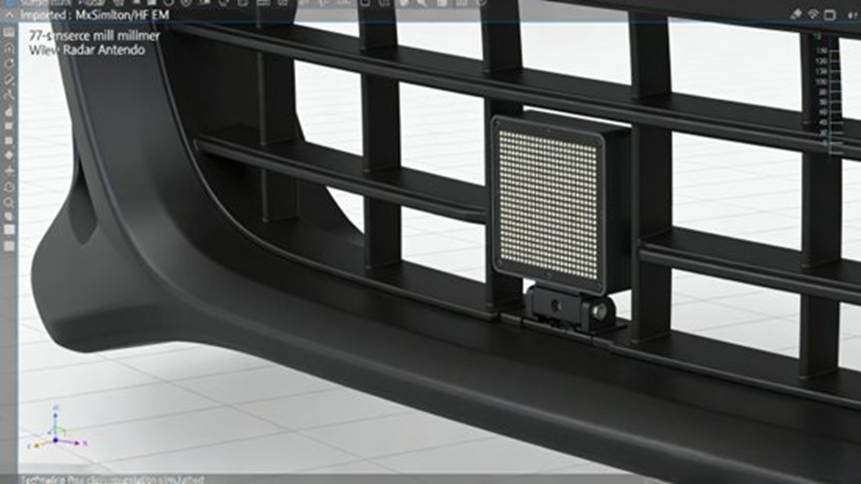
The workflow begins in the preprocessing module of the Chinese version of MxSim.HFEM.
What model files are imported?
The user imports the 3D radar antenna model through File → Import. The report states that multiple formats are supported, including:
- .mx
- .fem
- .bdf
At the same time, a simplified model of the vehicle front bumper is imported to simulate the real installation environment of the antenna.
How is the geometry cleaned?
MxSim’s built-in geometry cleanup function is used to remove:
- redundant faces
- tiny features
- unnecessary geometric detail
This reduces model complexity and improves simulation efficiency.
What materials are defined?
The report provides specific material definitions:
- antenna radiating element: copper
- conductivity: 5.8 × 10^7 S/m
- bumper material: PP plastic
- relative permittivity: 2.3
- loss tangent: 0.005
These parameters can be called directly from the automotive material library rather than being entered manually.
Step 2: How Are Mesh and Boundary Conditions Set Up?
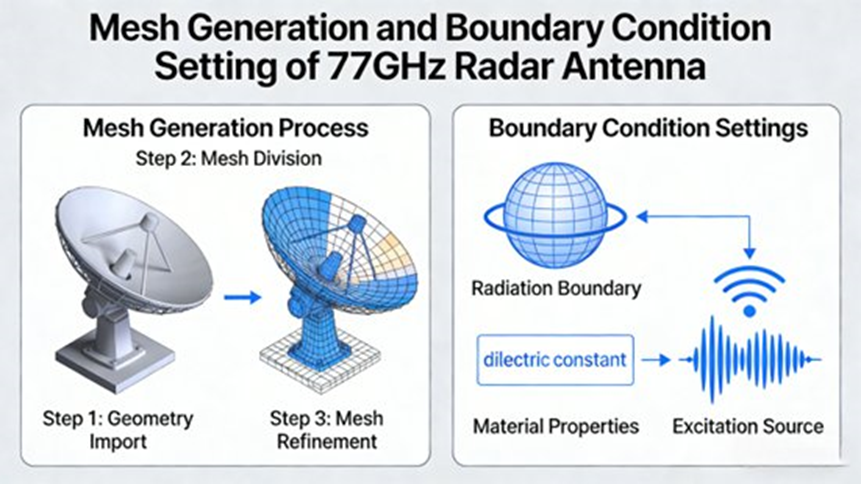
The next step is to enter the meshing module and select adaptive mesh generation.
What mesh settings are used in the case?
The report sets the mesh accuracy level to high precision. The software automatically refines and optimizes the mesh based on the complexity of the antenna and bumper structure.
Specific mesh sizes are given:
- antenna radiating element mesh size: 0.5 mm
- bumper mesh size: 5 mm
This reflects the need for much finer local resolution around the radiating structure in a 77 GHz scenario.
What excitation is used?
At the antenna radiating port, the report uses:
- voltage excitation
- frequency: 77 GHz
- amplitude: 1 V
What boundary condition is used?
The outer model boundary is set to an absorbing boundary to simulate free-space electromagnetic propagation and avoid reflections contaminating the result.
What solution domain is used?
The solution domain is defined as a spherical region with a radius of 1 meter, centered on the antenna, so the main radiation zone is fully captured.
Step 3: How Is the Solver Configured?
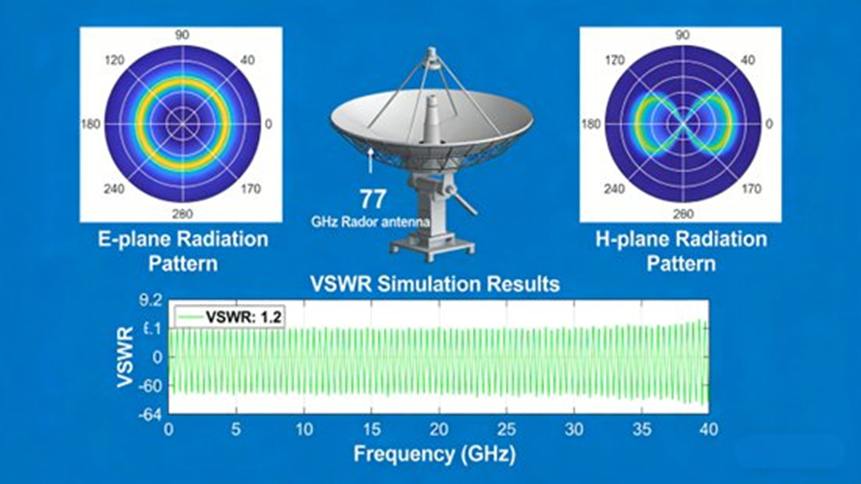
In the solver settings module, the user selects high-frequency full-wave solving.
What frequency range is analyzed?
The report specifies:
- frequency band: 76–78 GHz
- sweep step: 0.1 GHz
This ensures the software captures performance variation around the 77 GHz operating region.
What solver settings are used?
The case uses:
- MxSim’s self-developed high-order solver
- convergence precision: 1e-6
- CPU/GPU heterogeneous parallel computing
The report further states that the example uses a single RTX 3090 GPU, significantly shortening computation time.
What happens during computation?
After confirming all settings, the user submits the calculation. The software automatically performs the solve and displays:
- real-time calculation progress
- convergence curve
This lets engineers monitor the solution process and adjust parameters if convergence issues appear.
Step 4: How Are Results Post-Processed and Evaluated?
After the computation is complete, the user enters the post-processing module.
What results are examined?
The report describes the following outputs:
- E-plane radiation pattern
- H-plane radiation pattern
- gain
- beam width
- VSWR curve
How is installation influence evaluated?
A key engineering step is to compare:
- the antenna simulated by itself
- the antenna simulated after installation behind the bumper
This lets engineers quantify how the body structure changes performance and then optimize installation by adjusting:
- distance from the bumper
- installation angle
- surrounding geometric arrangement
Can the results be exported?
Yes. The software can automatically generate a simulation report that includes:
- core data
- key charts
- Chinese annotations
This makes the output suitable for engineering review and development decision-making.
What Were the Final Case Results?
The report states that at 77 GHz, the radar antenna produced:
- gain = 15.8 dBi
- VSWR = 1.32
Both performance values meet the intelligent driving sensing target.
After installation behind the bumper:
- gain decreases by 0.5 dBi
- VSWR remains essentially unchanged
This indicates that the bumper has only a small effect on radiation performance and that the current installation position is reasonable.
What engineering value did the case demonstrate?
The case shows that MxSim.HFEM can help engineers optimize both antenna structure and installation position before repeated hardware testing.
According to the report, this reduced the traditional physical test iteration cycle from 3–4 rounds to 1–2 rounds, lowering cost and shortening development time.
The report also states that the difference between simulation and physical testing can be controlled within 5%, which supports the claim that MxSim.HFEM has the precision and practicality required for industrial automotive engineering.
How Does MxSim.HFEM Compare with Imported Tools Such as HFSS and CST?
In automotive high-frequency electromagnetic simulation, imported tools such as ANSYS HFSS and CST Microwave Studio have traditionally dominated the market. However, the report argues that MxSim.HFEM has clear advantages in localization, automotive fit, service convenience, and overall cost-effectiveness while remaining competitive in technical performance.
Comparison Table
| Comparison Dimension | MxSim.HFEM (Chinese Version) | Imported High-Frequency EM Tools |
| Core algorithm | Self-developed high-order finite element algorithm, GPU parallel support, 5–10× faster solving, industrial accuracy | Traditional high-order algorithms, some workflows with weaker GPU support and slower runtime |
| User interface | Full Chinese interface, lower learning barrier, aligned with domestic engineering habits | English interface, more complex operation, longer learning cycle |
| Automotive adaptation | Built-in automotive material library, automotive-specific boundary conditions, support for domestic automotive standards, scenario optimization | General-purpose tools, weaker automotive-specific adaptation, more manual setup |
| Cost | Domestic software, better price-performance ratio, avoids heavy authorization fees, convenient local support | High license cost, high maintenance cost, slower overseas service response |
| Compatibility | Seamless connection with MxSim modules, multiphysics coupling support, mainstream CAD/CAE format compatibility | Compatibility varies, multiphysics continuity may require extra cost or additional tools |
What is the main conclusion of the comparison?
The report’s conclusion is that MxSim.HFEM does not underperform against imported tools in core engineering capability, while offering clear advantages in:
- localization
- cost control
- domestic workflow fit
- usability
- service responsiveness
This makes it especially suitable for domestic automotive enterprises, particularly small and medium-sized vehicle companies and parts suppliers.
What Is the Broader Engineering and Business Value for Automotive Companies?
For automotive companies, the value of high-frequency electromagnetic simulation is not limited to “better calculation.” It creates measurable engineering and business benefits:
- fewer blind physical test loops
- lower development cost
- faster iteration
- earlier design validation
- better antenna and connector placement decisions
- reduced EMC risk
- stronger confidence before test and certification stages
As vehicles continue to integrate more sensing, communication, and high-speed signal systems, these benefits become even more important.
What Are the Most Common Questions About MxSim.HFEM?
1) What makes HFEM better for high-frequency electromagnetic simulation?
HFEM improves accuracy and efficiency when solving high-frequency Maxwell equations, especially for complex antenna and radar geometries. MxSim.HFEM uses high-order vector basis functions to represent field variation more accurately with fewer mesh elements than traditional low-order FEM methods.
Engineering benefits
- 60% fewer mesh elements
- 5–10× faster convergence
- stronger modeling of wave propagation and scattering
Typical automotive scenarios
- 24 GHz and 77 GHz mmWave radar antennas
- 5G vehicle communication antennas
- EMC analysis of high-frequency electronic modules
2) How does MxSim.HFEM compare with Ansys HFSS or CST?
MxSim.HFEM aims to provide comparable high-frequency electromagnetic simulation capability while offering stronger localization and lower operational burden for domestic engineering workflows.
| Feature | MxSim.HFEM | HFSS / CST |
| Algorithm | High-order FEM | FEM / FIT / hybrid workflows |
| Interface | Chinese localized UI | English interface |
| GPU support | Yes | Limited or workflow-dependent |
| Automotive libraries | Built-in | More generic |
| Cost | Lower | Higher licensing burden |
Traditional tools remain industry benchmarks, but domestic tools such as MxSim.HFEM are increasingly attractive in automotive R&D because of cost efficiency and better fit with local engineering standards.
3) What automotive engineering problems can MxSim.HFEM solve?
MxSim.HFEM is used for high-frequency electromagnetic problems involving:
- wave propagation
- scattering
- coupling
- installed RF effects
Typical use cases
Vehicle antenna design
- radiation pattern
- gain
- VSWR
- placement optimization
Automotive EMC
- EMI coupling
- cable harness influence
- shielding and layout performance
mmWave radar simulation
- antenna array behavior
- bumper material influence
- beam characteristics
High-frequency connectors
- signal integrity
- RF leakage
- impedance matching
These are increasingly important because of ADAS, autonomous-driving functions, and V2X communication systems.
4) How does adaptive mesh refinement improve efficiency?
High-frequency EM models often involve complex geometries such as:
- antenna arrays
- body gaps
- electronic packaging
A uniform mesh leads to excessive computation. MxSim.HFEM uses adaptive refinement to automatically increase mesh density in regions with high electromagnetic field gradients.
Advantages
- more accurate field resolution
- lower computational cost
- less manual mesh tuning
This is especially useful in automotive models where geometric complexity changes sharply from one region to another.
5) How does MxSim.HFEM support multiphysics simulation in automotive design?
High-frequency electromagnetic problems are rarely isolated.
For example:
- antenna behavior depends on circuit parameters
- electromagnetic losses cause heating
- temperature affects reliability
- structure can affect electrical behavior
MxSim integrates with other modules in the MxSim platform to support multiphysics coupling.
| Coupling Type | Application |
| EM + Circuit | Radar antenna excitation |
| EM + Thermal | RF heating analysis |
| EM + Structural | Connector vibration or structure influence |
| EM + System simulation | ADAS sensor integration |
This allows engineers to simulate real vehicle operating conditions rather than separate isolated physics.
Key Takeaways
MxSim.HFEM is best understood as a high-frequency full-wave electromagnetic simulation tool built for automotive engineering, not just a generic RF solver.
Its main strengths include:
- high-order finite element accuracy
- adaptive local mesh refinement
- field-circuit coupling
- integration with thermal and structural workflows
- full Chinese interface
- automotive material libraries
- localized report generation
- lower cost and stronger domestic workflow fit
Its most immediate value appears in:
- antenna design and placement
- EMC analysis
- millimeter-wave radar simulation
- high-frequency heating modules
- high-frequency connector performance development
What Does the Report Conclude About MxSim.HFEM?
The report’s conclusion is that MxSim.HFEM, as a key high-frequency electromagnetic tool in the automotive toolchain, can accurately solve core automotive problems involving:
- vehicle antennas
- electromagnetic compatibility
- high-frequency heating
- connected high-frequency components
It does this through:
- self-developed high-order finite element algorithms
- adaptive mesh technology
- multiphysics coupling mechanisms
- efficient full-wave solving
- localized workflow design
The report also concludes that its accuracy and efficiency meet industrial automotive development requirements, while its Chinese interface, local adaptation, and cost-effectiveness make it a meaningful domestic alternative to imported tools.
What additional authority signals does the report provide?
To strengthen its engineering credibility, the report states that MxSim.HFEM is part of the broader MxSim platform backed by more than 30 years of CAE technology accumulation.
It further states that the platform has already provided technical support for more than 100 domestic vehicle programs, and that the market vehicle population associated with those programs has reached the ten-million scale.
These details matter because they show that the software is not positioned as an experimental or early-stage concept. It is presented as a proven engineering tool with real industry deployment.
What Is the Future Outlook for MxSim.HFEM?
The report’s outlook section is also important because it shows where the software is expected to evolve next.
1. Higher-frequency capability beyond 100 GHz
As intelligent and electric vehicles continue to develop, the number of high-frequency components will keep increasing. The report expects MxSim.HFEM to continue improving its solver efficiency and expand its capability into even higher-frequency domains, including:
- frequencies above 100 GHz
- automotive lidar-related adjacent high-frequency scenarios
- terahertz communication applications
2. Stronger integration with intelligent driving and connected vehicle development
The report expects deeper integration with automotive intelligent driving and vehicle networking domains, where RF simulation will increasingly intersect with full-system development.
3. More automation and intelligent templates
Another future direction is the development of dedicated automotive high-frequency simulation templates to make the workflow more:
- automated
- standardized
- intelligent
- easier for engineers to use
This would reduce the operational barrier even further.
4. Cloud-based collaborative simulation
The report also places MxSim.HFEM inside the broader MxSim strategy of “simulation + design + cloud services.” In the future, this may enable:
- cloud-based collaborative simulation
- multi-engineer parallel development
- higher team coordination efficiency
This would strengthen the domestic CAE ecosystem and help support the broader shift from “Made in China” to “Created in China” in automotive engineering technology.
Final Conclusion
Antenna simulation software is now a critical part of modern automotive engineering because high-frequency electromagnetic behavior directly affects vehicle connectivity, radar performance, EMC compliance, passenger comfort, and development cost. MxSim.HFEM answers that need with a full-wave, high-order finite element solution designed for automotive scenarios.
It combines:
- high-order vector basis functions up to 8th order
- more than 60% element reduction under the same accuracy target
- 5–10× faster convergence
- adaptive local mesh refinement
- field-circuit coupling
- electromagnetic-thermal-structural collaboration
- 100 MHz to 100 GHz coverage
- Chinese-localized workflow
- automotive material libraries
- domestic engineering report fit
The 77 GHz radar antenna case demonstrates that this is not a theoretical positioning statement. It is an engineering workflow capable of producing practical results: 15.8 dBi gain, 1.32 VSWR, only 0.5 dBi gain drop after bumper installation, and a reduction in physical test iterations from 3–4 rounds to 1–2 rounds.
With more than 30 years of CAE accumulation, technical support for 100+ vehicle programs, and deployment linked to a ten-million-scale vehicle population, MxSim.HFEM is presented as a serious domestic CAE capability for automotive high-frequency electromagnetic engineering.
For automotive teams looking for a practical, localized, and technically credible high-frequency electromagnetic simulation solution, MxSim.HFEM stands out as a strong option in the domestic automotive toolchain.
Author Bio
Johnny Liu is the CEO at Dowway Vehicle. He focuses on automotive engineering strategy, technology deployment, and the integration of simulation-driven workflows into vehicle development programs. His perspective centers on how advanced CAE tools can reduce testing waste, shorten development cycles, and support better engineering decisions in electric and intelligent vehicle programs.
