



< Back to Electrical & Electronic Toolchain
The automotive industry is advancing at a rapid pace, with electronics becoming central to vehicle systems, especially in electric vehicles (EVs), autonomous driving, and connected vehicle technologies. A crucial component driving this progress is Controller Area Network with Flexible Data Rate (CAN FD). CAN FD enables faster data transfer and larger data payloads compared to traditional CAN, making it essential for modern vehicle ECUs (Electronic Control Units), sensors, and domain controllers.
In this environment, high-quality automotive testing tools are necessary to ensure these systems work together seamlessly. The TC1014 Multi-Channel CAN FD Bus Testing Tool is one such solution, designed to meet the growing demands of automotive electronics testing and calibration.
- What is the TC1014?
- Key Features and Design of the TC1014
- Hardware Architecture and Technical Specifications
- Integrating Software with TC1014
- Applications in Automotive Testing
- Practical Considerations and Tips for Using TC1014
- The Future of Automotive Testing Tools
- Conclusion
- ? Top 5 FAQs (Most Discussed Recently) — TC1014 Multi‑Channel CAN FD Bus Tool
- 1) What are the core capabilities of the TC1014 for automotive CAN FD testing?
- 2) Does the TC1014 require a USB driver on Windows or Linux?
- 3) Can TC1014 be used for both real‑time testing and offline analysis?
- 4) What connectivity and integration options does TC1014 offer for automation or software development?
- 5) What are common challenges or setup pitfalls when using TC1014 in automotive environments?
- ? Bonus: Why CAN FD Tools like TC1014 Are Trending?
What is the TC1014?
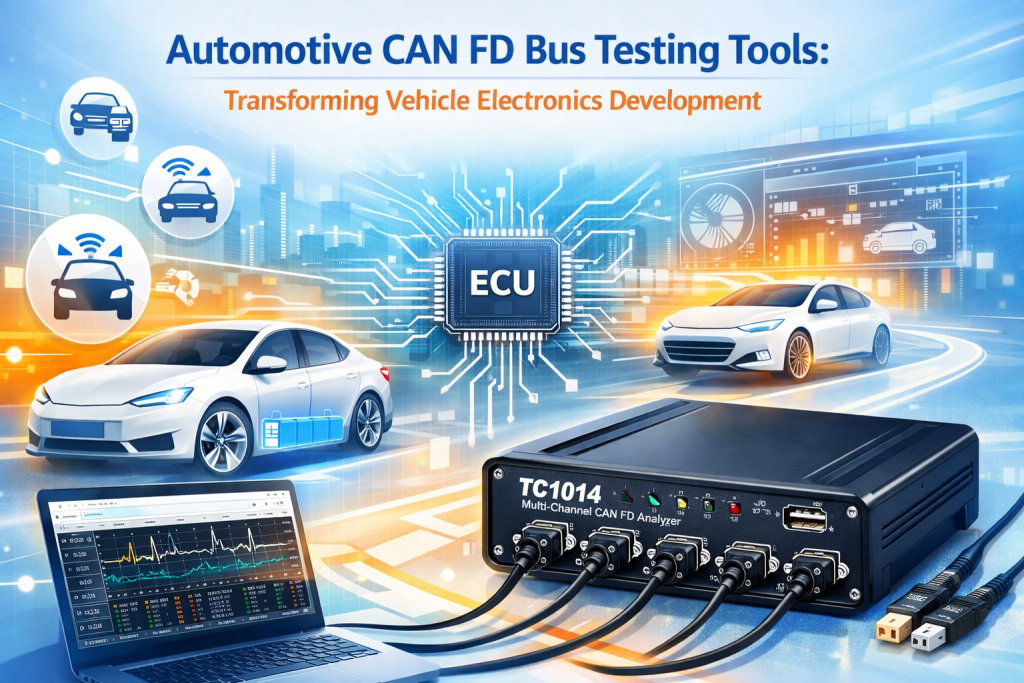
The TC1014 Multi-Channel CAN FD Bus Testing Tool is a specialized testing device for automotive electronics, developed by Dowway Vehicle. It helps engineers throughout the testing, calibration, and development phases by offering a 4-channel CAN FD interface that supports high-speed data transmission and multi-channel testing for complex vehicle systems.
With features like real-time data monitoring, simulation, and ECU programming, the TC1014 is an essential tool for validating the communication between vehicle components.
Key Features and Design of the TC1014
Targeted Applications
The TC1014 is built to solve the practical challenges automotive engineers face when testing modern electronic systems in vehicles. Its main features include:
- 4 independent CAN FD channels for multi-channel testing.
- Compatibility with both CAN 2.0A/B and ISO/Non-ISO CAN FD protocols.
- Plug-and-play setup with Windows and Linux systems.
Versatility for Lab and Field Testing
Engineers can use the TC1014 in both laboratory environments and real-world vehicle testing. This flexibility makes it ideal for complex automotive testing setups and real-time monitoring.
Hardware Architecture and Technical Specifications
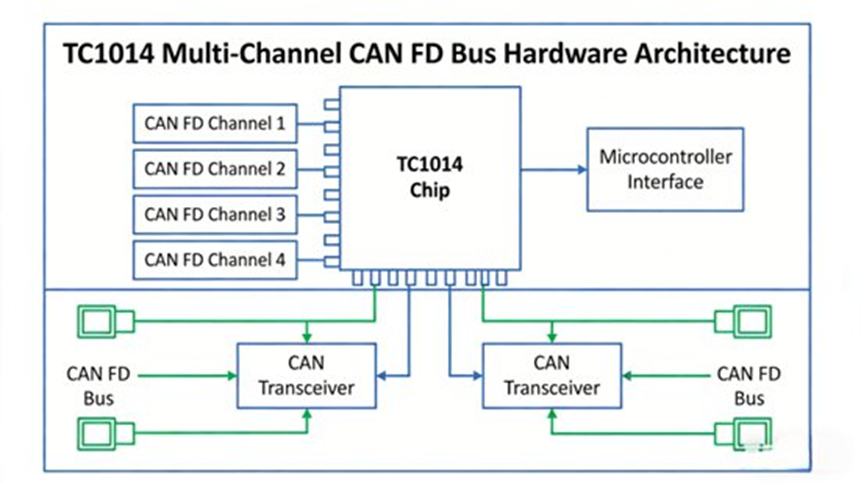
The TC1014 is designed to be both reliable and efficient in demanding testing conditions. Its hardware components are built for precision and ease of use:
1. CAN FD Interface Module
- 4 independent CAN FD channels: Enables parallel testing for multiple ECUs or systems at once.
- Data rates up to 8Mbps: Ideal for high-speed vehicle communication testing.
2. USB Communication Module
- USB 2.0 connectivity ensures simple integration with both Windows and Linux systems, requiring no additional drivers for easy setup.
3. Isolation Protection
- 2500V DC electrical isolation prevents damage from electrical interference and ensures data integrity during testing.
4. Control and Buffer Module
- 1μs hardware timestamp precision ensures accurate synchronization of multi-channel data.
- Buffer for up to 1000 frames per channel to ensure reliable data collection under high-load conditions.
Integrating Software with TC1014
The TC1014 is paired with TSMaster software, providing powerful features like:
- Real-time data monitoring: View and decode raw CAN FD data in DBC/ARXML formats.
- ECU diagnostics and calibration: Supports UDS diagnostics and CCP/XCP calibration for optimizing vehicle system performance.
- Simulation: Simulate and inject faults into vehicle systems to test how ECUs respond under different conditions.
Applications in Automotive Testing
The TC1014 is versatile and can be used in multiple automotive testing applications, including:
1. Multi-Channel Data Acquisition
- The TC1014 enables the collection of synchronized data from various vehicle systems, such as the powertrain, chassis, and infotainment systems. Engineers can track parameters like engine speed, vehicle speed, and braking signals in real time.
2. Domain Controller and ECU Testing
- The TC1014 allows engineers to test the interaction between domain controllers and ECUs across different vehicle subsystems. For example, it can simulate signals from components like seat adjusters and airbags to validate their communication with the seating domain controller.
3. ECU Calibration and Firmware Programming
- The tool enables online ECU calibration and firmware programming, allowing engineers to fine-tune vehicle control systems such as engine control units (ECUs) and battery management systems (BMS).
Practical Considerations and Tips for Using TC1014
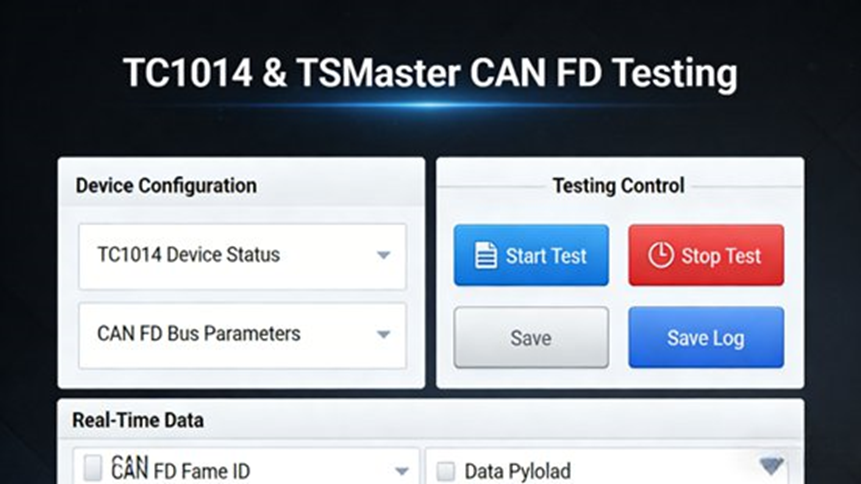
To ensure smooth and effective use of the TC1014 in various testing environments, consider the following practical tips:
1. Device Setup and Connections
- Make sure the CAN_H, CAN_L, and GND are correctly connected.
- Use internal 120Ω termination resistors to ensure proper network impedance matching and avoid signal reflections.
2. Software Configuration
- Ensure the appropriate DBC/ARXML files are loaded for accurate message decoding.
- Set the correct CAN FD baud rate to avoid bit rate mismatches and frame loss.
3. Environmental Protection
- When conducting tests in vehicles, ensure the TC1014 is placed in a dry, well-ventilated area to avoid overheating.
- Use electromagnetic shielding to protect the device from interference during testing.
The Future of Automotive Testing Tools
As electric vehicles (EVs) and autonomous driving systems continue to evolve, the demand for multi-channel, high-speed testing solutions like the TC1014 will only increase.
Emerging Automotive Needs
- As new communication protocols such as Ethernet and FlexRay are integrated into vehicle electronics, tools like the TC1014 may evolve to support these next-generation systems.
Future Development
- Future versions of the TC1014 could feature expanded support for more advanced testing needs, such as higher-speed buses, security features, and next-gen protocol integrations.
Conclusion
The TC1014 Multi-Channel CAN FD Bus Testing Tool is an indispensable asset for automotive engineers, providing essential features like real-time monitoring, ECU calibration, and multi-channel synchronization. As the automotive industry continues to evolve with smart vehicles and autonomous driving, the TC1014 will continue to play a crucial role in ensuring that the communication between vehicle systems is smooth and reliable.
About the Author
Johnny Liu, CEO at Dowway Vehicle, brings over 20 years of experience in automotive electronics and testing systems. His leadership has positioned Dowway Vehicle as a leader in providing advanced automotive testing solutions for modern vehicles.
Last Updated: March 2026
References:
- TC1014 Product Manual
- TSMaster Software Guide
- Automotive CAN FD Bus Testing Standards
? Top 5 FAQs (Most Discussed Recently) — TC1014 Multi‑Channel CAN FD Bus Tool
1) What are the core capabilities of the TC1014 for automotive CAN FD testing?
Answer:
The TC1014 is a 4‑channel CAN FD‑to‑USB interface device designed for automotive testing, calibration, and development. It supports ISO/non‑ISO CAN FD protocols with up to 8 Mbps data rates, μs‑level hardware timestamps, software‑configured 120Ω termination, and high isolation. It also enables supported data logging (BLF/ASC), DBC/ARXML loading, UDS diagnostics, CCP/XCP calibration, and secondary development via APIs for Windows and Linux.
2) Does the TC1014 require a USB driver on Windows or Linux?
Answer:
On Windows, the TC1014 uses a driver‑free (plug‑and‑play) USB 2.0 interface, meaning it is automatically recognized without manual driver installs. On Linux, it typically works with provided libraries (e.g., libtscan / tsdev) and may require loading specific modules or using APIs.
3) Can TC1014 be used for both real‑time testing and offline analysis?
Answer:
Yes. TC1014 supports real‑time CAN FD data monitoring with decoded signal display (via DBC/ARXML), as well as data logging in BLF/ASC formats for offline playback. These logs can be replayed to simulate bus conditions, support fault reproduction, and enhance ECU validation.
4) What connectivity and integration options does TC1014 offer for automation or software development?
Answer:
TC1014 includes secondary‑development APIs compatible with C++, C#, LabVIEW, Python, and other environments, allowing integration into automated test systems, SIL/HIL setups, ECU‑production line automation, or bespoke test frameworks. It also integrates with professional software such as TSMaster for deep analysis and calibration workflows.
5) What are common challenges or setup pitfalls when using TC1014 in automotive environments?
Answer:
Typical issues engineers highlight include:
- Incorrect cable connections or termination resistor settings — Ensure CAN_H/CAN_L/GND are correct and termination matches network topology.
- Mismatch in CAN FD arbitration/data segment bit rates — Leading to lost frames.
- Environmental interference — Use isolation and shielding to avoid EMI/ESD effects.
- Data management practices — Use BLF for efficient high‑volume captures and backup logs to prevent data loss.
? Bonus: Why CAN FD Tools like TC1014 Are Trending?
Recent discussions highlight that CAN FD (Flexible Data Rate) is now widely adopted across modern vehicle domains (powertrain, chassis, cockpit), necessitating advanced tools like TC1014 that offer high‑speed bus access, detailed timestamping, diagnostics, calibration and integration into engineering workflows.
