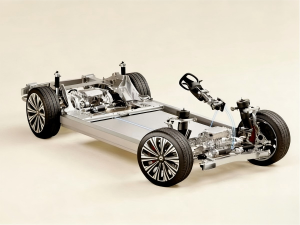




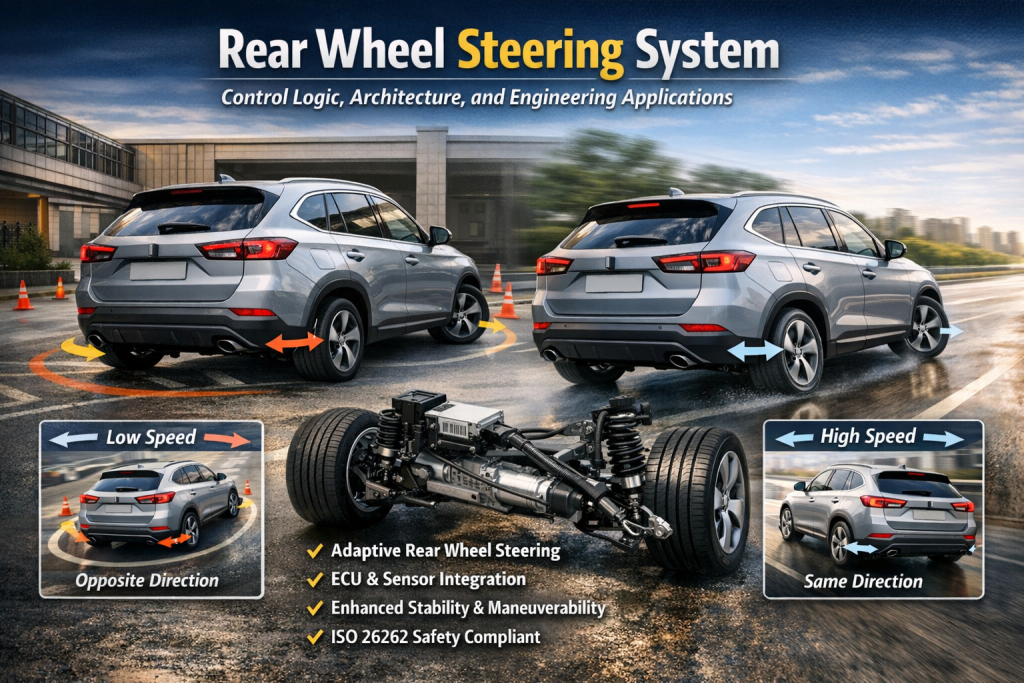
Rear wheel steering changes the angle of the rear wheels to help control a vehicle’s path. At low speeds, many systems turn the rear wheels in the opposite direction to the front wheels to reduce the space needed for a turn. At higher speeds, they may steer in the same direction to shape the vehicle’s response during cornering or lane changes.
The result depends on the vehicle, available rear steering angle and control calibration. A passenger car parking in a narrow street and a long utility vehicle moving through a work site need different steering behavior.
How does rear wheel steering work?
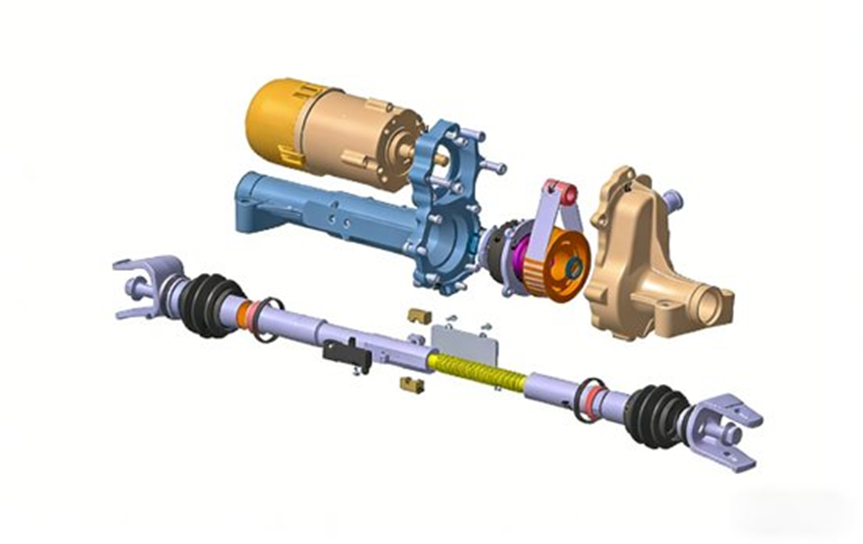
An active rear steering system uses an actuator to move the rear steering linkage. A controller calculates the requested rear wheel angle from the driver’s steering input and vehicle signals. Position sensors report the actual angle so the controller can correct tracking errors.
The controller repeats this sequence as the vehicle moves. Its calibration determines how much rear steering to request and what to do when an input or component becomes unavailable.
Opposite-direction steering at low speed
When the rear wheels turn against the front wheels, the vehicle can follow a tighter curve. This helps with parking, U-turns and maneuvering long vehicles around obstacles.
For a simplified low-speed bicycle model, path curvature is approximately:
curvature = (tan(front wheel angle) − tan(rear wheel angle)) / wheelbase
Here, both angles use the same sign convention. Opposite rear steering makes the angle difference larger. The model assumes negligible tire slip and represents each axle with a single wheel. It explains the steering geometry; it does not predict the full turning envelope, body overhang clearance or tire behavior of a real vehicle.
Same-direction steering at higher speed
Rear wheels steered in the same direction as the front wheels change the relationship between yaw response and lateral motion. With suitable calibration, this can make a lane change feel more settled and help manage sideslip.
The rear angle is usually smaller than the front angle in this operating mode. The useful relationship varies with speed, tire behavior, loading and the maneuver. There is no universal changeover speed that applies to every rear wheel steering system.
Transition between operating modes
The controller blends its requests as speed and driving conditions change. An abrupt angle change could disturb the vehicle or surprise the driver. Calibration therefore includes angle limits, rate limits, signal filtering and coordination with other chassis controls.
Main components of a rear wheel steering system
| Component | Role | Integration question |
|---|---|---|
| Rear steering actuator | Moves the rear steering mechanism | Can it meet force, travel and speed requirements across the load range? |
| Position sensing | Measures actuator or wheel position | How are faults and inconsistent readings detected? |
| Steering controller | Calculates and monitors steering commands | Which functions run locally and which belong to the vehicle controller? |
| Vehicle signals | Provide steering input, speed and vehicle-motion information | Are signal definitions, timing and validity checks agreed? |
| Power and communication | Supply electrical energy and transfer commands | What happens during supply loss or communication interruption? |
| Mechanical linkage and mounts | Transfer actuator movement to the wheels | Are stiffness, alignment, clearance and service access acceptable? |
An actuator’s published angle or force alone cannot establish vehicle compatibility. Suspension geometry, axle loading and available installation space also matter.
Benefits and trade-offs
Rear wheel steering can reduce low-speed maneuvering space and give engineers another way to tune handling. It is useful where wheelbase, body length or operating space makes front-only steering restrictive.
It also adds hardware, wiring, software and validation work. Rear suspension packaging becomes more demanding. Wheel alignment and service procedures need to account for the steering mechanism. Fault behavior must be considered at vehicle level, especially when a rear wheel angle remains offset after a failure.
Rear steering does not increase tire grip by itself. Its contribution depends on how the controller uses the grip available.
Where rear wheel steering is useful
Passenger cars and SUVs may use rear steering for parking and handling. Longer commercial or special-purpose vehicles may use it to negotiate constrained sites. Automated platforms can use independently controlled steering arrangements for additional maneuvering modes.
Crab motion requires suitable steering capability and control at both axles. Check that the complete vehicle supports this mode; a rear steering actuator alone does not establish that capability.
Rear wheel steering and steer-by-wire
Rear wheel steering describes which wheels steer. Steer-by-wire describes how steering commands reach the actuator. A vehicle can combine conventional front steering with electronically controlled rear steering.
For a wider view of the control system, see the steer-by-wire architecture guide. Explore Dowway steering solutions to discuss a vehicle application.
What to validate before vehicle integration
Start with maneuverability targets and the vehicle’s operating envelope. Check the swept path with the full body installed, including front and rear overhangs. Evaluate steering response under different loads and tire conditions.
Bench testing should establish actuator travel, force capability, tracking and thermal behavior. Vehicle testing should cover parking, cornering, lane changes and transitions between control modes. Fault injection is needed to assess invalid signals, interrupted communication, power faults and actuator faults. The required response and acceptance criteria belong in the project’s safety and validation plans.
Specify a rear steering project
Share the vehicle type, wheelbase, axle loads, tire size and target turning envelope. Include the installation space, steering travel or angle requirement, electrical supply and available vehicle signals. Explain whether the system will support a driver, an automated driving controller or both.
Send Dowway your rear steering requirements to discuss component selection and integration scope.
Review the rear steering system and integration options alongside the vehicle requirements, then confirm actuator capability, mounting and control interfaces for the proposed configuration.
Frequently asked questions
Is rear wheel steering the same as four-wheel steering?
Four-wheel steering generally means that both front and rear wheels steer. Rear wheel steering describes the rear axle function within that arrangement. Product terminology varies, so compare the actual steering layout and control modes.
Does rear wheel steering always reduce the turning radius?
Opposite-direction rear steering can reduce the low-speed turning radius. The improvement depends on wheelbase, steering angles and geometry. Same-direction steering serves a different control purpose.
Can rear steering be added to an existing vehicle?
It requires a compatible mechanical design, actuator installation, controls and validation. Suspension changes and vehicle approval requirements can make a retrofit substantially more involved than installing an actuator.
What happens if rear steering fails?
The response depends on the fault and system design. A project must define detection, available steering authority, driver warnings and any operating restrictions. A safe return to center cannot be assumed for every failure.