




- Author: Johnny Liu, CEO at Dowway Vehicle
- Published: June 11, 2026
- Category: Automotive Technology & EV Engineering
- Estimated Read Time: 5 mins
About the Author
Johnny Liu is the Chief Executive Officer at Dowway Vehicle. With over a decade of hands-on experience in automotive engineering, powertrain systems, and chassis dynamics, Johnny offers straightforward, unbiased technical analysis of the rapidly shifting Electric Vehicle (EV) market.
Recently, the car community has been flooded with a heated tech war between two major EV makers. Both brands claim that their own active suspension setup represents the absolute peak of the industry. However, looking at pure physics and engineering logic, at least one side is stretching the truth.
Today, let’s look past the internet flame wars, marketing buzzwords, and legal bickering. We will examine the technical realities of Distributed 800V Active Suspension and 48V Integrated Active Suspension to see which one actually wins.
Table of Contents
1. Defining the Core Tech: Distributed 800V vs. 48V Integrated
To understand this debate, we must first look at how these two active suspension setups are physically laid out.
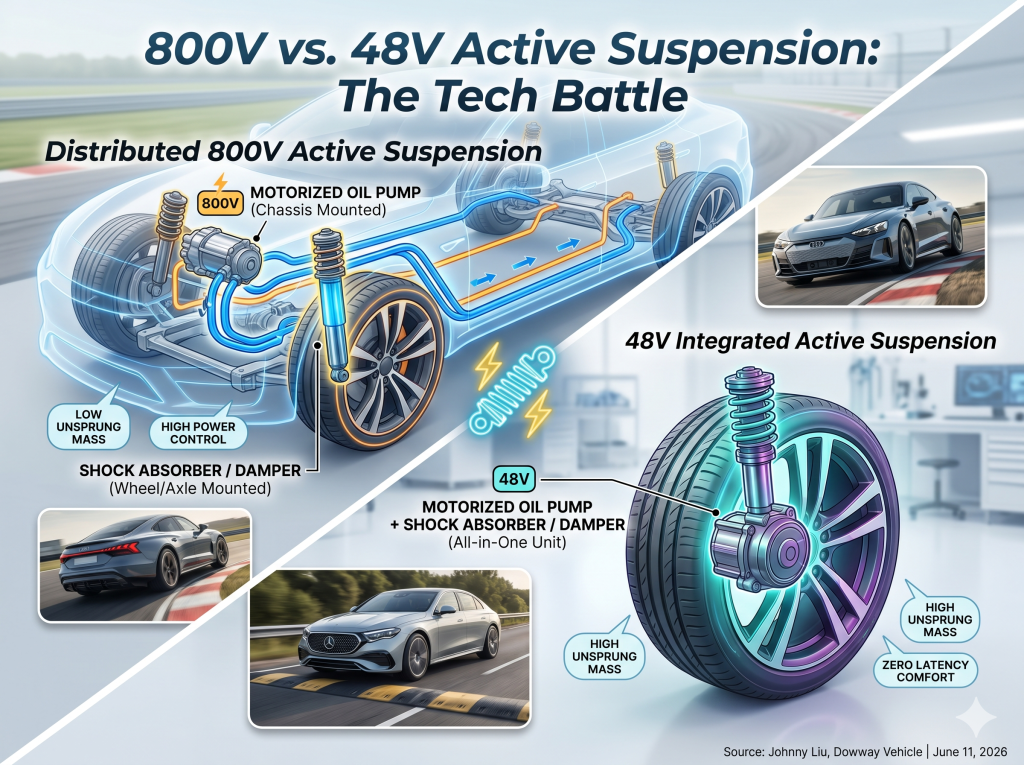
Distributed 800V Architecture:
[ Motorized Oil Pump ] ======(Hydraulic Lines)====== [ Shock Absorber / Damper ]
(Chassis Mounted) (Wheel/Axle Mounted)
48V Integrated Architecture:
[ Motorized Oil Pump + Shock Absorber / Damper ] (All-in-One Unit on Wheel/Axle)
- Distributed 800V Active Suspension: In this setup, the motorized hydraulic oil pump and the shock absorber (damper) sit separately. The pump is mounted on the car frame/chassis, connecting to the damper at the wheel via hydraulic lines.
- 48V Integrated Active Suspension: In this setup, the motorized hydraulic oil pump and the shock absorber are merged into a single, self-contained unit located right on the wheel assembly.
The Big Question for Car Buyers:
“If the integrated design is supposedly so superior, why is it currently limited to a 48V electrical system? Why haven’t manufacturers challenged themselves to build an 800V integrated system? Is an 800V motor truly inferior to a 48V motor in every aspect?”
To answer this, we have to look at the physical trade-offs of both designs.
2. 48V Integrated Suspension: Comfort is King, Handling is Compromised
Integrating the heavy motorized oil pump directly onto the shock absorber brings one massive physical drawback: it is like strapping a heavy sandbag to your calves while running.
In car engineering, this is known as increasing the unsprung mass (the weight of the suspension, wheels, and other parts directly connected to them, rather than supported by the springs).
The Drawback: Unsprung Mass & Agility
- By packing the motor, pump, and damper together at the wheel, the unsprung mass of the vehicle rises significantly.
- This extra weight inherently reduces the vehicle’s overall handling agility, steering response, and high-speed limits.
The Advantage: Zero Latency & High Comfort
- On the flip side, because the oil pump sits directly on the shock absorber, there is virtually zero delay in hydraulic fluid delivery.
- This makes the 48V integrated system brilliant at filtering out high-frequency micro-vibrations and minor road bumps. The shock absorber can react almost instantly, delivering great cabin comfort during daily drives.
3. Distributed 800V Suspension: Handling is King, Comfort Has Limits
By separating the motorized oil pump from the shock absorber, the distributed 800V system takes a completely different engineering path. It removes the “sandbag” from the vehicle’s calves, freeing up the wheel assembly to react quickly.
The Advantage: Unparalleled Power & Roll Control
- Lower Unsprung Mass: Moving the heavy pump assembly onto the chassis keeps the unsprung mass low, allowing the suspension to remain highly agile.
- 800V High-Voltage Power: Separating the parts allows engineers to safely and successfully run a high-power 800V system.
- This massive electrical power allows the suspension to perform extreme physical moves, such as single-wheel vehicle lifting (propelling a single corner of the car upward).
- It excels tremendously at keeping the car level during high-speed cornering and managing major road bumps (such as large dips and crests), pushing the car’s extreme handling limits and off-road capabilities to the max.
The Drawback: Hydraulic Delay & High-Frequency Noise
- Because the oil pump and the shock absorber are physically separated, the hydraulic fluid must travel through longer pipelines.
- This physical distance introduces a slight delay in oil delivery. Consequently, when dealing with minor, rapid, and high-frequency road vibrations, the distributed system’s dampening response is slightly slower and less smooth compared to the 48V integrated unit.
4. Head-to-Head Comparison: No Universal Champion
In car engineering, there is no such thing as a “perfect” system—only different sets of compromises. The table below outlines how these two systems compare across key areas:
| Feature / Metric | Distributed 800V Active Suspension | 48V Integrated Active Suspension |
| System Layout | Pump and Damper Separated | Pump and Damper Integrated |
| Voltage Level | High-Voltage (800V) | Low-Voltage (48V) |
| Unsprung Mass | Low (Better agility) | High (Reduced agility) |
| Oil Delivery Latency | Slight Delay (Due to pipe length) | Near-Zero Delay (Immediate action) |
| Micro-Vibration Filtering | Moderate | Excellent (Comfort-optimized) |
| Body Roll & Large Dips | Exceptional (High-limit handling) | Moderate |
| Special Features | Extreme power (e.g., Single-wheel lifting) | Standard active leveling |
How to Choose:
- Choose Distributed 800V if: You want sharp handling, high-speed cornering control, off-road dynamics, and tight body roll control.
- Choose 48V Integrated if: Your main goal is daily commuting comfort, smooth city driving, and softening rough asphalt surfaces.
The Bottom Line: Theory vs. Real-World Tuning
Keep in mind that this analysis is based on pure technical logic. In the real world, hardware is only half the battle. The final driving experience is heavily shaped by a manufacturer’s software and chassis tuning. A poorly tuned 800V system could easily feel worse than a beautifully tuned 48V setup, and vice versa.
Here at Dowway Vehicle, we don’t just rely on paper specs. We will soon be running real-world track and road tests on vehicles using both of these setups to see if these engineering theories hold up on actual asphalt. Stay tuned for our deep-dive testing report!
Frequently Asked Questions
- Q: What is the main difference between 800V and 48V active suspension?
- A: The physical layout of the pump and the damper. 800V systems keep the heavy hydraulic pump on the chassis to reduce wheel weight and boost handling, while 48V systems integrate the pump and damper on the wheel to eliminate fluid delay and maximize ride comfort.
- Q: Why don’t automakers build an 800V integrated active suspension?
- A: Because of excessive weight at the wheels. Mounting high-voltage 800V components directly on the wheel assembly creates too much unsprung mass (wheel weight). This ruins steering feedback, reduces agility, and harms overall handling.
- Q: Does 800V active suspension offer a smoother ride than 48V?
- A: No, 48V is often smoother on typical roads. While 800V is incredible at stopping body roll and handling big dips, the 48V integrated system is actually better at absorbing small, rapid, high-frequency road vibrations due to its zero-latency design.
Join the Discussion
Which active suspension philosophy fits your driving style? Would you sacrifice a bit of high-frequency comfort for ultimate handling limits, or is city commuting plushness your top priority? Let us know in the comments below!