

< Back to Performance Development
By Johnny Liu, CEO at Dowway Vehicle
Published: March 3, 2026
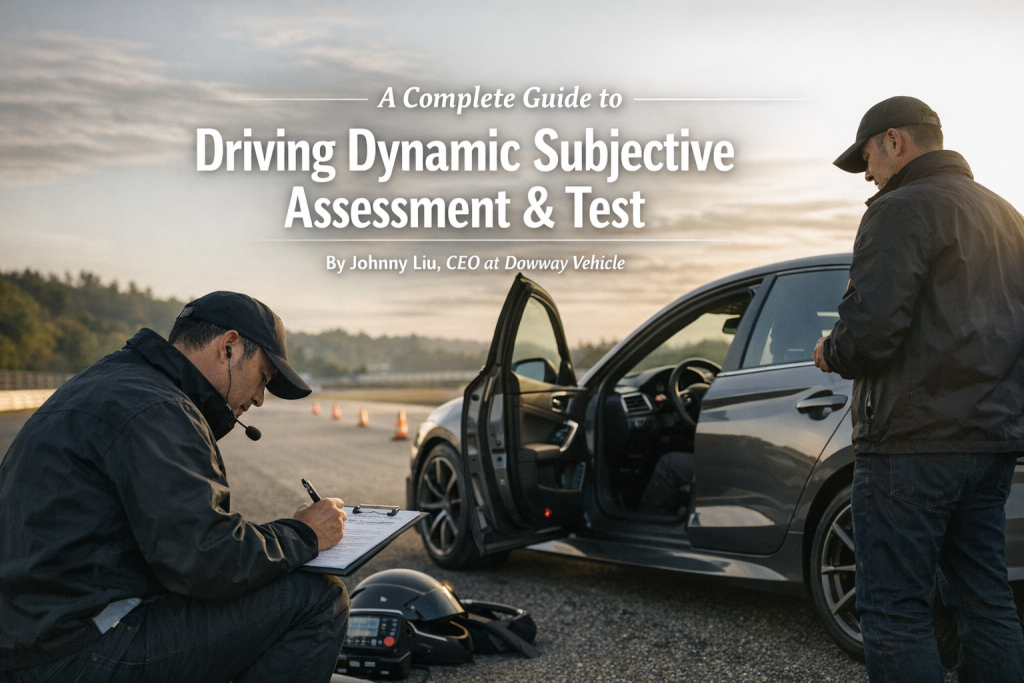
As cars become smarter, drivers want more than just basic transportation. They expect a great overall experience. In my years overseeing automotive development, I’ve learned that you cannot build a perfect car using numbers alone.
We traditionally divide vehicle testing into two parts: objective data and subjective feelings. Objective tests give us hard numbers—like acceleration times or braking distances. However, machines cannot tell you if a steering wheel feels too heavy, if the seat supports your back properly, or if cabin noise gives you a headache. That requires a human touch.
This is where the driving dynamic subjective assessment & test steps in. We use professional drivers to simulate real-world conditions. They turn abstract “user experience” into clear engineering goals. Today, you simply cannot launch or update a great car without this step.
- Core Principles of Subjective Performance Evaluation
- Building the Subjective Assessment & Test System
- Key Methodologies for Subjective Assessment
- Process Control and Result Analysis
- Frequently Asked Questions (FAQ)
- What is a driving dynamic subjective assessment & test in vehicle evaluation?
- What standards govern subjective assessments of vehicle ride and handling?
- Why combine subjective assessments with objective tests?
- How does subjective consistency vary among evaluators, and why does it matter?
- What kinds of tests or methods are used in subjective dynamic driving assessments?
- Summary of Key Concepts
- Industry Status and Future Trends
- Final Thoughts
Core Principles of Subjective Performance Evaluation
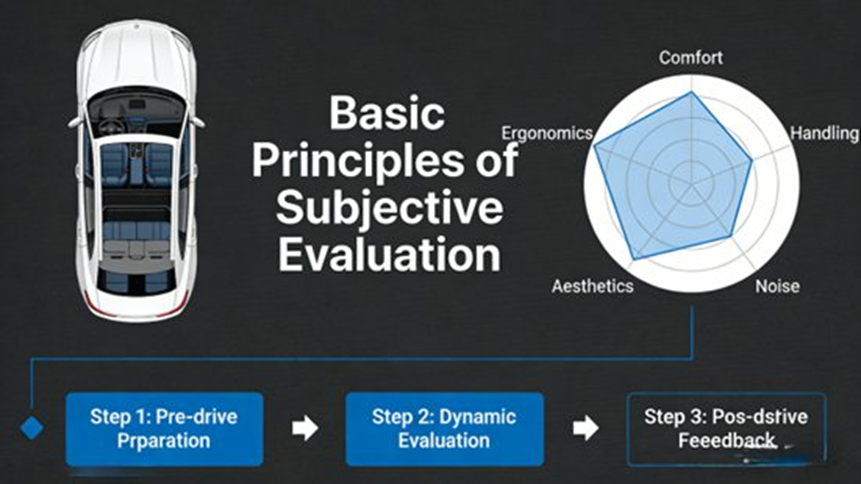
For reliable data, we stick to four main rules:
- Objectivity: Testers must leave their personal bias at the door. We use multiple drivers doing multiple runs to reduce individual differences.
- Standardization: We keep environments, roads, and scoring rules exactly the same. This makes every test comparable across different days and vehicles.
- Broad Coverage: We test all main performance areas. We cover routine daily commutes as well as extreme edge cases, keeping both new and veteran drivers in mind.
- Practicality: Our methods match how real people actually drive.
Building the Subjective Assessment & Test System
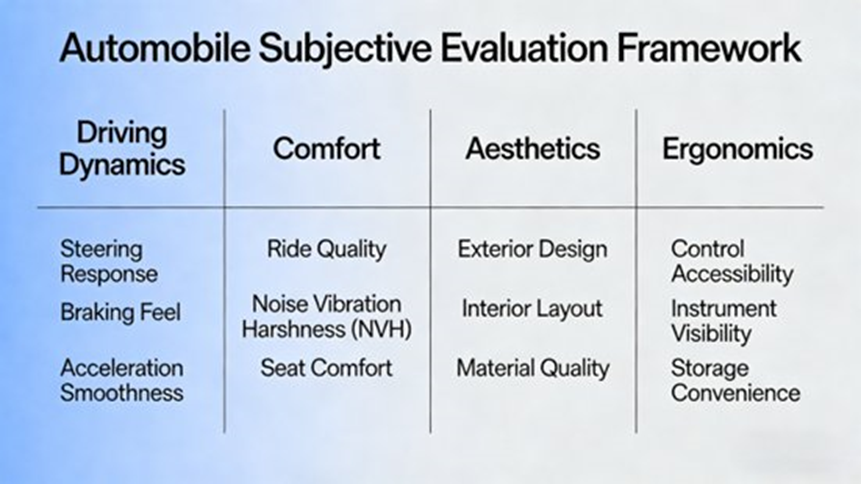
A successful testing system forms a strict loop: Training → Prep → Execution → Evaluation → Analysis → Feedback.
1. The Evaluator Team
Good data needs great drivers. Evaluators must have at least 3 years of driving experience. They must know vehicle structures—like the powertrain and chassis—inside and out to spot the root causes of problems. We usually deploy 5 to 10 core evaluators backed by 1 to 2 technical experts. We train them regularly so everyone uses the exact same scoring scale.
2. The Test Environment
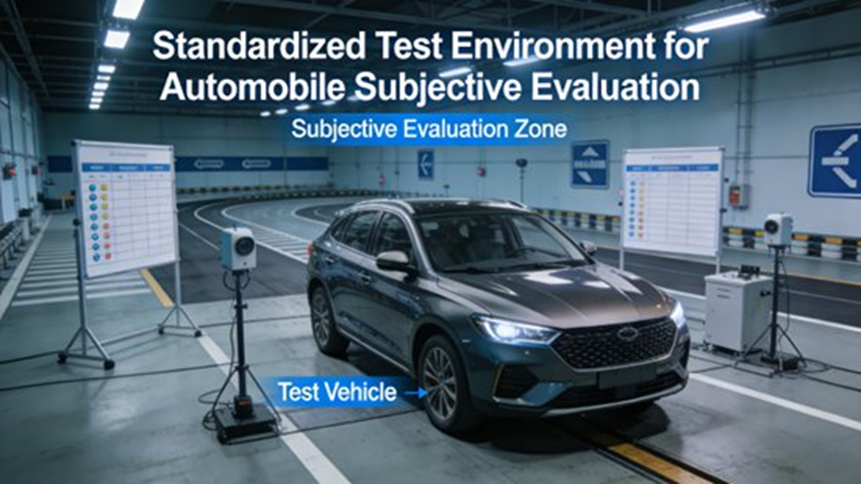
Stable environments prevent bad data. We use proving grounds with flat, dry tracks. You need a straight acceleration track (length ≥ 500m), a braking track (length ≥ 300m), and continuous curves (radius 50-100m). We also use rough and undulating roads to simulate real life.
Weather matters just as much. We run standardized tests at an ambient temperature of 20±5℃, relative humidity of 50±10%, and wind speeds ≤3m/s. Vehicles get pre-conditioned first. We normalize engine water and oil temperatures, set tires to standard pressures, and fill fuel tanks to specified levels.
3. Core Test Conditions (Scenarios)
Test conditions must cover daily driving uses and limits entirely:
- Powertrain: Standing starts (0-100km/h), rolling acceleration (80-120km/h), steady cruising (60, 100, 120km/h), and steep hills (15° and 20° gradients).
- Handling: Continuous cornering, emergency lane changes, stationary steering lock-to-lock, and low-speed parking.
- Braking: Emergency stops (100-0km/h), normal braking (60-0km/h), continuous braking, and slope braking.
- Comfort & NVH: Rough roads, high-speed runs, and idling. We check seat comfort, suspension bump filtering, visibility, and cabin noise frequencies (engine, tire, wind).
4. Indicators and Scoring Standards
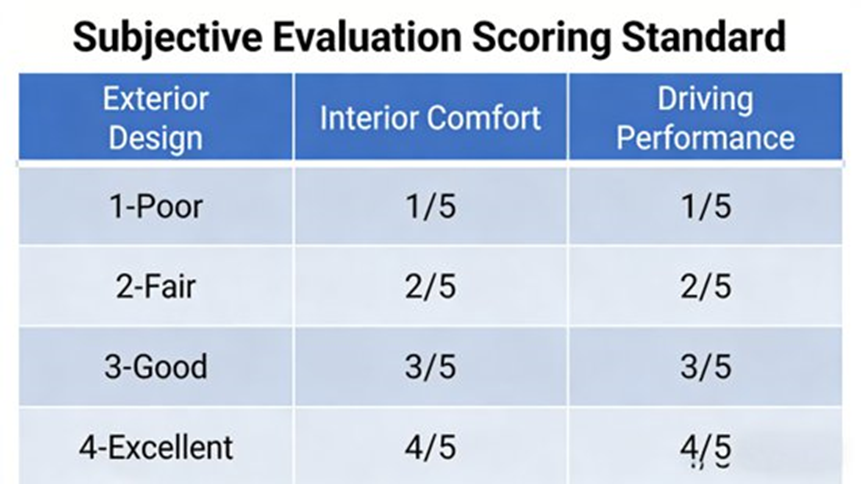
We rely on a two-tier indicator system and a strict 10-point scale (1 is worst, 10 is best).
Scoring Breakdown (Example: Powertrain Response):
- 10 Points: Immediate response; zero delay between pedal input and power.
- 8-9 Points: Fast response; minor delay that doesn’t hurt the drive.
- 6-7 Points: Noticeable delay during hard acceleration, but fine for daily trips.
- 4-5 Points: Obvious delay; hurts driver confidence during quick maneuvers.
- 1-3 Points: Severe delay; fails basic driving needs.
Core Evaluation Dimensions:
- Powertrain: Throttle response sync, continuous power delivery, power reserve for overtaking, and shift logic.
- Handling: Steering feel (effort, damping), precision (zero dead zone), body following speed during curves, and progressive roll control.
- Braking: Response sync, predictable braking travel vs. force, and vehicle stability (no deviation).
- Comfort & NVH: Seat support, suspension filtering, visibility without blind spots, and AC noise. We also track engine noise quality and body vibration limits.
Key Methodologies for Subjective Assessment
We apply specific methods for different performance areas.
Powertrain Performance Assessment
Testers focus heavily on dynamic response and smooth gear shifts. Evaluators execute 0-100km/h standing starts to catch transmission jolts. They perform 80-120km/h kick-downs at a steady 80km/h, and drive up 15°/20° slopes to check for power loss. The goal is continuous power delivery without sudden stutters or frequent gear hunting .
Handling Performance Assessment
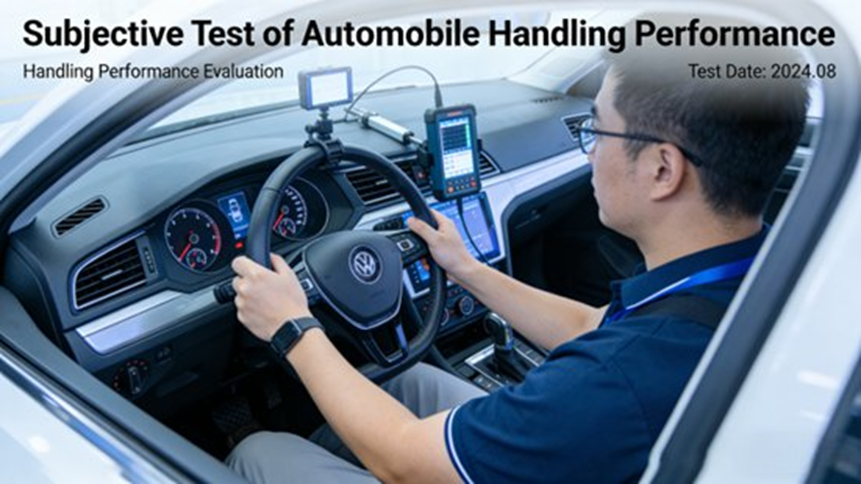
This phase tests steering precision and body control. Drivers navigate continuous curves at 40-60km/h and perform emergency lane changes at 80km/h to simulate obstacle avoidance. They also do low-speed parking at 5-10km/h. The steering must feel light at low speeds but heavy and stable at high speeds.
NVH Assessment
Testers judge idle noise inside the cabin, city traffic noise at 30-50km/h, and highway wind/tire noise at 100-120km/h. Vibrations must stay within comfortable limits. We reject any sharp, piercing sounds. The frequency distributions must allow normal conversation.
Process Control and Result Analysis
1. Test Execution Protocol
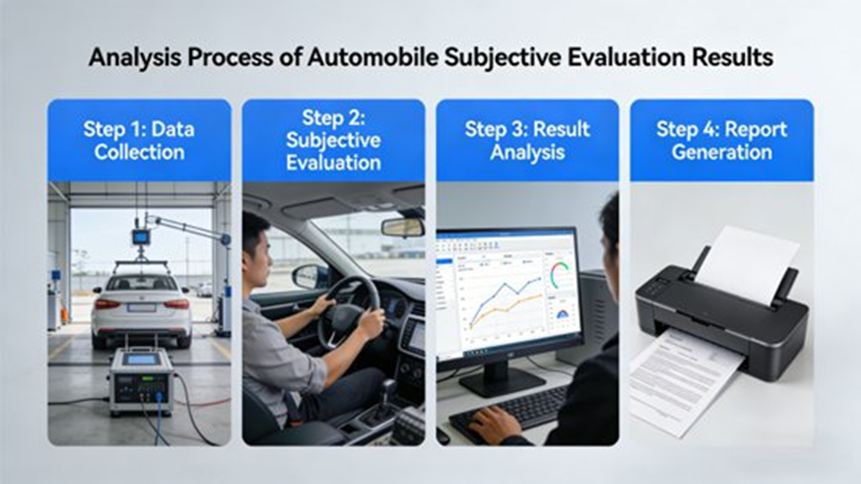
Testers fill out their scoring sheets immediately after a run so they don’t forget the feeling. We repeat every condition at least twice. Evaluators score the car independently to avoid peer pressure. We average the final results. If a score deviates by > 2 points among the team, we mandate a re-test and open a discussion to reach an agreement. Technical experts audit the paperwork to catch any errors.
2. Transforming Data into Engineering Fixes
We flag any indicator scoring below 6 points for immediate work. Engineers trace the subjective complaint back to a physical part. For instance, a low NVH score might mean we need better acoustic insulation or a different tire tread. Cross-functional teams adjust the parameters—like tuning the suspension—and then we test the car again to close the loop.
Frequently Asked Questions (FAQ)
What is a driving dynamic subjective assessment & test in vehicle evaluation?
It is a human-centered evaluation. Professional drivers rate a vehicle’s steering, ride comfort, handling, and stability based on their personal sensory perception during maneuvers. It captures the “feel” and confidence that simple numbers miss. Teams use standardized rating scales to keep the results reliable.
What standards govern subjective assessments of vehicle ride and handling?
According to SAE Mobilus, the most common standard is the SAE J1441 Subjective Rating Scale for Vehicle Ride and Handling. It gives engineers a clear framework to rate vehicle handling and comfort across different roads and maneuvers.
Why combine subjective assessments with objective tests?
As noted by Springer research, combining both methods gives you the full picture. Objective tools measure exact lateral G-forces or acoustic levels. Subjective feedback captures what the driver actually feels. Because human perception does not always match instrument readings perfectly, using both approaches improves vehicle tuning accuracy.
How does subjective consistency vary among evaluators, and why does it matter?
Scores can vary because drivers have different experience levels and sensory sensitivities. This inconsistency can reduce test repeatability. Managing evaluator consistency is a known industry challenge. Teams fix this by using statistical models and rigorous, regular training.
What kinds of tests or methods are used in subjective dynamic driving assessments?
Based on practices from sources like Multimatic, common methods include:
- On-Road Tests: Drivers rate handling and comfort while performing specific maneuvers.
- Simulator Tests: Teams use driving simulators to replicate real-world scenarios safely.
- Questionnaires: Drivers score attributes on predefined scales (like the 10-point system).
- Expert Panels: Utilizing highly trained test drivers to boost result repeatability.
Summary of Key Concepts
| Question | Short Answer |
| What does it mean? | A human-centered rating of vehicle behavior based on driver perception. |
| Which standards apply? | SAE J1441 Subjective Rating Scale for ride and handling. |
| Why combine with objective tests? | To connect driver perceptions with measurable vehicle performance. |
| Do scores vary between evaluators? | Yes—managing evaluator consistency remains a well-known industry challenge. |
| What methods are used? | On-road tests, driving simulators, structured questionnaires, and expert panels. |
Industry Status and Future Trends
Established global automakers already run mature subjective evaluation systems. Emerging brands are working hard to catch up.
The testing landscape is shifting quickly. Companies now use AI and big data to build smart evaluation models, capturing evaluators’ physiological signals (like heart rate) to reduce human error. We also see a push for unified national and global industry norms to ensure cross-brand comparability. More brands are bringing in third-party testing agencies for maximum fairness.
Final Thoughts
A driving dynamic subjective assessment & test translates cold data into a great driving experience. By mixing expert evaluators with strict, standardized rules across powertrain, handling, and NVH, automakers find exact areas to fix. As the industry moves toward electric and smart mobility, these testing methods will stay essential for building vehicles that truly connect with drivers.
