


< Back to Platform Development
By Johnny Liu, CEO at Dowway Vehicle
Published: March 5, 2026 | Read Time: 15 Minutes
- 1. The Main Role of Battery Packs in Electric Vehicles
- 2. Core Principles of Battery Pack Structural Design
- 3. Core Structural Components of an Automotive Battery Pack
- 4. Key Engineering Strategies in Structural Design
- 5. Performance Analysis and Engineering Verification
- 6. Engineering Case Study: Optimizing a Pure EV Battery Pack
- 7. Future Trends in Structural Design
- 8. Frequently Asked Questions (FAQs)
- Q1: How can the battery pack structure ensure safety during vehicle crashes?
- Q2: How can battery pack structures achieve lightweight design without compromising strength?
- Q3: How can thermal management be integrated into battery pack structural design?
- Q4: How should the battery pack be integrated into the vehicle structure?
- Q5: How can engineers analyze and validate battery pack structural reliability?
1. The Main Role of Battery Packs in Electric Vehicles
As the CEO of Dowway Vehicle, I often get asked how we keep EV batteries safe. The battery pack does a lot more than just hold power. It is the core of any New Energy Vehicle (NEV). Unlike a traditional gas tank, this structure handles mechanical support, blocks out weather, manages heat, and keeps the electrical systems safe. It also has to meet strict automotive rules, like ISO 26262 for functional safety and GB 38900 for NEV safety.
Right now, car makers face three big headaches: range anxiety, safety risks, and high costs. Good structural design fixes these problems. We save space to fit more battery cells. We manage heat to stop fires. We cut weight to help the car drive further.
2. Core Principles of Battery Pack Structural Design
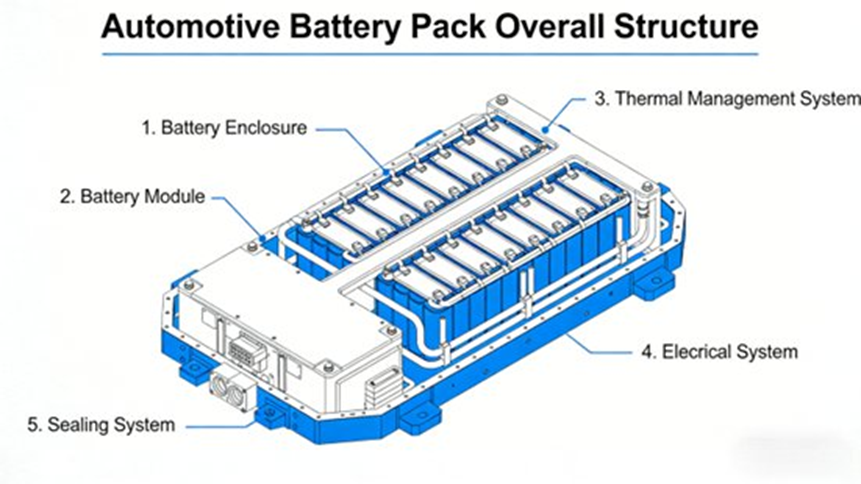
Battery designers stick to five main rules to make sure the pack fits the car and works right:
- Safety First: We build the frame to survive crashes, crushing, and bad vibrations. It must stop leaks and fires while keeping the electricity isolated to prevent short circuits.
- Easy to Adapt: The design needs to fit different chassis styles (under the floor, in the trunk) and different cell types. It must also balance the car’s weight.
- Highly Reliable: A car battery needs to last 8 to 10 years, or 150,000 to 200,000 kilometers. The frame must fight off rust, shake damage, and age.
- Lightweight: We use lighter materials like aluminum and clever shapes to cut the pack’s weight. This helps the car use less power.
- Easy to Build: Factories need to stamp, weld, and assemble these packs quickly and cheaply. The design also needs to make repair and recycling simple.
3. Core Structural Components of an Automotive Battery Pack
An EV battery pack breaks down into five main parts that work together.
3.1 The Enclosure
This is the outer shell. It holds the modules in place, blocks water, and takes the hit during a crash. Lower housings mostly use extruded or die-cast aluminum (like Al6061 or Al7075) welded together using Friction Stir Welding (FSW). Upper covers use thin aluminum or SMC (Sheet Molding Compound) plastics. We add metal ribs to handle crash forces and include drain holes for maintenance.
3.2 Battery Modules
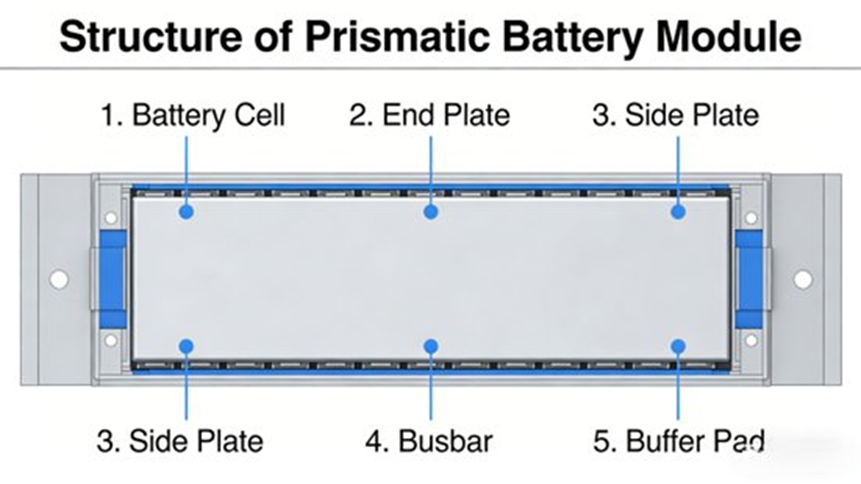
Modules are groups of battery cells wired together. The shape you pick changes how much energy fits and how well the battery cools.
| Module Type | Structural Features | Engineering Applications | Advantages | Disadvantages |
| Prismatic | Square cells arranged in order, fixed by end/side plates, connected by busbars. | Passenger cars, PHEVs (Mainstream choice). | High energy density, excellent space utilization, easy assembly. | Poor heat dissipation uniformity, demands high cell consistency. |
| Cylindrical | Honeycomb pattern arrangement, fixed by brackets or binding belts. | High-performance pure EVs, commercial vehicles. | Superior heat dissipation, high structural stability, mature process. | Lower space utilization, heavier structure, complex assembly. |
| Pouch | Flexible pouch cells stacked or arranged in a single layer, fixed by packaging. | High-end passenger cars, EVs with strict space limits. | Ultra-thin design, highest energy density, good flexibility. | Poor mechanical strength, prone to swelling, high sealing requirements. |
3.3 Thermal Management System
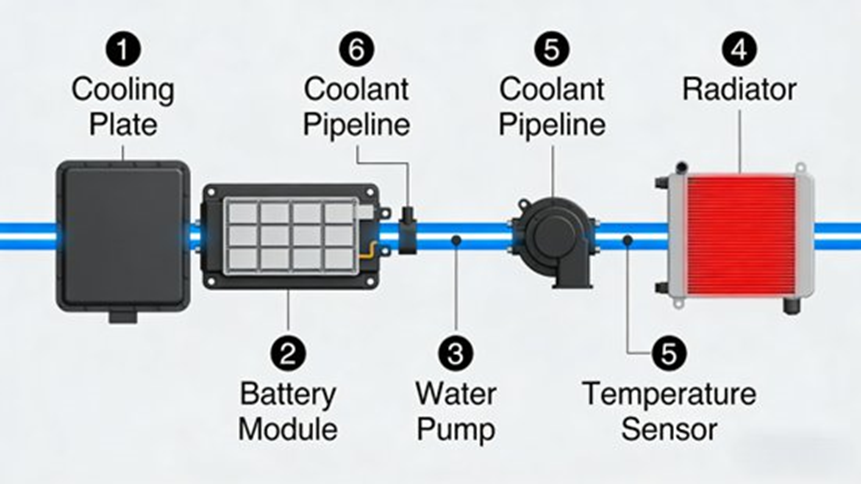
Batteries like to stay between 20°C and 40°C. Too hot, and they age fast or catch fire. Too cold, and the car loses range. Liquid cooling is the standard choice. We build micro-channel cooling plates under or beside the modules. The Vehicle Control Unit (VCU) pumps coolant through them to manage the heat.
3.4 Electrical System
This acts as the brain. The Battery Management System (BMS) tracks the charge (SOC) and health (SOH). It stops the battery from overcharging or getting too hot. The High-Voltage Power Distribution Unit (PDU) uses fuses to cut the power instantly if something shorts out.
3.5 Sealing System
We have to keep water and dust out to meet the IP67 standard. We use high-temp silicone or polyurethane sealants, plus EPDM rubber O-rings where the upper and lower shells meet.
4. Key Engineering Strategies in Structural Design
4.1 Cutting Weight
We drop weight by using Aluminum-Lithium (Al-Li) alloys. They cut weight by 10-15% and bump up strength by over 20% for the lower housing. We also use computer models to trim away metal that the frame does not need. Trimming just the support ribs can cut the shell weight by 8%.
4.2 Crash Safety
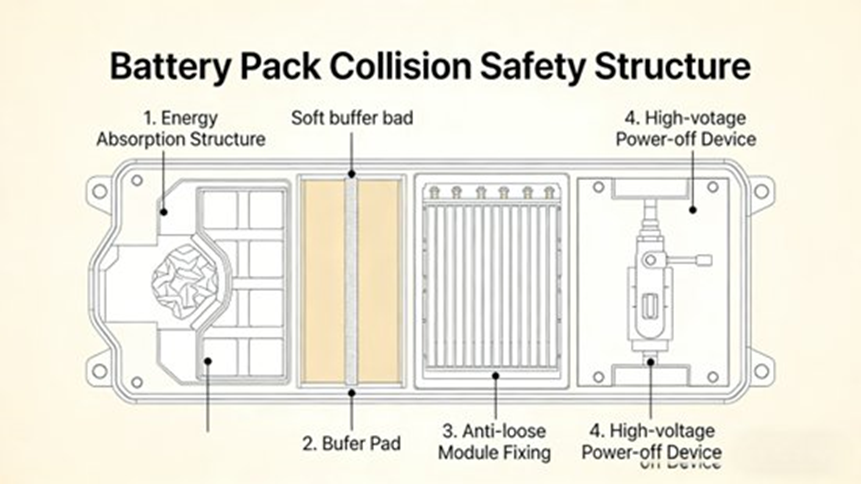
To pass GB 38900-2020 rules, we add energy-absorbing crush zones to the sides. Inside, we wrap the modules in special foam to stop cell damage. If a crash happens, the BMS cuts the high voltage right away to stop shocks.
4.3 Better Cooling
We use tiny 2-5mm channels inside the cooling plates, arranged in snake-like patterns. This keeps the temperature difference between cells at ≤5°C. We also add thermal grease to help the heat move faster.
4.4 Tight Seals
We use stepped edges where the metal plates meet. Robots apply the sealant to make sure there are no bubbles, and we treat the metal surface with anodizing to make the glue stick better.
5. Performance Analysis and Engineering Verification
Before we build a pack, we test it hard using computer models (like ANSYS or Abaqus) and physical labs.
5.1 Mechanical Tests
- Collision: We crash them from the front, side, and rear. The metal shell can only bend a tiny bit (<5mm) to stop internal shorts.
- Crush: The pack must survive a crush load of ≥100kN without leaking. Using die-cast aluminum can boost this resistance by 30%.
- Vibration: We shake them on a rig from 10-2000Hz at 1-3g for over 1000 hours to copy a lifetime of driving.
5.2 Heat Tests
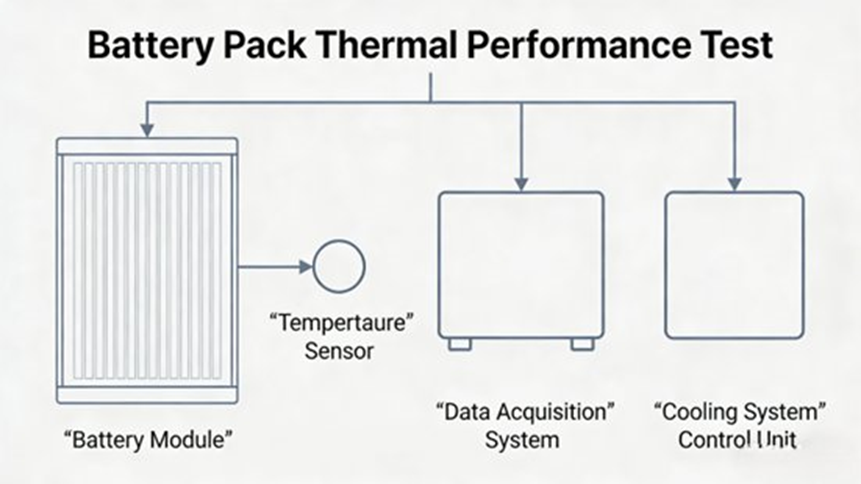
We make sure the pack stays between 20-40°C. Even if it is 60°C outside, the cells must stay under 55°C. In freezing -20°C weather, the pack must warm up past 15°C in just 30 minutes. Good liquid cooling hits >85% heat removal efficiency, using ≤3% of the car’s energy.
5.3 Safety Checks
We check the insulation (must be ≥100MΩ). We stab the cells with needles and overcharge them to make sure any fire stays contained and does not spread.
5.4 Battery Chemistry Checks
We look for at least ≥300Wh/L and ≥150Wh/kg of energy density. The battery must hold 80% of its charge after ≥1000 cycles. Charge efficiency needs to be ≥90% at 25°C and ≥70% at -10°C.
6. Engineering Case Study: Optimizing a Pure EV Battery Pack
I want to share a recent project we finished at Dowway Vehicle. We had a passenger EV pack that was too heavy, cooled poorly, and leaked.
First, we swapped the steel bottom for cast aluminum and used SMC composite for the top. With some clever computer tweaks to the metal ribs, the weight dropped by 12% (from 280kg to 246kg), giving the car 8% more range.
Next, we swapped the flat cooling plates for micro-channel ones. The cell temperature gap shrank from 8°C to 4°C, cooling improved by 20%, and the max temp stayed under 45°C.
Finally, we used robot-applied silicone to fix the leaks, upgrading the pack from IP65 to IP67. In crash tests, the shell only bent 4mm, and the power cut off in ≤50ms. The pack passed every test and is in mass production right now.
7. Future Trends in Structural Design
Looking ahead, builders will use more CTP (Cell-to-Pack) and CTC (Cell-to-Chassis) designs to save space. Cars will use big data and AI to learn how you drive and manage battery heat better. Materials like carbon fiber and Aluminum-Lithium will get cheaper and replace standard metals. We will also design packs from day one to be easy to recycle.
8. Frequently Asked Questions (FAQs)
Q1: How can the battery pack structure ensure safety during vehicle crashes?
Short Answer: It absorbs the crash energy and blocks metal from piercing the battery cells.
Detailed Answer: Crash safety is a major design target. During a bad wreck, bent metal can break a cell and start a fire. Engineers fix this by adding strong side-sill beams and crush zones that crumple on purpose. We build these computer models using Finite Element Analysis (FEA) to simulate side and bottom hits before we build the real car. This keeps the impact force away from the dangerous parts of the battery.
Q2: How can battery pack structures achieve lightweight design without compromising strength?
Short Answer: Engineers use lighter materials like aluminum alloys and smart computer design to remove extra weight.
Detailed Answer: The battery makes up 18% to 30% of the whole car’s weight, which hurts driving range. To fix this, we swap heavy steel for Aluminum-Lithium alloys or carbon fiber. We also use topology optimization—a computer method that tells us exactly where the metal needs to be thick and where we can shave it down. This drops the weight while keeping the frame stiff and safe.
Q3: How can thermal management be integrated into battery pack structural design?
Short Answer: We build cooling plates and fluid channels right into the battery frame under the cells.
Detailed Answer: Batteries generate a lot of heat. If they get too hot, they break down or catch fire. Modern designs place liquid cooling plates directly inside the pack structure. These plates have tiny channels inside them. We also use thermal paste to connect the battery cells to these cooling plates. This keeps the whole pack at a safe, even temperature.
Q4: How should the battery pack be integrated into the vehicle structure?
Short Answer: Newer cars build the battery cells straight into the car’s main body to save room.
Detailed Answer: Older EVs put cells into small modules, then put the modules into a big box, and bolted the box to the car. Newer CTP (Cell-to-Pack) designs skip the small modules. Even newer CTC (Cell-to-Chassis) designs skip the big box entirely and build the cells directly into the floor of the car. This saves weight and fits more power, but it makes the car harder to repair if something goes wrong.
Q5: How can engineers analyze and validate battery pack structural reliability?
Short Answer: We run computer simulations for stress and heat before building physical test units.
Detailed Answer: A car battery takes a beating from road bumps, hard stops, and weather. Before we stamp any metal, we use Computer-Aided Engineering (CAE) tools. We check stress and bending (FEA), test for shakes and rattles (Modal analysis), and simulate years of driving (Fatigue analysis). This proves the design works before we spend money on expensive physical prototypes.
