


< Back to Performance Development
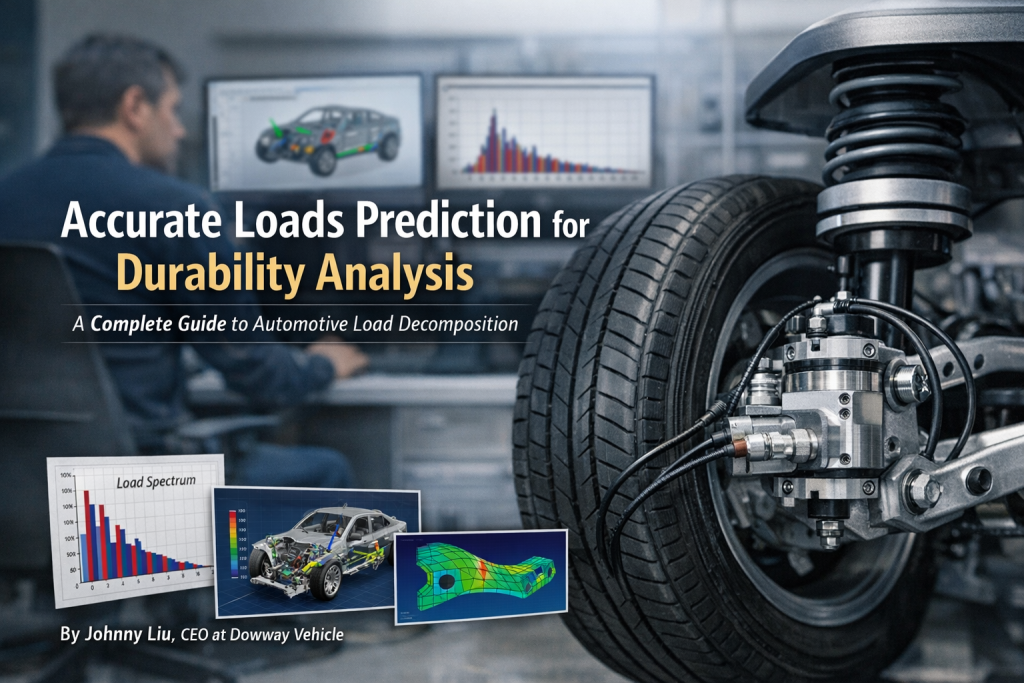
By Johnny Liu, CEO at Dowway Vehicle
Published: February 28, 2026
Key Takeaways:
- Core Goal: Accurate loads prediction connects actual driving conditions directly to precise component durability calculations.
- Main Methods: Engineers rely on physical test measurement, multibody dynamics (MBD) simulation, and a hybrid test-simulation approach to get the best results.
- Overcoming Hurdles: Teams handle mixed forces and changing transfer paths using mathematical decoupling and strict model calibration.
- What is Next: Better sensors, AI, and digital twins are pushing load prediction toward zero-error precision and full life-cycle tracking.
Car buyers today want safer, tougher vehicles that last longer. This demand pushes engineers to rethink how they build cars. During a normal drive, a vehicle handles many forces at once—rough roads, hard braking, sharp turns, and engine torque. These forces move through the frame, suspension, and drivetrain. Eventually, they hit individual parts, causing wear, tear, and fatigue.
Old methods guessed these forces or applied general vehicle loads to specific parts. This approach failed often. Parts were either built too heavy and expensive, or they were too weak and broke early. To fix this, the industry uses accurate loads prediction for durability analysis through load decomposition. This process takes whole-vehicle forces and breaks them down into precise data for each part. Teams use this data from early design all the way to final testing.
Core Concepts and Theoretical Foundations
Reverse Load Tracing and Decoupling
Automotive load decomposition works backward. It takes real driving data and traces it through the car’s structure. Coupled, multi-directional forces (like vertical bumps mixed with lateral turns) are separated into individual load components for every single part. The final output is a precise reliability load spectrum that tells engineers exactly how much stress a part will take over its lifetime.
Key Theoretical Pillars
Four core theories make this process work:
- Load Transfer Theory: Forces balance out. Energy moves through parts based on their stiffness and damping. This creates a clear map of how a bump on the road travels up to the chassis.
- Multibody Dynamics (MBD) Theory: Cars move dynamically. MBD models simulate kinematics and kinetics during acceleration, braking, and cornering. This calculates exact displacement, velocity, and force at any given moment.
- Load Decoupling Theory: Real loads are messy and mixed. Mathematical methods, like orthogonal decomposition, separate these mixed forces into clear, single-dimension metrics.
- Fatigue Cumulative Damage Theory: Engineers use rules like Miner’s rule and rainflow counting to turn force data into expected lifespan numbers. This confirms the decomposition data matches reality.
Mainstream Methodologies for Accurate Loads Prediction
Engineering teams pick specific methods based on their budget, timeline, and accuracy needs.
1. Test Measurement Method
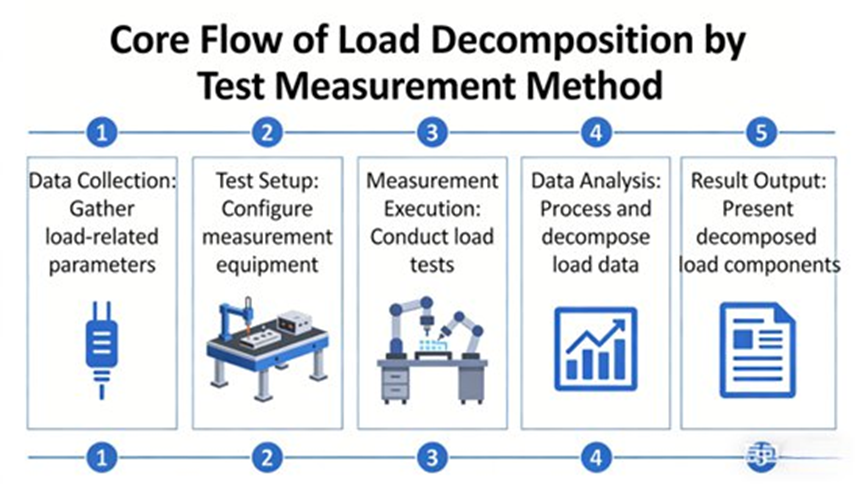
This data-driven approach puts sensors right on the car to capture real-world conditions.
- Workflow: Define test scenarios (city, highway, mountain). Install and calibrate sensors, such as 6-axis force sensors. Record dynamic data using DAQ systems. Clean the data to remove noise. Finally, break the numbers down and check them against force balance rules.
- Pros & Cons: Highly accurate. It catches real-world oddities like assembly errors or sudden potholes. However, it costs a lot of money and takes time. Teams mostly use it for late-stage validation.
2. Simulation Analysis Method
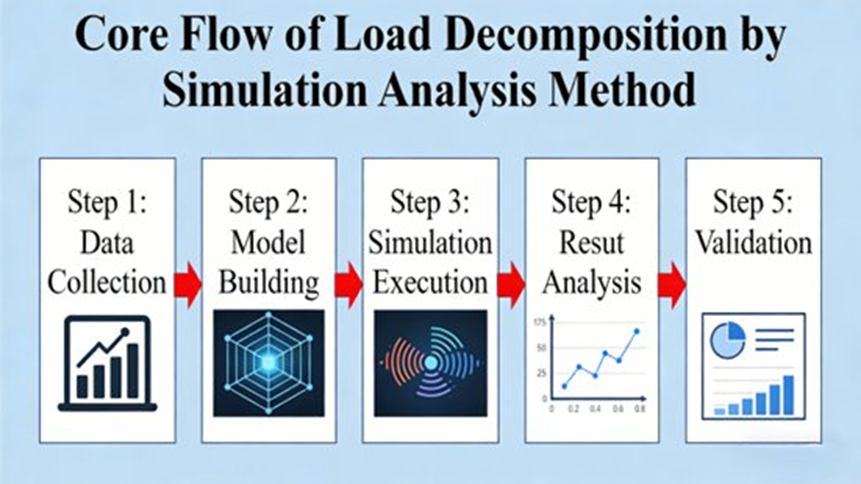
Using MBD and FEA, engineers build digital models to test forces virtually.
- Workflow: Build the digital models. Set up virtual scenarios and boundary conditions. Apply the load inputs. Run the solver calculations. Extract the data for each part and run fatigue calculations.
- Pros & Cons: Fast, cheap, and flexible for early-stage design. The downside is that simplified models might miss complex real-world variables.
3. Test-Simulation Combined Method
This is the industry standard. It blends the high accuracy of physical tests with the speed of digital simulation.
- Workflow: Collect a small amount of physical baseline data. Build the digital model. Calibrate the model against the physical data until the error margin drops below 10%. Run hundreds of virtual simulations. Extract the loads. Do a few physical tests to confirm the final numbers. Output the final durability load spectra.
- Pros & Cons: Offers the best balance of cost and performance. It covers every possible driving scenario accurately. It requires a team skilled in both physical testing and software simulation.
Key Challenges and Solutions
Getting accurate loads prediction for durability analysis is hard work. Here is how engineers solve the biggest problems:
- Severe Multi-Dimensional Load Coupling: A wheel takes hits from three directions at once. Solution: Teams use an “Orthogonal Decomposition + Modal Decoupling” strategy. They project loads onto distinct axes and use the component’s natural frequencies to filter out noise.
- Complex Transfer Paths: Load paths change when a car brakes versus when it turns. Solution: Engineers map connection nodes with strain gauges and use calibrated simulations to track how the paths shift.
- Accuracy Control: Small errors snowball. Solution: Teams run strict quality control on sensor placement, model parameters, and final rig tests.
- Different Driving Conditions: A car driven in a city wears differently than one driven on a mountain. Solution: Multi-Condition Load Fusion Technology. Engineers weigh and combine load spectra from different environments based on real-world mileage statistics.
Real-World Engineering Application: Suspension Arm Case Study
Dowway Vehicle ran a load decomposition project on a passenger car’s suspension arm to stop early fatigue cracking.
- Background: The arm handles vertical road impacts, lateral steering, and longitudinal braking. We needed a precise load spectrum to fix the design.
- Implementation: We put 6-axis wheel sensors and strain gauges on test cars. We built an ADAMS/CAR model. At first, the digital model was off by 15% compared to the physical tests. We tuned the suspension bushing stiffness and joint clearances. The error dropped to under 8%. We then ran 8 different virtual scenarios and decoupled the loads. We ran two final physical tests to verify. The error between the digital data and physical data was under 7%.
- Impact: We fed the verified spectrum into FEA software. The old fatigue life was 2.8×10⁵ cycles. The target was ≥2.5×10⁵. We optimized the structural fillets and added thickness to high-stress areas. The new fatigue life hit 3.5×10⁵ cycles. We also cut material from safe areas, making the part lighter. The early cracking stopped completely.
Future Trends
As cars become smarter, load decomposition changes with them:
- Near-Zero Error: Smaller, better sensors and highly detailed digital models will shrink prediction errors to near zero.
- Speed through AI: Machine learning algorithms will handle simulation setups, model calibration, and data processing much faster than humans can.
- Closed-Loop Integration: Test data, design software, and life prediction tools will talk to each other directly, automatically updating models as new data comes in.
- Full Life-Cycle Tracking: Cars on the road will use onboard sensors to track actual wear and tear. This helps owners know when to fix their cars and gives engineers real data for the next vehicle generation.
Frequently Asked Questions (FAQ)
1. What is the role of accurate load prediction in durability and fatigue analysis?
The durability of a part depends directly on the forces it takes over time. Durability analysis uses those forces to calculate how long a part will last. Bad load prediction leads to bad lifespan estimates, which causes unexpected failures. Engineers use real test data, multibody dynamics, and statistical spectra to get the exact inputs they need.
2. How do engineers get realistic loads when direct measurement is hard?
Testing every part on a real road is usually impossible. Instead, engineers use hybrid methods:
- Virtual sensing: Mix limited physical sensor data with digital models to guess forces in hard-to-reach places.
- Simulation: Run virtual vehicles through digital environments to generate realistic force data over time.
- Databases: Use established industry standard loading profiles as a baseline.
3. What engineering methods predict loads for durability simulations?
Several trusted tools handle this work:
- Finite Element Analysis (FEA): Calculates exact stress and strain on complex shapes.
- Multi-Body Dynamics (MBD): Simulates how the whole car moves and finds the forces at work before sending that data to FEA.
- Rainflow cycle counting: Turns massive amounts of force data into clear fatigue damage numbers.
4. Can machine learning improve load prediction?
Yes. Physics-informed machine learning models improve accuracy fast:
- Pattern extraction: AI finds hidden trends in historical test data to fill gaps where digital models struggle.
- Physics-informed networks: These AI models learn basic mechanical laws so they do not produce physically impossible results.
These tools need high-quality data to work well.
5. What are the main hurdles in load predictions for durability?
The biggest challenges include:
- Real conditions: Every driver and every road is different. Capturing that exact mix is tough.
- Data noise: Bad sensor readings ruin machine learning predictions.
- Complex loading: Calculating the damage when forces push and pull from different directions at the same time is mathematically hard.
Fixing these problems requires combining real physical tests, advanced simulations, and smart data processing.
Final Thoughts
Automotive reliability load decomposition connects complex real-world driving directly to precise part design. By breaking down mixed forces into clear load spectra, this process stops teams from guessing. It ensures parts are strong enough to last, but light enough to keep costs down.
Methods like the Test-Simulation Combined approach prove that accurate loads prediction for durability analysis is an absolute necessity. As engineers integrate AI and full life-cycle tracking, this process will remain the foundation of building safe, durable, and successful vehicles.
About the Author
Johnny Liu is the CEO of Dowway Vehicle, bringing years of expertise in automotive reliability engineering, durability analysis, and chassis design. He specializes in bridging advanced simulation with real-world physical testing to resolve complex load prediction challenges in modern vehicle development.
