


< Back to Automotive Simulation Toolchain
Author: Johnny Liu, CEO at Dowway Vehicle
Last Updated: March 13, 2026
Category: Automotive Engineering / CAE / CFD / AI
AI-enhanced Computational Fluid Dynamics, or AICFD, is changing how automotive teams run aerodynamic, thermal, and airflow simulation. By bringing AI into mesh generation, solver acceleration, physical-model tuning, and design optimization, AICFD helps teams get useful answers faster, run more iterations, lower simulation cost, and support vehicle development with a tighter engineering loop.
- AICFD combines AI methods such as deep learning, PINNs, and GNNs with CFD workflows.
- It improves mesh generation, solver speed, and physical-model accuracy.
- In automotive work, it is already useful for body aerodynamics, wind noise, engine-bay cooling, EV thermal systems, and cabin air quality.
- It works best with traditional CFD, not as a full replacement.
- The main barriers are data, explainability, talent, and software integration.
Most vehicle programs do not slow down because engineers run out of ideas. They slow down because good simulation still takes too much setup, too much compute time, and too much manual work before the first design decision can be made.
That is where AICFD starts to matter.
It shifts CFD from a process driven mostly by manual experience to one driven by data and physics together. Public guidance for AI-era search visibility still points back to the same basics: clear text, strong page structure, helpful content, and easy crawlability.
- What is AI-enhanced CFD in automotive engineering?
- Why is AICFD becoming a core part of the automotive toolchain?
- How does AICFD work at the technical level?
- How does intelligent mesh generation and optimization work?
- How do AI-enhanced solver methods speed up CFD?
- How does data-driven physical-model optimization improve simulation quality?
- Where is AICFD used in automotive engineering today?
- How does AICFD improve vehicle aerodynamic optimization?
- How does AICFD improve engine-bay thermal management?
- How does AICFD support EV battery, motor, and controller thermal management?
- How does AICFD improve cabin air quality and passenger comfort?
- How does AICFD compare with traditional CFD?
- What is slowing down AICFD adoption, and how can companies respond?
- What are the future trends for AICFD in automotive engineering?
- What does this mean for automotive R&D teams?
- FAQs
- What is AI-enhanced CFD and how does it differ from traditional CFD?
- What are the main benefits of using AI in CFD for automotive design?
- How does AI accelerate CFD simulations technically?
- What are the challenges or limitations of AICFD adoption in automotive workflows?
- What is the future outlook of AICFD in automotive research and industry?
- About the Author
- References
- Keyword Extraction
- Meta Pack
- TL;DR
- What is AI-enhanced CFD in automotive engineering?
- Why is AICFD becoming a core part of the automotive toolchain?
- How does AICFD work at the technical level?
- How does intelligent mesh generation and optimization work?
- How do AI-enhanced solver methods speed up CFD?
- How does data-driven physical-model optimization improve simulation quality?
- Where is AICFD used in automotive engineering today?
- How does AICFD improve vehicle aerodynamic optimization?
- How does AICFD improve engine-bay thermal management?
- How does AICFD support EV battery, motor, and controller thermal management?
- How does AICFD improve cabin air quality and passenger comfort?
- How does AICFD compare with traditional CFD?
- What is slowing down AICFD adoption, and how can companies respond?
- What are the future trends for AICFD in automotive engineering?
- What does this mean for automotive R&D teams?
- FAQs
- What is AI-enhanced CFD and how does it differ from traditional CFD?
- What are the main benefits of using AI in CFD for automotive design?
- How does AI accelerate CFD simulations technically?
- What are the challenges or limitations of AICFD adoption in automotive workflows?
- What is the future outlook of AICFD in automotive research and industry?
- About the Author
- References
What is AI-enhanced CFD in automotive engineering?
AICFD is the deep integration of AI and traditional CFD. It is not just an AI tool sitting beside a CFD package. It changes the core simulation workflow itself.
In automotive engineering, CFD is one of the main tools behind aerodynamic performance, thermal-system design, powertrain efficiency, wind-noise analysis, EV battery cooling, and cabin airflow work. Its simulation accuracy and speed can affect development time, cost, and product performance in a direct way.
Traditional CFD still does the heavy lifting in many programs, but it comes with familiar pain points:
- mesh generation takes time,
- solver cycles can run for hours or days,
- parameter tuning often depends on senior engineer experience,
- and optimization loops become expensive as geometry and physics get more complex.
AICFD is built to address those pain points. In the source report, it is described as a system that blends AI methods such as deep learning, Physics-Informed Neural Networks, and Graph Neural Networks with CFD’s numerical solving, mesh handling, and physical modeling. The goal is simple: higher accuracy, faster runs, and lower cost at the same time.
That direction also matches public research in AI for CFD, where current work focuses on surrogate modeling, PINN-based learning, mesh intelligence, and automotive aerodynamic benchmarks.
Why is AICFD becoming a core part of the automotive toolchain?
AICFD is gaining ground because vehicle development is moving faster while the simulation work is getting harder.
Automakers now need to improve drag, cooling, noise, range, and thermal safety in shorter development windows. At the same time, the physics is not getting simpler. A modern vehicle program may need to solve:
- external body aerodynamics,
- underbody flow,
- engine-bay heat rejection,
- battery cooling,
- motor and controller cooling,
- cabin ventilation,
- pollutant diffusion,
- and sometimes fluid-thermal-structural coupling.
That is a lot to ask from a workflow that still leans heavily on manual meshing and long solver times.
The source report makes this point clearly: CFD is a core tool in vehicle aero, thermal management, and powertrain efficiency work, and its speed and precision can shape product competitiveness. As AI continues to improve mesh handling, solving, and optimization, automotive teams can move from a simulation process driven mostly by manual setup to one driven by physics and learned data together.
That is why AICFD is now part of the broader automotive toolchain conversation, not just a niche research topic.
How does AICFD work at the technical level?
AICFD is built around three main technical modules:
- intelligent mesh generation and optimization,
- AI-enhanced solver methods,
- data-driven physical-model optimization.
These three modules connect tightly with real automotive use cases and form a closed technical loop.
How does intelligent mesh generation and optimization work?
Mesh quality still sits at the center of CFD accuracy. If the mesh is poor, the simulation result is hard to trust.
In traditional CFD, mesh generation for complex automotive geometry can take more than 40% of the total workflow time. That is easy to understand when you look at the kind of geometry involved:
- vehicle body curvature,
- engine-bay packaging,
- underbody channels,
- mirror shapes,
- pipe routing,
- battery-pack passages.
Manual meshing in those areas takes time and often depends on a skilled engineer who knows where the flow gradients will matter most. It can also create problems such as mesh distortion and negative-volume cells.
AICFD improves this part of the workflow in two main ways.
GNN-based intelligent mesh smoothing
The report describes a GNN-based mesh smoothing method that can automatically read neighborhood features from the geometry model without relying on node-input order. That allows the system to adjust node positions quickly and smooth the mesh with much less manual intervention.
The practical gain is speed. According to the report, mesh smoothing efficiency can improve by more than ten times, while also helping avoid mesh distortion issues that commonly slow down traditional workflows.
AI-based adaptive mesh refinement
AICFD also uses adaptive mesh refinement guided by AI analysis of the flow field in real time.
Instead of placing the same mesh density everywhere, the system looks for regions with strong gradients and then refines the mesh where it matters most. In automotive simulation, those regions include:
- body-surface boundary layers,
- vortices inside the engine bay,
- wake regions behind the vehicle,
- the front impact area,
- the mirror region,
- and the rear wake separation zone.
Smoother regions can then be meshed more loosely.
In full-vehicle aerodynamic simulation, that means dense mesh near the front windward face, around the mirrors, and inside the rear wake, while flatter body-side regions can use a sparser mesh. The report states that this can reduce total mesh count by 30% to 50% while keeping drag-coefficient error within 3%. That is strong enough for engineering design work.
Public work on AI meshing and automotive AI-CFD benchmarks points in the same direction: better automation, faster setup, and more consistent industrial use.
How do AI-enhanced solver methods speed up CFD?
Traditional CFD solvers are based on numerical methods such as the finite volume method. They solve the Navier–Stokes equations and related transport equations through repeated iteration. That gives solid results, but the compute load can be heavy.
A complex thermal case in automotive engineering, such as engine-bay cooling, may take hours or even days to solve.
The report explains that AICFD speeds this up through two main routes.
Physics-Informed Neural Networks
PINNs place the governing fluid equations directly inside the loss function of a neural network. In simple terms, the model is trained to fit the physics, not just the data.
That creates a path for mesh-free or reduced-mesh computation in some problems. It also removes one of the most time-consuming steps in standard CFD.
The report gives an automotive example: air leakage through a door gap. In a case like that, AICFD can raise compute speed by more than 500 times and bring the response down to the second level.
That kind of gain is not small. It changes the way simulation can be used in early design and quick checks.
Hybrid solver acceleration
A second route is hybrid acceleration, where AI does not replace the solver. It helps the solver run with fewer wasted iterations.
The report describes this as a setup in which AI:
- predicts residual-convergence trends,
- helps stop redundant computation earlier,
- and uses GNNs to predict pressure-field and velocity-field correction values.
That shortens the iteration cycle while keeping the solution close to traditional CFD accuracy.
In full-vehicle aerodynamic simulation, the report says solve time can drop from 24 hours to 2–3 hours, with accuracy staying in line with conventional CFD.
That is the kind of speed change that lets a team test many more design variants in the same program window.
Public research on PINNs and neural CFD also supports these routes as active areas of development for fluid simulation.
How does data-driven physical-model optimization improve simulation quality?
This is one of the most useful parts of AICFD for automotive engineering.
Traditional CFD often depends on empirical turbulence models such as:
- k-epsilon
- k-omega
These models are widely used and still valuable, but they are not perfect. In complex conditions such as high-speed body turbulence, in-cylinder flow, multiphase cooling, or conjugate heat transfer, their limits become easier to see.
AICFD brings in a data-driven route.
Instead of relying only on empirical formulas, it learns flow behavior from higher-quality data sources such as:
- wind-tunnel test data,
- Direct Numerical Simulation data,
- and high-accuracy flow datasets.
That makes it possible to build an AI turbulence model that can capture flow patterns more accurately in difficult scenarios.
The report also puts strong focus on multi-physics coupling, which matters a lot in vehicle engineering because many real cases are not “flow only.” They often involve:
- fluid + heat transfer,
- fluid + solid interaction,
- battery coolant flow + temperature coupling,
- and in some cases chemical-reaction behavior.
In these cases, AICFD can use AI to replace or simplify hard sub-models, such as complex chemical-kinetics modules, and learn the interaction between flow and solid structures more directly.
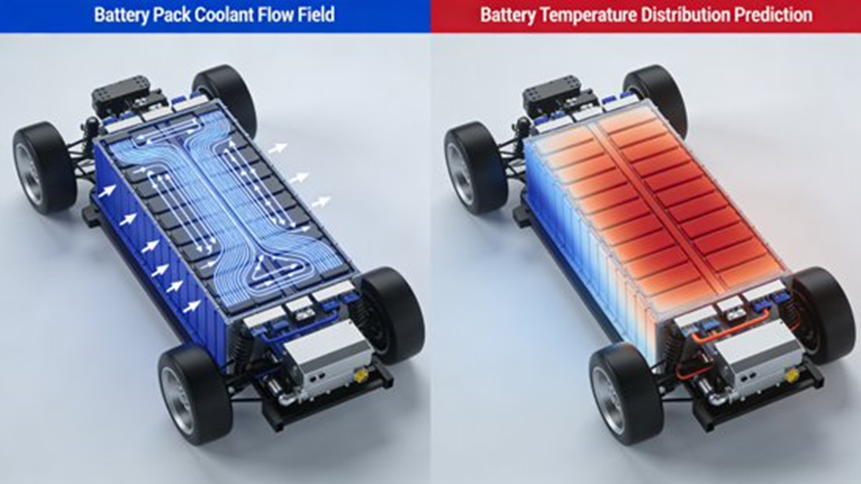
A clear example from the report is EV battery thermal management. There, the AI-coupled model can predict coolant distribution and pack temperature-field changes with error controlled within 2%, which is good enough to support design optimization.
Where is AICFD used in automotive engineering today?
The report highlights four main application areas:
- vehicle aerodynamic optimization,
- engine-bay thermal management,
- EV thermal management,
- cabin air quality and comfort.
These are not side cases. They are some of the most expensive, time-sensitive, and performance-linked parts of vehicle simulation work.
How does AICFD improve vehicle aerodynamic optimization?
This is the best-known and most developed automotive use case.
Aerodynamic performance affects:
- fuel economy,
- EV range,
- high-speed stability,
- and NVH, especially wind noise.
Traditional aerodynamic development usually depends on a loop of wind-tunnel testing plus standard CFD. That has worked for years, but it is costly, slow, and hard to scale when many body variants need to be checked.
AICFD changes that through an integrated loop built around:
geometry parameterization -> AI simulation prediction -> intelligent search for the best design
The report gives a clear engineering workflow.
Engineers start with FFD, or Free-Form Deformation, to parameterize the body shape. They can control and vary:
- front-end contour,
- roof arc,
- rear-end shape,
- side-mirror form.
That produces a large set of geometric variants.
Then AICFD uses historical simulation data to train an AI reduced-order model that can predict three-dimensional flow fields at second-level speed. That lets engineers assess key aerodynamic indicators such as:
- Cd (drag coefficient),
- Cl (lift coefficient).
After that, an AI optimization algorithm searches for the best body scheme while still respecting real design limits such as styling requirements and package space.
The report includes a concrete case from a domestic vehicle program. After using this AICFD toolchain, the team finished work in 15 days that had taken 3 months before. The body drag coefficient dropped from 0.32 to 0.26, fuel use improved by 0.8 L/100 km, and high-speed vehicle stability also improved.
That is a strong example of why AICFD matters. It turns aerodynamics from a bottleneck into a faster design loop.
What about aerodynamic noise and wind noise?
The report does not stop at drag.
It also covers aerodynamic noise simulation, which is becoming more important in EVs because powertrain noise drops and wind noise becomes easier for occupants to hear.
The report states that, after numerical-format optimization, AICFD can support full-vehicle wind-noise simulation on meshes around the 40-million-cell level, with speed comparable to foreign commercial software. It also says full-band sound-pressure results are close to measured values and meet automotive-industry use standards.
That matters because aeroacoustics is often harder to speed up than simple drag prediction.
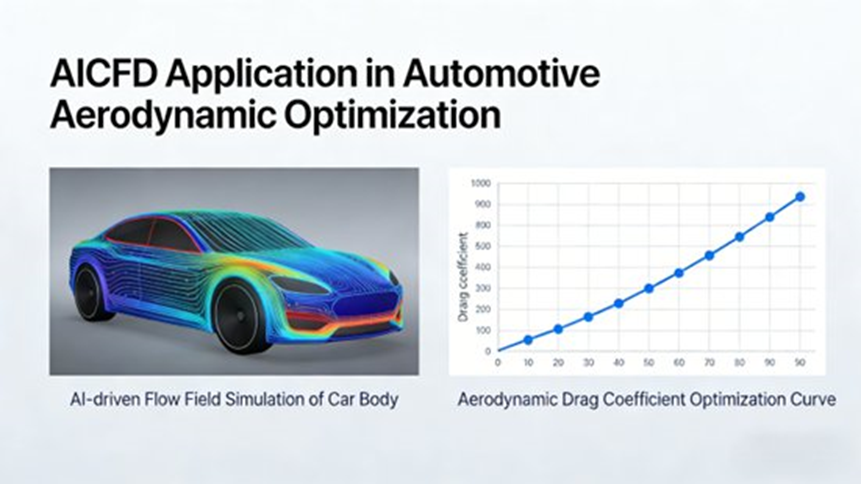
Figure 1. AICFD Application in Automotive Aerodynamic Optimization
Left: AI-driven flow-field simulation of car body; Right: aerodynamic drag-coefficient optimization curve.
Recent automotive aerodynamic benchmark work also shows that AI models are now being tested on realistic vehicle shapes, not just toy cases.
How does AICFD improve engine-bay thermal management?
Engine-bay flow is one of the hardest environments to simulate inside a vehicle.
It involves:
- the engine,
- radiator,
- condenser,
- fan,
- piping,
- recirculation zones,
- strong coupled heat transfer.
Traditional CFD can model all of this, but it is expensive in time and compute. It also takes skill to set up and interpret well.
The report explains that AICFD improves this area by bringing together:
- optimized multiphase-flow handling,
- improved conjugate-heat-transfer treatment,
- AI adaptive meshing,
- and dynamic boundary-condition support.
That allows teams to model engine-bay airflow and heat transfer under different operating conditions such as:
- idle,
- low speed,
- high speed.
They can then judge:
- radiator heat rejection,
- fan performance,
- and whether pipe routing makes sense.
The report includes a case from a joint-venture brand program. By optimizing:
- fan speed,
- radiator angle,
- pipe routing,
the team lowered the maximum engine-bay temperature by 12°C, raised radiator efficiency by 15%, reduced fan energy use, and solved a high-temperature warning issue that had become a real engineering problem.
The report also includes a practical detail that is easy to miss but matters for adoption: an AICFD “front-front processing” module with interactive Q&A can help engineers define physical scenarios and boundary conditions faster. That lowers the entry barrier so even less experienced users can get started more quickly.
Tianfu’s public product pages describe similar features around automatic meshing, guided setup, fast solving, and post-processing in automotive cases.
How does AICFD support EV battery, motor, and controller thermal management?
This is one of the highest-value application areas for AICFD in today’s vehicle industry.
In new-energy vehicles, thermal management directly affects:
- battery safety,
- battery life,
- range,
- motor efficiency,
- controller reliability.
The physics is hard because the system often includes:
- coolant circulation,
- airflow,
- phase-change heat transfer,
- temperature gradients in compact spaces.
The report says that, in battery thermal management, AICFD can model coolant distribution between battery modules, predict cell-to-cell temperature differences, and optimize coolant-pipe layout and flow allocation so that pack temperature spread stays within 3°C.
That detail matters because pack average temperature is not enough. Uniformity matters for both safety and life.
The report also says that AICFD can model airflow and heat transfer inside motors and electronic control assemblies, then improve cooling structures to reduce working temperature and raise efficiency and service life.
A real project example is also included. A new-energy vehicle company used AICFD to optimize its battery thermal-management system and got:
- 20% higher heat-dissipation efficiency,
- 10% higher range,
- and lower thermal-system manufacturing cost.
The report then goes a step further and says AI reduced-order models trained on historical simulation data can support real-time thermal simulation, which makes them useful for digital-twin systems and dynamic battery-thermal monitoring.
Public battery thermal-management research also keeps moving toward faster predictive models and real-time system tracking.
Figure 2. AICFD Simulation of New Energy Vehicle Battery Thermal Management
Left: battery-pack coolant flow field; Right: battery-temperature distribution prediction.
How does AICFD improve cabin air quality and passenger comfort?
Cabin air is a fluid problem, a thermal problem, and a comfort problem at the same time.
The report lists the main cabin air-quality indicators as:
- airflow velocity distribution,
- temperature distribution,
- pollutant spread, including formaldehyde and PM2.5.
Traditional CFD can model cabin airflow, but it becomes slow when engineers want to test many real operating cases, such as:
- HVAC on,
- windows open,
- different driving speeds.
AICFD helps here by speeding up the simulation and making repeated checks easier.
According to the report, it can model:
- HVAC outlet flow distribution,
- cabin thermal uniformity,
- pollutant spread paths,
- ventilation-system performance.
It can then be used to improve vent layout, airflow allocation, and ventilation-system design.
The report gives one premium-vehicle case. After adjusting vent layout and ventilation settings with AICFD, the team cut cabin temperature-adjustment time by 30% and raised pollutant-removal efficiency by 40%.
That affects comfort, climate-control feel, and cabin environmental quality in a real way.
Published work on vehicle cabin airflow and air quality also shows how ventilation choices can change particle and CO2 behavior inside the cabin.
How does AICFD compare with traditional CFD?
AICFD is faster and easier to scale for early design work. Traditional CFD still matters for final high-fidelity verification.
That is the main difference.
The report compares the two like this:
| Comparison Dimension | Traditional CFD | AICFD |
| Core paradigm | Mesh-based numerical iteration based on physical formulas | Data-driven plus physics-constrained integration |
| Computational speed | Slow; complex cases take hours to days | Very fast; seconds to minutes or a few hours, typically 50x–500x faster |
| Mesh dependence | High; needs strong mesh quality and manual work | Lower; adaptive meshing and mesh-free routes are possible |
| Simulation accuracy | Depends on empirical models; complex scenes may show 5%–10% error | Data-driven with physical constraints; complex-scene error can stay within 5% |
| Engineering fit | Complex operation, high learning cost, weak fit for rapid iteration | More intelligent, easier to use, supports batch simulation and automated search for better designs |
| Cost control | High compute cost, more wind-tunnel dependence | Lower compute demand, fewer wind-tunnel cycles, 30%–50% lower R&D cost in target workflows |
The report is careful on one point that should stay exactly as written in substance:
AICFD does not fully replace traditional CFD.
The better route is a combined workflow:
- use AICFD for fast prediction, large design-space exploration, and intelligent optimization,
- use traditional CFD for high-accuracy verification.
That combination gives the best balance of speed, accuracy, and engineering trust.
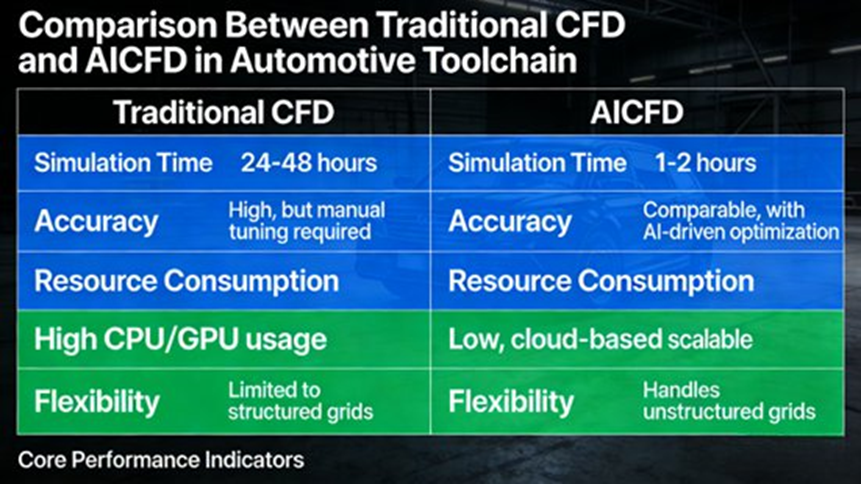
Figure 3. Comparison Between Traditional CFD and AICFD in the Automotive Toolchain
Core performance-indicator comparison.
What is slowing down AICFD adoption, and how can companies respond?
AICFD is promising, but the report says large-scale adoption still faces four main barriers:
- lack of high-quality data,
- weak explainability,
- shortage of cross-disciplinary talent,
- immature software ecosystem.
Each one is real.
High-quality data is still hard to get
AI models need a lot of high-quality labeled data, including:
- wind-tunnel data,
- DNS data,
- high-fidelity CFD data,
- and ideally some vehicle-test data.
That data is expensive to generate, hard to clean, and often scattered across teams.
Recommended response
The report suggests building an automotive fluid-simulation database that combines:
- wind-tunnel data,
- traditional CFD data,
- real-vehicle test data.
It also recommends cleaning and labeling the data and, where possible, using industry data-sharing through alliances to lower data-collection cost.
Engineers still need to trust the model
The black-box problem is real.
In safety-linked cases such as battery thermal management and engine cooling, engineers need to know why a model predicts what it predicts. A result without clear physical logic is hard to trust.
Recommended response
The report suggests using PINN-based physical constraints so the model is forced to follow the governing equations. It also recommends stronger result-visualization tools so engineers can inspect flow fields, temperature fields, and physical patterns directly.
That is a sensible route because it raises model trust without giving up speed.
The talent gap is still wide
AICFD asks for people who understand:
- fluid mechanics,
- AI algorithms,
- automotive engineering.
That mix is still rare.
Recommended response
The report suggests:
- internal cross-training in flow, AI, and engineering programming,
- and closer work with universities to build a stronger talent pipeline.
It describes the target engineer as someone with a combined flow + algorithm + coding skill set.
The software ecosystem is still developing
AICFD also has to fit into real industrial toolchains. That means CAD, CAE, model cleanup, solving, optimization, post-processing, and design review all need to connect well.
The report says domestic AICFD software is still growing in areas such as:
- large-scale multi-physics stability,
- very-large-mesh simulation,
- and workflow compatibility with established engineering systems.
Recommended response
The report suggests closer cooperation between software vendors and automotive R&D teams, plus better integration with CAD/CAE tools such as:
- CATIA
- ANSYS
The goal is a single engineering path from:
geometry modeling -> simulation analysis -> optimization design
That is the kind of workflow integration that will decide whether AICFD becomes a standard engineering tool or stays limited to selected projects.
Public neural CFD work also keeps stressing scale, physical consistency, and integration as major open areas.
What are the future trends for AICFD in automotive engineering?
The report lays out four future directions:
- generative AI for aerodynamic shape design,
- AICFD plus digital twins,
- stronger cross-scale and multi-physics simulation,
- growth of domestic AICFD software.
These four trends fit together well.
Generative AI will start shaping vehicle aero design
The report describes a future workflow where engineers enter aerodynamic targets and body-shape limits, and a generative model produces candidate forms automatically.
The example is clear:
- target: Cd ≤ 0.25
- constraints: vehicle length, width, height, and styling limits
- result: body forms generated by AI and then checked through second-level AICFD prediction
The report specifically names GANs and diffusion models as likely tools in this process.
That would create a closed loop of design -> simulation -> optimization with far less manual iteration and a better chance of finding shapes that human teams may not think of first.
Public research is already moving toward closed-loop AI systems for car-body design and aerodynamic prediction.
AICFD and digital twins will work together
This trend matters a lot for EVs and connected vehicles.
The report describes digital twins for vehicle fluid systems that take in real-time sensor data such as:
- engine temperature,
- battery temperature,
- cabin air-quality data.
AICFD then runs fast simulation on top of that live data, predicts system state, warns of faults such as overheating or thermal runaway, and helps adjust thermal or ventilation settings in real time.
That takes AICFD beyond offline design work and into live vehicle operation support.
Cross-scale and multi-physics simulation will get stronger
The report expects future AICFD systems to handle simulation across scales, from microscopic fluid behavior to full-vehicle flow fields, and across multiple physics:
- fluid,
- heat transfer,
- structure,
- electromagnetics.
It also gives two examples that should stay in the article because they show exactly where this is going:
- engine in-cylinder simulation, where airflow, fuel injection, combustion reaction, and heat transfer are solved together,
- battery-pack simulation, where fluid flow, temperature, and electrochemical reaction are solved in one coupled environment.
That kind of coupled simulation is where older workflows often become too slow for wide design-space search.
Domestic AICFD software will keep growing
The report makes a strong point here. Much of the automotive CFD market still depends on foreign commercial software, which creates pressure around cost, licensing, and technical dependence.
It points to domestic software such as Nanjing Tianfu AICFD and says locally built tools are getting better in:
- solver independence,
- fit for automotive use cases,
- speed,
- precision.
In some target workflows, the report says their performance is already close to, or beyond, foreign commercial tools.
Public Tianfu materials also position AICFD as an independently developed CFD platform for flow, heat transfer, multiphase flow, noise, and combustion, with direct coverage of drag, wind noise, full-vehicle thermal management, battery, motor, and controller analysis.
The report’s view is that this matters not only for cost, but also for a more self-controlled automotive software chain.
What does this mean for automotive R&D teams?
AICFD is not just a faster CFD switch.
It changes the way engineering teams can work.
With AICFD, teams can:
- test more design variants,
- narrow down better options earlier,
- reduce repeated wind-tunnel work,
- shorten the simulation loop,
- and reserve traditional CFD for the most demanding verification work.
That is the practical value.
The source report closes on the same point: AICFD has already become an important part of automotive aerodynamic development, engine thermal management, EV thermal systems, and cabin air-quality work. Even though data, trust, talent, and integration still need work, the direction is clear. As generative AI, digital twins, and coupled simulation keep improving, AICFD will push automotive development toward a process that is more intelligent, more precise, and faster to use.
For automotive engineers and product teams, learning how AICFD works is now part of staying competitive.
FAQs
What is AI-enhanced CFD and how does it differ from traditional CFD?
AI-enhanced CFD adds machine learning to the CFD workflow so teams can predict flow behavior faster and reduce manual setup work. Traditional CFD depends mainly on mesh-based numerical solving, while AICFD adds learned models that can help with meshing, solver speed, and flow prediction.
In practice, AICFD combines methods such as PINNs, GNNs, and data-driven surrogate models with standard CFD workflows. That gives teams a faster route for early design checks and optimization, while traditional CFD still plays a major role in final validation. Public research in neural CFD and automotive aero benchmarks reflects the same split between fast prediction and high-fidelity verification.
What are the main benefits of using AI in CFD for automotive design?
The main gains are faster simulation, less manual meshing work, lower compute cost in repeated studies, and better support for design optimization. That makes a big difference when teams need to compare many geometry variants in a short program window.
In automotive work, these gains show up most clearly in aerodynamic optimization, engine-bay cooling, EV thermal systems, and cabin airflow studies. AICFD lets teams screen more designs, get answers earlier, and shift CFD from a late validation step toward a broader design tool. Recent automotive AI-CFD benchmark work has been built around these same practical goals.
How does AI accelerate CFD simulations technically?
AI speeds CFD through three main routes: PINNs, surrogate models, and hybrid solver assistance. Each one cuts time in a different part of the workflow.
PINNs embed the governing equations into network training, which can reduce or bypass heavy meshing in some problems. Surrogate models learn from existing simulation data and then predict drag, pressure, or flow fields very quickly. Hybrid methods help standard solvers by predicting convergence trends, initializing fields, or reducing the number of iterations needed. Those routes are now central themes in current AI-CFD work.
What are the challenges or limitations of AICFD adoption in automotive workflows?
The biggest issues are data quality, generalization, model trust, and software integration. A model can look good in a narrow test set and still struggle when it sees a new geometry or a new operating condition.
That is why companies still need strong datasets, physical constraints, and a clean integration path into CAD, CAE, and HPC systems. Public neural CFD research keeps pointing to scale, physical consistency, and robust industrial deployment as the hardest problems still open today.
What is the future outlook of AICFD in automotive research and industry?
The field is moving toward more automated design loops, real-time digital twins, and stronger physics-plus-ML simulation frameworks. That points to faster body-shape generation, quicker thermal checks, and broader coupled simulation in real engineering programs.
For automotive teams, that likely means AI-assisted geometry generation, real-time thermal monitoring, wider use of reduced-order models, and stronger local software ecosystems. Research on closed-loop automotive design systems and large neural CFD models is already moving in that direction.
About the Author
Johnny Liu is the CEO at Dowway Vehicle. His work focuses on vehicle engineering, product development strategy, and the use of digital engineering tools in automotive R&D.
Editorial note:
This article is based on the full technical report provided for this project, with selected public references added to support current search, AI-CFD, and toolchain context. It is written for engineering analysis and industry reference.
References
- Google Search Central, AI Features and Your Website. Accessed March 13, 2026.
- Google Search Central, Creating Helpful, Reliable, People-First Content. Accessed March 13, 2026.
- Raissi, Perdikaris, Karniadakis, Physics-informed neural networks. Journal of Computational Physics.
- AI meshing and automotive aerodynamic benchmark sources.
- Neural CFD and industrial-scale deployment discussion.
- Real-world automotive aerodynamic surrogate benchmarking.
- Nanjing Tianfu official AICFD product pages.
- EV battery thermal-management literature.
- Vehicle cabin airflow and air-quality studies.
- Closed-loop AI automotive design research.
“By the way — if this helped you, I’d love your support.
✅ Leave a review for this GPT so more creators and professionals can benefit
✅ Need help with content, SEO, or business strategy? Send me a message anytime
✅ Want advanced growth playbooks, templates, and AI tools?
If you found this helpful, I’d truly appreciate a quick review — it helps this tool reach more creators.
Need help crafting high-ranking SEO/AEO content, building AI-powered marketing systems, or growing online visibility?
Feel free to message me here anytime, or explore more resources and updates at
👉 Visit: KhalidMarjan.com
Follow my journey & get daily insights:
You can also connect with me on social — I share deep-dive strategies, prompts, and growth secrets for modern entrepreneurs.
🔗 LinkedIn: https://www.linkedin.com/in/khalid-marjan-819589126/
🔗 Facebook: https://www.facebook.com/khalidmarjanumar/ – Digital Marketing, AI & Business growth content
Thanks for being here — keep building, keep creating, and let’s grow together 🚀”
- 题先给一段短回答,再展开
- 保留原报告全部技术细节、案例、数字、趋势,不做删减
- 语言改得更自然,避开你列出的高 AI 痕迹词和套话
- Meta Title 控制在 60 字符内
- Meta Description 控制在 160 字符内
- 补了 URL 和关键词提取
Keyword Extraction
Primary Keyword
AI-Enhanced CFD in Automotive Engineering
Secondary Keywords / Entity Set
- AI-enhanced Computational Fluid Dynamics
- AICFD
- automotive CFD
- AI CFD automotive
- vehicle aerodynamic optimization
- engine bay thermal management
- EV battery thermal management
- cabin air quality simulation
- physics-informed neural networks
- graph neural networks
- AI turbulence model
- digital twin in automotive engineering
- automotive simulation toolchain
- Nanjing Tianfu AICFD
Meta Pack
Meta Title
AI-Enhanced CFD for Automotive Engineering
Length: 42 / 60
Meta Description
See how AI-enhanced CFD helps car makers cut simulation time, improve aerodynamics, manage heat, and speed up EV development.
Length: 127 / 160
Suggested URL
https://www.yourdomain.com/ai-enhanced-cfd-automotive-engineering
Slug
ai-enhanced-cfd-automotive-engineering
AI-Enhanced CFD in Automotive Engineering
Author: Johnny Liu, CEO at Dowway Vehicle
Last Updated: March 13, 2026
Category: Automotive Engineering / CAE / CFD / AI
AI-enhanced Computational Fluid Dynamics, or AICFD, is changing how automotive teams run aerodynamic, thermal, and airflow simulation. By bringing AI into mesh generation, solver acceleration, physical-model tuning, and design optimization, AICFD helps teams get useful answers faster, run more iterations, lower simulation cost, and support vehicle development with a tighter engineering loop.
TL;DR
- AICFD combines AI methods such as deep learning, PINNs, and GNNs with CFD workflows.
- It improves mesh generation, solver speed, and physical-model accuracy.
- In automotive work, it is already useful for body aerodynamics, wind noise, engine-bay cooling, EV thermal systems, and cabin air quality.
- It works best with traditional CFD, not as a full replacement.
- The main barriers are data, explainability, talent, and software integration.
Most vehicle programs do not slow down because engineers run out of ideas. They slow down because good simulation still takes too much setup, too much compute time, and too much manual work before the first design decision can be made.
That is where AICFD starts to matter.
It shifts CFD from a process driven mostly by manual experience to one driven by data and physics together. Public guidance for AI-era search visibility still points back to the same basics: clear text, strong page structure, helpful content, and easy crawlability.
What is AI-enhanced CFD in automotive engineering?
AICFD is the deep integration of AI and traditional CFD. It is not just an AI tool sitting beside a CFD package. It changes the core simulation workflow itself.
In automotive engineering, CFD is one of the main tools behind aerodynamic performance, thermal-system design, powertrain efficiency, wind-noise analysis, EV battery cooling, and cabin airflow work. Its simulation accuracy and speed can affect development time, cost, and product performance in a direct way.
Traditional CFD still does the heavy lifting in many programs, but it comes with familiar pain points:
- mesh generation takes time,
- solver cycles can run for hours or days,
- parameter tuning often depends on senior engineer experience,
- and optimization loops become expensive as geometry and physics get more complex.
AICFD is built to address those pain points. In the source report, it is described as a system that blends AI methods such as deep learning, Physics-Informed Neural Networks, and Graph Neural Networks with CFD’s numerical solving, mesh handling, and physical modeling. The goal is simple: higher accuracy, faster runs, and lower cost at the same time.
That direction also matches public research in AI for CFD, where current work focuses on surrogate modeling, PINN-based learning, mesh intelligence, and automotive aerodynamic benchmarks.
Why is AICFD becoming a core part of the automotive toolchain?
AICFD is gaining ground because vehicle development is moving faster while the simulation work is getting harder.
Automakers now need to improve drag, cooling, noise, range, and thermal safety in shorter development windows. At the same time, the physics is not getting simpler. A modern vehicle program may need to solve:
- external body aerodynamics,
- underbody flow,
- engine-bay heat rejection,
- battery cooling,
- motor and controller cooling,
- cabin ventilation,
- pollutant diffusion,
- and sometimes fluid-thermal-structural coupling.
That is a lot to ask from a workflow that still leans heavily on manual meshing and long solver times.
The source report makes this point clearly: CFD is a core tool in vehicle aero, thermal management, and powertrain efficiency work, and its speed and precision can shape product competitiveness. As AI continues to improve mesh handling, solving, and optimization, automotive teams can move from a simulation process driven mostly by manual setup to one driven by physics and learned data together.
That is why AICFD is now part of the broader automotive toolchain conversation, not just a niche research topic.
How does AICFD work at the technical level?
AICFD is built around three main technical modules:
- intelligent mesh generation and optimization,
- AI-enhanced solver methods,
- data-driven physical-model optimization.
These three modules connect tightly with real automotive use cases and form a closed technical loop.
How does intelligent mesh generation and optimization work?
Mesh quality still sits at the center of CFD accuracy. If the mesh is poor, the simulation result is hard to trust.
In traditional CFD, mesh generation for complex automotive geometry can take more than 40% of the total workflow time. That is easy to understand when you look at the kind of geometry involved:
- vehicle body curvature,
- engine-bay packaging,
- underbody channels,
- mirror shapes,
- pipe routing,
- battery-pack passages.
Manual meshing in those areas takes time and often depends on a skilled engineer who knows where the flow gradients will matter most. It can also create problems such as mesh distortion and negative-volume cells.
AICFD improves this part of the workflow in two main ways.
GNN-based intelligent mesh smoothing
The report describes a GNN-based mesh smoothing method that can automatically read neighborhood features from the geometry model without relying on node-input order. That allows the system to adjust node positions quickly and smooth the mesh with much less manual intervention.
The practical gain is speed. According to the report, mesh smoothing efficiency can improve by more than ten times, while also helping avoid mesh distortion issues that commonly slow down traditional workflows.
AI-based adaptive mesh refinement
AICFD also uses adaptive mesh refinement guided by AI analysis of the flow field in real time.
Instead of placing the same mesh density everywhere, the system looks for regions with strong gradients and then refines the mesh where it matters most. In automotive simulation, those regions include:
- body-surface boundary layers,
- vortices inside the engine bay,
- wake regions behind the vehicle,
- the front impact area,
- the mirror region,
- and the rear wake separation zone.
Smoother regions can then be meshed more loosely.
In full-vehicle aerodynamic simulation, that means dense mesh near the front windward face, around the mirrors, and inside the rear wake, while flatter body-side regions can use a sparser mesh. The report states that this can reduce total mesh count by 30% to 50% while keeping drag-coefficient error within 3%. That is strong enough for engineering design work.
Public work on AI meshing and automotive AI-CFD benchmarks points in the same direction: better automation, faster setup, and more consistent industrial use.
How do AI-enhanced solver methods speed up CFD?
Traditional CFD solvers are based on numerical methods such as the finite volume method. They solve the Navier–Stokes equations and related transport equations through repeated iteration. That gives solid results, but the compute load can be heavy.
A complex thermal case in automotive engineering, such as engine-bay cooling, may take hours or even days to solve.
The report explains that AICFD speeds this up through two main routes.
Physics-Informed Neural Networks
PINNs place the governing fluid equations directly inside the loss function of a neural network. In simple terms, the model is trained to fit the physics, not just the data.
That creates a path for mesh-free or reduced-mesh computation in some problems. It also removes one of the most time-consuming steps in standard CFD.
The report gives an automotive example: air leakage through a door gap. In a case like that, AICFD can raise compute speed by more than 500 times and bring the response down to the second level.
That kind of gain is not small. It changes the way simulation can be used in early design and quick checks.
Hybrid solver acceleration
A second route is hybrid acceleration, where AI does not replace the solver. It helps the solver run with fewer wasted iterations.
The report describes this as a setup in which AI:
- predicts residual-convergence trends,
- helps stop redundant computation earlier,
- and uses GNNs to predict pressure-field and velocity-field correction values.
That shortens the iteration cycle while keeping the solution close to traditional CFD accuracy.
In full-vehicle aerodynamic simulation, the report says solve time can drop from 24 hours to 2–3 hours, with accuracy staying in line with conventional CFD.
That is the kind of speed change that lets a team test many more design variants in the same program window.
Public research on PINNs and neural CFD also supports these routes as active areas of development for fluid simulation.
How does data-driven physical-model optimization improve simulation quality?
This is one of the most useful parts of AICFD for automotive engineering.
Traditional CFD often depends on empirical turbulence models such as:
- k-epsilon
- k-omega
These models are widely used and still valuable, but they are not perfect. In complex conditions such as high-speed body turbulence, in-cylinder flow, multiphase cooling, or conjugate heat transfer, their limits become easier to see.
AICFD brings in a data-driven route.
Instead of relying only on empirical formulas, it learns flow behavior from higher-quality data sources such as:
- wind-tunnel test data,
- Direct Numerical Simulation data,
- and high-accuracy flow datasets.
That makes it possible to build an AI turbulence model that can capture flow patterns more accurately in difficult scenarios.
The report also puts strong focus on multi-physics coupling, which matters a lot in vehicle engineering because many real cases are not “flow only.” They often involve:
- fluid + heat transfer,
- fluid + solid interaction,
- battery coolant flow + temperature coupling,
- and in some cases chemical-reaction behavior.
In these cases, AICFD can use AI to replace or simplify hard sub-models, such as complex chemical-kinetics modules, and learn the interaction between flow and solid structures more directly.
A clear example from the report is EV battery thermal management. There, the AI-coupled model can predict coolant distribution and pack temperature-field changes with error controlled within 2%, which is good enough to support design optimization.
Where is AICFD used in automotive engineering today?
The report highlights four main application areas:
- vehicle aerodynamic optimization,
- engine-bay thermal management,
- EV thermal management,
- cabin air quality and comfort.
These are not side cases. They are some of the most expensive, time-sensitive, and performance-linked parts of vehicle simulation work.
How does AICFD improve vehicle aerodynamic optimization?
This is the best-known and most developed automotive use case.
Aerodynamic performance affects:
- fuel economy,
- EV range,
- high-speed stability,
- and NVH, especially wind noise.
Traditional aerodynamic development usually depends on a loop of wind-tunnel testing plus standard CFD. That has worked for years, but it is costly, slow, and hard to scale when many body variants need to be checked.
AICFD changes that through an integrated loop built around:
geometry parameterization -> AI simulation prediction -> intelligent search for the best design
The report gives a clear engineering workflow.
Engineers start with FFD, or Free-Form Deformation, to parameterize the body shape. They can control and vary:
- front-end contour,
- roof arc,
- rear-end shape,
- side-mirror form.
That produces a large set of geometric variants.
Then AICFD uses historical simulation data to train an AI reduced-order model that can predict three-dimensional flow fields at second-level speed. That lets engineers assess key aerodynamic indicators such as:
- Cd (drag coefficient),
- Cl (lift coefficient).
After that, an AI optimization algorithm searches for the best body scheme while still respecting real design limits such as styling requirements and package space.
The report includes a concrete case from a domestic vehicle program. After using this AICFD toolchain, the team finished work in 15 days that had taken 3 months before. The body drag coefficient dropped from 0.32 to 0.26, fuel use improved by 0.8 L/100 km, and high-speed vehicle stability also improved.
That is a strong example of why AICFD matters. It turns aerodynamics from a bottleneck into a faster design loop.
What about aerodynamic noise and wind noise?
The report does not stop at drag.
It also covers aerodynamic noise simulation, which is becoming more important in EVs because powertrain noise drops and wind noise becomes easier for occupants to hear.
The report states that, after numerical-format optimization, AICFD can support full-vehicle wind-noise simulation on meshes around the 40-million-cell level, with speed comparable to foreign commercial software. It also says full-band sound-pressure results are close to measured values and meet automotive-industry use standards.
That matters because aeroacoustics is often harder to speed up than simple drag prediction.
Figure 1. AICFD Application in Automotive Aerodynamic Optimization
Left: AI-driven flow-field simulation of car body; Right: aerodynamic drag-coefficient optimization curve.
Recent automotive aerodynamic benchmark work also shows that AI models are now being tested on realistic vehicle shapes, not just toy cases.
How does AICFD improve engine-bay thermal management?
Engine-bay flow is one of the hardest environments to simulate inside a vehicle.
It involves:
- the engine,
- radiator,
- condenser,
- fan,
- piping,
- recirculation zones,
- strong coupled heat transfer.
Traditional CFD can model all of this, but it is expensive in time and compute. It also takes skill to set up and interpret well.
The report explains that AICFD improves this area by bringing together:
- optimized multiphase-flow handling,
- improved conjugate-heat-transfer treatment,
- AI adaptive meshing,
- and dynamic boundary-condition support.
That allows teams to model engine-bay airflow and heat transfer under different operating conditions such as:
- idle,
- low speed,
- high speed.
They can then judge:
- radiator heat rejection,
- fan performance,
- and whether pipe routing makes sense.
The report includes a case from a joint-venture brand program. By optimizing:
- fan speed,
- radiator angle,
- pipe routing,
the team lowered the maximum engine-bay temperature by 12°C, raised radiator efficiency by 15%, reduced fan energy use, and solved a high-temperature warning issue that had become a real engineering problem.
The report also includes a practical detail that is easy to miss but matters for adoption: an AICFD “front-front processing” module with interactive Q&A can help engineers define physical scenarios and boundary conditions faster. That lowers the entry barrier so even less experienced users can get started more quickly.
Tianfu’s public product pages describe similar features around automatic meshing, guided setup, fast solving, and post-processing in automotive cases.
How does AICFD support EV battery, motor, and controller thermal management?
This is one of the highest-value application areas for AICFD in today’s vehicle industry.
In new-energy vehicles, thermal management directly affects:
- battery safety,
- battery life,
- range,
- motor efficiency,
- controller reliability.
The physics is hard because the system often includes:
- coolant circulation,
- airflow,
- phase-change heat transfer,
- temperature gradients in compact spaces.
The report says that, in battery thermal management, AICFD can model coolant distribution between battery modules, predict cell-to-cell temperature differences, and optimize coolant-pipe layout and flow allocation so that pack temperature spread stays within 3°C.
That detail matters because pack average temperature is not enough. Uniformity matters for both safety and life.
The report also says that AICFD can model airflow and heat transfer inside motors and electronic control assemblies, then improve cooling structures to reduce working temperature and raise efficiency and service life.
A real project example is also included. A new-energy vehicle company used AICFD to optimize its battery thermal-management system and got:
- 20% higher heat-dissipation efficiency,
- 10% higher range,
- and lower thermal-system manufacturing cost.
The report then goes a step further and says AI reduced-order models trained on historical simulation data can support real-time thermal simulation, which makes them useful for digital-twin systems and dynamic battery-thermal monitoring.
Public battery thermal-management research also keeps moving toward faster predictive models and real-time system tracking.
Figure 2. AICFD Simulation of New Energy Vehicle Battery Thermal Management
Left: battery-pack coolant flow field; Right: battery-temperature distribution prediction.
How does AICFD improve cabin air quality and passenger comfort?
Cabin air is a fluid problem, a thermal problem, and a comfort problem at the same time.
The report lists the main cabin air-quality indicators as:
- airflow velocity distribution,
- temperature distribution,
- pollutant spread, including formaldehyde and PM2.5.
Traditional CFD can model cabin airflow, but it becomes slow when engineers want to test many real operating cases, such as:
- HVAC on,
- windows open,
- different driving speeds.
AICFD helps here by speeding up the simulation and making repeated checks easier.
According to the report, it can model:
- HVAC outlet flow distribution,
- cabin thermal uniformity,
- pollutant spread paths,
- ventilation-system performance.
It can then be used to improve vent layout, airflow allocation, and ventilation-system design.
The report gives one premium-vehicle case. After adjusting vent layout and ventilation settings with AICFD, the team cut cabin temperature-adjustment time by 30% and raised pollutant-removal efficiency by 40%.
That affects comfort, climate-control feel, and cabin environmental quality in a real way.
Published work on vehicle cabin airflow and air quality also shows how ventilation choices can change particle and CO2 behavior inside the cabin.
How does AICFD compare with traditional CFD?
AICFD is faster and easier to scale for early design work. Traditional CFD still matters for final high-fidelity verification.
That is the main difference.
The report compares the two like this:
| Comparison Dimension | Traditional CFD | AICFD |
| Core paradigm | Mesh-based numerical iteration based on physical formulas | Data-driven plus physics-constrained integration |
| Computational speed | Slow; complex cases take hours to days | Very fast; seconds to minutes or a few hours, typically 50x–500x faster |
| Mesh dependence | High; needs strong mesh quality and manual work | Lower; adaptive meshing and mesh-free routes are possible |
| Simulation accuracy | Depends on empirical models; complex scenes may show 5%–10% error | Data-driven with physical constraints; complex-scene error can stay within 5% |
| Engineering fit | Complex operation, high learning cost, weak fit for rapid iteration | More intelligent, easier to use, supports batch simulation and automated search for better designs |
| Cost control | High compute cost, more wind-tunnel dependence | Lower compute demand, fewer wind-tunnel cycles, 30%–50% lower R&D cost in target workflows |
The report is careful on one point that should stay exactly as written in substance:
AICFD does not fully replace traditional CFD.
The better route is a combined workflow:
- use AICFD for fast prediction, large design-space exploration, and intelligent optimization,
- use traditional CFD for high-accuracy verification.
That combination gives the best balance of speed, accuracy, and engineering trust.
Figure 3. Comparison Between Traditional CFD and AICFD in the Automotive Toolchain
Core performance-indicator comparison.
What is slowing down AICFD adoption, and how can companies respond?
AICFD is promising, but the report says large-scale adoption still faces four main barriers:
- lack of high-quality data,
- weak explainability,
- shortage of cross-disciplinary talent,
- immature software ecosystem.
Each one is real.
High-quality data is still hard to get
AI models need a lot of high-quality labeled data, including:
- wind-tunnel data,
- DNS data,
- high-fidelity CFD data,
- and ideally some vehicle-test data.
That data is expensive to generate, hard to clean, and often scattered across teams.
Recommended response
The report suggests building an automotive fluid-simulation database that combines:
- wind-tunnel data,
- traditional CFD data,
- real-vehicle test data.
It also recommends cleaning and labeling the data and, where possible, using industry data-sharing through alliances to lower data-collection cost.
Engineers still need to trust the model
The black-box problem is real.
In safety-linked cases such as battery thermal management and engine cooling, engineers need to know why a model predicts what it predicts. A result without clear physical logic is hard to trust.
Recommended response
The report suggests using PINN-based physical constraints so the model is forced to follow the governing equations. It also recommends stronger result-visualization tools so engineers can inspect flow fields, temperature fields, and physical patterns directly.
That is a sensible route because it raises model trust without giving up speed.
The talent gap is still wide
AICFD asks for people who understand:
- fluid mechanics,
- AI algorithms,
- automotive engineering.
That mix is still rare.
Recommended response
The report suggests:
- internal cross-training in flow, AI, and engineering programming,
- and closer work with universities to build a stronger talent pipeline.
It describes the target engineer as someone with a combined flow + algorithm + coding skill set.
The software ecosystem is still developing
AICFD also has to fit into real industrial toolchains. That means CAD, CAE, model cleanup, solving, optimization, post-processing, and design review all need to connect well.
The report says domestic AICFD software is still growing in areas such as:
- large-scale multi-physics stability,
- very-large-mesh simulation,
- and workflow compatibility with established engineering systems.
Recommended response
The report suggests closer cooperation between software vendors and automotive R&D teams, plus better integration with CAD/CAE tools such as:
- CATIA
- ANSYS
The goal is a single engineering path from:
geometry modeling -> simulation analysis -> optimization design
That is the kind of workflow integration that will decide whether AICFD becomes a standard engineering tool or stays limited to selected projects.
Public neural CFD work also keeps stressing scale, physical consistency, and integration as major open areas.
What are the future trends for AICFD in automotive engineering?
The report lays out four future directions:
- generative AI for aerodynamic shape design,
- AICFD plus digital twins,
- stronger cross-scale and multi-physics simulation,
- growth of domestic AICFD software.
These four trends fit together well.
Generative AI will start shaping vehicle aero design
The report describes a future workflow where engineers enter aerodynamic targets and body-shape limits, and a generative model produces candidate forms automatically.
The example is clear:
- target: Cd ≤ 0.25
- constraints: vehicle length, width, height, and styling limits
- result: body forms generated by AI and then checked through second-level AICFD prediction
The report specifically names GANs and diffusion models as likely tools in this process.
That would create a closed loop of design -> simulation -> optimization with far less manual iteration and a better chance of finding shapes that human teams may not think of first.
Public research is already moving toward closed-loop AI systems for car-body design and aerodynamic prediction.
AICFD and digital twins will work together
This trend matters a lot for EVs and connected vehicles.
The report describes digital twins for vehicle fluid systems that take in real-time sensor data such as:
- engine temperature,
- battery temperature,
- cabin air-quality data.
AICFD then runs fast simulation on top of that live data, predicts system state, warns of faults such as overheating or thermal runaway, and helps adjust thermal or ventilation settings in real time.
That takes AICFD beyond offline design work and into live vehicle operation support.
Cross-scale and multi-physics simulation will get stronger
The report expects future AICFD systems to handle simulation across scales, from microscopic fluid behavior to full-vehicle flow fields, and across multiple physics:
- fluid,
- heat transfer,
- structure,
- electromagnetics.
It also gives two examples that should stay in the article because they show exactly where this is going:
- engine in-cylinder simulation, where airflow, fuel injection, combustion reaction, and heat transfer are solved together,
- battery-pack simulation, where fluid flow, temperature, and electrochemical reaction are solved in one coupled environment.
That kind of coupled simulation is where older workflows often become too slow for wide design-space search.
Domestic AICFD software will keep growing
The report makes a strong point here. Much of the automotive CFD market still depends on foreign commercial software, which creates pressure around cost, licensing, and technical dependence.
It points to domestic software such as Nanjing Tianfu AICFD and says locally built tools are getting better in:
- solver independence,
- fit for automotive use cases,
- speed,
- precision.
In some target workflows, the report says their performance is already close to, or beyond, foreign commercial tools.
Public Tianfu materials also position AICFD as an independently developed CFD platform for flow, heat transfer, multiphase flow, noise, and combustion, with direct coverage of drag, wind noise, full-vehicle thermal management, battery, motor, and controller analysis.
The report’s view is that this matters not only for cost, but also for a more self-controlled automotive software chain.
What does this mean for automotive R&D teams?
AICFD is not just a faster CFD switch.
It changes the way engineering teams can work.
With AICFD, teams can:
- test more design variants,
- narrow down better options earlier,
- reduce repeated wind-tunnel work,
- shorten the simulation loop,
- and reserve traditional CFD for the most demanding verification work.
That is the practical value.
The source report closes on the same point: AICFD has already become an important part of automotive aerodynamic development, engine thermal management, EV thermal systems, and cabin air-quality work. Even though data, trust, talent, and integration still need work, the direction is clear. As generative AI, digital twins, and coupled simulation keep improving, AICFD will push automotive development toward a process that is more intelligent, more precise, and faster to use.
For automotive engineers and product teams, learning how AICFD works is now part of staying competitive.
FAQs
What is AI-enhanced CFD and how does it differ from traditional CFD?
AI-enhanced CFD adds machine learning to the CFD workflow so teams can predict flow behavior faster and reduce manual setup work. Traditional CFD depends mainly on mesh-based numerical solving, while AICFD adds learned models that can help with meshing, solver speed, and flow prediction.
In practice, AICFD combines methods such as PINNs, GNNs, and data-driven surrogate models with standard CFD workflows. That gives teams a faster route for early design checks and optimization, while traditional CFD still plays a major role in final validation. Public research in neural CFD and automotive aero benchmarks reflects the same split between fast prediction and high-fidelity verification.
What are the main benefits of using AI in CFD for automotive design?
The main gains are faster simulation, less manual meshing work, lower compute cost in repeated studies, and better support for design optimization. That makes a big difference when teams need to compare many geometry variants in a short program window.
In automotive work, these gains show up most clearly in aerodynamic optimization, engine-bay cooling, EV thermal systems, and cabin airflow studies. AICFD lets teams screen more designs, get answers earlier, and shift CFD from a late validation step toward a broader design tool. Recent automotive AI-CFD benchmark work has been built around these same practical goals.
How does AI accelerate CFD simulations technically?
AI speeds CFD through three main routes: PINNs, surrogate models, and hybrid solver assistance. Each one cuts time in a different part of the workflow.
PINNs embed the governing equations into network training, which can reduce or bypass heavy meshing in some problems. Surrogate models learn from existing simulation data and then predict drag, pressure, or flow fields very quickly. Hybrid methods help standard solvers by predicting convergence trends, initializing fields, or reducing the number of iterations needed. Those routes are now central themes in current AI-CFD work.
What are the challenges or limitations of AICFD adoption in automotive workflows?
The biggest issues are data quality, generalization, model trust, and software integration. A model can look good in a narrow test set and still struggle when it sees a new geometry or a new operating condition.
That is why companies still need strong datasets, physical constraints, and a clean integration path into CAD, CAE, and HPC systems. Public neural CFD research keeps pointing to scale, physical consistency, and robust industrial deployment as the hardest problems still open today.
What is the future outlook of AICFD in automotive research and industry?
The field is moving toward more automated design loops, real-time digital twins, and stronger physics-plus-ML simulation frameworks. That points to faster body-shape generation, quicker thermal checks, and broader coupled simulation in real engineering programs.
For automotive teams, that likely means AI-assisted geometry generation, real-time thermal monitoring, wider use of reduced-order models, and stronger local software ecosystems. Research on closed-loop automotive design systems and large neural CFD models is already moving in that direction.
About the Author
Johnny Liu is the CEO at Dowway Vehicle. His work focuses on vehicle engineering, product development strategy, and the use of digital engineering tools in automotive R&D.
Editorial note:
This article is based on the full technical report provided for this project, with selected public references added to support current search, AI-CFD, and toolchain context. It is written for engineering analysis and industry reference.
References
- Google Search Central, AI Features and Your Website. Accessed March 13, 2026.
- Google Search Central, Creating Helpful, Reliable, People-First Content. Accessed March 13, 2026.
- Raissi, Perdikaris, Karniadakis, Physics-informed neural networks. Journal of Computational Physics.
- AI meshing and automotive aerodynamic benchmark sources.
- Neural CFD and industrial-scale deployment discussion.
- Real-world automotive aerodynamic surrogate benchmarking.
- Nanjing Tianfu official AICFD product pages.
- EV battery thermal-management literature.
- Vehicle cabin airflow and air-quality studies.
- Closed-loop AI automotive design research.
