

< Back to Data Acquisition Toolchain
By Johnny Liu, CEO at Dowway Vehicle
Last Updated: March 2026
- Introduction to Automated Driving (AD) Technology
- Overview of AD Station Series
- Key Components of AD Station Series
- Core Technical Specifications and Benefits
- Engineering Applications of AD Station Series
- AD Station Series Compatibility and Integration
- Real-World Use Cases and Success Stories
- Technical Advantages and Industry Value
- Conclusion: The Future of Automated Driving Test Equipment
- ❓ 1. What exactly is the AD Station Series and what problems does it solve?
- ❓ 2. How does AD Station Series handle data synchronization across multiple sensors?
- ❓ 3. What types of data acquisition and injection can AD Station Series perform?
- ❓ 4. What hardware capabilities are highlighted for AD Station Workstations like W100?
- ❓ 5. Can AD Station Series be used for both real vehicle tests and simulation/virtual environments?
Introduction to Automated Driving (AD) Technology
The field of automated driving (AD) has advanced rapidly, especially as the technology progresses from Level 2 (L2) automation to Level 4 (L4) and beyond. This progress brings about the need for automated driving test equipment to ensure the systems work reliably and safely in real-world environments. With autonomous vehicles (AVs) requiring vast amounts of data from various sensors, proper test equipment is crucial to capture, process, and validate this data.
Levels of Automation
- L2 (Partial Automation): The system helps with some driving functions, but a human must remain in control.
- L3 (Conditional Automation): The vehicle can manage driving tasks but needs a human to take over when necessary.
- L4 (High Automation): The vehicle can fully operate autonomously in certain environments, without human intervention.
- L5 (Full Automation): The vehicle operates completely autonomously in all environments.
Automated Driving Test Equipment like the AD Station Series plays a key role in the development and testing of these systems, ensuring they meet the standards required for deployment.
Overview of AD Station Series
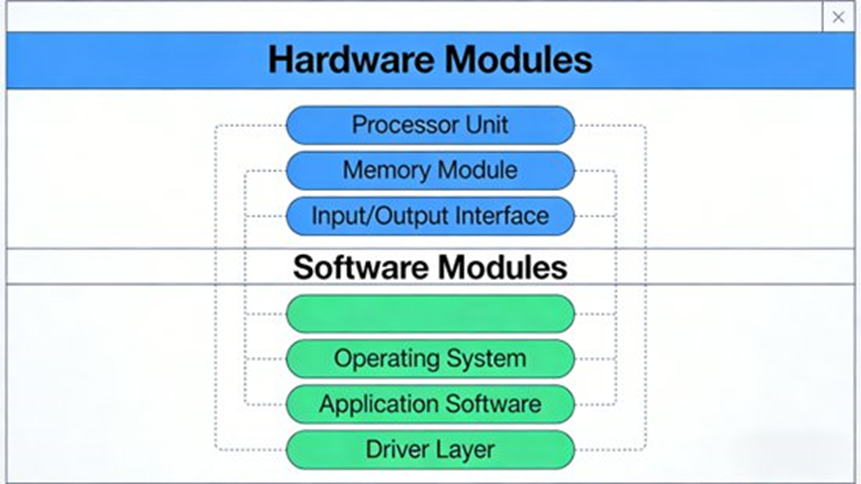
The AD Station Series is a comprehensive solution for autonomous driving development, integrating data collection, real-time processing, and algorithm validation. It is used to test and validate autonomous systems by providing synchronized sensor data, high-precision timestamps, and scenario simulations.
Core Features of AD Station Series
- All-in-One Solution: Covers data collection, processing, and validation for autonomous driving systems.
- Modular Architecture: Offers flexibility with hardware components and software customization to suit various stages of AD development.
- High Precision and Scalability: Supports the testing of L2 to L5 automation levels with precise multi-sensor data synchronization.
Key Components of AD Station Series
Hardware Overview
- Main Control Module: Built with Intel Xeon Gold 5317 processors for robust performance during data processing.
- Sensor Interface Modules: Compatible with various sensors through GMSL, Ethernet, and CAN interfaces.
- Data Storage and Processing: Equipped with up to 4TB DDR4 RAM and NVMe SSD for high-capacity data storage and fast processing.
- Computational Power: Supports dual RTX 3090 GPUs and Xilinx FPGA chips for real-time AI processing.
Software Capabilities
- Modular Software Design: Built on Linux Ubuntu 20.04, offering flexibility in data collection and real-time synchronization for algorithms.
- Algorithm Integration: Seamlessly integrates with popular tools like Simulink and Prescan for validating AD algorithms like object detection and sensor fusion.
Core Technical Specifications and Benefits
High-Performance Computing for AD Testing
The AD Station Series is designed to manage complex data collection tasks:
- Intel Xeon Processors for high-speed data processing.
- 16TB of RAM and NVMe SSDs to handle large-scale data without lag.
- GPU and FPGA Integration for AI-driven real-time decision-making.
Precision Synchronization for Multiple Sensors
AD Station Series uses PTP (Precision Time Protocol) and GPS synchronization for sub-millisecond precision across all sensors. This ensures that cameras, LIDAR, IMU, and radar data is synchronized, enabling accurate data fusion for real-time processing.
Adaptability for Different Development Stages
The system adapts to different levels of AD development:
- L2-L3 Testing: Used for validating assisted driving algorithms.
- L4-L5 Testing: Provides real-world testing for fully autonomous vehicles in diverse environments.
Engineering Applications of AD Station Series
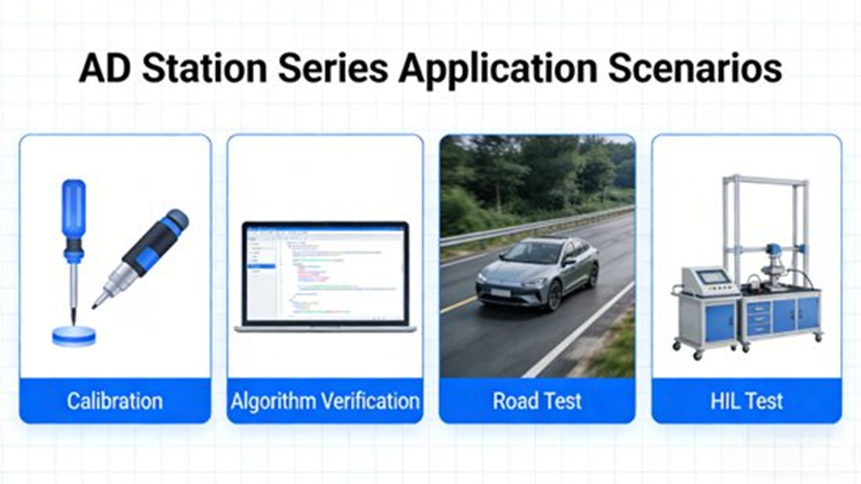
Sensor Calibration and Data Synchronization
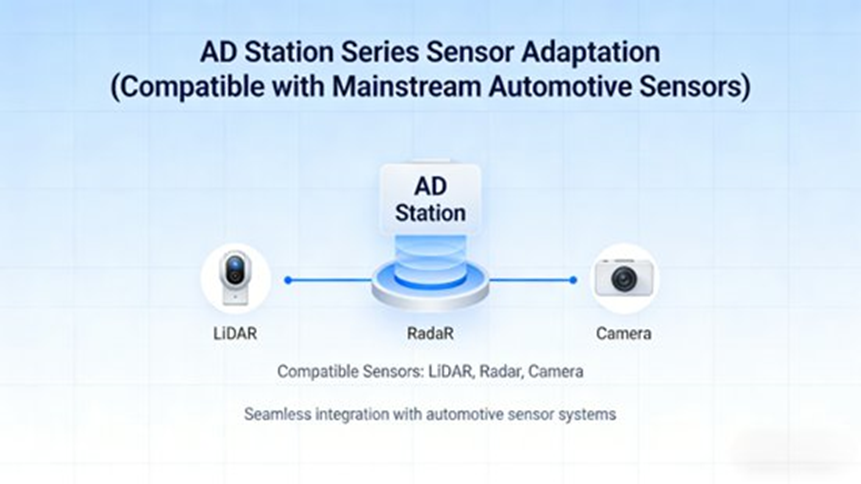
AD Station Series is essential for sensor calibration, ensuring that cameras, LIDAR, IMU, and radar work together seamlessly. It solves common issues like timestamp discrepancies, ensuring accurate multi-sensor data fusion for perception algorithms.
Algorithm Validation and Iteration
The system supports quick algorithm testing and optimization. By feeding real-world sensor data into the algorithm, engineers can iterate and fine-tune the system efficiently.
Vehicle Testing and Road Data Collection
AD Station Series can be deployed in real-world vehicle road tests, capturing sensor data and allowing engineers to remotely monitor and analyze test results in real-time.
Hardware-in-the-Loop (HIL) Testing for System Validation
The AD Station Series also supports hardware-in-the-loop (HIL) testing, allowing simulation software to inject virtual sensor data into real hardware setups. This enables efficient scenario testing and algorithm validation without needing physical tests.
AD Station Series Compatibility and Integration
Sensor and Algorithm Compatibility
The system supports a wide range of industry-standard sensors (e.g., Leopard, Velodyne, Mobileye) and is compatible with deep learning and reinforcement learning frameworks, ensuring it meets the needs of various autonomous driving algorithms.
Industry Collaboration and Customization
AD Station Series is highly customizable, allowing for collaboration with sensor manufacturers and software developers. This flexibility ensures the system integrates seamlessly with both experimental and production-level systems.
Real-World Use Cases and Success Stories
AD Station Series in L3 and L4 Testing
For example, a robotaxi company used AD Station Series to collect over 100TB of data in one day during urban road tests. This data improved the object detection algorithm’s accuracy to 99.2%.
Driving Efficiency in Autonomous Vehicle Development
By combining multiple testing functions into one platform, AD Station Series streamlines development cycles, reduces costs, and ensures that autonomous vehicles meet real-world performance standards.
Technical Advantages and Industry Value
Key Advantages of AD Station Series
- Integration: Combines data collection, processing, and validation into one comprehensive solution.
- Precision: Achieves sub-millisecond synchronization, ensuring accurate data fusion.
- Scalability: Adapts to both current and future AD development needs.
The Role of AD Station Series in the Autonomous Vehicle Industry
AD Station Series accelerates the development and deployment of autonomous driving systems, allowing for faster, more reliable testing.
Future Development and Evolution
The AD Station Series will continue evolving by incorporating technologies like AI-driven testing and digital twins, improving the system’s capabilities for complex scenario simulation and validation.
Conclusion: The Future of Automated Driving Test Equipment
As autonomous driving technology continues to evolve, AD Station Series remains a critical tool in ensuring these systems are thoroughly tested and validated. Its precision, flexibility, and scalability make it essential for any organization looking to deploy L4 or L5 autonomous vehicles successfully.
Top 5 Most Discussed FAQs (Last Month) — AD Station Series Technical & Engineering Application
❓ 1. What exactly is the AD Station Series and what problems does it solve?
Answer:
The AD Station Series is an integrated autonomous driving data acquisition and processing workstation, providing synchronized multi-sensor collection, high-precision timestamping, and real-time data handling for AD/ADAS development. It addresses challenges in sensor data fusion and algorithm validation. (vcarsystem.com)
❓ 2. How does AD Station Series handle data synchronization across multiple sensors?
Answer:
Using PTP/GPS synchronization, it ensures sub-millisecond precision in time synchronization between cameras, LIDAR, IMU, radar, and other sensors, facilitating accurate multi-sensor datasets for perception and fusion algorithms. (vcarsystem.com)
❓ 3. What types of data acquisition and injection can AD Station Series perform?
Answer:
It supports raw video capture, sensor data acquisition, low-latency bypass, and simulation data injection for HIL testing, enabling both real-world and virtual testing scenarios. (en.vcarsystem.com)
❓ 4. What hardware capabilities are highlighted for AD Station Workstations like W100?
Answer:
It features PCIe slots, GPU/CPU expandability, multi-channel capture cards, and FPGA integration, supporting AI/processing tasks with seamless Linux compatibility. (aumo.cn)
❓ 5. Can AD Station Series be used for both real vehicle tests and simulation/virtual environments?
Answer:
Yes, it is suitable for real vehicle road tests and HIL simulation environments, providing synchronized data from physical sensors and virtual simulations for comprehensive testing. (aumo.cn)
Summary of Key Points from Discussions
- AD Station Series is increasingly recognized as a core data solution for autonomous driving pipelines, bridging sensor acquisition, processing, and evaluation. (vcarsystem.com)
- High-precision time synchronization and multi-sensor support are key selling points. (vcarsystem.com)
Data injection and versatile use from real tests to simulated HIL environments are growing discussion points. (aumo.cn)
