


< Back to Automotive Simulation Toolchain
Author: Johnny Liu, CEO at Dowway Vehicle
Last Updated: March 2026
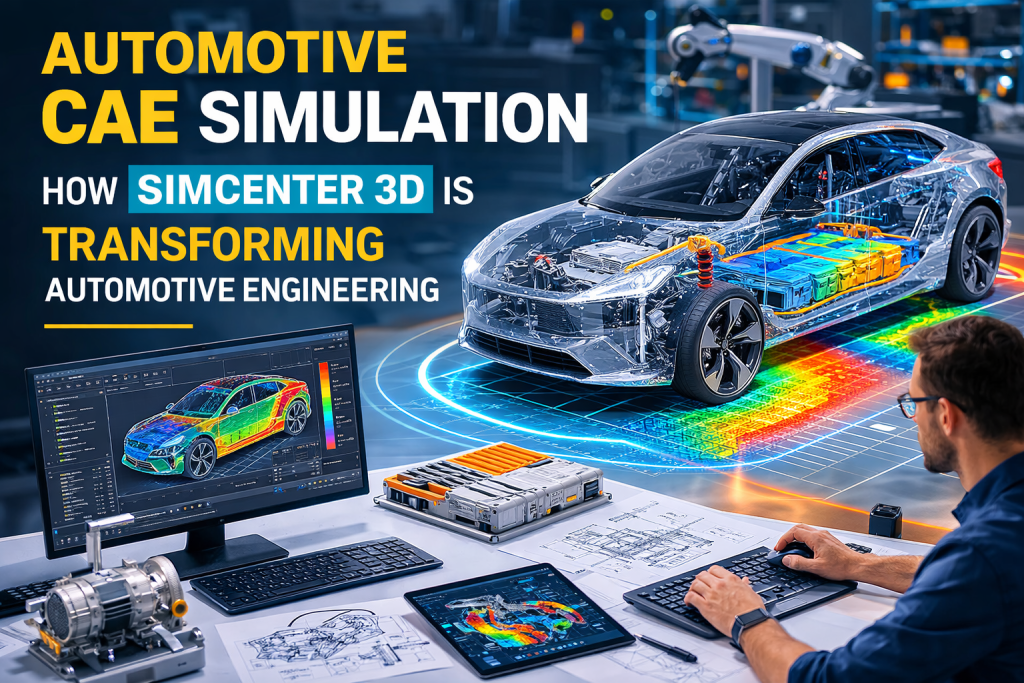
The automotive industry is transforming, with a growing need for advanced simulation tools that can predict vehicle performance accurately and efficiently. As electric vehicles (EVs), autonomous driving systems, and stricter safety standards emerge, traditional engineering approaches are no longer enough. Simcenter 3D, developed by Siemens, is helping automotive engineers meet these new challenges by providing a comprehensive CAE (Computer-Aided Engineering) platform that integrates multiple simulation disciplines into one environment. This article will explore how Simcenter 3D is used in automotive engineering, including its applications in structural analysis, NVH (Noise, Vibration, Harshness) testing, vehicle dynamics, and thermal management.
- What is Simcenter 3D and Why is it Important in Automotive Engineering?
- Key Features and Benefits of Simcenter 3D in Automotive Engineering
- Real-World Applications of Simcenter 3D in Automotive Engineering
- Simcenter 3D vs. Traditional Automotive CAE Tools
- The Future of Automotive CAE Simulation with Simcenter 3D
- FAQs on Automotive CAE Simulation and Simcenter 3D
- 1. What is Simcenter 3D and how is it used in automotive engineering?
- 2. How does Simcenter 3D integrate with NX and Teamcenter in the automotive toolchain?
- 3. How does Simcenter 3D perform NVH analysis?
- 4. What multiphysics simulations are supported in Simcenter 3D?
- 5. Why do automotive engineers use Simcenter 3D instead of traditional CAE tools?
- Conclusion
What is Simcenter 3D and Why is it Important in Automotive Engineering?
Simcenter 3D is a multi-disciplinary CAE simulation platform that combines structural, thermal, acoustic, motion, and electromagnetic simulations into one system. In automotive engineering, Simcenter 3D helps engineers:
- Predict vehicle structural strength and durability.
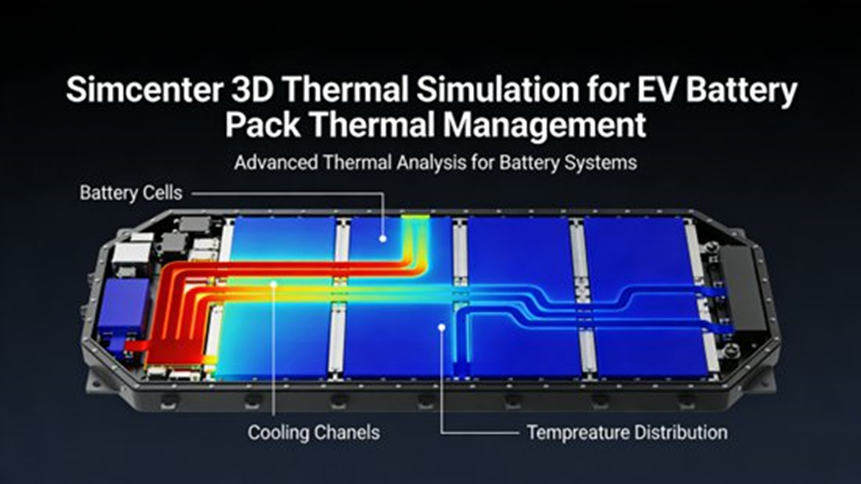
- Analyze thermal behavior of EV batteries.
- Simulate vehicle dynamics and suspension systems.
- Perform NVH analysis to ensure comfort and quietness in vehicles.
By integrating CAE and CAD workflows, Simcenter 3D reduces the need for physical prototypes and speeds up the product development process. Engineers can test and optimize designs virtually, making decisions earlier in the design cycle.
Key Features and Benefits of Simcenter 3D in Automotive Engineering
1. Multi-Disciplinary Integration for Faster Design
Simcenter 3D integrates various types of simulations into one unified platform:
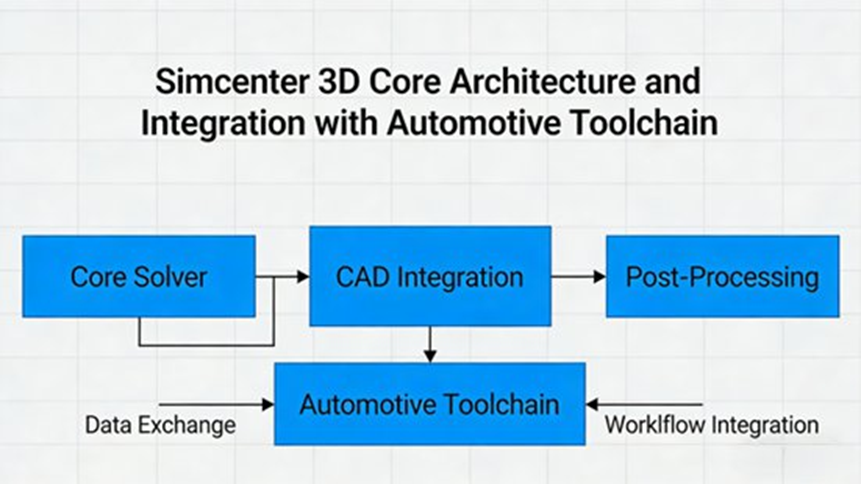
- CAD-CAE Integration: When changes are made to the CAD model, the simulation models automatically update, ensuring consistency.
- Multi-Physics Simulation: Engineers can simulate structural, thermal, fluid, and electromagnetic systems together, providing a more comprehensive view of vehicle performance.
- Centralized Data Management: The platform integrates with NX (CAD software) and Teamcenter (PLM), making it easier for different teams to collaborate and manage data.
2. Structural and Durability Simulation
Simcenter 3D plays a crucial role in ensuring that automotive components can withstand the stresses they face in real-world conditions. Key features include:
- Crash Simulations: Predicting how a vehicle’s structure will perform during a crash.
- Fatigue Analysis: Evaluating how parts perform under repeated stress over time.
- Lightweighting: Simulating and optimizing the use of lightweight materials, like composites and aluminum, to improve fuel efficiency and reduce vehicle weight.
These capabilities help engineers design stronger and more durable vehicles while optimizing performance.
3. NVH (Noise, Vibration, Harshness) Simulation
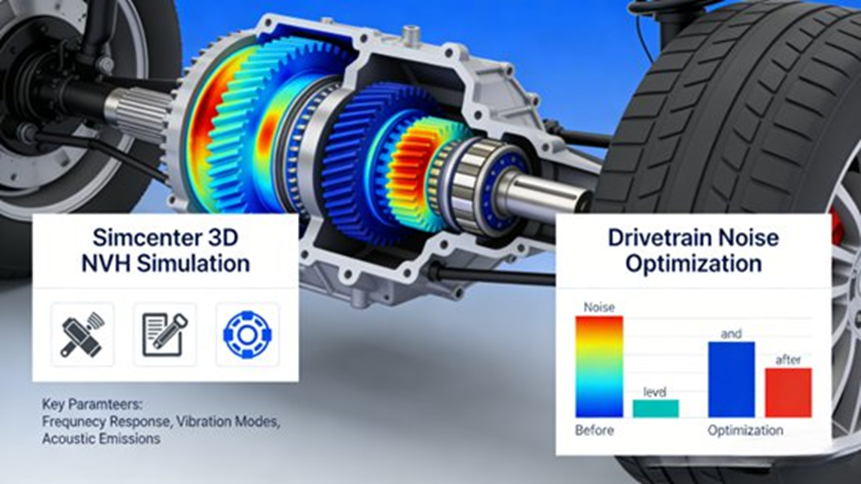
NVH performance is critical to vehicle comfort, especially in the case of electric vehicles (EVs), where engine noise is minimal. Simcenter 3D helps engineers evaluate and reduce unwanted noise and vibrations from components like the powertrain, tires, and suspension:
- Powertrain Noise: Simulating noise generated by the engine, transmission, or electric motors.
- Road Noise: Analyzing how the road interacts with the tires and chassis to generate noise.
- Cabin Noise: Modeling how sound travels inside the vehicle to improve comfort.
Using advanced methods like Finite Element Method (FEM) and Boundary Element Method (BEM), Simcenter 3D provides accurate NVH simulations that improve vehicle quality and user experience.
4. Multi-Body Dynamics (MBD) for Vehicle Performance
Vehicle performance depends heavily on the suspension, steering, and powertrain systems. Simcenter 3D offers Multi-Body Dynamics (MBD) simulation to optimize these critical systems:
- Suspension System: Analyzing how the suspension reacts to different road conditions, helping engineers improve ride comfort and handling.
- Steering Dynamics: Optimizing the steering system for better control and driver feedback.
- Powertrain: Simulating how the transmission and engine interact under different driving conditions to optimize performance.
These simulations help engineers design vehicles that are more stable, comfortable, and safe.
5. Integration of Simulation with Physical Testing
One of the key strengths of Simcenter 3D is its ability to integrate simulation data with physical testing, creating a feedback loop that enhances accuracy:
- Simulate and Test: Engineers can use Simcenter 3D to simulate vehicle performance and compare it with test results, refining designs as needed.
- Test Optimization: Simulations help engineers identify optimal test conditions, reducing the need for physical testing and saving time.
- Faster Iterations: By adjusting designs based on simulation results, engineers can quickly improve performance without waiting for physical prototypes.
Real-World Applications of Simcenter 3D in Automotive Engineering
1. Chassis Optimization for Electric Vehicles
Automakers like Hyundai use Simcenter 3D to optimize their electric vehicle (EV) chassis designs. This involves:
- Improving suspension for better handling and comfort.
- Reducing vehicle weight to increase energy efficiency.
- Accelerating the development process by using virtual testing instead of building multiple physical prototypes.
2. Autonomous Vehicle Development
In the autonomous vehicle space, Simcenter 3D is used to simulate and test essential components like:
- Sensor integration.
- Vehicle dynamics and control systems.
By using Simcenter 3D, engineers can test autonomous vehicle systems virtually, reducing the risk and cost associated with physical testing.
Simcenter 3D vs. Traditional Automotive CAE Tools
Compared to traditional CAE tools, Simcenter 3D offers several key advantages:
- Unified Platform: Traditional tools often require engineers to switch between different software, which leads to inefficiencies. Simcenter 3D integrates multiple simulations in one platform.
- Faster Workflows: Automated processes such as mesh generation, model reduction, and design exploration speed up simulation times, allowing for faster decision-making.
- Improved Collaboration: The integration with NX and Teamcenter enables teams to work together more efficiently by sharing data and results in real-time.
These features help engineers reduce development time, lower costs, and improve overall design quality.
The Future of Automotive CAE Simulation with Simcenter 3D
As the automotive industry moves toward electric vehicles (EVs) and autonomous driving technologies, Simcenter 3D will continue to be an essential tool for designing and testing next-generation vehicles. Upcoming trends include:
- Digital Twin Technology: Real-time virtual models of vehicles to predict performance and optimize designs.
- AI-Driven Simulation: Leveraging artificial intelligence to automate design optimization.
- Autonomous Systems and EV Innovations: Simcenter 3D will continue to drive development in these areas by providing advanced simulation capabilities for complex systems.
FAQs on Automotive CAE Simulation and Simcenter 3D
1. What is Simcenter 3D and how is it used in automotive engineering?
Simcenter 3D is a multi-disciplinary simulation platform that integrates structural, thermal, motion, and electromagnetic simulations. It is used in automotive engineering to predict vehicle performance and optimize designs early in the development cycle, reducing the need for physical prototypes.
2. How does Simcenter 3D integrate with NX and Teamcenter in the automotive toolchain?
Simcenter 3D integrates directly with NX (CAD) and Teamcenter (PLM), allowing for real-time updates between design and simulation models. This integration streamlines workflows from design to testing, eliminating data silos and improving collaboration across teams.
3. How does Simcenter 3D perform NVH analysis?
Simcenter 3D uses FEM, BEM, and hybrid modeling to simulate and optimize NVH performance. This helps engineers predict and reduce noise, vibration, and harshness in vehicles, improving comfort and cabin quietness.
4. What multiphysics simulations are supported in Simcenter 3D?
Simcenter 3D supports a wide range of multiphysics simulations, including structural, thermal, fluid-structure interaction, electromagnetic analysis, and motion dynamics. This enables engineers to model complex interactions between systems and optimize performance in areas like thermal management and vehicle dynamics.
5. Why do automotive engineers use Simcenter 3D instead of traditional CAE tools?
Simcenter 3D offers a unified platform, faster workflows, and improved accuracy, allowing automotive engineers to optimize designs, reduce physical testing, and accelerate the development process. It provides an integrated solution that enhances collaboration and speeds up time-to-market.
Conclusion
Simcenter 3D is transforming the way the automotive industry approaches design, testing, and validation. By integrating multiple simulation disciplines into one platform, it helps engineers reduce time-to-market, lower costs, and improve product quality. As the industry moves toward electric and autonomous vehicles, Simcenter 3D will continue to play a pivotal role in shaping the future of automotive engineering.
About the Author
Johnny Liu is the CEO of Dowway Vehicle, a leading company specializing in automotive engineering and CAE simulation. With over 15 years of experience in the industry, Johnny has been instrumental in helping automotive companies transition to digital engineering and achieve their design goals faster and more efficiently.
Last Updated: March 2026
