

< Back to Data Acquisition Toolchain
Quick Answer
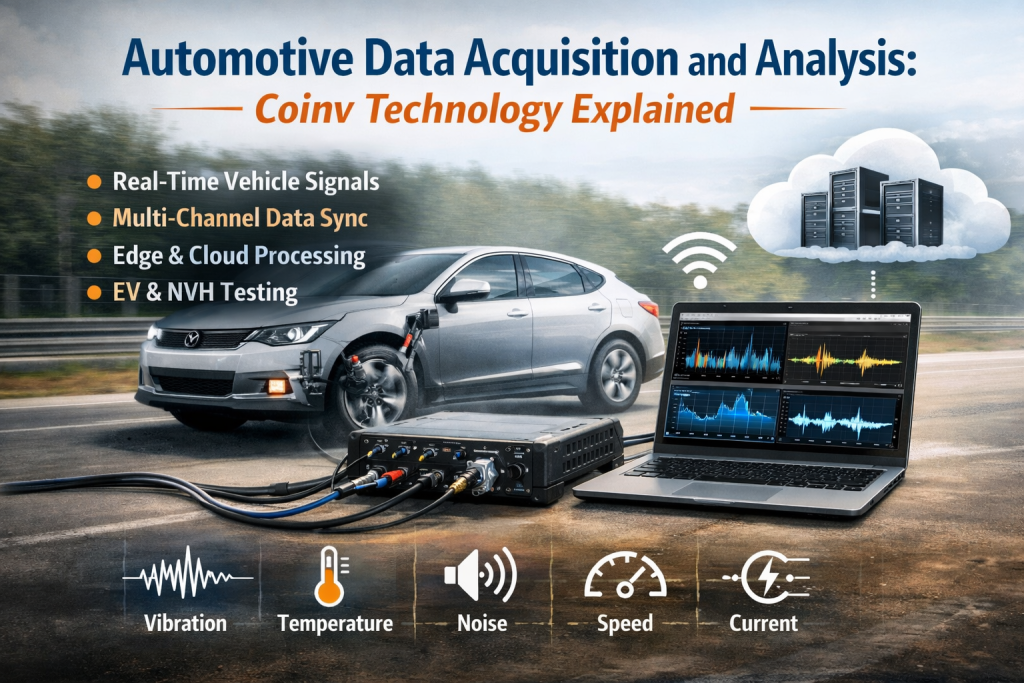
Automotive data acquisition and analysis is the process of collecting and analyzing real-time vehicle signals—like vibration, noise, temperature, current, and speed—to understand how a vehicle behaves under real driving conditions. Coinv systems make this possible by capturing synchronized, high-frequency data across multiple systems.
- Why Dynamic Signal Analysis Matters in Modern Vehicles
- What Is Automotive Data Acquisition and Analysis?
- How Automotive Data Acquisition Systems Work
- Key Technologies Behind High-Precision Data Acquisition
- Application Scenario 1: EV Battery, Motor, and Control Systems
- Application Scenario 2: NVH Testing
- Application Scenario 3: Fault Diagnosis and Predictive Maintenance
- From Data to Decisions
- Challenges in Automotive Data Acquisition
- Future Trends
- FAQs
- What does automotive dynamic signal acquisition measure in real-world testing?
- Why is synchronization critical in automotive data acquisition systems?
- What are the biggest challenges in automotive data acquisition today?
- How is AI changing automotive signal analysis?
- What should engineers consider when selecting a data acquisition system?
- Author
- Captures real-world vehicle signals in motion
- Supports multi-channel synchronized data
- Used in EV systems, NVH testing, and diagnostics
- Combines onboard processing with cloud analysis
- Helps engineers improve performance and reduce failures
Why Dynamic Signal Analysis Matters in Modern Vehicles
Vehicles today don’t operate in stable conditions. Everything changes—speed, load, temperature, road surface.
If you only look at static data, you miss what actually happens on the road.
I’ve seen a case where a drivetrain issue couldn’t be found in lab tests. Once we recorded vibration and torque together during real driving, the root cause showed up immediately.
That’s the gap dynamic signal analysis fills.
What Is Automotive Data Acquisition and Analysis?
At a practical level, this is about turning physical behavior into usable data.
A modern system collects:
- mechanical signals (vibration, speed, torque)
- electrical signals (current, voltage)
- thermal signals (temperature)
Coinv systems follow a full loop:
acquire → transmit → process → analyze → apply
What makes this different from older systems is the focus on time-sensitive signals—things that change quickly and don’t repeat in a predictable way.
How Automotive Data Acquisition Systems Work
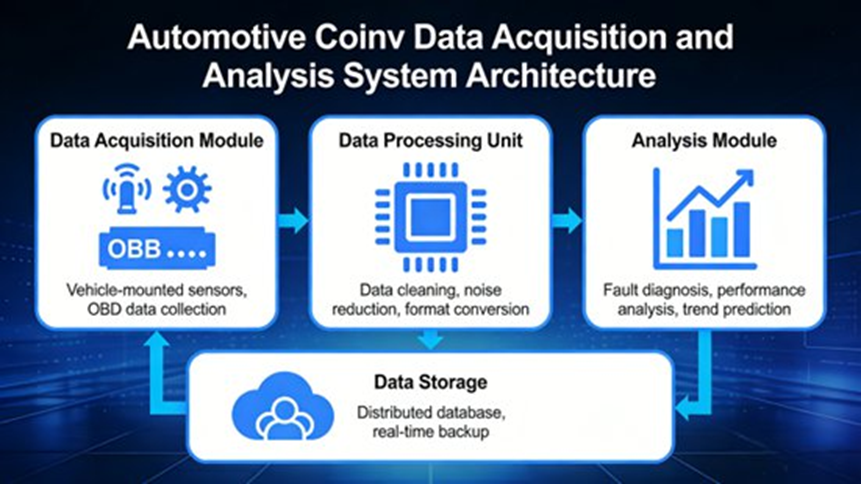
Data Acquisition Layer (Sensors & Hardware)
Everything starts with sensors.
Typical setup includes:
- accelerometers for vibration
- microphones for noise
- temperature sensors
- pressure sensors
- current sensors
- speed sensors
But sensors alone aren’t enough.
Signal conditioning handles:
- amplification
- filtering
- isolation
Without this step, interference from the vehicle itself can distort the data.
Data Transmission Layer
Data moves from the vehicle to processing systems in two ways:
Wired systems
- CAN
- Ethernet
- RS485
These are stable and used in lab setups.
Wireless systems
- 4G / 5G
- Wi-Fi
- Bluetooth
These are used during road testing.
Modern setups often include onboard processing to reduce how much data needs to be sent.
Data Processing Layer
Raw data is not ready for analysis.
It must be cleaned and aligned:
- noise filtering (Kalman, wavelet)
- calibration using sensor parameters
- time synchronization across channels
- compression to reduce storage load
Even small timing differences between channels can break the analysis.
Data Analysis Layer
This is where engineers actually learn something.
Common methods:
- time-domain (peak, RMS, kurtosis)
- frequency-domain (FFT, spectrum)
- time-frequency (wavelet, STFT)
Machine learning is also used to:
- classify faults
- detect patterns
- predict failures
Application Layer
The final step is using the results.
This includes:
- improving system performance
- identifying faults
- adjusting control parameters
- storing test data for future use
Key Technologies Behind High-Precision Data Acquisition
Multi-Channel Synchronization
Signals must line up in time.
For example:
- vibration vs motor speed
- current vs temperature
Coinv systems use:
- PTP synchronization
- hardware triggers
Accuracy reaches microseconds.
Without this, cause-and-effect relationships are lost.
Anti-Interference Design
Vehicles generate noise—electrical and mechanical.
To keep signals clean:
- shielded cables are used
- isolation modules reduce interference
- grounding is carefully designed
- filtering removes unwanted noise
Systems must meet EMC standards such as ISO 11452.
Real-Time Analysis (Edge + Cloud)
Modern systems split work:
- onboard processing handles fast detection
- cloud systems handle deeper analysis
Example:
Battery systems sampled every 10 ms can detect abnormal conditions almost instantly.
Application Scenario 1: EV Battery, Motor, and Control Systems
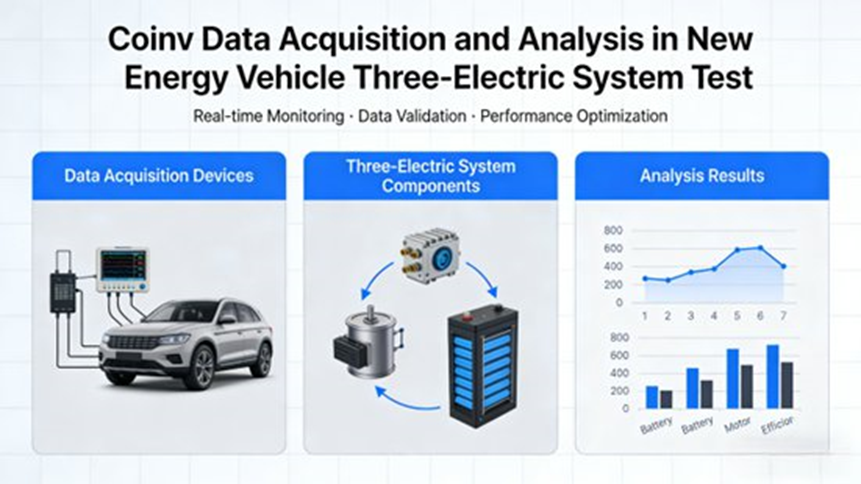
What Gets Measured
Battery:
- voltage (±0.1% FS)
- current (±0.2% FS)
- temperature (±0.5°C)
- SOC
Motor:
- speed (±1 r/min)
- torque (±0.3% FS)
- vibration (±50g range)
Control:
- CAN signals
- ECU data
Sampling:
- battery: 100 Hz–1 kHz
- motor: 1 kHz–10 kHz
- control: 100 Hz
Real Project Example
In a heavy-duty EV durability test:
- 8 analog channels and 4 CAN channels were synchronized
Results:
- battery efficiency improved by over 10%
- motor vibration dropped by around 30%
- noise reduced by about 5 dB(A)
Application Scenario 2: NVH Testing
NVH stands for noise, vibration, and harshness.
Measurement Setup
- accelerometers on engine, chassis, and body
- microphones inside and outside the cabin
- sampling up to 20 kHz
Analysis Approach
- FFT identifies dominant frequencies
- time-frequency methods catch transient events
Example:
A vehicle had cabin noise above 60 dB(A).
Cause:
- worn engine mount
Fix:
- replacement reduced noise by 8 dB(A)
Application Scenario 3: Fault Diagnosis and Predictive Maintenance
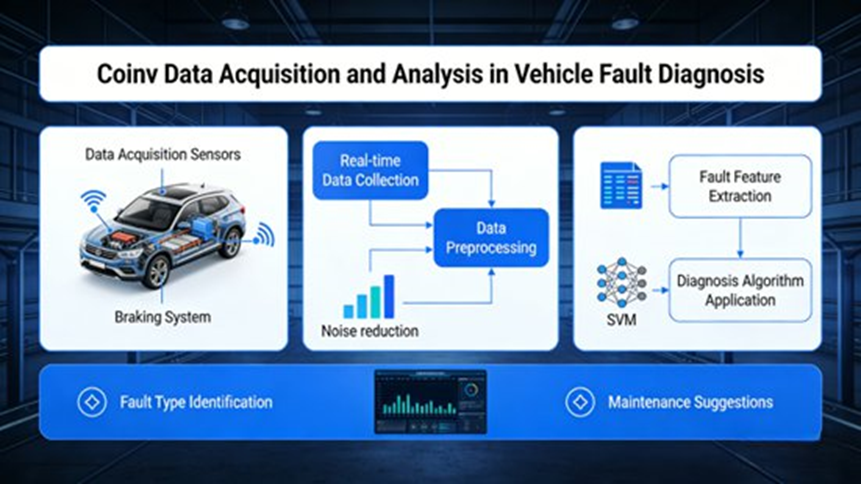
Fault Detection
Typical patterns:
- bearing wear → increased vibration peaks
- gear wear → abnormal frequency components
AI-Based Analysis
Machine learning models can:
- identify fault types
- estimate severity
Accuracy can exceed 90% with good data.
Predictive Maintenance
Instead of waiting for failure:
- track signal trends
- estimate remaining life
Real results:
- maintenance costs reduced by about 40%
- failure rates reduced by about 35%
System features include:
- 72-hour local data buffering
- AES-128 encryption
From Data to Decisions
Data itself doesn’t fix anything.
What matters is how it is used:
- linking signals to physical causes
- feeding results into design updates
- improving reliability over time
This is where Coinv systems show their value.
Challenges in Automotive Data Acquisition
- large data volumes
- synchronization complexity
- harsh operating environments
- hardware durability
Future Trends
AI Integration
- automated diagnostics
- pattern detection
Smaller Systems
- portable devices
- integrated vehicle modules
Multi-Source Data
- combining vehicle and environmental data
Standardization
- unified formats
- comparable test results
FAQs
What does automotive dynamic signal acquisition measure in real-world testing?
It measures multiple types of signals at the same time during real driving. This includes vibration, noise, electrical values like voltage and current, mechanical data like torque and speed, and environmental factors such as temperature and strain. The goal is to capture everything together, not separately.
Why is synchronization critical in automotive data acquisition systems?
Synchronization makes sure all signals line up in time. This allows engineers to compare things like vibration and speed accurately. In systems with many channels, even tiny timing errors can lead to wrong conclusions, especially when tracking faults or noise sources.
What are the biggest challenges in automotive data acquisition today?
The main challenges include handling large data volumes, connecting different systems like sensors and CAN networks, dealing with interference and harsh environments, and meeting real-time processing needs. These challenges are growing as vehicles become more complex.
How is AI changing automotive signal analysis?
AI helps analyze complex data faster and more accurately. It can detect faults, recognize patterns, and predict failures before they happen. This reduces testing time and improves maintenance planning.
What should engineers consider when selecting a data acquisition system?
They should look at sampling rate, number of channels, real-time processing ability, noise resistance, and compatibility with vehicle systems like CAN and Ethernet. The system should also work reliably during real driving without losing data.
Author
Johnny Liu
CEO, Dowway Vehicle
Johnny Liu works in vehicle testing systems and automotive data analysis. He has led EV durability testing, NVH analysis projects, and predictive maintenance system development.
Last Updated: March 24, 2026
