

< Back to Vehicle Design & Engineering Hub
By Johnny Liu, CEO at Dowway Vehicle | Published: February 25, 2026
Abstract:
As someone who has spent years on the factory floor, I know that final assembly is where the real magic happens—it’s the beating heart of auto manufacturing. It brings together the body, powertrain, chassis, interior, and electrical parts. If this step works well, your production is fast and your quality stays high. This report fully evaluates a new final assembly project across six key areas: background, tech specs, resources, money, risk management, and the bottom line.
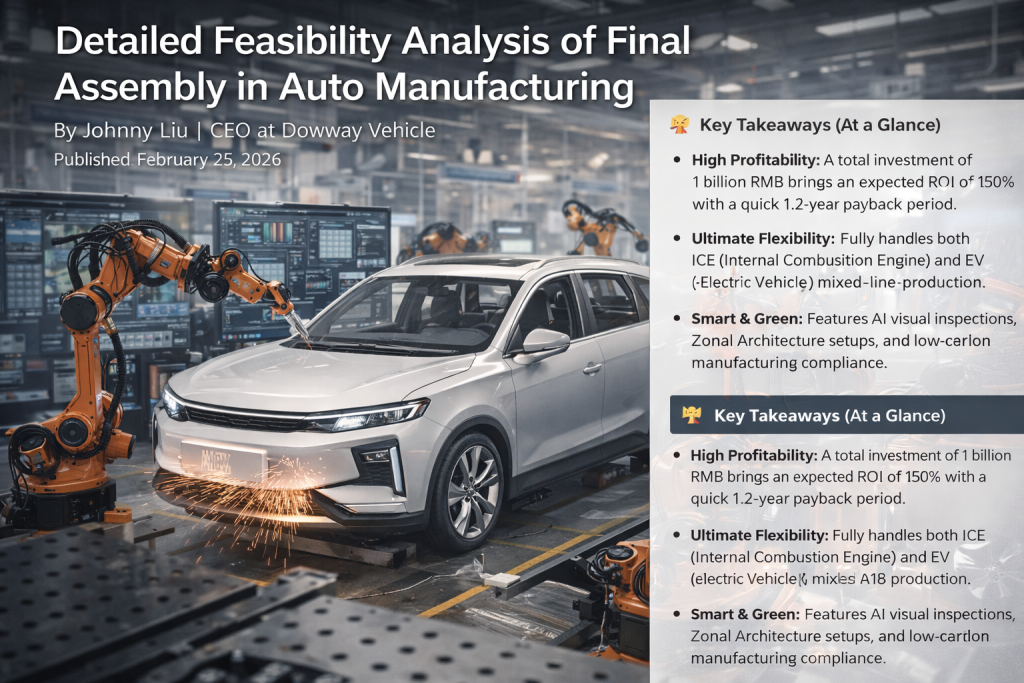
Key Takeaways (At a Glance)
- High Profitability: A total investment of 1 Billion RMB brings an expected ROI of 150% with a quick 1.2-year payback period.
- Ultimate Flexibility: Fully handles both ICE (Internal Combustion Engine) and EV (Electric Vehicle) mixed-line production.
- Smart & Green: Features AI visual inspections, Zonal Architecture setups, and low-carbon manufacturing compliance.
1. Project Background and Value
1.1 Industry Trends: Electric, Smart, and Green
The global auto industry is going through a massive shift. According to the International Energy Agency [External Link: IEA Global EV Outlook], global EV sales hit 10.6 million in 2022 and should cross 28% by 2026. This rapid change forces assembly lines to adapt to [Internal Link: Zonal Architecture in Auto Electronics] and handle mixed production of gas cars, EVs, and PHEVs. On top of that, strict “Dual Carbon” goals mean factories must move toward low-carbon methods right now.
1.2 Core Project Value
From an engineering standpoint, this analysis clears up process routes and equipment choices. Financially, it calculates exact ROI. In practice, it guides construction and daily work, cutting down the project timeline significantly.
2. Technical Feasibility
2.1 Process Route Adaptability
This setup takes on both ICE cars and EVs with a technical maturity of over 98%. For EVs, we refined the battery, motor, and electronic control assembly. We added laser positioning for battery packs (X/Y/Z deviation ≤0.5mm) and strict airtightness testing. The flexible design lets teams switch models in under 30 minutes, easily handling 6-8 different car models per line.
2.2 Optimal Equipment Selection
We focus heavily on smart, fast, and flexible tools:
- Main Line: Electrified Monorail Systems (EMS) run at 0.5-3m/min with an accuracy of ±0.1mm, supported by AGV logistics.
- Testing: We use four-wheel alignment, rain test booths, and AI visual inspection systems that cut defects by more than 30%. [Internal Link: AI Visual Inspection in Auto Manufacturing]
2.3 Detailed Quality Control
Following ISO/TS 16949 standards, we run First Article Inspection (FAI) and In-Process Quality Control (IPQC). Lean tools keep the total defect rate firmly below 0.5%.
2.4 Technical Team Support
Running this requires a dedicated team of 50+ engineers and technicians. Tech partners like Huawei and Siemens will provide hands-on training and system support.
3. Resource Allocation
3.1 Facility and Space Requirements
To build 100,000 units a year, the plant needs 20,000-25,000 sqm with a load-bearing capacity of ≥200kPa. We also left a 10%-15% space buffer just in case we need to expand later.
3.2 Supply Chain Management
We built partnerships with Tier-1 suppliers (e.g., CATL) to lock in raw materials. We rely on Just-In-Time (JIT) delivery synced via our MES platform. [Internal Link: JIT Delivery Strategies]
3.3 Utilities & Human Resources
The project needs around 300 people on site. The location is fully prepped with stable 380V/220V power, industrial water, and clean compressed air.
4. Economic Feasibility
4.1 Investment Breakdown (Total: 1 Billion RMB)
We structured the initial funding to get the best asset quality for a 100,000-unit capacity.
| Investment Category | Amount (Million RMB) | Notes |
| Equipment & Install | 450 | 56.25% of Fixed Assets (Core EMS/Robots) |
| Site Construction | 250 | Facility and basic infrastructure |
| Layout & Debugging | 50 | Process flow setup |
| Office Space | 50 | Admin and planning teams |
| Working Capital | 200 | Covers the first 6-month operational cycle |
| Total | 1,000 | Fully Funded via Mixed Channels |
4.2 Annual Operating Costs (Estimated: 6 Billion RMB)
| Cost Component | Annual Cost (Billion) | Notes |
| Raw Materials | 4.50 | Battery, Powertrain, etc. (75.0%) |
| Labor & Salaries | 0.36 | 300 staff @ ~120k RMB/year average |
| Logistics & Admin | 0.40 | Transportation, taxes, and daily office ops |
| Equipment Maint. | 0.08 | 1.78% of equipment buy cost |
| Utilities | 0.06 | Power, water, pneumatics |
4.3 Expected Returns
Assuming an 80,000 RMB average selling price, yearly revenue hits 8 Billion RMB.
- After-tax Profit: 1.5 Billion RMB (25% tax rate).
- ROI: 150% (Industry average is usually 80%-100%).
- Payback Time: 1.2 years.
5. Risk Assessment and Planning
- Tech & Market Risks: We track R&D daily and keep our ICE/EV product mix flexible to handle sudden market shifts.
- Supply Chain Risks: We keep 2-3 backup suppliers for every critical part and aim to source 75% of parts locally.
- Regulatory Risks: We stay ahead of the curve on ISO standards and EU battery carbon footprint rules.
6. The Bottom Line and Next Steps
6.1 The Final Verdict
This final assembly project is highly doable. The tech is mature, the resources match perfectly, and the numbers show an amazing 150% ROI with a very short 1.2-year payback period.
6.2 Actionable Steps
We need to speed up site construction and sign those Tier-1 supplier contracts immediately. Keep the line designs digital and flexible to meet upcoming “Dual Carbon” mandates without delay.
Frequently Asked Questions (FAQ)
Q1: What is the expected ROI for this project?
A: The project delivers an estimated Return on Investment (ROI) of 150%, turning an after-tax profit of 1.5 Billion RMB a year. The payback period is just 1.2 years.
Q2: Can this line build both gas cars and electric cars?
A: Yes. The floor uses a flexible design that lets teams mix production for standard gas cars, EVs, and PHEVs. Model changeovers take less than 30 minutes.
Q3: What kind of space does a 100,000-unit plant need?
A: You need about 20,000 to 25,000 square meters. It also requires roughly 300 on-site workers and heavy-duty industrial utilities.

·