

< Back to Automotive Simulation Toolchain
Author: Johnny Liu
CEO at Dowway Vehicle
Last Updated: March 2026
- Quick Answer
- What Is High-Frequency NVH Simulation in Automotive Engineering?
- Why High-Frequency Noise Prediction Matters
- Traditional Methods for Automotive Acoustic Simulation
- Energy-Based Methods for Mid-High Frequency NVH Simulation
- Automotive Acoustic Simulation Software
- Overview of PERA SIM ProNas
- Key Features of PERA SIM ProNas
- Automotive NVH Simulation Workflow
- Case Study: Firewall Acoustic Optimization
- Case Study: Full Vehicle High-Frequency NVH Prediction
- Case Study: Acoustic Package Material Selection
- Advantages of Domestic NVH Simulation Tools
- Best Practices for Accurate NVH Simulation
- Future Trends in Automotive NVH Simulation
- Frequently Asked Questions
- What advantages does the EFEA-SEA hybrid method provide?
- What frequency range is suitable for EFEA-based NVH simulation tools?
- How does ProNas integrate with automotive CAE workflows?
- How accurate are EFEA-SEA NVH simulations compared with vehicle tests?
- What engineering problems are usually solved with ProNas-type NVH tools?
- Author
Quick Answer
High-frequency NVH simulation studies vibration and acoustic energy in vehicles within the 400 Hz–10,000 Hz range. Engineers often use Energy Finite Element Analysis (EFEA) together with Statistical Energy Analysis (SEA) to predict cabin noise, evaluate acoustic materials, and locate vibration sources before building physical prototypes.
- High-frequency NVH covers 400 Hz–10 kHz vibration noise
- Typical sources include tire noise, wind noise, panel vibration
- FEM becomes slow at high frequency
- EFEA-SEA hybrid models improve efficiency
- Tools such as PERA SIM ProNas support this analysis
- Simulation helps reduce prototypes and shorten development cycles
What Is High-Frequency NVH Simulation in Automotive Engineering?
High-frequency NVH simulation studies how vibration energy travels through vehicle structures and acoustic cavities.
NVH stands for:
Noise, Vibration, and Harshness
These vibrations move through panels, air cavities, and insulation materials until they reach passengers.
Engineers usually divide NVH problems by frequency range.
| Frequency Range | Method | Engineering Use |
| 0–400 Hz | FEM / BEM | structural vibration |
| 400–10,000 Hz | EFEA / SEA | mid-high frequency NVH |
| >10 kHz | ray acoustics | very high frequency |
The mid-high range is difficult because structural vibration modes increase rapidly.
Common noise sources include:
- tire-road interaction
- aerodynamic wind noise
- engine high-order vibration
- vibrating body panels
- interior cavity resonance
These effects strongly influence vehicle cabin sound quality.
Why High-Frequency Noise Prediction Matters
High-frequency noise has become more noticeable in modern vehicles.
Electric vehicles are a good example. When engine noise disappears, wind noise and tire noise become easier to hear.
Simulation allows engineers to study these problems early.
Benefits include:
- identifying noise paths before prototypes exist
- reducing expensive testing cycles
- improving acoustic comfort
- supporting design optimization
Many development teams now rely on virtual NVH development before the first prototype vehicle is built.
Traditional Methods for Automotive Acoustic Simulation
Finite Element Method (FEM)
The finite element method calculates structural vibration directly.
Strengths:
- precise structural modeling
- accurate geometry representation
- effective at low frequencies
Limitations appear when frequency increases.
At high frequencies FEM requires extremely dense meshes. This creates large models and longer solving time.
Boundary Element Method (BEM)
Boundary element methods are used mainly for acoustic radiation.
Typical applications include:
- exterior noise radiation
- low-frequency acoustic fields
However, solving large boundary systems becomes difficult when frequency rises.
Statistical Energy Analysis (SEA)
Statistical Energy Analysis focuses on energy exchange between subsystems rather than detailed vibration motion.
Strengths:
- efficient at high frequencies
- simplified models
Limitations:
- requires subsystem definitions
- depends on modal density estimates
- limited spatial resolution
Complex vehicle structures make subsystem modeling time-consuming.
Energy-Based Methods for Mid-High Frequency NVH Simulation
Energy-based approaches were introduced to address the limits of FEM and SEA.
These methods calculate energy density propagation instead of displacement fields.
Energy Finite Element Analysis (EFEA)
Energy Finite Element Analysis applies wave theory to energy propagation.
Instead of solving displacement at every point, the method solves energy density relationships between finite elements.
The numerical formulation often uses:
- finite-volume techniques
- difference methods
This allows the solver to estimate vibration energy flow through structural elements.
Key benefits:
- good geometric representation
- higher efficiency in mid-high frequency ranges
- element-level spatial resolution
EFEA-SEA Hybrid Modeling
Many NVH solvers combine EFEA with SEA principles.
In this hybrid approach:
- the mesh remains similar to FEM models
- energy transfer equations resemble SEA
The solver calculates energy density across elements without manual subsystem partitioning.
This method works well in the 400 Hz – 10 kHz range.
Automotive Acoustic Simulation Software
Several CAE tools support mid-high frequency acoustic simulation.
Examples include:
- LMS Virtual.Lab
- Actran
- VA One
These tools connect multiple physics domains.
Typical modules include:
- structural simulation
- fluid dynamics
- acoustic analysis
This integrated workflow supports full-frequency NVH prediction.
Overview of PERA SIM ProNas
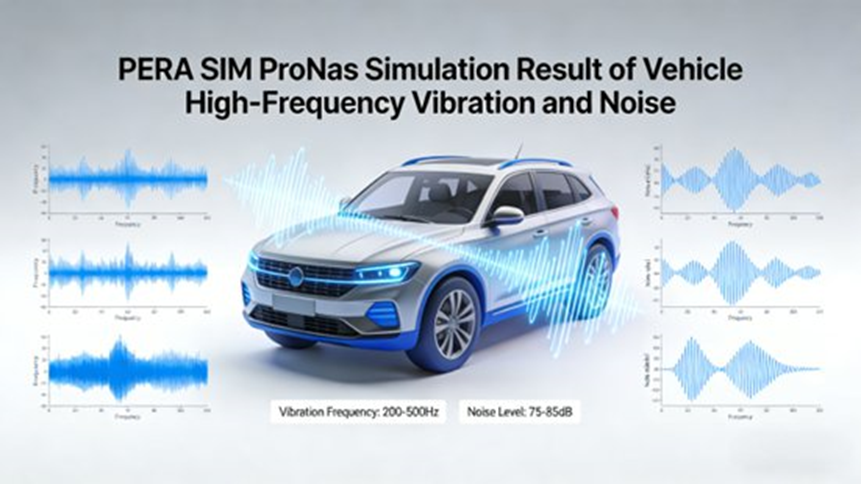
PERA SIM ProNas is a simulation tool focused on mid-high frequency acoustic analysis.
It is part of the PERA SIM software platform developed by PERA Global.
The solver focuses on vibration noise prediction within:
400 Hz – 10,000 Hz
It works together with other modules in the platform.
| Module | Purpose |
| PERA SIM Mechanical | structural simulation |
| PERA SIM Fluid | fluid simulation |
| PERA SIM AcousticBEM | low-frequency acoustics |
| PERA SIM ProNas | mid-high frequency acoustics |
Together these modules allow engineers to study the full NVH process:
noise source → transmission path → cabin response
Key Features of PERA SIM ProNas
Model Import and Pre-Processing
Automotive models can contain thousands of parts.
ProNas accepts several CAE mesh formats:
- BDF
- DAT
- NAS
These formats are commonly generated by preprocessors such as:
- HyperMesh
- PERA SIM PreMech
The software can automatically:
- detect enclosed cavities
- group elements
- define structural regions
This reduces model preparation time.
Acoustic Package Modeling
Vehicle acoustic packages include materials such as:
- roof liners
- floor insulation
- firewall damping layers
- door trim materials
ProNas can calculate acoustic behavior using Biot theory for porous materials.
Engineers may either:
- model the materials directly
- enter measured acoustic parameters
This supports accurate evaluation of absorption and insulation performance.
Multi-Physics Coupled Simulation
Vehicle noise propagation involves multiple physics domains.
ProNas supports several coupling types.
Structure–acoustic coupling
Models vibration transfer between structural panels and air cavities.
Fluid–structure–acoustic coupling
Combines aerodynamic loads with structural vibration and acoustic response.
This allows engineers to simulate real driving conditions.
Post-Processing and Result Analysis
ProNas provides visualization tools for NVH analysis.
Typical outputs include:
- vibration velocity contour maps
- sound pressure distribution maps
- energy density plots
- vibration energy transfer paths
These results help engineers locate noise sources quickly.
Automotive NVH Simulation Workflow
Model Preparation
Vehicle geometry is simplified before meshing.
Typical steps include removing:
- small holes
- tiny chamfers
- non-critical features
High-order tetrahedral meshes are commonly used.
Important components such as firewalls and acoustic packages often require mesh refinement.
Mesh distortion should remain below 5%.
Material Parameter Definition
Structural properties include:
- elastic modulus
- Poisson ratio
- density
- damping coefficient
Acoustic properties include:
- absorption coefficient
- transmission loss
Experimental measurements provide the most reliable parameters.
Load and Boundary Conditions
Typical excitation sources include:
- road vibration loads
- engine vibration inputs
- aerodynamic pressure loads
Engineers may also import measured test data.
Solver Settings
Typical simulation parameters include:
- frequency range: 400 Hz – 10 kHz
- frequency step: 50 Hz
- structural damping coefficient: 0.04
Case Study: Firewall Acoustic Optimization
The firewall separates the engine bay from the passenger cabin.
Simulation process:
- geometry preparation
- acoustic material definition
- excitation loading
- solver analysis
Broadband noise from 100 Hz – 8000 Hz was applied to the engine side.
Simulation showed weak insulation in the 2000–3000 Hz range.
Optimization included:
- increasing damping layer thickness from 2 mm to 3 mm
- modifying insulation materials
Results:
- transmission loss increased above 40 dB
- cabin engine noise dropped 3–5 dB
Simulation time was reduced from 3 days to 1 day.
Case Study: Full Vehicle High-Frequency NVH Prediction
An SUV model was analyzed.
The model included:
- structural mesh
- interior cavity mesh
- six major body panels
Three monitoring points were defined:
- front head position
- rear head position
- front footwell
Results showed:
- 62% of footwell noise came from floor vibration
- 58% of rear passenger noise came from roof vibration
Improvements included:
- floor reinforcement
- roof insulation upgrades
- optimized tire design
Interior noise decreased by 4 dB.
Case Study: Acoustic Package Material Selection
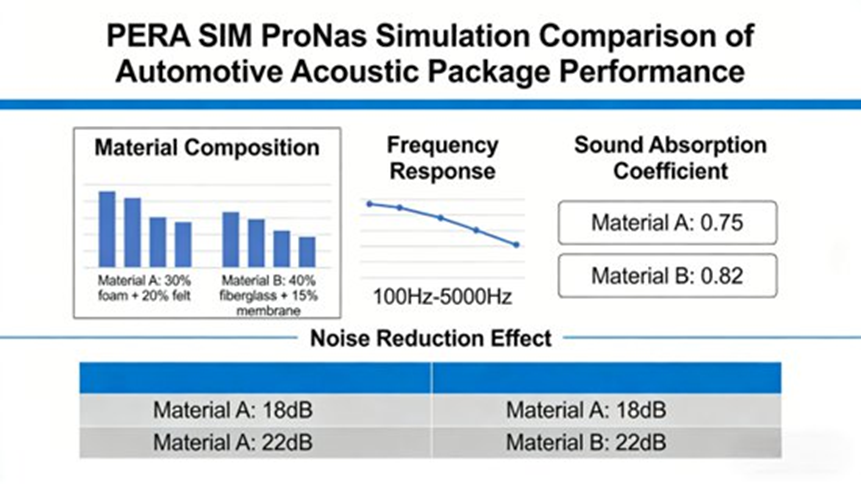
Three roof insulation designs were evaluated.
| Design | Description |
| Option 1 | standard insulation + damping layer |
| Option 2 | high-density insulation + damping layer |
| Option 3 | standard insulation + double damping layers |
Results showed option 2 achieved:
- absorption coefficient above 0.6 between 1000–4000 Hz
- transmission loss around 42 dB
Option 2 also reduced cost by 15% compared with option 3.
Advantages of Domestic NVH Simulation Tools
Domestic CAE software provides several practical advantages.
Localized workflow
- Chinese interface
- localized support
- compatibility with domestic engineering processes
Computational efficiency
EFEA solvers often improve calculation speed by 30–50%.
Cost control
Domestic tools usually require lower licensing costs and allow customization.
Best Practices for Accurate NVH Simulation
Model simplification
Remove unnecessary geometry.
Mesh quality
Maintain distortion below 5%.
Material accuracy
Use experimental data when possible.
Simulation validation
Compare results with:
- semi-anechoic chamber tests
- vehicle road tests
Typical deviation between simulation and experiment is within 3%.
Future Trends in Automotive NVH Simulation
Several technology trends are shaping NVH simulation.
These include:
- AI-assisted noise source detection
- automatic acoustic optimization
- digital twin NVH models
- integrated multi-physics simulation
These tools help engineering teams improve vehicle acoustic quality earlier in development.
Frequently Asked Questions
What advantages does the EFEA-SEA hybrid method provide?
The hybrid method improves efficiency in mid-high frequency simulation. It solves vibration energy at the element level while keeping computational cost lower than full FEM models.
Engineers use it to study cabin noise, acoustic packages, and structural vibration behavior.
What frequency range is suitable for EFEA-based NVH simulation tools?
EFEA-based tools normally work best between 400 Hz and 10 kHz.
This range includes tire noise, wind noise, engine high-frequency vibration, panel radiation, and cabin acoustic resonance.
How does ProNas integrate with automotive CAE workflows?
ProNas supports BDF, DAT, and NAS mesh files and works with preprocessors such as HyperMesh and PERA SIM PreMech.
This allows engineers to reuse existing finite-element meshes and reduce model preparation time.
How accurate are EFEA-SEA NVH simulations compared with vehicle tests?
Simulation accuracy depends on material parameters, boundary conditions, and excitation loads.
When calibrated using test data, simulation results often match experimental trends and are suitable for engineering optimization.
What engineering problems are usually solved with ProNas-type NVH tools?
Engineers commonly use these tools for:
- cabin noise prediction
- acoustic package design
- noise source identification
- structural panel optimization
- system-level noise path analysis
These simulations track vibration and acoustic energy from excitation sources to interior response points.
Author
Johnny Liu
CEO at Dowway Vehicle
Johnny Liu has more than 15 years of experience in automotive engineering. His work includes vehicle architecture development, simulation technologies, and digital vehicle design.
