


< Back to Automotive Simulation Toolchain
By Johnny Liu, CEO at Dowway Vehicle
Last Updated: March 2026
- Introduction
- What is Multi-Physics Simulation in Automotive Engineering?
- Introduction to MxSim.Multiphy
- Key Technology Features of MxSim.Multiphy
- Applications of MxSim.Multiphy in Automotive Engineering
- Case Studies and Practical Use Cases
- Why Choose MxSim.Multiphy Over Other CAE Tools?
- Future of Multi-Physics Simulation in Automotive Engineering
- Conclusion
- FAQ
- Author Bio
Introduction
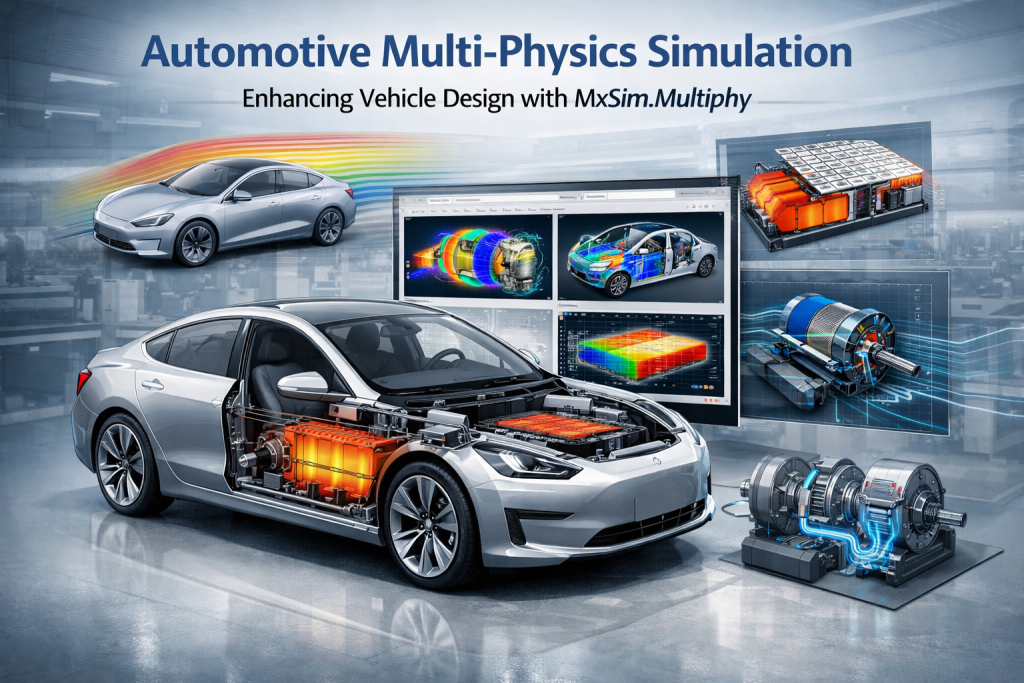
The automotive industry is undergoing a transformation. As vehicles become more complex with the rise of electric vehicles, smart systems, and lightweight materials, traditional simulation tools can no longer meet the growing demands of modern vehicle design. Multi-physics simulation has emerged as a solution to overcome design limitations, improve product reliability, and increase development efficiency.
In this article, we explore MxSim.Multiphy, a multi-physics simulation software developed by Hunan Maixi Software. MxSim.Multiphy combines multiple physical fields—such as thermal, electromagnetic, structural, and electrochemical simulations—into one platform. This powerful tool helps engineers optimize vehicle design across the entire development process, from concept to final product.
What is Multi-Physics Simulation in Automotive Engineering?
Multi-Physics Simulation refers to the integration of multiple interacting physical phenomena into one simulation. In the context of automotive engineering, this could involve the interaction between thermal management, electromagnetic performance, and structural integrity, all of which are crucial for designing modern electric vehicles (EVs).
Traditional single-physics simulations focus on one specific physical phenomenon at a time. However, modern automotive systems require the simulation of multiple domains simultaneously. For example, optimizing a battery system requires understanding how the electrochemical, thermal, and structural domains interact. Multi-physics simulation tools like MxSim.Multiphy offer an effective way to simulate these complex interactions, improving the design process and increasing the accuracy of predictions.
Introduction to MxSim.Multiphy
MxSim.Multiphy is part of the MxSim software suite, developed by Hunan Maixi Software. Leveraging more than 30 years of experience in Computer-Aided Engineering (CAE), this tool integrates multiple fields of simulation into a single, unified solver. It is specifically designed to address the challenges faced by the automotive industry, providing engineers with a comprehensive solution to optimize vehicle systems.
MxSim.Multiphy stands out due to its ability to simulate structural, thermal, fluid, electromagnetic, and electrochemical phenomena simultaneously, offering powerful capabilities to improve vehicle design and development. Here are some key features that make it an essential tool for automotive engineering:
- Cost-Effectiveness: Compared to international CAE tools like ANSYS and COMSOL, MxSim.Multiphy offers significant cost savings while providing localized support and customization.
- Self-Controlled Algorithm Stack: MxSim.Multiphy operates with fully self-controlled algorithms, avoiding the commercial risks and technical barriers of foreign software.
- Customization for Automotive Industry Needs: The software is specifically designed for the Chinese automotive market, offering localized industry standard templates and a Chinese language interface to improve accessibility for local engineers.
Key Technology Features of MxSim.Multiphy
Modular Architecture
MxSim.Multiphy utilizes a modular architecture that supports easy integration with other MxSim tools (e.g., MxSim.Mechanical, MxSim.CFD). This architecture ensures that the tool can handle various stages of vehicle development, from pre-processing to post-processing, in a seamless and efficient manner.
Efficient Multi-Physics Coupling
MxSim.Multiphy supports two types of coupling modes:
- Sequential Coupling: Best for weakly interacting physics, where each physical domain is solved independently before being combined.
- Direct Coupling: Used for strongly coupled systems, such as battery electrochemistry combined with thermal and structural simulations. This method provides higher accuracy for complex automotive systems.
The choice between these modes depends on the level of interaction between the physics domains being simulated.
Customization for Automotive Engineering
MxSim.Multiphy is highly customizable to meet the specific needs of the automotive industry. It provides specialized modules for:
- Vehicle body structure simulations.
- Battery performance and safety simulations.
- Electric drive system simulations.
- Aerodynamics and fluid dynamics simulations.
Additionally, the software is compatible with Chinese industry standards, making it easier for local engineers to adopt and use in automotive R&D.
Applications of MxSim.Multiphy in Automotive Engineering
Vehicle Body Structure Analysis
MxSim.Multiphy enables engineers to simulate the structural integrity and thermal behavior of a vehicle’s body. This is crucial for ensuring vehicle safety and optimizing lightweight materials. The software can simulate collision events and analyze how a vehicle’s body responds to forces and heat, helping engineers design safer and more energy-efficient vehicles.
Battery Thermal Management and Safety
Efficient thermal management is essential for the safety and performance of electric vehicle batteries. MxSim.Multiphy simulates thermal runaway scenarios to predict how heat will propagate through a battery pack. This allows engineers to optimize battery pack design, ensuring safety and longevity by improving heat dissipation systems.
Electric Drive System Simulation
For electric drive systems, MxSim.Multiphy can simulate the performance of electric motors, inverters, and cooling systems. By optimizing the electromagnetic performance and thermal properties of these components, engineers can design more efficient and reliable electric powertrains for electric vehicles.
Aerodynamics and Fluid Flow Simulations
MxSim.Multiphy can be used to simulate fluid dynamics in vehicle design, optimizing the aerodynamics of a vehicle. Reducing drag and improving the thermal management of components are critical for enhancing energy efficiency, especially in electric vehicles.
Case Studies and Practical Use Cases
Case Study 1: White Body Structure-Heat Coupling Simulation
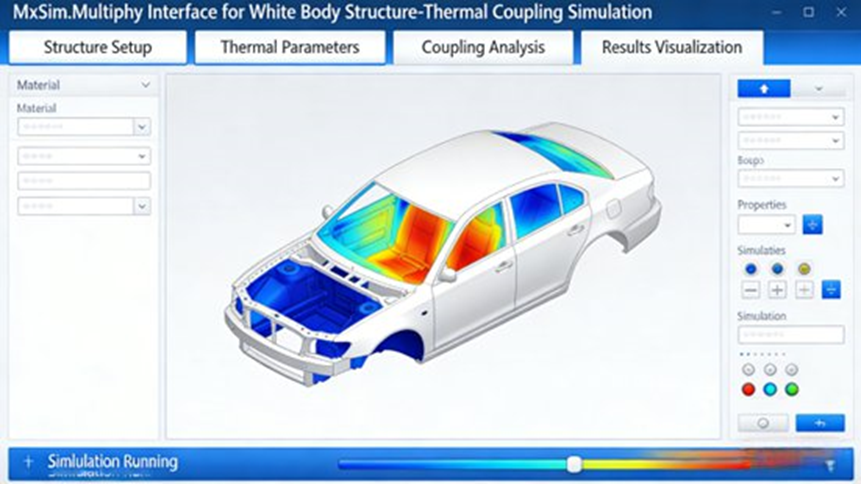
- Objective: Simulate the thermal behavior and structural integrity of the white body structure of a vehicle under extreme conditions.
- Process: MxSim.Multiphy was used to simulate temperature distribution and stress response of the vehicle body at 40°C and 120°C in the engine compartment.
- Results: The simulation identified critical stress points and helped optimize lightweight designs, reducing the vehicle’s weight by 3.2kg.
Case Study 2: Battery Electrochemical-Thermal-Structural Coupling
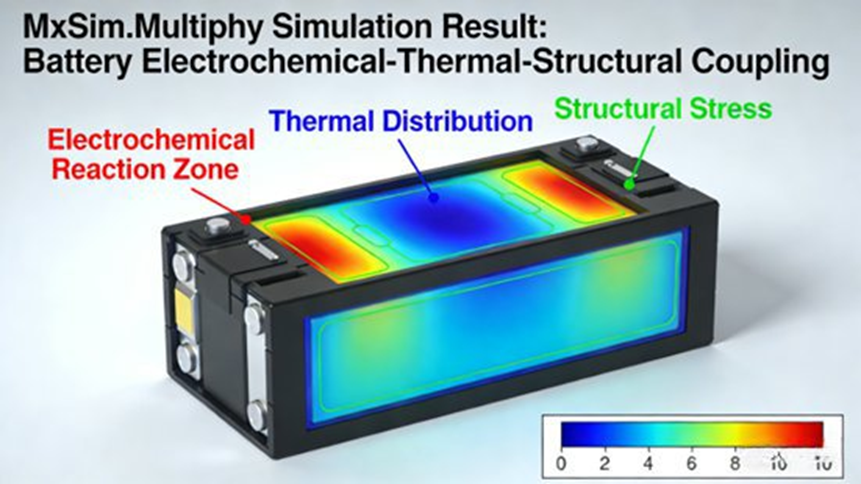
- Objective: Simulate the behavior of an electric vehicle battery pack under normal and thermal runaway conditions.
- Process: Using direct coupling, MxSim.Multiphy simulated the charging and discharging cycles, analyzing temperature uniformity and structural integrity.
- Results: By optimizing the thermal management system, engineers increased the dissipation time by 79%, enhancing battery safety.
Case Study 3: Electric Drive System Electro-Thermal-Fluid Coupling
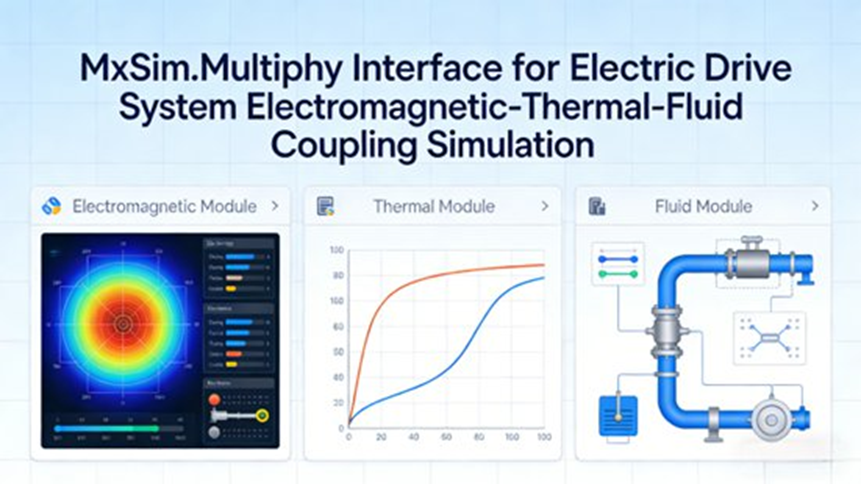
- Objective: Optimize the electric drive system by simulating electromagnetic losses, temperature distribution, and cooling efficiency.
- Process: MxSim.Multiphy was used to analyze electric motor performance, inverter cooling, and fluid dynamics in the cooling system.
- Results: The optimization led to a 4.5% improvement in efficiency, while reducing the motor winding temperature from 142°C to 128°C.
Why Choose MxSim.Multiphy Over Other CAE Tools?
Cost-Effectiveness
MxSim.Multiphy offers substantial cost savings compared to other tools like ANSYS and COMSOL. It also provides localized support and customization options that make it a great choice for engineers seeking a cost-effective and efficient solution.
Localization and Adaptation
Designed for the Chinese automotive market, MxSim.Multiphy supports domestic industry standards and is fully localized, offering a Chinese language interface for ease of use.
Ease of Use and Customization
With a user-friendly interface and customizable templates, MxSim.Multiphy simplifies the simulation process and reduces the learning curve for engineers.
Future of Multi-Physics Simulation in Automotive Engineering
As the automotive industry shifts towards electrification, automation, and smart vehicle technologies, multi-physics simulation will continue to play a crucial role. The future of MxSim.Multiphy lies in expanding capabilities for autonomous driving and digital twins, providing high-precision simulations for next-generation vehicles.
Conclusion
MxSim.Multiphy is a powerful and versatile tool that helps automotive engineers solve complex challenges in vehicle design. Whether you are optimizing electric vehicle batteries, improving electric drive systems, or enhancing vehicle body structures, MxSim provides the tools necessary to advance the development of safer, more efficient vehicles.
For automotive manufacturers seeking to stay competitive, MxSim.Multiphy is a must-have solution for R&D.
FAQ
1. What physical fields and coupling types does MxSim.Multiphy support?
Answer: MxSim.Multiphy supports electromagnetic-thermal-structural, electrochemical-thermal-structural, thermal-fluid-solid, and structure-thermal coupling for simulating interacting physical phenomena.
2. How is MxSim.Multiphy different from foreign multiphysics tools?
Answer: MxSim.Multiphy offers lower costs, localized support, and a self-controlled algorithm stack, making it an affordable and customizable alternative to COMSOL and ANSYS.
3. Is MxSim.Multiphy suitable for commercial automotive engineering workflows?
Answer: Yes, MxSim is applied in automotive R&D, offering multi-domain coupling solutions and fitting well into commercial workflows.
4. How do I choose between sequential vs. direct coupling modes in MxSim.Multiphy?
Answer: Sequential coupling is efficient for weakly coupled systems, while direct coupling is ideal for strongly interacting systems, like battery electrochemistry.
5. What are typical difficulties or advice for users new to multiphysics simulation?
Answer: New users face challenges with mesh quality, boundary conditions, and effective use of parallel processing (GPU/CPU) for large-scale simulations.
Author Bio
Johnny Liu is the CEO of Dowway Vehicle, a leading automotive technology firm in China. With over 15 years of experience in automotive engineering and software solutions, Johnny has been instrumental in advancing vehicle R&D using state-of-the-art simulation tools like MxSim.Multiphy.
