


< Back to Performance Development
By Johnny Liu, CEO at Dowway Vehicle | Published: February 28, 2026
Author’s Note: At Dowway Vehicle, my team and I spend our days engineering solutions that make cars ride smoother and quieter. Car buyers today expect comfort as a baseline. To meet this standard, we rely heavily on specific testing and data methods. This guide breaks down the exact tools we use to solve Noise, Vibration, and Harshness (NVH) problems: NTF and VTF Analysis.
- Executive Summary
- 2.1 Vibration Transfer Function (VTF) Explained
- 2.2 Noise Transfer Function (NTF) Explained
- 2.3 The Physical Link Between NTF and VTF
- 2.4 Engineering Reference Standards
- 3.1 Core Testing Principles
- 3.2 Physical Vehicle Testing Schemes
- 3.3 CAE Simulation Testing Workflows
- 4.1 Core Data Analysis Indicators
- 4.2 Typical Data Analysis Case: SUV Booming Noise
- 5.1 Transfer Path Optimization
- 5.2 Structural Design & Component Selection
- 5.3 Mass Production Troubleshooting
- 6.1 Current Technical Bottlenecks
- 6.2 Future Development Trends
- Q1: What are NTF and VTF, and how are they defined in automotive engineering?
- Q2: What is the primary purpose of conducting NTF and VTF analysis?
- Q3: How do engineers interpret transfer function results to find NVH problems?
- Q4: What are the most common ways to optimize or reduce unfavorable transfer functions in vehicles?
- Q5: How are NTF and VTF used specifically during the vehicle development lifecycle?
Executive Summary
- What is VTF? Vibration Transfer Function measures how much vibration travels from a source (like a wheel) to a physical touchpoint (like a steering wheel).
- What is NTF? Noise Transfer Function measures how that vibration turns into actual noise hitting the passenger’s ears.
- Why it matters: Engineers use NTF and VTF analysis to find weak structural spots, fix booming noises, and stop idle vibrations without always needing expensive physical prototypes.
1. Introduction to Automotive NVH and Transfer Functions
Car buyers expect a quiet, smooth ride. For automakers, NVH performance directly shows their engineering strength. Engines, transmissions, suspensions, and tires constantly generate vibrations and noise while driving. These travel through the body structure and air into the cabin. If left unchecked, they cause passenger discomfort and hurt the vehicle’s market appeal.
The old “Design-Build-Test” cycle takes too much time and money. Today, CAE (Computer-Aided Engineering) simulation software speeds up this workflow. NTF and VTF analysis stand out as the main testing and simulation tools. They measure exact vibration and noise paths, locate structural weaknesses, and give engineers hard data to fix Trimmed Body (TB) or powertrain noise issues.
2. Core Definitions and Physical Principles of NTF & VTF
2.1 Vibration Transfer Function (VTF) Explained
VTF is the ratio of the vibration response at a specific point to the initial vibration input.
- Physical Essence: It measures the exact transfer rate of vibration energy from point A to point B.
- Units: We apply a unit force (N) or acceleration (m/s²). We measure the response in acceleration (m/s²), velocity (m/s), or displacement (m). Common units are m/(s²·N) or m/(s·N).
- Typical Response Points: Areas passengers actually touch, such as the steering wheel, seat mounts, and gear shift lever.
2.2 Noise Transfer Function (NTF) Explained
NTF is the ratio of the noise response to the initial vibration input.
- Physical Essence: It calculates the overall rate at which vibration turns into acoustic energy (noise) at a specific spot.
- Units: The input remains a unit force or acceleration. The response is sound pressure level (dB(A)). Common units are dB(A)/N.
- Typical Response Points: The right ear of the driver, the right ear of the front passenger, and the ears of rear passengers.
2.3 The Physical Link Between NTF and VTF
In any car, vibration and noise go hand in hand. Vibration acts as the main trigger for structure-borne noise. Engineers focus on the forward chain reaction: Vibration Excitation → Structural Transfer → Noise Radiation.
VTF maps the travel of vibration energy. This makes it the baseline for NTF. If VTF runs too high, the structure absorbs very little energy. This raw energy hits the body panels (like the floor or roof) and forces them to radiate noise, which drives the NTF up. Because of this, NTF and VTF share a matching frequency pattern. A peak in VTF usually lines up with a peak in NTF under the same source.
2.4 Engineering Reference Standards
Engineers judge NTF and VTF against strict benchmarks based on competitor data and isolation targets:
- VTF Targets (20-100Hz): Under unit load, the velocity at the steering wheel should stay below 0.3mm/s/N (strict target: 0.2mm/s/N). Seat mounts must stay below 0.1mm/s/N (strict target: 0.03mm/s/N).
- NTF Targets (20-200Hz): Under unit load, the sound pressure level in the primary direction should stay below 55-60dB(A), and the secondary direction below 60-65dB(A).
3. NTF & VTF Testing Principles and Methodologies
3.1 Core Testing Principles
Both tests treat the NVH setup as a linear system within the testing frequency range (usually 20-2000Hz). We use Fast Fourier Transform (FFT) to turn time-domain signals into frequency-domain signals. We also run Coherence Analysis to verify the data’s linear correlation.
3.2 Physical Vehicle Testing Schemes
Test Preparation:
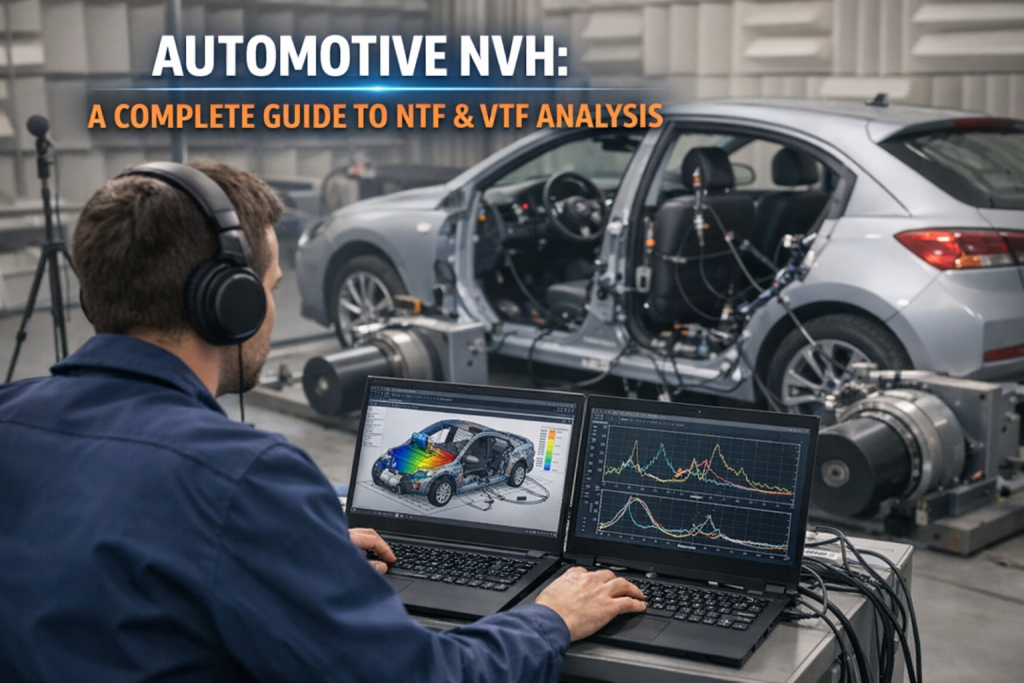
Vehicles or Trimmed Bodies (TB) must be in standard production or prototype condition. We run tests inside a semi-anechoic or fully anechoic chamber at 20±5°C and 40%-60% humidity. Required gear includes electrodynamic shakers (0-2000Hz), impact hammers, IEPE piezoelectric accelerometers (±50g to ±500g range), free-field microphones, and multi-channel DAQ systems (like Siemens LMS SCADAS) with a sampling rate of at least 51.2kS/s.
Sensor Layout Strategy:
- Excitation Points: Powertrain mounts (3 directions), suspension connection points (shock absorber towers, lower control arms), tire centers, and exhaust hangers.
- Response Points: VTF points (seat rails, steering wheel at 12 o’clock) use 3-axis accelerometers. NTF points (occupant ears) use microphones.
Testing Workflow:
- Setup & Calibration.
- Excitation: Run a sine sweep (20-2000Hz at 1oct/min) with a force amplitude of 5-10N.
- Data Acquisition: Record signals 3 times per point to keep the coefficient of variation under 5%.
- Processing: Run FFT and coherence analysis. Discard any data where coherence ($\gamma^2$) falls below 0.8.
- Output: Generate the final amplitude/phase vs. frequency curves.
3.3 CAE Simulation Testing Workflows
- Model Building: Import CAD data to build a TB finite element model. These often exceed 2.45 million mesh elements.
- Boundary Conditions: Set up physical constraints and apply unit forces.
- Computation: Solve for VTF/NTF frequencies using programs like OptiStruct or Abaqus.
- Validation: Check results against physical test data. Keep the error margin under 10% and adjust the structural design as needed.
4. Data Analysis Methods and Engineering Interpretation
4.1 Core Data Analysis Indicators
- Amplitude Characteristics: Peak frequencies tell us exactly where the fault lies. We match them to known sources: Engine Idle (20-50Hz), Engine Acceleration (50-200Hz), Tire Vibration (20-200Hz), Suspension Resonance (10-30Hz), and Body Panel Modal Frequencies (20-100Hz).
- Phase Characteristics: A sharp phase shift (from 0° to 180°) points to system resonance, which heavily spikes transfer rates.
- Coherence Analysis ($\gamma^2$): This checks our math. A score of $\gamma^2 \ge 0.8$ means the data is strong and valid.
4.2 Typical Data Analysis Case: SUV Booming Noise
- Problem: An SUV produced a low-frequency booming noise (56Hz and 112Hz) near the driver’s ear at 60km/h.
- Testing: We applied force at the tire center, tracked VTF at the seat mount, and measured NTF at the driver’s ear.
- Analysis: VTF hit a peak of 0.15mm/s/N and NTF hit 62dB(A)/N at both 56Hz and 112Hz. This proved that raw vibration travel directly caused the cabin noise.
- Path Localization: Using Transfer Path Analysis (TPA), we mapped the exact route: Tire Center → Rear Suspension Lower Arm → Body Floor → Cabin Cavity.
5. Engineering Applications in NVH Optimization
5.1 Transfer Path Optimization
Following the SUV case above, resolving the 112Hz booming noise required three direct changes:
- Structure: We increased the cross-section of the lower suspension arm to boost dynamic stiffness.
- Damping: We placed new rubber bushings at the arm-to-body connection, raising the damping ratio to 0.25.
- Body Floor: We welded stiffeners to the floor to shift its modal frequency away from the 112Hz zone.
Result: VTF dropped to 0.08mm/s/N, and NTF dropped to 53.55dB(A)/N. The booming noise vanished.
5.2 Structural Design & Component Selection
Before building physical cars, CAE simulation helps us adjust body panel thickness and powertrain mounts. We also test and select physical components—like specific tire brands, shock absorbers, and heavy-duty rubber bushings—that naturally block vibration travel.
5.3 Mass Production Troubleshooting
When a standard production sedan suffered from severe seat vibration (30Hz) at idle, VTF testing caught a powertrain mount transferring force at 0.35mm/s/N. By swapping out the mount’s rubber bushing for a higher damping version, we dropped the VTF to 0.2mm/s/N and solved the issue quickly without an expensive recall.
6. Technical Challenges and Future Trends
6.1 Current Technical Bottlenecks
- High-Frequency Precision: Once frequencies cross 1000Hz, signal loss and background noise make testing much harder.
- Non-Linear Systems: Hard acceleration or rough roads force the car to act outside standard linear assumptions, throwing off standard test models.
- Data Overload: Engineers often have to sort through hundreds of transfer curves from over 20 different vehicle attachment points.
6.2 Future Development Trends
The industry is moving toward a tighter blend of physical testing and CAE simulation. Automakers are also building AI tools to sort through massive datasets and spot risks automatically. Furthermore, engineers are creating new testing methods to handle the high-frequency whining noises found in New Energy Vehicles (NEVs).
7. Final Thoughts
NTF and VTF analysis form the backbone of automotive NVH engineering. By mapping exactly how vibration travels and turns into noise, teams can spot the exact part causing the problem. Mastering these tools, alongside CAE simulation, gives automakers the power to build quieter cars, lower their R&D costs, and win over demanding drivers.
8. Frequently Asked Questions (FAQ)
Q1: What are NTF and VTF, and how are they defined in automotive engineering?
Answer: In vehicle NVH, VTF (Vibration Transfer Function) tracks how vibrations move from a source (like a wheel hub) to parts you touch (like a steering wheel). NTF (Noise Transfer Function) measures how that same vibration turns into actual sound pressure hitting the occupants’ ears. Both use math to compare the initial force to the final cabin response across different frequencies.
Q2: What is the primary purpose of conducting NTF and VTF analysis?
Answer: We run these tests to find weak structural spots and map the exact paths noise and vibration take to enter the cabin. By looking at the transfer data, we can single out the specific part—like a stiff suspension bushing or a thin floor panel—that magnifies the problem, giving us a clear target to fix.
Q3: How do engineers interpret transfer function results to find NVH problems?
Answer: We look closely at frequency-response curves generated by our sensors. We search for sharp “peaks” on the graph where the vibration or noise goes above our design targets.
A peak means the structure is highly sensitive at that specific frequency. We match that peak frequency (say, 30Hz) to a known source (like engine idle) to track down the root cause.
Q4: What are the most common ways to optimize or reduce unfavorable transfer functions in vehicles?
Answer: When we find a bad transfer function peak, my team at Dowway Vehicle usually fixes it by:
- Increasing Stiffness: Adding stiffeners to shift a part’s resonance away from the problem frequency.
- Upgrading Damping: Swapping out rubber bushings or engine mounts for materials that absorb more energy.
- Decoupling Paths: Changing how parts bolt together so multiple vibration paths stop reinforcing each other.
Q5: How are NTF and VTF used specifically during the vehicle development lifecycle?
Answer: Engineers use these tools from day one. In the early design phase, we run CAE software to simulate NTF/VTF on virtual car models to catch obvious flaws. During the prototype stage, we put real cars in testing chambers to check if the physical numbers match the virtual models. Even after the car hits the assembly line, we use VTF tests to rapidly diagnose unexpected factory issues like idle vibrations.
