


< Back to Automotive Simulation Toolchain
Author: Johnny Liu, CEO at Dowway Vehicle
Last Updated: March 16, 2026
Jurisdiction / industry note: This article is written for engineering and commercial reference in the automotive sector. It is not legal, regulatory, or certification advice.
Automotive NVH simulation gives engineers a way to predict and improve noise, vibration, and harshness before a physical prototype is built. Simcenter Acoustics Simulation is useful because it covers full-frequency acoustic analysis, structural-acoustic coupling, flow-induced noise, optimization, and validation support in one workflow. For car makers working on EVs, hybrids, and quieter cabins, that makes it a practical tool for reducing risk earlier in development.
- Simcenter Acoustics Simulation is used in automotive NVH workflows for interior noise, exterior radiation, vibro-acoustics, and aeroacoustics.
- It uses FEM, BEM, and ray acoustics to handle low-, mid-, and high-frequency noise problems.
- It works with broader CAE workflows, including structure, motion, CFD, and test correlation.
- It is used for engine idle noise, drivetrain gear whine, wind noise, chassis noise, and in-cabin acoustic comfort.
- Its value shows up in shorter development cycles, fewer prototypes, lower cost, and better NVH performance.
As vehicles become quieter and more software-driven, NVH gets harder to ignore. That is especially true in electric vehicles. Once combustion noise is gone, people hear wind rush, road input, motor whine, inverter tones, and other sounds that used to stay in the background. That is why acoustic simulation now sits much closer to the front end of vehicle development.
- What Is Automotive NVH Simulation and Why Does It Matter?
- What Is Simcenter Acoustics Simulation?
- Why Is Simcenter Acoustics Simulation a Good Fit for Automotive NVH?
- How Does Simcenter Handle Full-Frequency Automotive Acoustic Simulation?
- How Does Multiphysics Coupling Recreate Real Vehicle Conditions?
- How Does Simcenter Fit Into the Automotive Development Workflow?
- Acoustic Modeling and Meshing for Automotive Applications
- Vibro-Acoustic Simulation for Powertrain and Body Noise
- Fluid-Acoustic Simulation for Wind Noise and Flow-Induced Noise
- Acoustic Optimization and Post-Processing
- Real Automotive Use Cases Covered in the Report
- What Engineering Value Does Simcenter Deliver?
- Example Engineering Workflow
- What Are the Future Trends for Simcenter Acoustics Simulation?
- Final Takeaway
- What problems does Simcenter Acoustics Simulation solve in automotive NVH development?
- Which acoustic simulation methods are used in Simcenter Acoustics Simulation?
- How does Simcenter integrate with other CAE tools in the automotive development workflow?
- Can Simcenter Acoustics Simulation replace physical NVH testing?
- What are the main advantages of using Simcenter for automotive acoustic simulation?
What Is Automotive NVH Simulation and Why Does It Matter?
Automotive NVH simulation is the digital study of how noise and vibration start, move through the vehicle, radiate into the air, and are heard by the driver and passengers. It matters because NVH affects comfort, perceived quality, and how refined a vehicle feels on the road.
Older NVH workflows depended heavily on physical prototype testing. That usually meant building hardware, running tests, finding a problem, changing the design, then testing again. It worked, but it cost time and money. It also made late-stage changes more likely.
Simulation shifts that work earlier. Engineers can test ideas while the vehicle is still being designed. That gives them more freedom to adjust body structure, materials, geometry, sealing, insulation, and subsystem layouts before the build phase locks things down.
This matters even more in EV programs. With less masking noise from an engine, smaller acoustic issues become easier to hear. Wind noise, road noise, electric drive tonal noise, and electronic noise all stand out more. That pushes NVH from a secondary concern to a core product target.
What Is Simcenter Acoustics Simulation?
Simcenter Acoustics Simulation is Siemens’ acoustic simulation capability within the Simcenter and Siemens Xcelerator environment. In automotive work, it is used to study both interior and exterior acoustics, from single components to full-vehicle behavior.
It is not just a standalone acoustic solver. It fits into a broader engineering workflow that covers modeling, solving, interpretation, optimization, and comparison with test data. That makes it useful for teams working across body, powertrain, chassis, cockpit, airflow, and complete vehicle NVH development.
In practice, it supports work from concept design through detailed engineering and on to production validation. That wide span is one reason it shows up so often in automotive NVH toolchains.
Why Is Simcenter Acoustics Simulation a Good Fit for Automotive NVH?
There are three main reasons.
First, it covers the full frequency range that matters in vehicles. Automotive noise is not one thing. Low-frequency boom, mid-frequency mechanical noise, and high-frequency wind or electronic noise all behave differently. Simcenter uses different solution methods for those different ranges.
Second, it supports multiphysics workflows. Vehicle noise is usually created by structure, fluid flow, rotating systems, and acoustic propagation working together. A tool that only solves one part of that story will miss useful detail.
Third, it fits the way automotive development teams actually work. It can sit inside an engineering process that includes CAD import, model cleanup, solver setup, design iteration, optimization, and test correlation.
Those three points are at the center of the report, and they are also why the tool is practical in day-to-day vehicle development.
How Does Simcenter Handle Full-Frequency Automotive Acoustic Simulation?
Automotive NVH covers a wide frequency range, and each range calls for a different method. The report breaks this into three bands:
- Low frequency: 20–200 Hz
Examples include engine idle vibration and body resonance. - Mid frequency: 200–2000 Hz
Examples include gear whine and tire-related noise. - High frequency: above 2000 Hz
Examples include wind noise and electronic noise.
Simcenter handles this range by combining three main methods: FEA / FEM, BEM, and ray acoustics.
Finite Element Method for low-frequency vibro-acoustics
FEM is well suited to low-frequency interior acoustics and structure-acoustic coupling. In automotive work, this is where engineers study things like:
- engine idle vibration transmitted into the cabin
- body resonance
- panel participation
- cabin boom
- structural modes interacting with air cavities
- the effect of insulation and trim in low-frequency cabin response
A typical case is engine idle. Vibration from the engine or its mounts travels into the body structure, excites body panels and the floor, then drives the air in the cabin. FEM is a strong choice for this kind of coupled behavior.
Boundary Element Method for mid- and high-frequency radiation
BEM is useful for exterior acoustics and radiation problems because it only needs the outer surface mesh. That makes it efficient for many automotive studies where meshing the entire fluid domain would take too much time.
Common automotive uses include:
- exhaust noise radiation
- tire and road-noise radiation
- gearbox housing radiation
- electric drive housing radiation
- exterior sound field studies
- selected cabin sound-field problems in mid- to high-frequency ranges
The report stresses that BEM improves efficiency without meshing the whole air volume around the structure. That is one of its practical advantages in automotive NVH work.
Ray acoustics for high-frequency cabin and wind-noise work
Ray acoustics is suited to high-frequency sound propagation, reflections, and scattering, especially in large or complex spaces. In vehicle engineering, this is useful for:
- high-frequency wind-noise behavior
- reflection and scattering inside the cabin
- acoustic comfort in quiet EV cabins
- passenger listening conditions
- high-frequency propagation where full volumetric methods would be costly
The report points out that this is especially relevant for electric vehicles. Without engine masking, high-frequency sounds become more noticeable, so the accuracy of high-frequency analysis matters more.
How Does Multiphysics Coupling Recreate Real Vehicle Conditions?
Vehicle NVH does not come from a single source. It comes from a chain of physical effects. Structure vibrates. Air moves. Pressure changes. Acoustic waves propagate. Rotating systems add tonal content. Road input excites suspension. Seals and body surfaces affect wind behavior.
That is why multiphysics coupling matters.
Structure and acoustics together
A large share of cabin noise starts as structural vibration. An engine block, gearbox housing, suspension arm, floor panel, or body side can vibrate first. That vibration then travels through the structure, excites a panel or cavity, and becomes audible sound inside the car.
A coupled structure-acoustic workflow helps engineers track that full chain instead of only measuring the final result.
CFD and acoustics together
Wind noise depends on body shape and airflow behavior. Flow separation, turbulence, pressure fluctuations, and interaction with mirrors, glazing, seals, and body edges all affect what the occupants hear.
By combining CFD and acoustics, engineers can identify:
- where airflow separates
- where vortices form
- which regions create fluctuating pressure
- how those pressure changes become audible cabin noise
That helps them change body shape or sealing in a more targeted way.
Motion, drivetrain, and acoustics together
Gear whine and electric drive tonal noise are often created in rotating systems before they show up as radiated sound. The report mentions Hyundai’s use of Simcenter 3D Motion Drivetrain together with acoustic simulation to improve gear whine behavior. That is a good example of how motion, structural response, and acoustics need to be studied together.
This kind of multiphysics setup is one of the clearest strengths of the Simcenter approach.
How Does Simcenter Fit Into the Automotive Development Workflow?
The tool is built to fit the full vehicle development process rather than a single isolated task.
The report highlights that Simcenter Acoustics Simulation works with mainstream CAD tools such as Siemens NX and CATIA. That matters because automotive teams need to move from design data to simulation models without wasting time on heavy rework.
It also supports parameter studies and design iteration. Engineers can change things like:
- panel thickness
- material properties
- gear tooth geometry
- insulation layout
- mounting conditions
- part position
Then they can run comparisons and move toward a better solution through a design-simulation-optimization loop.
This makes it useful at several stages:
Concept stage
At the concept stage, teams can use it to spot likely NVH risks before prototypes exist.
Detailed design stage
During detailed design, teams can refine structure, materials, surfaces, and layouts.
Validation stage
Later in the program, they can compare simulation results with measured test data and improve model accuracy.
That flow matters because it reduces late engineering changes and helps teams solve noise issues when design flexibility is still high.
Acoustic Modeling and Meshing for Automotive Applications
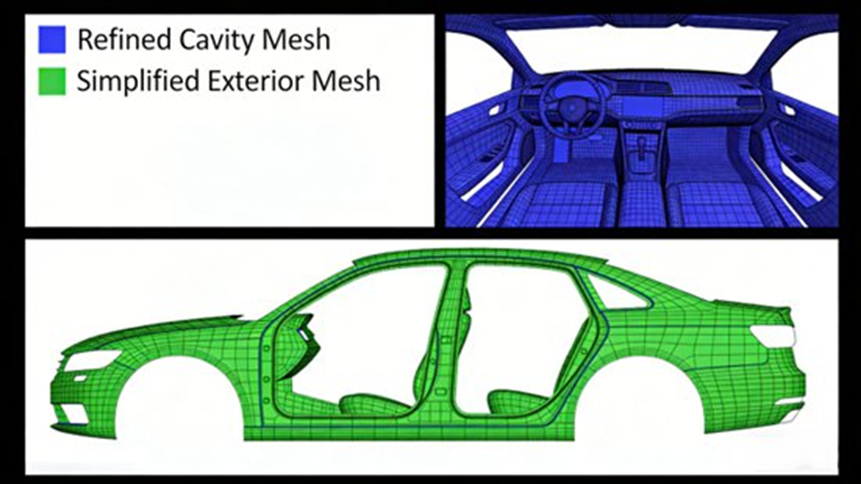
The first core module in the report is acoustic modeling and mesh processing, and that is the right place to start. If the model is poor, the acoustic results will not be trustworthy.
Vehicle geometry is complex. Body structures, cavities, ducts, trim parts, powertrain housings, and underbody features can make model preparation slow unless the tool handles cleanup well.
Geometry simplification and repair
The report states that the software can identify and remove unnecessary CAD details such as:
- small chamfers
- small holes
- minor redundant features
It can also repair geometric problems such as:
- overlapping surfaces
- broken edges
- disconnected faces
- defects that would hurt mesh quality
This matters because production CAD often includes many details that are useful for manufacturing but do not improve acoustic prediction.
Acoustic mesh generation
The report lists three mesh types:
- tetrahedral meshes
- hexahedral meshes
- hybrid Hexa-Tetra meshes
It also mentions support for:
- mesh refinement
- mesh smoothing
- balancing local detail with total solution time
That flexibility matters because different parts of a vehicle need different mesh strategies. A cabin cavity may need finer treatment than a less critical exterior region. The goal is to keep the model accurate where it matters without making the full solve unnecessarily heavy.
Material libraries and custom acoustic materials
The report says the software includes automotive-relevant acoustic materials such as:
- sound insulation cotton
- absorptive foam
- sheet metal
- glass
Engineers can use built-in properties or define custom values from measured data. That helps keep the model closer to the real vehicle.
Engineering example from the report
The report gives a new-energy vehicle cockpit quietness project as an example. In that case, engineers:
- imported the body CAD model
- simplified redundant geometry
- refined the mesh in the cabin cavity, instrument panel, and door trim regions
- used insulation material properties from the material set
- built the cockpit acoustic model for later cabin noise simulation and optimization
That example shows the real purpose of this module: fast creation of a simulation-ready acoustic model for vehicle cabin work.
Vibro-Acoustic Simulation for Powertrain and Body Noise
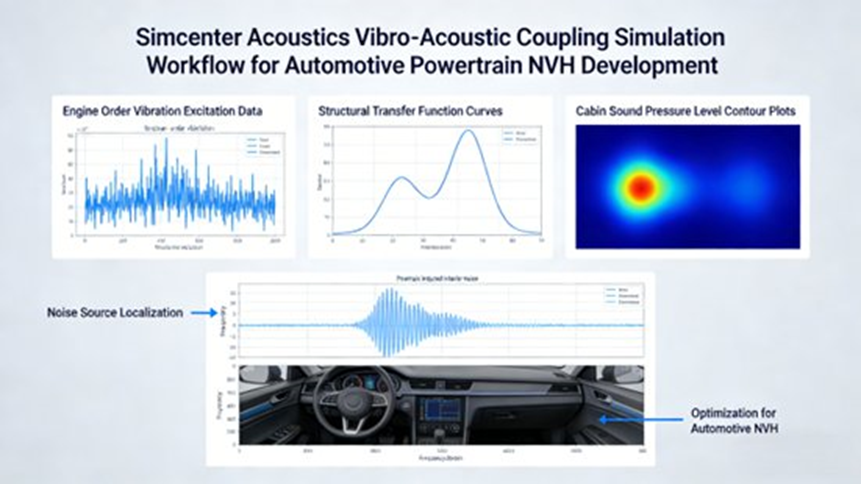
The second core module in the report is vibro-acoustic simulation. This is one of the most important parts of automotive NVH because many cabin noise problems begin with structural vibration.
The report describes two main coupling approaches: direct coupling and indirect coupling.
Direct coupling
Direct coupling is suited to low-frequency cases where structural vibration and acoustic response strongly affect each other. In this method, the structural vibration equations and the acoustic wave equations are solved together.
This is useful for:
- engine idle vibration
- body vibration creating low-frequency cabin noise
- panel vibration affecting enclosed air cavities
- floor and dashboard low-frequency response
Indirect coupling
Indirect coupling is more efficient for many mid- and high-frequency problems. Engineers first solve the structural response, then use the surface vibration velocity as an acoustic boundary condition for the radiation analysis.
This is useful for:
- tire noise
- higher-frequency panel radiation
- wind-driven structural acoustic response
- selected mid-band noise studies where direct coupling would be too costly
Real excitation sources
The report says this module can define real automotive excitations such as:
- engine block excitation
- road input
- gear mesh excitation
It also says engineers can import measured excitation data, including vibration data collected through test systems such as Simcenter SCADAS. That is a practical detail and it matters. A model with realistic excitation gives results that are much closer to real vehicle behavior.
Engineering example from the report
The report describes a passenger vehicle engine noise project where engineers built a coupled model of:
- the engine block
- the body structure
- the cabin acoustic domain
They simulated idle operating conditions and identified cabin noise peaks in regions such as:
- under the instrument panel
- below the front seats
They then improved:
- body panel thickness
- insulation material layout
The report says this reduced cabin idle noise by 3 dB(A). That is a meaningful improvement in real vehicle work.
Fluid-Acoustic Simulation for Wind Noise and Flow-Induced Noise
The third core module in the report is fluid-acoustic simulation, used to solve wind noise and other flow-induced noise problems.
As vehicles get faster and cabins get quieter, wind noise becomes more obvious. This is even more noticeable in electric vehicles.
Why this module matters
Wind noise does not come from one single point. It usually comes from airflow interacting with body surfaces, seals, glass edges, mirrors, pillars, and rear-end geometry. Pressure fluctuations and turbulent flow then create noise that reaches the cabin.
The report also says this module can be used for other flow-induced noise problems such as:
- exhaust systems
- cooling systems
Methods in the report
The report mentions two main approaches:
- Direct Numerical Simulation (DNS) for very high-fidelity turbulence studies
- Hybrid methods, such as LBM-acoustic or LES-acoustic coupling, for a better balance between accuracy and efficiency
That distinction matters. Some programs need a very detailed study of one critical area. Others need faster full-vehicle prediction during earlier design work.
Driving-condition support
The report says this module can simulate different driving conditions, including:
- high-speed driving
- crosswind driving
That gives teams a better view of how noise changes under real operating scenarios.
Engineering example from the report
The report gives a new-energy vehicle wind-noise project as an example. Engineers built a full-vehicle CFD-acoustic model and simulated airflow and noise at 120 km/h.
They found major separation areas around:
- the side mirror
- the window edge
- the rear section of the car
They then improved:
- mirror shape
- window sealing strips
- rear spoiler angle
The report says these changes reduced cabin wind noise by 2.5 dB(A) at high speed.
That example captures the logic of the full workflow: identify the flow problem, understand the acoustic result, then change the body or sealing where it matters.
Acoustic Optimization and Post-Processing
The fourth core module in the report is acoustic optimization and post-processing. This is where simulation becomes design action.
Result visualization
The report lists several result views and analysis outputs, including:
- sound pressure contours
- sound intensity maps
- frequency spectrum analysis
- sound level meter curves
These help engineers quickly see:
- where noise is highest
- which frequency bands are causing trouble
- what source is likely driving the problem
- how the sound is spreading or being transmitted
The report gives a good example here too. It says frequency spectrum analysis can help show whether a peak is caused by gearbox gear whine or another source.
Optimization support
The report says this module supports:
- parameter optimization
- topology optimization
Possible design variables include:
- insulation thickness
- panel stiffness
- material properties
- component installation position
- structural dimensions
Possible goals include:
- lower interior sound pressure level
- better frequency response
- lower noise peaks in target bands
- acceptable performance within cost and weight limits
Comparison with test data
The report says engineers can compare simulation results with measured data from tools such as Simcenter Testlab. That allows model calibration and improves result accuracy. This is a key point. The workflow is not “simulation instead of testing.” It is simulation plus targeted testing and correlation.
Engineering example from the report
The report describes a chassis noise project where engineers used post-processing to identify a suspension lower control arm as a main contributor to cabin mid-frequency noise.
They then changed:
- material properties
- structural dimensions
- structural layout through topology work
The report says the result was:
- 15% lower control-arm vibration amplitude
- 4 dB(A) lower cabin mid-frequency noise peak
It also says the final design still met lightweight requirements.
Real Automotive Use Cases Covered in the Report
The report covers a broad set of vehicle applications. They all matter because together they show this is a full toolchain solution, not a narrow acoustic utility.
1. New-energy vehicle cockpit acoustic model preparation
Used to build and refine a simulation-ready cabin acoustic model with body, trim, and insulation details.
2. Passenger vehicle engine idle noise reduction
Used to study how engine vibration travels through the structure into the cabin.
3. Drivetrain gear whine optimization
Used to predict noise from gear mesh vibration and improve tooth microgeometry or drivetrain parameters.
4. New-energy vehicle high-speed wind-noise reduction
Used to study airflow separation, window-edge noise, mirror noise, and rear-end aerodynamic effects.
5. Chassis and suspension noise refinement
Used to track structure-borne contributors such as suspension arms and improve their behavior.
6. In-vehicle audio and speaker grille optimization
The report references Mazda’s use of Simcenter 3D and Simcenter Heeds to reduce speaker grille simulation time from 2.5 days to 4 hours and shorten full speaker analysis time to 2 hours.
These examples span cockpit, body, chassis, powertrain, airflow, and in-cabin audio work. That range is a big part of the software’s value.
What Engineering Value Does Simcenter Deliver?
The report groups the value into three areas: shorter development cycles, lower development cost, and better NVH performance. That structure is useful and should stay in the article.
Shorter development cycles
Traditional NVH work often depends on multiple prototype rounds. The report says a vehicle program may need 3–5 rounds of physical prototypes, with each round taking 1–2 months for testing and modification. Simulation reduces that delay by moving problem finding and design changes earlier.
The report also gives a Hyundai-related drivetrain example where engineers used simulation during concept design to identify gear whine early, improve gear microgeometry and transmission ratio, and cut drivetrain NVH development time by 30%.
Lower development cost
The report says physical NVH prototypes are expensive and test programs require significant manpower, facilities, and budget. By replacing part of that loop with virtual simulation, teams can reduce:
- prototype count
- test count
- design rework
- engineering hours spent on late fixes
The Mazda example is useful here too. The report says Mazda reduced the number of physical prototypes in an in-vehicle audio program from 3 to 1, while also cutting development cost by 40%.
Better NVH performance and stronger product competitiveness
The report makes a strong commercial point here: NVH is now a core product differentiator. Customers hear the difference between a vehicle that feels quiet and controlled and one that does not.
It includes a domestic midsize SUV example where engineers used full-vehicle NVH simulation to improve:
- engine noise
- wind noise
- tire noise
- body structure
- insulation layout
- body aerodynamic shape
The final result in the report was:
- idle cabin noise ≤ 38 dB(A)
- 120 km/h cabin noise ≤ 62 dB(A)
The report says this helped the vehicle reach a leading NVH level in its segment.
Example Engineering Workflow
A typical engineering workflow based on the report looks like this:
- Import CAD for the body, cabin, chassis, or powertrain.
- Remove redundant geometry and repair model defects.
- Build the right acoustic mesh for the target problem.
- Assign structural and acoustic material properties.
- Select FEM, BEM, ray acoustics, or a coupled multiphysics setup.
- Define real excitations such as engine vibration, road input, gear mesh, or flow pressure.
- Solve the structural, acoustic, or coupled response.
- Review plots, spectra, and contribution patterns.
- Run parameter or topology optimization.
- Compare simulation with measured data and refine the model.
This mirrors the engineering logic of the original report very closely.
What Are the Future Trends for Simcenter Acoustics Simulation?
The report closes with three future directions.
1. Deeper use of AI
The report says future versions are likely to use AI more heavily for:
- automatic noise-source identification
- simulation parameter adjustment
- faster optimization
- higher efficiency and accuracy
2. Integration with digital twins
The report expects closer use with digital twin methods, including:
- real-time simulation
- online NVH monitoring
- full-lifecycle performance optimization
3. Stronger multidisciplinary workflows
The report says future development will likely connect acoustic simulation more closely with other tools, including battery simulation and electronic system simulation, so NVH work can be handled at full-system level.
Final Takeaway
Simcenter Acoustics Simulation is a strong fit for automotive NVH work because it matches both the physics of vehicle noise and the structure of modern vehicle development. It supports low-, mid-, and high-frequency noise analysis, structure-acoustic coupling, wind-noise prediction, optimization, and comparison with test data in one connected workflow.
For automotive teams, the message is simple: it is easier and cheaper to solve NVH problems when simulation is used early and used often. That is especially true in EV programs, where quiet cabins make small acoustic issues much easier to hear.
Frequently Asked Questions About Simcenter Acoustics Simulation
What problems does Simcenter Acoustics Simulation solve in automotive NVH development?
Short answer: It helps engineers predict and improve vehicle noise and vibration before hardware is built.
It supports work on:
- interior cabin noise
- exterior radiation noise
- vibro-acoustic coupling
- aeroacoustic effects
- drivetrain and EV noise studies
That makes it useful for finding NVH issues earlier, reducing prototype dependence, and shortening development cycles. It is especially helpful in EV programs, where motor noise, inverter tones, and wind noise are easier to hear once combustion masking is gone.
Which acoustic simulation methods are used in Simcenter Acoustics Simulation?
Short answer: It mainly uses FEM, BEM, and ray acoustics.
Each method solves a different part of the automotive NVH problem:
- FEM for interior acoustics and low-frequency vibro-acoustic response
- BEM for exterior radiation and many mid- to high-frequency problems
- Ray acoustics for high-frequency sound propagation, reflections, and scattering
Using these methods together gives engineers a way to study full-frequency NVH behavior, from structural vibration to airborne cabin noise.
How does Simcenter integrate with other CAE tools in the automotive development workflow?
Short answer: It works as part of a larger Siemens engineering environment.
That means it can be used alongside workflows involving:
- structural dynamics
- multibody motion
- CFD
- powertrain simulation
- system-level NVH prediction
- test correlation
This is useful for studies where structure, motion, flow, and acoustics all affect the final noise result, such as gear whine, wind noise, and electric drive NVH.
Can Simcenter Acoustics Simulation replace physical NVH testing?
Short answer: No, but it can reduce the amount of testing needed.
The strongest workflow is usually simulation first, then targeted validation testing. Simulation helps engineers catch issues earlier and explore more design options. Physical testing is still needed for correlation, confirmation, and final tuning.
That balance is a big part of modern automotive NVH development.
What are the main advantages of using Simcenter for automotive acoustic simulation?
Short answer: Faster analysis, lower cost, better fidelity, and stronger support for complex vehicle noise problems.
The main advantages include:
- faster NVH analysis
- multiphysics modeling
- high-fidelity digital prototypes
- lower prototype and test cost
- strong support for EV and e-drive noise work
Those benefits matter because modern vehicles need more acoustic refinement, and they need it earlier in development.
