


< Back to Vehicle Design & Engineering Hub
By Johnny Liu, CEO at Dowway Vehicle
Published: February 26, 2026
- 1. The Shift in Auto Manufacturing
- 2. Core Concepts of Process Planning
- 3. The 6 Key Steps in the Planning Workflow
- 4. New Tech Driving Process Optimization
- 5. Common Pain Points in Older Methods
- 6. Strategic Paths for Process Optimization
- 7. Real-World Case Study: Upgrading a NEV Plant
- 8. Frequently Asked Questions (FAQ)
- 9. Final Thoughts & Future Trends
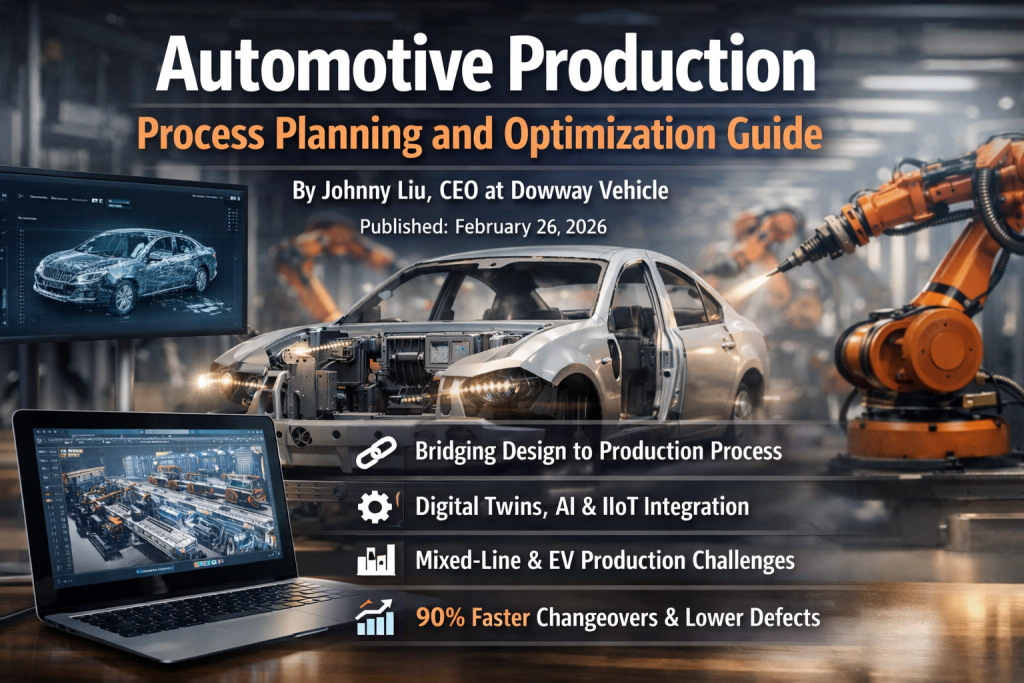
🔑 Key Takeaways
- Core Goal: Process planning connects a car’s design with how we actually build it. It guarantees quality, speeds up production, and keeps costs in check.
- Tech Upgrades: Old manual planning methods are giving way to Digital Twins, AI algorithms, and IIoT for real-time, data-driven decisions.
- Major Hurdles: Factories often struggle with a gap between design and process teams, data silos, and the shift to mixed-line production for Electric Vehicles (EVs).
- Proven Results: Switching to flexible, modular assembly can cut changeover times by nearly 90%, lower defect rates, and reduce energy use.
1. The Shift in Auto Manufacturing
The auto industry is changing fast. We are moving toward electric, smart, and lightweight vehicles. Because of this, traditional manufacturing methods face huge hurdles. Today’s factories must run mixed lines for different models. They have to hit tight precision targets, keep costs down, and meet strict green manufacturing goals.
Production Process Planning and Optimization acts as the main bridge between product design and the factory floor. It dictates production speed, product quality, factory costs, and safety. This guide breaks down the core concepts, daily workflows, common hurdles, and tech-driven solutions for modern auto production.
2. Core Concepts of Process Planning
At its heart, auto process planning focuses on the product, relies on resources, targets efficiency, and guarantees quality. It turns raw materials and parts into finished vehicles through standard steps: Stamping, Welding, Painting, and General Assembly.
The main goals are simple:
- Guarantee Quality: Ensure strict machining and assembly precision to drop defect rates.
- Boost Efficiency: Smooth out workflow transitions, clear bottlenecks, and maximize line output.
- Control Costs & Environmental Results: Better manage equipment, tools, and labor while cutting material waste, energy use, and pollution.
Old planning relied heavily on manual experience. Modern process planning is different. It relies on Digital tools (like simulation), Collaborative systems (linking design and logistics), and Flexible setups (adapting quickly to custom orders).
3. The 6 Key Steps in the Planning Workflow
Step 1: Product Design Analysis & Manufacturability Review
Planning starts by looking at 3D models and blueprints. A joint review checks if the part is easy to make, assemble, and test. For example, when designing an EV battery pack shell, teams must verify if the shape allows for easy stamping and welding. This prevents expensive, design-induced delays later on.
Step 2: Process Division & Workflow Routing
We divide vehicle production into four main stages: Stamping, Welding, Painting, and General Assembly. General assembly usually follows this path: Interior -> Chassis -> Powertrain -> Exterior -> Testing. For mixed-line production, planners use modular sub-assembly strategies. This allows teams to build core modules off the main line and dock them quickly when ready.
Step 3: Equipment & Tooling Configuration
Your equipment must match your capacity goals. This means setting up automated stamping presses, robotic welding lines, and Automated Guided Vehicles (AGVs) for assembly. Tooling and fixtures serve a dual purpose: they position the part and prevent errors, ensuring high first-pass yields.
Step 4: Process Parameter Setting
Engineers must lock in vital parameters—like stamping pressure, welding current, and paint baking temperature. They base these settings on material properties and past testing data to stop defects before they happen.
Step 5: Personnel Allocation & Standard Operating Procedures (SOPs)
Clear SOPs keep the line moving safely. Assembly stations need detailed manuals that show exact assembly sequences, torque limits, and clearances. This cuts down on human error.
Step 6: Process Validation & Iterative Improvement
Before full production, the planned process goes through small-batch trial runs. This checks if the workflow makes sense and meets quality standards. Optimization never stops; teams constantly collect real-time data to tweak and improve the line.
4. New Tech Driving Process Optimization
4.1 Digital Simulation & Digital Twin Technology
Simulation software (like Tecnomatix and CATIA) lets engineers test processes on a screen. They can predict stamping spring-back or welding heat deformation early. Beyond that, Digital Twins build real-time digital copies of physical assembly lines. Tesla’s Shanghai Gigafactory uses over 2,000 smart sensors to run a digital twin system, catching 89.2% of machine faults before they break down.
4.2 AI & Machine Learning
AI gives managers clear decision support. Genetic algorithms can figure out the best machine layouts. For instance, Volkswagen used them to move welding robots around, cutting cycle time from 75 to 68 seconds. Toyota uses machine learning to predict market demand fluctuations with 92.4% accuracy.
4.3 Industrial Internet of Things (IIoT)
IIoT relies on connected sensors to gather live data. By watching equipment status, factory managers can fix machines before they fail. This stops bad units from going down the line and saves money on rework.
4.4 Modular & Flexible Manufacturing
Modular manufacturing splits cars into standard blocks (battery packs, cockpits, e-drives). Flexible factory designs, like swapping fixed belts for moving AGVs, can shrink line changeover times from 2 hours to just 15 minutes.
5. Common Pain Points in Older Methods
Even with new technology, the industry still battles several headaches:
- Design-Process Gap: When design and process teams do not talk early on, factories end up with hard-to-build parts and long delay cycles.
- Relying on Manual Experience: Many smaller firms still rely on manual guesswork. This leads to slow planning and wrong machine settings.
- Data Silos: Data from MES, ERP, and machine monitors often sit in separate systems. Without connected data, optimization is just a guessing game.
- Green Manufacturing Gaps: Heavy energy use in old stamping and painting lines goes against modern green manufacturing rules.
6. Strategic Paths for Process Optimization
To fix these issues, auto makers must adopt a few clear strategies:
- Build a Collaborative System: Set up regular reviews and use shared digital workspaces so design and process teams look at the same data.
- Accelerate Digital Upgrades: Move away from manual guesswork. Use digital twins and AI algorithms instead.
- Run on Data: Unify your software platforms to break down data silos. Use closed-loop systems, like a data-driven “torque-angle method” for tight bolt connections.
- Upgrade Line Flexibility: Switch to modular builds and flexible AGV systems, backed by smart scheduling software.
- Go Green: Cut material waste and use cleaner methods (like waste heat recovery or trivalent chromium passivation).
7. Real-World Case Study: Upgrading a NEV Plant
Background: A New Energy Vehicle (NEV) maker needed to shift from a single-model line to a 3-model mixed line. Their old setup caused 2-hour changeover times, a high defect rate of 3.2%, and poor paint usage.
Optimization Measures:
- Added Tecnomatix for simulation and built a shop-floor digital twin.
- Used neural networks to auto-adjust welding settings.
- Switched to modular sub-assemblies and put AGVs on the floor with quick-change fixtures.
- Brought in robotic electrostatic painting and waste heat recovery systems.
Results:
- Efficiency: Changeover time fell from 2 hours to 15 minutes. Takt time dropped from 3 mins/unit to 1.8 mins/unit (a 60% capacity jump).
- Quality: Defect rates fell from 3.2% to 0.8%.
- Cost & Green Benefits: Paint usage jumped by 23%, unit energy consumption dropped by 18%, and labor costs fell by 25% (saving about 120 million RMB a year). Pollutant emissions dropped by 30%.
8. Frequently Asked Questions (FAQ)
Q1: What is auto production process planning, and why does it matter?
It is the clear plan of exactly how a factory will turn raw materials into a finished car. It covers workflows, line capacities, and logistics. Industry experts at Oplit point out that good planning ensures smooth operations, cuts waste, and improves vehicle quality. This helps car brands hit strict delivery dates in a tough market.
Q2: What are the main ways to optimize production planning?
Factories use a few main tools to keep up with changing demand: Advanced Planning & Scheduling (APS) systems for live adjustments, Simulation & Digital Twin models to test ideas virtually, math models for logistics, and Lean Manufacturing rules (like SMED) to cut physical waste.
Q3: What are the biggest hurdles in planning auto production?
The main issues include sudden demand shifts that old, static planning methods simply cannot handle. Managing multiple build stages at once is highly complex. Disconnected data ruins planning accuracy, and managers constantly struggle to balance cutting costs with keeping quality high.
Q4: How does simulation support auto process planning?
Simulation software builds virtual models of real production lines. It lets planners test new workflows, floor layouts, or tool changes, and measure their exact effects before moving heavy machinery. This cuts down on physical trial-and-error costs and keeps the factory running.
Q5: What global standards back up production planning optimization?
Global industry standards heavily support strong production planning. These include IATF 16949 (for quality management), Master Production Schedules (MPS) (to link market forecasts with factory output), Production Part Approval Process (PPAP), and 8D Problem Solving for fixing root-cause issues.
9. Final Thoughts & Future Trends
Good process planning and optimization are the backbone of high-quality auto manufacturing. By blending simulation, AI, and IIoT, factories can break through old data silos and slow manual routines.
Looking forward, factories will become much smarter. AI will take over manual routine checks across the whole build cycle. Extreme line flexibility will be the standard. Driven by carbon-neutral goals, green materials and clean energy will be a basic requirement. Ultimately, optimization will stretch far beyond the factory walls, linking design teams, supply chains, and after-sales service into one smooth system.

·