


< Back to Data Management System
Author: Johnny Liu
Author Title: CEO at Dowway Vehicle
Published Date: March 11, 2026
Last Updated: March 11, 2026
Content Type: Expert industry analysis
Reviewed For: Automotive operations, digital supply chain systems, EV supply chain execution, SCM software evaluation
About the Author:
Johnny Liu is CEO at Dowway Vehicle. He writes about automotive manufacturing systems, vehicle engineering operations, supply chain execution, digital plant management, and the shift toward electric and connected vehicles. This article is based on the full source report on YonSuite SCM in the automotive sector and is written for readers evaluating automotive supply chain systems in real operating environments.
- Introduction
- Why Automotive Companies Need Specialized Automotive Supply Chain Management Software
- What YonSuite SCM Means as Automotive Supply Chain Management Software
- YonSuite SCM Technical Architecture for Automotive Supply Chains
- How YonSuite SCM Supports Automotive Procurement Management
- How YonSuite SCM Improves Automotive Inventory Management
- How YonSuite SCM Supports Automotive Logistics Management
- How YonSuite SCM Connects the Automotive Value Chain
- Data Analysis and Decision Support in Automotive Supply Chains
- Automotive Use Cases for YonSuite SCM
- Business Value of YonSuite SCM in Automotive Engineering
- Automotive Parts Supplier Case: YonSuite SCM in Practice
- Why YonSuite SCM Fits Automotive Digital Transformation
- Future Direction of YonSuite SCM in Automotive Supply Chains
- Frequently Asked Questions
- 1. How is the shift to Electric Vehicles (EVs) changing automotive supply chains?
- 2. Is Just-In-Time (JIT) manufacturing dead in automotive after the pandemic?
- 3. What is a supply chain control tower, and why does automotive need one?
- 4. How are AI and big data actually used in automotive SCM?
- 5. Why is it so hard for automotive companies to replace legacy ERP and SCM systems?
- Final Takeaway
Introduction
Automotive supply chain management software helps OEMs, EV manufacturers, and auto parts suppliers manage procurement, inventory, logistics, supplier collaboration, and real-time supply chain visibility. YonSuite SCM is designed for automotive companies that need tighter control over complex BOMs, JIT delivery, EV component traceability, and cross-functional coordination across sourcing, production, warehousing, and distribution.
Automotive supply chains are large, fast-moving, and difficult to manage. They span R&D, procurement, production, logistics, inventory, sales, and after-sales service, while involving thousands of suppliers and many thousands of parts across the value chain.
As the automotive industry moves toward electric vehicles, intelligent systems, and connected mobility, supply chain teams face greater pressure from demand swings, shorter technology cycles, engineering changes, and stricter delivery requirements. This is why automotive companies increasingly need supply chain management software that improves coordination, traceability, and decision-making across the entire operation.
Traditional supply chain methods often fall short in this environment. Common problems include disconnected systems, weak coordination, heavy inventory, high cost pressure, and poor visibility across the chain. Those problems are even harder to handle in new energy vehicle programs and intelligent vehicle programs. For example, battery and motor procurement cycles directly affect vehicle delivery. Smart cockpit and autonomous driving modules require tighter links between engineering and supply chain teams.
YonSuite SCM is built as an integrated digital supply chain toolchain under the Yonyou BIP ecosystem. It is designed for growing enterprises and built on a cloud-native, microservices-based foundation. In automotive use, it connects procurement, inventory, logistics, collaboration, and analytics from upstream suppliers to downstream dealers and end users. It is built to suit the industry’s real operating traits: many product variants, small-lot production, high precision, and strong cross-functional coordination.
This article explains how YonSuite SCM works as automotive supply chain management software in real automotive operations. It covers the platform’s technical architecture, core functional modules, business value, and a practical parts supplier case, while showing how it supports JIT supply, BOM complexity, EV component control, IoT monitoring, control tower visibility, supplier management, and digital decision support.
For readers who want background on Yonyou’s broader platform ecosystem, the company’s official site provides product context: Yonyou.
Why Automotive Companies Need Specialized Automotive Supply Chain Management Software
Automotive supply chains are harder than most manufacturing chains
Automotive manufacturing is a complex manufacturing model. A single vehicle program depends on close coordination between engineering, sourcing, manufacturing, warehousing, transportation, distribution, dealers, and after-sales operations. These links are tightly connected. A problem in one part of the chain can quickly spread to the rest.
The complexity is not only about scale. It is also about change. Market demand moves quickly. Regulations change. Product upgrades happen faster than before. Vehicle programs keep adding electronic systems, smart functions, and new energy components. This creates more pressure on procurement planning, supplier coordination, inventory control, and delivery timing.
In electric vehicle programs, battery packs, motors, and electronic control units need tighter planning and storage control. In intelligent vehicle programs, smart cockpit systems and autonomous driving modules increase the need for rapid engineering-to-supply coordination. These are not small adjustments. They change how supply chains must operate day to day.
Why older supply chain methods struggle
Many legacy supply chain setups still rely on disconnected data, manual updates, and systems that do not communicate well across departments. That creates information silos. Procurement may not see design changes early enough. Warehouses may not have clean visibility into live demand. Logistics teams may not stay fully in step with plant scheduling. Suppliers may receive updates too late.
This often leads to slow coordination, delayed deliveries, stock buildup, weak cost control, and poor response to engineering changes. In automotive manufacturing, those issues can stop production or cause expensive delays.
Where YonSuite SCM fits
YonSuite SCM is built to connect the full automotive supply chain from suppliers to end users. As automotive supply chain management software, it supports OEMs, parts manufacturers, dealer networks, and cross-regional operations. Compared with traditional SCM systems, it offers lightweight deployment, modular expansion, strong industry fit, and faster adaptation to different business models in the automotive sector.
What YonSuite SCM Means as Automotive Supply Chain Management Software
A digital supply chain toolchain for growing automotive enterprises
YonSuite SCM is part of the Yonyou BIP ecosystem. It is positioned as a digital and intelligent supply chain platform for growing enterprises. In automotive use, it helps companies connect sourcing, inventory, logistics, collaboration, and analysis inside one system.
This matters because automotive companies often need a practical system path, not a large one-time rebuild. YonSuite SCM supports that by letting businesses start with urgent modules, then add more functions later.
What it helps automotive companies do
YonSuite SCM helps automotive enterprises:
- connect upstream suppliers with downstream channels
- reduce information barriers across R&D, production, sourcing, sales, and service
- improve planning accuracy
- strengthen supplier control
- manage inventory with more precision
- monitor logistics in real time
- support management decisions with live data
Why it is different from generic SCM tools
Generic SCM tools may cover standard procurement or stock functions, but automotive operations need more. YonSuite SCM is built around the actual characteristics of automotive engineering and production. These include:
- multi-variant products
- small-batch combinations
- high-precision parts
- frequent design changes
- strong coordination across teams and companies
Its modular design also matters. An auto parts company can start with procurement and inventory. An OEM can connect the whole chain. This reduces transformation risk and avoids large system reconstruction at the start.
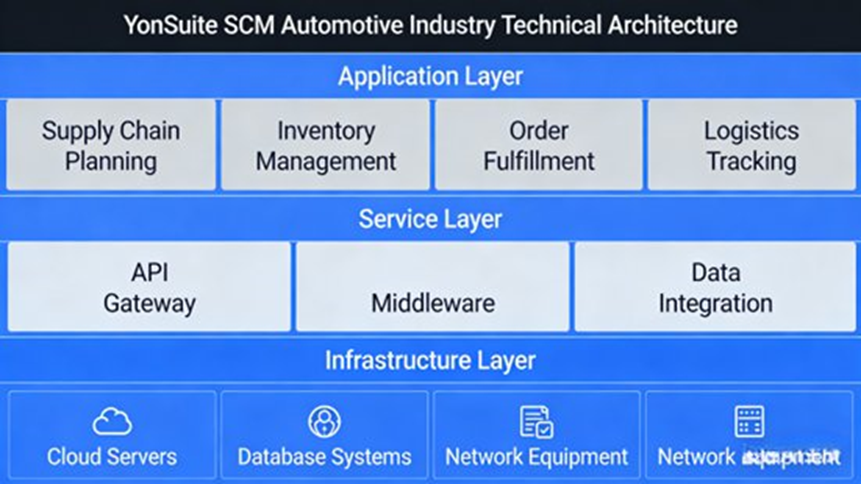
YonSuite SCM Technical Architecture for Automotive Supply Chains
A four-layer architecture built for automotive complexity
YonSuite SCM uses a four-layer architecture that fits the complexity of automotive supply chains:
- bottom support layer
- core technology layer
- application layer
- industry adaptation layer
This structure is built on a unified digital base and combines cloud-native architecture with AI, big data, IoT, and blockchain.
Bottom support layer
The bottom support layer is the operating base of the platform. It uses a cloud-native architecture and supports multi-tenant and multi-data-center deployment. This is useful for automotive groups with multiple factories, regional operations, and different business units.
This layer includes both IaaS and PaaS capabilities. The PaaS layer is based on Yonyou iuap 6.0 and provides:
- microservice registration
- configuration center functions
- service governance
- data middle platform support
This structure lets companies split and combine business modules with flexibility. For example, a parts manufacturer can use procurement and inventory only. A vehicle maker can run the full chain. This reduces digital transformation cost and avoids large-scale system rebuilding.
The bottom support layer also focuses on stability and security. It includes:
- data encryption
- permission control
- disaster recovery
- backup mechanisms
These functions protect core supply chain data such as BOM data, procurement prices, production plans, and inventory records, while also supporting automotive data compliance needs.
Core technology layer
The core technology layer gives YonSuite SCM its intelligent and connected operating logic. It uses AI, big data, IoT, and blockchain, with direct links to automotive use cases.
AI technology
AI supports:
- intelligent demand forecasting
- intelligent production scheduling
- intelligent replenishment
- supplier risk warning
Using historical automotive sales data, market demand shifts, and policy changes, the system can forecast vehicle and part demand more accurately. This helps guide procurement and production planning and reduces the risk of shortage or overstock.
AI also helps assess suppliers by looking at delivery ability, quality level, and financial condition. This helps companies identify supply risk early and keep the chain more stable.
Big data technology
Big data functions build a supply chain data platform that combines:
- parts procurement data
- production data
- logistics data
- inventory data
- after-sales data
With data mining and analysis, companies can find bottlenecks, improve stock structure, and reduce sourcing cost. For example, procurement price trends and supplier quotations can be compared to support better buying decisions. Inventory turnover analysis can help improve stock distribution and raise turnover speed.
IoT technology
IoT links the system with:
- production equipment
- logistics vehicles
- warehousing equipment
This gives real-time data collection and monitoring across the chain. In automotive use, production quality data for parts can be captured and tied into SCM records so quality issues can be traced quickly. Logistics vehicles can also be tracked through GPS and status monitoring, which helps keep part deliveries in step with assembly rhythm.
Blockchain technology
Blockchain supports two key areas in the report:
- auto parts traceability
- supply chain finance
It allows lifecycle tracking of parts from R&D and production to procurement and after-sales use. This supports automotive quality control requirements. It also helps with credit sharing among supply chain participants, which can support financing access for smaller firms.
Application layer
The application layer contains the main business modules used by automotive teams:
- procurement management
- inventory management
- logistics management
- supply chain collaboration
- data analysis and decision support
These modules are connected and work in a closed loop that matches real automotive workflows.
Industry adaptation layer
The industry adaptation layer is one of the strongest points of YonSuite SCM. It is what separates the platform from a general-purpose SCM system. It is designed for:
- vehicle manufacturing
- auto parts production
- vehicle sales
- after-sales operations
Several automotive-specific adaptations are especially important.
For complex BOM structures and multi-version part management, the system supports super BOM and configurable BOM management.
For final assembly timing, the system supports production and logistics coordination for Just-In-Time (JIT) part supply.
For new energy vehicle parts such as batteries, motors, and electronic control systems, the platform strengthens procurement and stock control and supports real-time monitoring of temperature and humidity to protect quality.
How YonSuite SCM Supports Automotive Procurement Management
Procurement in automotive is high-pressure and detail-heavy
Automotive procurement involves many categories, many suppliers, high quality standards, and strict delivery timing. A sourcing delay or a poor-quality inbound part can affect production rhythm very quickly. YonSuite SCM addresses this with full-process digital procurement control.
Intelligent procurement planning
The system uses:
- vehicle production plans
- BOM lists
- inventory levels
- demand forecast data
to generate procurement plans automatically. It also supports multiple plan versions so teams can compare and adjust them when needed. This fits multi-variant and small-batch production patterns.
If an OEM adjusts production scheduling, the system can update the related component sourcing plan in sync. That helps reduce shortages and excess stock.
Supplier lifecycle management
YonSuite SCM builds supplier records that include:
- supplier qualifications
- production capacity
- quality level
- delivery ability
- quotation data
It supports supplier grading, such as core suppliers and backup suppliers. It also uses AI for ongoing supplier evaluation and regular reviews.
For critical automotive suppliers, such as engine or transmission suppliers, the platform can monitor production progress and quality status more closely. It also supports global sourcing and socialized transactions, which helps automotive enterprises expand supplier options and manage sourcing cost better.
Digital procurement execution
Procurement execution is handled online from start to finish, including:
- purchase request
- purchase order
- receipt
- inspection
- warehouse entry
Orders are linked with production plans and inventory data, so teams can track order status and get alerts for delivery delays.
When parts arrive, the system can match purchase orders with inspection standards and record inbound quality results digitally. If parts fail inspection, return workflows can start quickly. The system also includes price comparison logic and price warning functions to help manage procurement cost.
Procurement settlement automation
YonSuite SCM can connect with finance systems to support automatic matching between:
- procurement invoices
- purchase orders
- warehouse receipts
It supports several settlement methods, such as:
- pay on delivery
- monthly settlement
- acceptance bills
This improves settlement speed, reduces manual errors, and supports integrated business-finance-tax management.
How YonSuite SCM Improves Automotive Inventory Management
Automotive inventory is more than stock counting
Automotive inventory includes many part types, many specifications, high-value items, and shelf-life-sensitive materials. In EV programs, this gets even more difficult because batteries and related systems need strict environmental control and faster stock rotation.
Multi-dimensional inventory management
YonSuite SCM manages inventory by:
- part category
- specification
- batch
- shelf life
- storage location
This gives real-time stock visibility and supports fine-grained control for automotive parts. For batteries and other key EV components, the system can store:
- production batch
- validity period
- environmental parameters such as temperature and humidity
This helps prevent expiry, damage, and value loss.
Intelligent inventory alerts
The system supports:
- lower stock alerts
- upper stock alerts
- shelf-life alerts
- excess stock alerts
If stock drops below a safe level, the system can trigger replenishment reminders. If parts are close to expiration, it can prompt teams to move them out first and reduce waste.
Inventory optimization and turnover
With big data analysis, YonSuite SCM helps improve stock structure and assign inventory more reasonably across plants and warehouses. It supports higher turnover and lower working capital pressure. The report links this logic with practical outcomes such as inventory turnover improvements of 20% to 30% in YonSuite-based use cases.
Inventory traceability and counting
The platform supports full lifecycle tracking from:
- inbound
- outbound
- transfer
- scrap
It also supports digital counting through scanning and RFID. This helps maintain inventory accuracy and meets automotive traceability requirements.
How YonSuite SCM Supports Automotive Logistics Management
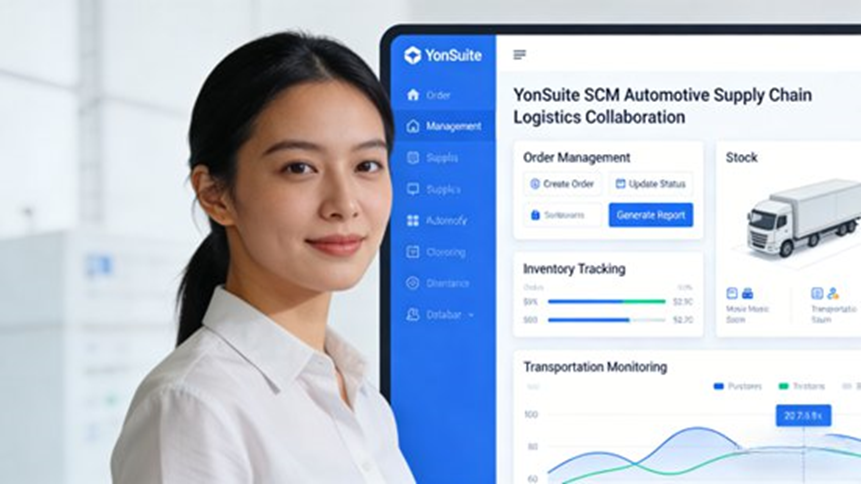
Automotive logistics has many moving parts
Automotive logistics includes:
- inbound part logistics
- production logistics
- finished vehicle logistics
- after-sales logistics
These flows often involve long transport distances, complex route planning, strict delivery windows, and high cost pressure.
Logistics path optimization
YonSuite SCM can compare route and transport choices based on:
- cost
- delivery timing
- transport risk
It supports road, rail, sea, and air transport comparisons. For urgent core parts, it can support air freight or expedited road transport choices. For finished vehicle distribution, it can help improve routing to control cost.
Real-time logistics monitoring
Using IoT links to vehicles and warehousing equipment, the platform can monitor:
- shipment position
- temperature
- humidity
- vibration or shock conditions
This creates visibility during transport. If delays or damage risks appear, the system can issue alerts so teams can respond earlier.
Logistics collaboration
The platform supports coordination between:
- logistics service providers
- suppliers
- plants
- dealers
This allows shipment information to be shared across the chain. Suppliers can track transport progress and prepare for handoff. Vehicle makers can track vehicle delivery progress and prepare warehousing or sales plans. The system also supports internal transaction coordination and cross-regional logistics operations.
Logistics cost control
YonSuite SCM records logistics cost data across stages and uses analysis to find bottlenecks and cost drivers. Companies can compare service providers, assess service quality, reduce transport distance, and improve routing choices.
How YonSuite SCM Connects the Automotive Value Chain
R&D and supply chain collaboration
Automotive supply chains need to stay in step with engineering changes. YonSuite SCM connects with PLM systems and synchronizes engineering BOM with manufacturing BOM. When design changes happen, updates can move into supply chain processes quickly so procurement and production stay consistent.
This is important for fast-changing modules such as smart cockpit systems. If design data changes, suppliers can be notified quickly and production plans can be adjusted. This helps reduce part shortages and avoid obsolete stock. The report also links this logic with practical YonSuite use in centralized drawing management and real-time BOM synchronization.
Production and sales collaboration
YonSuite SCM combines sales data with production data so demand changes can move into planning more quickly. When a dealer places an order, that information can be sent directly to production planning and parts sourcing teams. This helps shorten delivery cycles and keep production closer to market demand.
Supply and demand collaboration
The system supports real-time sharing of:
- demand information
- inventory information
- production information
between suppliers, OEMs, and dealers. Suppliers can view production schedules and stock levels. Dealers can view finished vehicle stock and delivery timing. This helps balance supply and demand more accurately.
Supply chain control tower
YonSuite SCM supports a supply chain command center, or control tower, built around:
- real-time end-to-end visibility
- intelligent warning
- collaborative decision support
This helps automotive companies monitor supply chain conditions and make faster decisions in a market that changes quickly.
Data Analysis and Decision Support in Automotive Supply Chains
Multi-dimensional data analysis
YonSuite SCM supports analysis across:
- procurement cost
- inventory turnover
- logistics cost
- supplier performance
- demand forecasting
It also supports custom reporting for enterprise-specific management needs. Procurement cost analysis can show which parts or suppliers are too expensive. Inventory turnover analysis can show where stock structure should change. Logistics analysis can show where costs are too high.
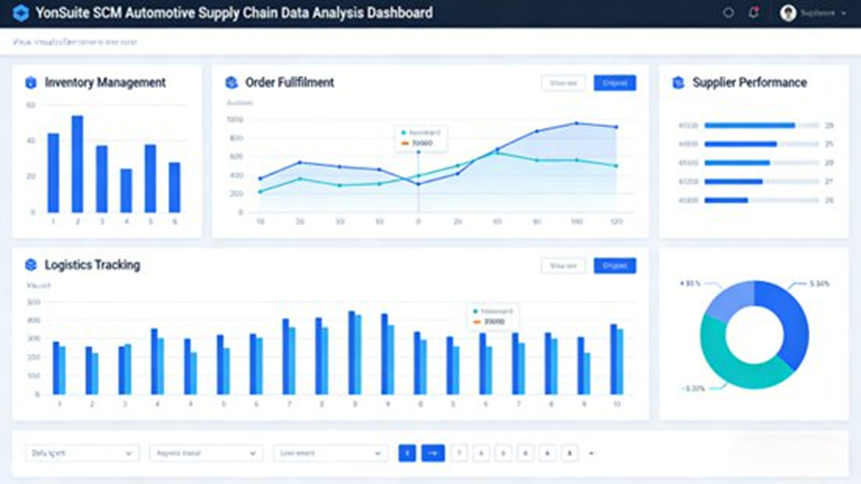
Visual decision support
Dashboards and reports present supply chain status in a clear visual form. Managers can view:
- inventory levels
- procurement progress
- logistics progress
- supplier performance
The system supports drill-down analysis so users can move from summary metrics to detailed records. This helps leadership teams spot problems and act faster.
Intelligent decision suggestions
YonSuite SCM also gives system-generated suggestions based on data and AI. These may include:
- better purchase timing
- better purchase pricing windows
- improved stock allocation
- better logistics route choices
This helps move teams from manual reaction to earlier intervention.
Automotive Use Cases for YonSuite SCM
OEM use
For OEMs, YonSuite SCM supports planning, sourcing, production coordination, JIT part flow, and delivery visibility. It helps keep final assembly supplied on time and reduces disruptions across departments.
Auto parts supplier use
For parts suppliers, it helps coordinate with several OEM customers at once, improve delivery reliability, reduce waste across sourcing and logistics, and strengthen quality traceability.
EV component use
For batteries, motors, and electronic control systems, YonSuite SCM supports tighter procurement rules, more precise stock management, and live environmental monitoring to protect part quality.
Dealer and downstream use
For dealer networks and downstream channels, the system improves visibility into vehicle availability, order progress, and delivery timing. It also supports after-sales parts response.
Business Value of YonSuite SCM in Automotive Engineering
Cost and efficiency gains
The report identifies clear value in cost and efficiency. With intelligent procurement, better stock planning, and improved logistics routing, YonSuite SCM can help automotive firms achieve:
- 5% to 15% lower procurement cost
- 20% to 30% higher inventory turnover
- 10% to 20% lower logistics cost
- 30% to 50% shorter delivery cycles
The report also links these value ranges with practical YonSuite use cases, including improved inventory turnover and lower production cost in similar manufacturing settings.
Quality control and traceability
YonSuite SCM supports full lifecycle traceability of automotive parts. This helps companies identify quality issues faster, trace root causes, manage supplier quality more closely, and reduce loss tied to defective parts. It also supports fast handling of nonconforming materials and follow-up actions.
Faster response to market and design changes
Since sourcing, planning, inventory, and logistics data are connected, companies can respond faster when demand changes or engineering updates happen. This is especially useful in automotive operations built around many variants, smaller batches, and frequent updates.
Support for digital transformation
The platform helps automotive firms move away from manual and fragmented processes and build visible, connected supply chain operations. Its modular design supports a phased transformation path, which lowers entry barriers for businesses of different sizes.
Automotive Parts Supplier Case: YonSuite SCM in Practice
Company background and pain points
The report describes a domestic automotive parts company that produces engine parts and transmission parts for several major OEMs. The company faced serious supply chain problems, including:
- low collaboration efficiency
- heavy inventory buildup
- high procurement cost
- weak quality traceability
These issues were affecting production performance and market competitiveness.
Procurement improvements
After adopting YonSuite SCM, the company built a supplier grading system, monitored core suppliers in real time, improved procurement planning, and moved procurement processes online.
The reported results were:
- 40% increase in procurement efficiency
- 12% reduction in procurement cost
The report also notes that this result is consistent with similar YonSuite outcomes at another automotive parts enterprise in Handan that achieved an annual procurement cost reduction of 12%.
Inventory improvements
Using multi-dimensional stock control and intelligent alerts, the company improved stock structure and reduced excess inventory.
The reported results were:
- 25% increase in inventory turnover
- 30% reduction in capital occupation
For high-precision engine components, stock control became more accurate, reducing the risk of part expiry or damage.
Collaboration and delivery improvements
The company connected with OEMs and suppliers in real time through shared production plans, inventory data, and delivery progress.
The reported results were:
- 98% on-time delivery rate for components
- shorter waiting time at customer plants
- better customer satisfaction
- faster handling of design changes
- lower risk of obsolete parts after engineering updates
The report also connects this pattern with YonSuite use in real-time BOM synchronization and coordinated engineering change handling.
Quality traceability improvements
The company used YonSuite SCM to build lifecycle traceability across sourcing, production, warehousing, and delivery. When quality problems appeared, it could locate the cause faster.
The reported result was:
- 20% reduction in quality loss
This shows that the platform fits the quality and traceability requirements of automotive parts manufacturing.
Why YonSuite SCM Fits Automotive Digital Transformation
Built for real automotive operating conditions
Automotive companies need systems that can handle:
- many variants
- precision parts
- strong cross-functional coordination
- shorter product cycles
- design change impact across the chain
YonSuite SCM is structured around those conditions rather than generic manufacturing assumptions.
Scalable for different business models
The platform can support:
- OEMs
- Tier suppliers
- fast-growing parts manufacturers
- cross-regional operations
- multi-plant organizations
Because deployment can be partial or full, companies can choose the pace that fits their operating reality.
Modular deployment path
A business can start with procurement and inventory, then expand into logistics, collaboration, and analytics later. This modular path lowers risk and avoids forcing a full one-time replacement project.
Future Direction of YonSuite SCM in Automotive Supply Chains
Deeper support for EV and intelligent vehicle programs
As the automotive sector keeps moving toward electrification and connected vehicles, YonSuite SCM is expected to deepen its support for:
- EV battery supply chains
- motor and electronic control supply chains
- autonomous driving module coordination
- smart cockpit-related supply planning
More AI-led decision support
The platform is also expected to strengthen full-process intelligent decision support through:
- more accurate forecasting
- faster replenishment response
- more flexible scheduling
- stronger decision automation
More value-added services
The report also points to future expansion in:
- supply chain finance
- carbon management
- green supply chain transformation
These areas matter more as automotive firms balance cost, resilience, compliance, and sustainability.
Frequently Asked Questions
1. How is the shift to Electric Vehicles (EVs) changing automotive supply chains?
Short answer: EVs add more pressure to inventory control, supplier planning, environmental monitoring, and logistics because batteries and electronics are high-value, sensitive, and time-sensitive.
The move to EVs changes the supply chain at a basic level. Batteries, motors, power electronics, and control systems are not managed like many traditional internal combustion components. They need stricter storage rules, tighter quality control, and closer tracking across their lifecycle.
In real operations, this means companies need more than standard stock counts. They need to track temperature, humidity, shelf life, batch data, and movement conditions in real time. Older systems often treat inventory too uniformly, which creates risk when handling EV components that can degrade if stored or moved poorly.
YonSuite SCM matches this need through multi-dimensional inventory control and IoT-based visibility. In the report, this is shown through support for battery, motor, and electronic control management, along with real-time temperature and humidity monitoring.
2. Is Just-In-Time (JIT) manufacturing dead in automotive after the pandemic?
Short answer: No. JIT is still used, but it now depends on stronger visibility, better data sync, and faster warning systems.
JIT did not disappear. What changed is the level of system support required to make it work safely. In the past, many firms ran lean operations on top of siloed systems. That became risky when disruptions exposed weak visibility across suppliers, production plans, transport, and warehousing.
Today, JIT in automotive works best when engineering, sourcing, production, inventory, and supplier data are linked in real time. Without that, the risk of line stoppage is too high.
This is where YonSuite SCM matters. The report shows support for PLM integration, BOM synchronization, supplier coordination, real-time logistics monitoring, and control tower visibility. Those are the conditions needed to run JIT with less risk.
3. What is a supply chain control tower, and why does automotive need one?
Short answer: A control tower is a live command center for supply chain visibility, warning, and decision support across the full network.
Automotive supply chains are spread across many suppliers, plants, warehouses, carriers, dealers, and service channels. Problems can start far upstream but only become visible when they are already affecting production or delivery.
A control tower helps by pulling real-time data into one operating view. It can show shipment progress, part conditions, inventory changes, and delivery risks. It also supports earlier decisions instead of late reaction.
The YonSuite SCM report directly describes a supply chain control tower built around end-to-end visibility, intelligent warning, and collaborative decision support. Its role is to break information silos and improve resilience in a changing market.
4. How are AI and big data actually used in automotive SCM?
Short answer: They are used for demand forecasting, supplier risk checks, smart replenishment, inventory optimization, and logistics decisions.
Automotive teams usually do not care about AI as a slogan. They care about whether it helps solve real problems. In daily supply chain work, the most practical uses are clear.
One is dynamic demand forecasting. The system uses historical sales data, market changes, and policy shifts to improve planning.
Another is supplier risk assessment. The system checks supplier delivery performance, quality levels, capacity, and even financial condition to spot risk earlier.
A third use is smart replenishment and route choice. The system can suggest better stock layouts and better freight plans based on delivery needs and cost pressure.
YonSuite SCM includes these exact uses in the report through AI-driven forecasting, supplier evaluation, replenishment support, inventory analysis, and logistics route improvement.
5. Why is it so hard for automotive companies to replace legacy ERP and SCM systems?
Short answer: Full replacement is costly and risky, so many firms prefer modular cloud-native systems that can be adopted step by step.
Automotive firms often depend on old on-premise ERP and SCM systems that are deeply tied into plant operations. Replacing everything at once can be expensive and may put production continuity at risk.
That is why more companies look for modular, cloud-native, microservices-based systems instead of large one-time replacement projects. A modular setup lets them solve urgent problems first, such as procurement or inventory, then expand later.
This matches the YonSuite SCM model closely. The report describes a cloud-native architecture built on a PaaS base with microservices and modular deployment. It lets businesses adopt a “Lego-like” path without rebuilding the whole system on day one.
Final Takeaway
YonSuite SCM is positioned as automotive supply chain management software built for the real demands of automotive operations.It combines cloud-native deployment, microservices, AI, big data, IoT, blockchain, procurement control, inventory precision, logistics visibility, collaboration across R&D-production-supply-sales, and management decision support.
The automotive fit is clear throughout the report. It covers:
- complex BOM structures
- super BOM and configurable BOM support
- JIT part supply
- EV component control
- supplier lifecycle management
- inventory warning and traceability
- real-time logistics monitoring
- PLM collaboration
- control tower visibility
- analytics and AI-driven recommendations
- phased digital transformation
The case example also gives concrete outcomes in procurement, inventory, delivery, and quality traceability. Together, these details show that YonSuite SCM is positioned as a practical supply chain system for automotive firms that need cost control, stronger quality handling, faster response, and a workable path toward digital operations.
