


< Back to Electrical & Electronic Toolchain
Author: Johnny Liu, CEO at Dowway Vehicle
Expert Reviewer: Dowway Vehicle E/E Engineering Review Team
Last Updated: March 17, 2026
Primary Keyword: automotive wiring harness design software
Audience: Automotive engineering teams, E/E architects, toolchain leads, OEMs, suppliers
- Why Automotive Wiring Harness Design Software Matters More in Modern Vehicles
- What Is Automotive Wiring Harness Design Software?
- Why Traditional E/E and Harness Workflows Break Down
- Where Siemens Capital Fits in the Automotive E/E Toolchain
- Capital System Architect: From Requirements to E/E Architecture
- Capital Electrical: The Core of Automotive Wiring Harness Design Software
- Capital Embedded Software & Network: Why Harness Design Now Depends on Software and Communication
- Capital Verification & Validation: Virtual Testing Before Physical Prototypes
- How Capital Creates a Closed-Loop E/E Development Flow
- Key Engineering Benefits of Capital in Real Automotive Programs
- Engineering Practice Cases
- What Automotive Teams Should Do Before Adopting Capital
- Future Trends: Where Capital and Automotive E/E Development Are Headed
- Bottom Line
- What problems does Siemens Capital solve in automotive E/E development?
- How does Capital support model-based systems engineering (MBSE)?
- How does Capital improve wiring harness design and electrical system engineering?
- How does the Capital toolchain integrate embedded software and AUTOSAR development?
- What advantages does Capital offer compared with traditional E/E development tools?
- Author Bio
Direct answer:
Modern automotive wiring harness design software has to do much more than create schematics. In current EV, ADAS, and connected-car programs, harness work ties directly to E/E architecture, network communication, embedded software, virtual testing, and production handoff. Siemens Capital matters because it brings those areas into one connected development flow. (Siemens Digital Industries Software)
- Siemens Capital is an E/E systems development portfolio that covers architecture, electrical design, network communication, and embedded software. (Siemens Digital Industries Software)
- Capital Systems Architect helps teams study E/E architectures and adjust functional allocation against cost, weight, and bandwidth targets. (Siemens Digital Industries Software)
- Capital Harness Designer supports detailed, validated, manufacturing-ready harness designs, variant handling, and change-aware workflows. (Siemens Digital Industries Software)
- Capital Embedded supports AUTOSAR Classic and Adaptive, while Capital Network Designer manages in-vehicle communication and timing analysis. (Siemens Digital Industries Software)
- The bigger value is the digital thread: requirements, architecture, electrical design, software, validation, and manufacturing stay connected. (Siemens Digital Industries Software)
Modern vehicle programs have changed the role of harness engineering. The source report behind this article states that current battery-electric vehicles average more than 3,000 individual wires, and that E/E architectures are moving from distributed layouts toward domain controllers and central compute platforms. That shift raises system complexity fast. It also changes where design risk shows up: not only in wiring, but in function allocation, network load, software integration, packaging, compliance, and validation strategy. The Siemens Capital portfolio is built for that wider problem, not just for drawing harnesses. (Siemens Digital Industries Software)
This version of the article has been revised to fit stronger SEO and LLM-reading patterns. Each section starts with a short answer, the entity names stay consistent, and the article keeps the full technical detail from your report instead of trimming it down.
Why Automotive Wiring Harness Design Software Matters More in Modern Vehicles
Short answer:
Wiring harness design now sits inside a much larger E/E engineering process. Once vehicles move toward electrification, central compute, rich sensor sets, and software-heavy functions, harness design becomes a system-level activity rather than a downstream drafting job. (Siemens Digital Industries Software)
Siemens describes Capital as software for E/E system and software architectures, network communications, and embedded software development, engineered in the context of a digital twin. That matters in daily engineering work because architecture choices change harness outcomes. If a team reduces ECU count, moves functions across domains, changes bus topology, or adds Ethernet traffic, the harness changes too. Connector count, branch length, shielding needs, routing space, thermal behavior, and service access all move with those upstream decisions. (Siemens Digital Industries Software)
That is why a search for automotive wiring harness design software often leads to a broader question: which toolchain can support the full E/E lifecycle without forcing teams to work in silos?
What Is Automotive Wiring Harness Design Software?
Short answer:
Automotive wiring harness design software is an engineering environment used to define, validate, optimize, and prepare vehicle electrical interconnect systems for production. In current programs, it also needs to stay connected to architecture, communication networks, embedded software, and manufacturing data. (Siemens Digital Industries Software)
In a real OEM or supplier workflow, that software should support:
- schematic capture
- component and connectivity definition
- harness topology and layout preparation
- BOM and manufacturing-document generation
- design-rule checks and validation
- options and variants
- engineering change control
- linkage to 3D packaging data
- network and software context where needed
Capital fits that definition better than a narrow drafting application because Siemens built the portfolio to connect harness engineering with architecture, networks, embedded software, and downstream processes. (Siemens Digital Industries Software)
Why Traditional E/E and Harness Workflows Break Down
Short answer:
Traditional workflows struggle because modern vehicle development is cross-domain, iterative, and standards-heavy. The source report identifies four core pain points, and each one still shows up in current automotive programs.
1. Cross-domain collaboration is weak
Electrical, electronics, software, and mechanical teams often use separate tools and separate data models. That creates gaps in handoff quality, slows iteration, and drives late rework. Siemens’ recent integration material around Capital, NX, and Teamcenter says those connections help remove delays and errors caused by siloed workflows and manual data transfer. (Siemens Digital Industries Software)
2. The process is fragmented
Requirements, architecture, electrical design, embedded software, and validation often live in different systems. Once traceability breaks, teams lose confidence in change impact and test coverage. Siemens positions Capital as a connected E/E systems development portfolio for exactly that reason. (Siemens Digital Industries Software)
3. Complexity is rising faster than legacy methods can handle
The source report describes a move from distributed E/E layouts to domain control and central compute. That increases complexity in:
- function allocation
- network traffic
- controller placement
- harness routing
- bandwidth planning
- derivative management
Capital Systems Architect is positioned around optimizing architectures against cost, weight, and bandwidth targets, which maps directly to those pressures. (Siemens Digital Industries Software)
4. Compliance and safety demands are higher
The report also points to functional safety and cybersecurity pressure. ISO 26262 covers road-vehicle functional safety, and ISO/SAE 21434 defines engineering requirements for cybersecurity risk management in road vehicles. AUTOSAR now spans Classic, Adaptive, and Foundation standards, which adds process and integration demands across software and communication layers. (国际标准化组织)
These four issues explain why Capital should be presented as a lifecycle platform rather than only a harness tool.
Where Siemens Capital Fits in the Automotive E/E Toolchain
Short answer:
Siemens Capital sits across the full E/E development flow. It covers architecture, electrical systems, network communication, embedded software, validation, and production continuity inside the Siemens Xcelerator ecosystem. (Siemens Digital Industries Software)
Your source report describes Capital as an E/E system full-lifecycle integrated development platform built around a digital thread and digital twin. That framing matches Siemens’ public positioning. In practical automotive terms, the portfolio supports:
- requirements and architecture definition
- electrical design and wiring harness development
- embedded software and in-vehicle network engineering
- virtual verification and validation
- manufacturing and lifecycle continuity
The value does not come from one module alone. It comes from the way those modules stay connected through a shared engineering flow. (Siemens Digital Industries Software)
Capital System Architect: From Requirements to E/E Architecture
Short answer:
Capital Systems Architect helps teams move from requirements to architecture decisions before they lock in downstream cost, weight, bandwidth, and harness complexity. It is where many of the most expensive electrical decisions start. (Siemens Digital Industries Software)
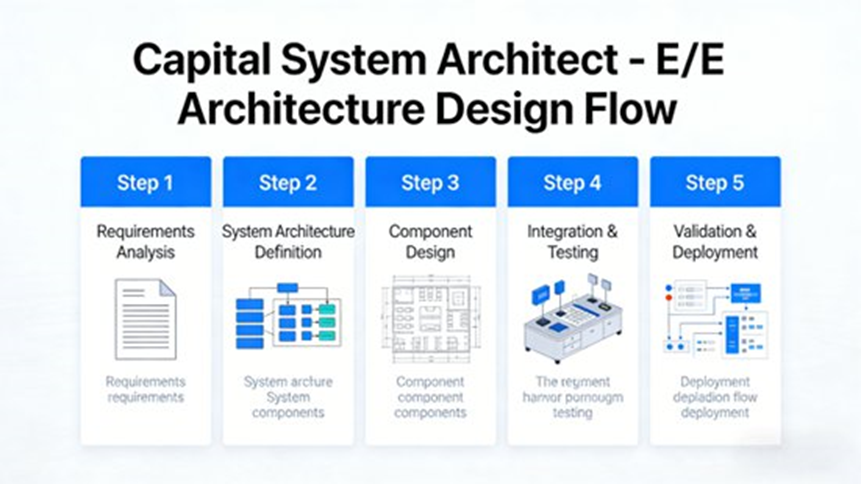
Siemens says Capital Systems Architect is a system modeling tool that can analyze E/E architecture designs, optimize functional allocations, redistribute functions and signals, and generate correct-by-construction outputs for detailed design tools. (Siemens Digital Industries Software)
Requirements modeling and traceability
The source report says vehicle-level functions such as powertrain control, automated-driving support, and infotainment should be decomposed into subsystem requirements and linked back to architecture elements. That bidirectional traceability helps teams keep design intent clear and supports safety-oriented process work.
Architecture exploration and optimization
This module also supports early trade studies. According to your report, engineers can compare architecture options against:
- cost
- harness weight
- bandwidth
- power use
- performance
- response speed
That includes decisions around the number of domain controllers, function allocation across controllers, and network topology. Siemens also states that Capital Systems Architect helps optimize architecture designs across E/E domains. (Siemens Digital Industries Software)
For EV programs, this can reduce controller count, lower harness mass, and improve system response. Your report later gives a concrete domestic EV example where two domain controllers were removed, harness weight dropped 15 percent, and cost fell 20 percent.
Standards-aware design checks
The source report states that early architecture work includes checks against major automotive standards such as AUTOSAR and ISO 26262. Siemens says the tool supports collaboration across hardware, software, network, and electrical domains and can feed validated outputs downstream. (Siemens Digital Industries Software)
Open architecture and tool integration
This is another detail that should stay in the article. The report points to open integration with PLM and mechanical tools, and that fits Siemens’ own messaging around broader digital-thread use across engineering domains. That openness helps keep electrical and mechanical views in sync and reduces design-island problems. (Siemens Digital Industries Software)
Capital Electrical: The Core of Automotive Wiring Harness Design Software
Short answer:
Capital Electrical and Capital Harness Designer sit closest to the target keyword. They cover logical electrical design, detailed harness engineering, validation, variants, manufacturing outputs, and change handling in one connected environment. (Siemens Digital Industries Software)
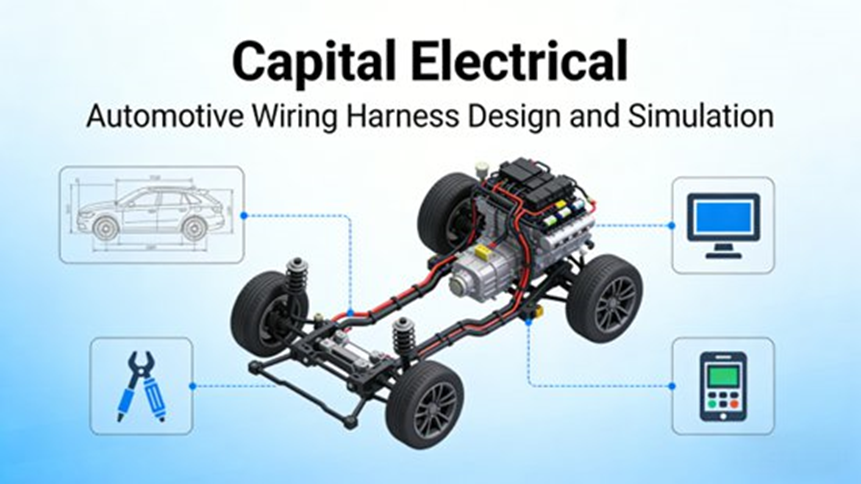
Siemens says Capital Harness Designer lets engineers create detailed, validated, manufacturing-ready harness designs. Siemens also highlights rules-based collaborative design merging, variant management, and change-aware workflows. (Siemens Digital Industries Software)
Automated schematic and logical electrical design
The source report stresses standardized libraries for connectors, fuses, relays, and similar components. It also points to automated generation of schematics and BOMs. Siemens’ harness material says the tool can automatically add wires, terminals, seals, cavity plugs, tapes, tubing, heat shrink, and other harness parts to build a full manufacturing BOM. (Siemens Digital Industries Software)
Your report includes one practical program result here: in a joint-venture new-energy vehicle program, this kind of workflow improved schematic-design efficiency by more than 40 percent and raised BOM accuracy to 99.8 percent. That figure comes from the source report, so it should be treated as report-based evidence rather than a separately verified public benchmark.
Harness layout, routing, and packaging optimization
The report makes clear that harness engineering is physical as well as logical. Route planning, fixing-point placement, 3D packaging, and derivative-specific layout all matter. Siemens also says users can manage multiple harness variants from a single 150% design and automatically generate manufacturing BOMs per variant. (Siemens Digital Industries Software)
This matters even more in vehicles with battery systems, high-voltage distribution, multiple sensors, and dense electronics packaging.
Electrical simulation and performance analysis
A full article on this topic cannot skip the performance side. Your report says harness optimization must consider:
- voltage drop
- electromagnetic interference
- thermal load
- signal quality and routing risk
That is especially relevant in EV and ADAS programs. High-voltage harnesses, camera and lidar links, radar units, and mixed low-voltage/high-voltage packaging create risks that are costly to fix late.
The source report gives a useful example: on automated-driving programs, harness layout for lidar and camera systems can be optimized to reduce EMI risk and protect signal transmission quality.
Manufacturing data output
The report also says Capital can produce manufacturing-oriented outputs such as 2D drawings and process files. Siemens describes its harness design flow as manufacturing-ready and built for downstream reuse. (Siemens Digital Industries Software)
That direct path from design to production is one reason the toolchain is used in large OEM and supplier programs.
Version control, change impact, and traceability
This part should stay detailed because automotive E/E programs change constantly. Your report says Capital can identify design-change impact quickly and update related artifacts such as schematics and harness layouts. Siemens also describes graphical and tabular difference reports, version management, compatibility control, and configurable change policies that determine how design changes from multiple sources should be applied. (Siemens Digital Industries Software)
That level of control is essential in multi-team, multi-region, and multi-variant vehicle development.
Lear LVPG platform example
The source report includes an engineering example from Lear’s LVPG electrical-system design platform. According to the report, Lear used Capital’s connection capture, platform-level wiring synthesis, design optimization and validation, and electrical simulation capabilities to create an electrical-layer foundation that connected cleanly with the mechanical layer. The result was fewer synchronization errors and direct transfer of routing data to global production lines.
I did not verify a public Siemens case page for this exact Lear example in this session, so I am keeping it here as source-report content. It still matters because it shows how Capital can link design and manufacturing inside a supplier environment.
Capital Embedded Software & Network: Why Harness Design Now Depends on Software and Communication
Short answer:
Modern harness design depends on software and network architecture because communication design changes physical system requirements. Capital covers both areas, which helps teams avoid late integration problems. (Siemens Digital Industries Software)
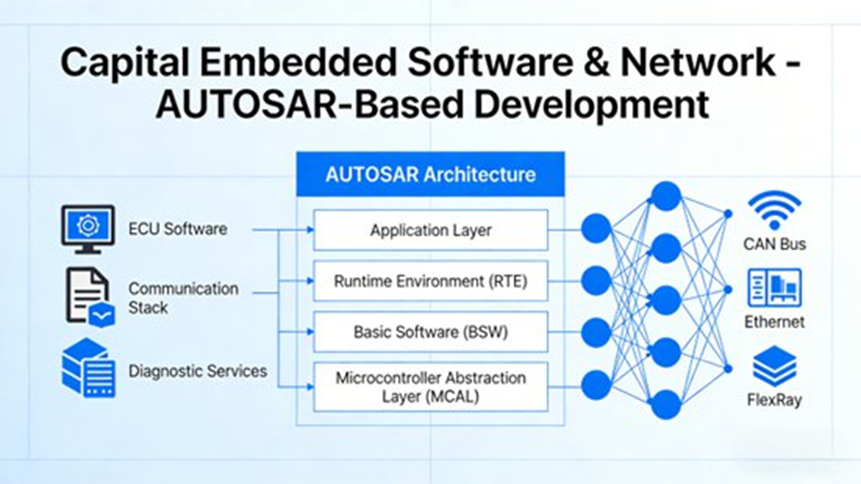
Siemens says the Capital embedded solution is a scalable AUTOSAR development platform with tools and runtime software for on-time deployment. Siemens also says Capital Network Designer manages in-vehicle network communication. (Siemens Digital Industries Software)
Vehicle network design and simulation
The source report notes support for CAN, LIN, and Ethernet, along with topology design, node configuration, communication matrix generation, and network-performance simulation. Siemens says Capital can help design right-sized communication networks with detailed timing analysis, optimize and verify network designs, and deliver accurate communication-network implementation. (Siemens Digital Industries Software)
That is a big deal in smart connected vehicles where automated-driving data, body-domain traffic, and infotainment traffic can all compete for bandwidth and timing margins.
Embedded software development and integration
The report also points to AUTOSAR-based software component development, configuration, integration, code-framework generation, and reuse of validated components. Siemens says Capital provides implementations for AUTOSAR Classic and AUTOSAR Adaptive. AUTOSAR itself says the Adaptive Platform is meant for high-performance computing ECUs and use cases such as autonomous driving, while common parts of Classic and Adaptive are released as AUTOSAR Foundation. (Siemens Digital Industries Software)
This matters in domain-controller and central-compute programs, where software reuse and predictable deployment can cut development time.
Joint software and network validation
Your report treats software-network co-validation as a core capability, and that point should stay. A harness can be electrically correct and still fail a program if network timing, ECU behavior, or software integration does not match architecture intent. By keeping architecture, communication, embedded software, and validation connected, Capital reduces the chance that teams discover these mismatches only during later vehicle tests. (Siemens Digital Industries Software)
Capital Verification & Validation: Virtual Testing Before Physical Prototypes
Short answer:
Capital’s verification flow helps teams test E/E behavior earlier through virtual methods, which cuts dependence on slow and expensive physical prototypes. That is one of the most practical benefits in current vehicle development. (Siemens Digital Industries Software)
The source report identifies three main strengths here.
Virtual simulation across operating and fault scenarios
The report describes digital-twin-based simulation of:
- high- and low-temperature environments
- complex road conditions
- fault scenarios
- subsystem safety behavior
- overall performance behavior
That matters because many E/E faults are costly or risky to discover only in hardware.
The report uses battery-management-system validation as an example. Teams can model BMS behavior under different temperatures and charging conditions, then check charging control and overheat protection before running the same volume of physical testing.
Automated test-case generation
Your report says test cases can be generated automatically from requirements and design rules, which helps raise test coverage and supports safety-driven development processes.
Traceable test data and faster root-cause analysis
The report also says Capital can log test data automatically, generate reports, and support traceable analysis of test results so engineers can find root causes faster. In one automated-driving E/E testing example from the source report, automated test generation raised coverage above 95 percent and cut the testing cycle by around 60 percent. Again, those numbers come from the source report and should be read as project-level results unless verified elsewhere.
How Capital Creates a Closed-Loop E/E Development Flow
Short answer:
The strongest case for Capital is not any single module. It is the closed-loop flow from requirements to manufacturing, with changes tracked through a shared digital thread. (Siemens Digital Industries Software)
A simplified lifecycle view looks like this:
- capture and structure requirements
- define and optimize system architecture
- develop electrical schematics and harnesses
- configure vehicle networks and embedded software
- run virtual validation and automated testing
- generate manufacturing-ready outputs
- manage changes across the shared data model
This connected flow is the core answer to the four pain points described earlier: weak collaboration, fragmented process, rising complexity, and stronger compliance demands.
Key Engineering Benefits of Capital in Real Automotive Programs
Short answer:
The source report lists four main engineering benefits: connected lifecycle flow, model-based automation, safer standards-aware development, and an open ecosystem that works with existing enterprise tools. None of those points should be dropped.
1. End-to-end lifecycle integration
Capital’s connected modules reduce handoff gaps between requirements, architecture, electrical design, software, network, validation, and manufacturing. Siemens presents the portfolio this way in its official materials. (Siemens Digital Industries Software)
The source report attributes major gains to that integration, including development-cycle reductions in the 30 to 50 percent range and design-error reduction above 60 percent, based on Siemens-referenced data in the report.
2. Model-based and automated development
The report says MBSE, digital twins, and automation raise engineering speed and consistency. It notes that harness-design automation can exceed 80 percent and software-code generation automation can exceed 70 percent in some workflows, which frees engineers from a large amount of repeat work.
3. Better compliance and risk control
Built-in rules and validation flows help teams meet functional-safety, cybersecurity, and process-governance needs. ISO 26262 and ISO/SAE 21434 make that discipline more valuable than ever.
4. Open ecosystem and multi-tool compatibility
The source report also says Capital can integrate with third-party tools such as CAD, PLM, and test systems, and that it supports custom development and global collaboration. That open-ecosystem story also appears in Siemens’ broader Capital messaging. (Siemens Digital Industries Software)
Engineering Practice Cases
Short answer:
The report uses three cases to show how Capital works in real engineering settings: Lear in supplier electrical-system development, Airbus in complex multi-team E/E work, and a domestic new-energy vehicle program focused on architecture and harness optimization.
Lear: electrical-system platform integration
As already covered, the report says Lear used Capital as the electrical-layer core of its LVPG platform. The value here is clean data flow between electrical and mechanical layers, fewer synchronization errors, and direct routing-data transfer to global production lines.
Airbus: complex E/E development at scale
Siemens announced in 2022 that Airbus selected Capital from the Xcelerator portfolio to speed up next-generation commercial-aircraft E/E systems development. Siemens said the choice was driven in part by Capital’s digital thread and openness, which supported integration across a broader engineering enterprise. (西门子新闻)
Airbus is not an automotive company, but the case still proves something useful: Capital works well in large, complex, highly controlled E/E development environments with many teams and strict configuration needs.
Domestic new-energy vehicle architecture optimization
The source report includes a highly relevant EV case. In that program, the automaker used Capital’s architecture-design module to optimize domain-controller function allocation, removed two domain controllers, lowered harness weight by 15 percent, cut cost by 20 percent, solved high-voltage harness EMI issues through electrical-design optimization, and reduced physical-vehicle testing by 40 percent. Total development time dropped 35 percent.
Those figures come from the source report. They matter because they show how architecture design, harness layout, EMI control, and virtual validation can work together as one engineering result.
What Automotive Teams Should Do Before Adopting Capital
Short answer:
Your report ends with practical rollout advice, and it is worth keeping in full because it helps readers move from product interest to implementation planning.
1. Plan the rollout and train the team early
The report says companies should define target use cases, rollout scope, and expected results before deployment. Training should cover model-based design, tool operation, and collaborative development methods across functions.
2. Build standardized development workflows
The report recommends using Capital as the foundation for a standardized E/E development process with clear roles, deliverables, design rules, and compliance checks. That reduces human error and raises consistency across programs.
3. Treat data reuse as a strategic asset
This is one of the strongest points in the report. Design data, models, test cases, and engineering knowledge created in Capital should be managed as reusable company assets. Good classification, storage, traceability, and reuse reduce repeat work across future platforms.
4. Strengthen integration with third-party tools
The report also recommends connecting Capital with existing PLM, CAD, and test systems to create a full E/E development ecosystem. That advice fits Siemens’ public direction around broader digital-thread use across engineering and lifecycle domains. (Siemens Digital Industries Software)
Future Trends: Where Capital and Automotive E/E Development Are Headed
Short answer:
The source report points to three next steps: more AI in design work, tighter links between digital twins and physical tests, and stronger cloud-based collaboration through Capital X. Those trends fit current Siemens messaging and the wider direction of vehicle E/E development. (Siemens Digital Industries Software)
Deeper use of AI
The report predicts more AI use in architecture optimization, harness-layout optimization, and automated test-case generation. That makes sense as E/E complexity keeps growing.
Stronger digital twin plus physical-test connection
The report also says high-fidelity digital twins will work more closely with physical tests so teams can lower cost while improving validation quality. Siemens already frames Capital around engineering and validating complex products in the context of a digital twin. (Siemens Digital Industries Software)
Cloud-native collaboration and Capital X
The report names Capital X as a cloud direction for multi-team, multi-region collaboration with lower hardware cost. Siemens’ current pages point to Capital X as its cloud-based E/E systems development solution, and Harness Designer is also offered as a SaaS option. (Siemens Digital Industries Software)
Relevance to software-defined vehicles
The report closes on a broader point: as vehicles move toward central compute, software-defined functionality, and intelligent networking, an integrated E/E platform becomes more useful, not less. That is why this cluster-page topic works. The user may begin with harness software, but the best answer naturally expands into the full E/E lifecycle.
Bottom Line
Short answer:
Automotive wiring harness design software is no longer a narrow drafting category. In modern vehicle programs, harness work is tied to E/E architecture, controller strategy, network topology, software integration, virtual validation, and manufacturing continuity. Siemens Capital stands out because it connects those layers inside one development environment. (Siemens Digital Industries Software)
That is also why your source report works so well as the base for this article. It does not frame Capital as a single harness application. It frames Capital as an integrated, model-based, automation-driven, open-ecosystem platform for full-lifecycle automotive E/E development. That is the most accurate way to present it.
FAQ
What problems does Siemens Capital solve in automotive E/E development?
Short answer:
Siemens Capital helps teams handle rising E/E complexity by connecting architecture, electrical design, software, network engineering, validation, and manufacturing in one workflow. That cuts handoff friction and makes traceability easier. (Siemens Digital Industries Software)
Modern vehicles contain thousands of wires, many ECUs, and mixed communication networks such as CAN, LIN, and Ethernet. In disconnected toolchains, those pieces are often managed in separate environments. Capital addresses that by linking E/E architecture design, electrical schematics, harness engineering, embedded software, network development, verification, and production data through a shared digital thread. (Siemens Digital Industries Software)
This connected setup helps teams test earlier, manage design changes with more confidence, and reduce the gaps that often appear between architecture, electrical engineering, software, and manufacturing. That usually leads to fewer errors and faster delivery of complex vehicle platforms. (Siemens Digital Industries Software)
How does Capital support model-based systems engineering (MBSE)?
Short answer:
Capital supports MBSE through Capital Systems Architect, which gives engineers a way to build architecture models, map functions to domains and ECUs, and study trade-offs before detailed design starts. (Siemens Digital Industries Software)
With this model-based flow, teams can capture system requirements, describe functional behavior, map functions to ECUs and networks, and keep bidirectional traceability between requirements and system models. That matters because architecture choices later affect harness complexity, software partitioning, validation scope, and compliance work. (Siemens Digital Industries Software)
MBSE also helps teams compare cost, weight, power use, bandwidth, and performance before physical implementation. That is one reason it has become more valuable in domain-controller and central-compute vehicle architectures. (Siemens Digital Industries Software)
How does Capital improve wiring harness design and electrical system engineering?
Short answer:
Capital improves harness engineering by combining schematic work, connectivity definition, detailed harness design, validation, variants, and manufacturing-ready outputs in one connected environment. It also supports controlled change handling. (Siemens Digital Industries Software)
In practice, engineers can use rules-based schematic and connectivity design, automate BOM and documentation creation, validate harnesses before release, and connect electrical design data with packaging and mechanical constraints. That reduces manual mistakes and makes design changes easier to manage in large vehicle programs. (Siemens Digital Industries Software)
Capital also supports analysis that helps teams catch voltage-drop, thermal-load, and EMI issues earlier in development. That matters even more in EVs and sensor-heavy vehicles where packaging density and high-voltage routing increase electrical-system risk.
How does the Capital toolchain integrate embedded software and AUTOSAR development?
Short answer:
Capital brings software and network work into the same E/E flow, which helps teams avoid late integration problems between ECU software, communication design, and the physical electrical system. (Siemens Digital Industries Software)
Siemens says Capital Embedded is a scalable AUTOSAR development platform and that Capital Network Designer manages in-vehicle communication. The platform supports ECU software configuration, communication modeling, timing analysis, and deployment work tied to AUTOSAR Classic and Adaptive. (Siemens Digital Industries Software)
AUTOSAR says the Adaptive Platform is meant for high-performance computing ECUs used in cases such as autonomous driving, while shared parts of Classic and Adaptive are released as AUTOSAR Foundation. That matters because software, network load, and ECU placement now affect architecture and harness outcomes together. (Autosar)
What advantages does Capital offer compared with traditional E/E development tools?
Short answer:
Capital gives teams a connected lifecycle flow, earlier virtual validation, stronger traceability, and a broader integration path with enterprise tools. Those gains are hard to get from disconnected legacy tools. (Siemens Digital Industries Software)
One clear benefit is end-to-end integration. Changes in requirements, architecture, wiring, or software can move through one development flow instead of being passed across isolated systems. Another benefit is digital-twin-based validation, which reduces dependence on physical prototypes. (Siemens Digital Industries Software)
Capital also offers stronger data continuity and a more open ecosystem. Siemens positions the portfolio around integration across engineering and lifecycle domains, which is useful for OEMs and suppliers running complex cross-domain programs. (Siemens Digital Industries Software)
Author Bio
Johnny Liu is the CEO at Dowway Vehicle and writes about automotive engineering, vehicle E/E development, architecture strategy, manufacturing workflows, and software-defined vehicle transformation. His work focuses on how engineering tools and process design shape real vehicle programs, especially in electrified and intelligent platforms.
