

< Back to Electrical & Electronic Toolchain
- Introduction to AUTOSAR NeuSAR OS
- What is NeuSAR OS and How Does It Relate to the AUTOSAR Standard?
- The Core Components and Technical Architecture of NeuSAR OS
- Key Features of NeuSAR OS
- How NeuSAR OS Enhances Development Efficiency and Reduces Engineering Costs
- Safety and Security Standards Supported by NeuSAR OS
- FAQs about NeuSAR OS
- 1. What is NeuSAR OS and how does it relate to the AUTOSAR standard?
- 2. What core components and layers make up the technical architecture of NeuSAR OS?
- 3. What development toolchain support does NeuSAR provide for AUTOSAR projects?
- 4. How does NeuSAR OS help improve development efficiency and reduce engineering costs?
- 5. What safety and security standards does NeuSAR OS support for automotive software?
- Summary of Recent Industry Trends
- Conclusion
Introduction to AUTOSAR NeuSAR OS
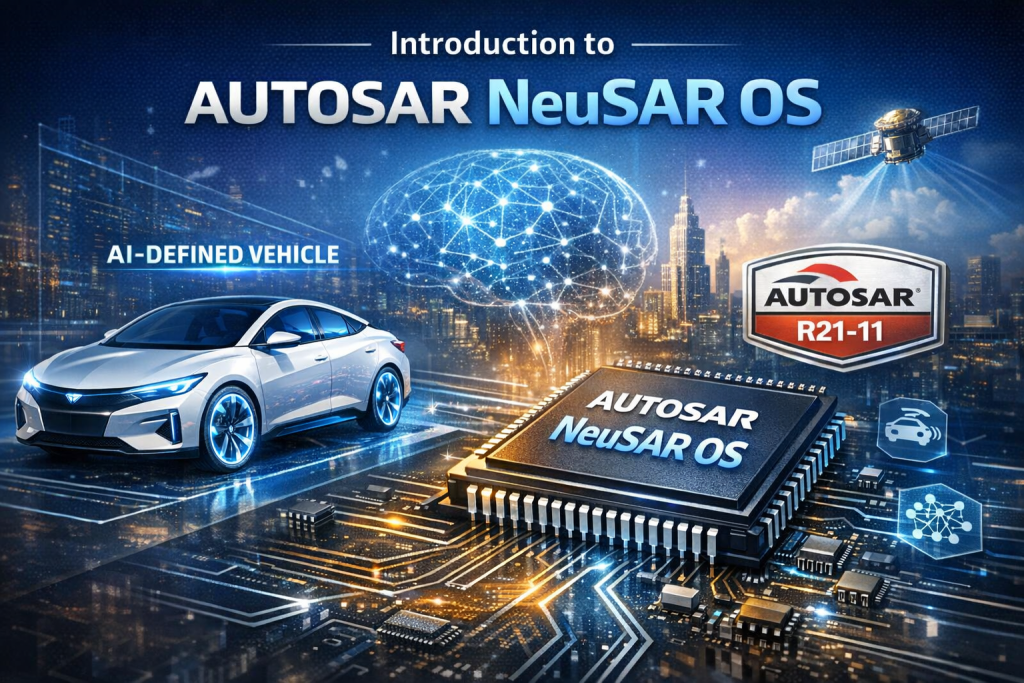
The automotive industry is moving rapidly toward more intelligent, connected, and efficient vehicles. To support this shift, AUTOSAR NeuSAR OS provides a powerful operating system that meets the growing demands of AI-defined vehicles (AIDV). Designed to be fully compliant with the AUTOSAR R21-11 standard, NeuSAR OS integrates seamlessly with both Classic and Adaptive platforms, ensuring that it can support both traditional automotive control systems and modern AI applications.
In this article, we’ll look at the core features of NeuSAR OS, how it’s built to handle complex tasks, and its impact on the development process of modern vehicles.
What is NeuSAR OS and How Does It Relate to the AUTOSAR Standard?
NeuSAR OS is a smart automotive operating system developed for AI-defined vehicles (AIDV). It follows the AUTOSAR R21-11 standard, which is key to the AUTOSAR ecosystem, enabling the development of modular and scalable vehicle systems. By integrating AUTOSAR base software, middleware, and AI frameworks, NeuSAR OS supports the real-time operations required for traditional vehicle systems and the high-performance needs of AI-driven technologies such as autonomous driving and AI-assisted vehicles.
AUTOSAR (Automotive Open System Architecture) is a global standard designed to create a modular framework for automotive software. NeuSAR OS goes beyond the base standard by offering a combined solution for both legacy automotive systems and next-generation AI applications.
The Core Components and Technical Architecture of NeuSAR OS
NeuSAR OS is based on a four-layer architecture that is designed to offer flexibility, scalability, and security for automotive applications:
- Base Software Layer (cCore & aCore)
- NeuSAR cCore supports real-time applications based on the AUTOSAR Classic Platform and is used in traditional vehicle control systems like engine control and body control.
- NeuSAR aCore is built for high-performance applications, such as AI processing for autonomous driving and in-vehicle assistant technologies. It uses the AUTOSAR Adaptive Platform for more complex tasks.
- Middleware Layer (Service Framework)
This layer, known as the NeuSAR Service Framework, supports cross-domain communication and allows for seamless integration between various vehicle systems. The Service-Oriented Architecture (SOA) makes it possible to manage services across different domains without worrying about underlying hardware differences. - AI Framework Layer
NeuSAR OS includes an AI Framework that efficiently manages data, models, and computational resources needed for AI-driven applications. This framework is essential for integrating autonomous driving features, AI-assisted in-car systems, and other advanced technologies. - Toolchain Layer
The NeuSAR toolchain includes tools like NeuSAR Copilot, NeuSAR DevKit, and NeuSAR Configurator. These tools streamline the development process by offering intelligent code generation, simulation, and debugging features, which significantly enhance developer productivity.
Key Features of NeuSAR OS
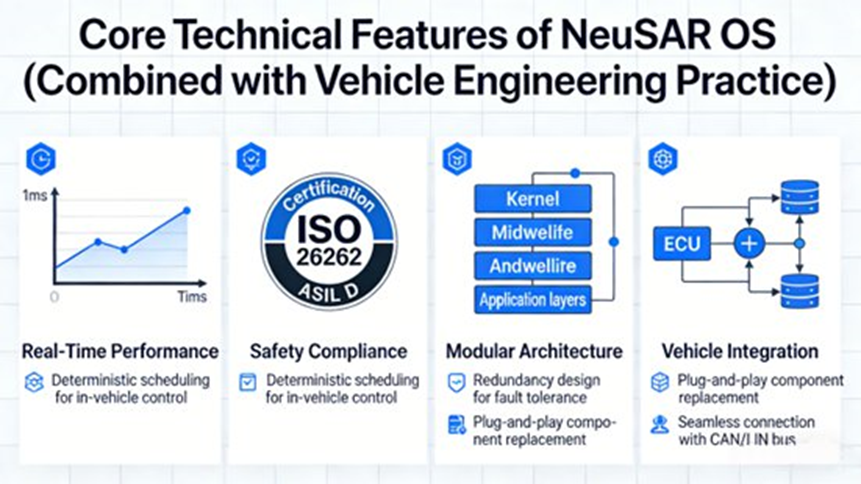
NeuSAR OS offers several standout features that make it ideal for automotive software development:
- Functional Safety Compliance
NeuSAR OS complies with the ISO 26262 functional safety standard, ensuring that real-time automotive applications operate safely. It has achieved ASIL-D certification, the highest safety integrity level, which is essential for critical applications such as autonomous driving. - Cross-Platform Compatibility
NeuSAR OS supports both legacy ECUs (Electronic Control Units) and next-generation centralized computing platforms, making it flexible enough to handle a wide range of vehicle architectures. As the automotive industry shifts toward integrated vehicle systems, NeuSAR OS can seamlessly adapt to both traditional and cutting-edge vehicle designs. - AI Integration
NeuSAR OS simplifies the integration of AI models into automotive applications. The AI Framework provides a unified environment for managing AI models, which helps developers deploy AI solutions faster and more efficiently. This is especially beneficial for technologies like autonomous driving and in-vehicle assistants. - Development Tools for Efficiency
NeuSAR offers a powerful toolchain, including NeuSAR Copilot, NeuSAR Configurator, and NeuSAR Reflasher, all of which help developers design, configure, and test automotive software with ease. These tools streamline the development cycle, reduce complexity, and improve overall productivity.
How NeuSAR OS Enhances Development Efficiency and Reduces Engineering Costs
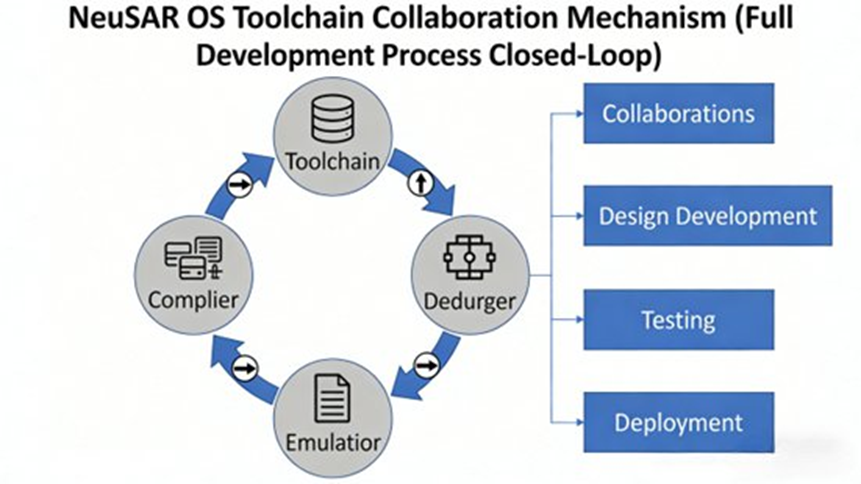
NeuSAR OS introduces several tools and features that improve development workflows and reduce costs:
- NeuSAR Copilot uses AIGC to automate repetitive tasks such as code generation, smart configuration, and debugging, which significantly accelerates project delivery and reduces the learning curve for new developers. This automation allows engineers to focus on higher-level tasks, improving productivity.
- Integrated Toolchain ensures that the entire development process, from design to deployment, takes place within a single platform. This reduces the need for complex tool integrations and helps teams work more efficiently.
- By automating time-consuming tasks, NeuSAR OS helps reduce engineering costs and speed up the development process, allowing manufacturers to bring new vehicles to market faster.
Safety and Security Standards Supported by NeuSAR OS
In the automotive industry, safety and security are critical. NeuSAR OS addresses these concerns with robust standards:
- ISO 26262 Functional Safety: NeuSAR OS ensures that safety-critical applications comply with ASIL-D certifications, guaranteeing that applications like autonomous driving systems meet the highest safety standards.
- ISO 21434 Network Security: NeuSAR OS supports cybersecurity standards by integrating secure communication protocols and Over-the-Air (OTA) updates, ensuring that the vehicle software remains protected against cyber threats and is up-to-date.
FAQs about NeuSAR OS
1. What is NeuSAR OS and how does it relate to the AUTOSAR standard?
Answer: NeuSAR OS is an intelligent automotive operating system designed for the AIDV era, fully compliant with the AUTOSAR R21-11 standard. It integrates base software, middleware, and AI frameworks for efficient development, safety, and cross-domain applications. ([ReachAuto][1])
2. What core components and layers make up the technical architecture of NeuSAR OS?
Answer: NeuSAR OS architecture consists of four layers:
• Base Software (cCore & aCore): Real-time and high-performance functionality. ([ReachAuto][2])
• Middleware (Service Framework): Cross-domain service calls and SOA. ([NeuSAR][3])
• AI Framework: Management of data, models, and AI resources. ([ReachAuto][1])
• Toolchain Layer: Tools for development and configuration. ([NeuSAR][4])
3. What development toolchain support does NeuSAR provide for AUTOSAR projects?
Answer: NeuSAR offers a comprehensive toolchain (NeuSAR DevKit) that supports the full development cycle, including code generation, debugging, and testing. ([NeuSAR][4])
4. How does NeuSAR OS help improve development efficiency and reduce engineering costs?
Answer: NeuSAR Copilot, powered by AIGC, automates code generation and configuration, reducing the learning curve and speeding up project delivery. ([ReachAuto][1])
5. What safety and security standards does NeuSAR OS support for automotive software?
Answer: NeuSAR OS complies with ISO 26262 for functional safety and ISO 21434 for network security, ensuring that automotive software meets high safety and cybersecurity standards. ([ReachAuto][1])
Summary of Recent Industry Trends
- Software-First Development Model: The shift toward vehicle-level software integration is driving demand for solutions like NeuSAR OS, which supports both cross-domain and cross-platform development. ([NeuSAR][3])
- E/E Architecture Support: NeuSAR OS is fully adaptable to next-gen E/E architectures, helping transition from distributed ECUs to central computing platforms. ([ReachAuto][1])
- Toolchain Usability: Developers are discussing how NeuSAR’s DevKit simplifies configuration and onboarding, helping to reduce setup time and improve collaboration. ([NeuSAR][4])
Conclusion
As the automotive industry moves toward AI-defined vehicles, AUTOSAR NeuSAR OS offers a powerful solution for managing both traditional vehicle systems and emerging AI applications. With its cross-platform compatibility, AI integration, and compliance with safety and security standards, NeuSAR OS is a game-changer in automotive software development. By simplifying the development process and enhancing productivity, NeuSAR OS will continue to play a critical role in shaping the future of the automotive industry.
About the Author
Johnny Liu is the CEO of Dowway Vehicle, a leader in automotive software development. With over 15 years of experience, Johnny is a recognized authority on AUTOSAR standards, AI integration in vehicles, and automotive software architecture.
