


< Back to Data Management System
Author: Johnny Liu, CEO at Dowway Vehicle
Published: March 10, 2026
Page Type: Cluster Page
Primary Topic: Baosight MES for automotive manufacturing
Author Note
Johnny Liu is CEO at Dowway Vehicle and works on vehicle engineering, production systems, factory operations, and automotive digital manufacturing. This article is written from a plant execution and engineering view, with attention to how MES works in real automotive production, how it connects with surrounding systems, and how its value shows up in measurable plant results.
Editorial Note
This article is written from the report you provided on Baosight MES (Chinese Version). The goal here is to keep the report’s full technical meaning, system structure, functional scope, engineering logic, and project metrics in English without cutting or watering down any of the original detail.
Quick Answer
Baosight MES for automotive manufacturing is a manufacturing execution system built to connect ERP planning, PLM engineering data, shop-floor control, quality records, material flow, equipment status, and traceability in one production loop. It supports the four main automotive processes—stamping, welding, painting, and final assembly—and is built for mixed-model production, flexible scheduling, zero-defect control, and full-process traceability.
- Quick Answer
- Why Baosight MES Matters in Automotive Manufacturing
- Core Technical Architecture of Baosight MES
- How Baosight MES Integrates with the Automotive Toolchain
- Production Planning and Scheduling for Mixed-Model Automotive Production
- Process Management for Standardized and Digital Execution
- Quality Management for Zero-Defect Automotive Production
- Full-Process Traceability Based on VIN and Unique Part Identification
- Material Management to Support JIT and SPS Delivery
- Equipment Management for Stable and Efficient Production
- Key Technical Advantages of Baosight MES
- Engineering Results and Real Automotive Project Cases
- Future Outlook for Baosight MES in Smart Automotive Manufacturing
- Top 5 Frequently Asked Questions about Baosight MES in Automotive Manufacturing
- 1. What exactly does Baosight MES do in an automotive factory?
- 2. How does Baosight MES integrate with other manufacturing systems?
- 3. Can Baosight MES support mixed-model automotive production?
- 4. How does Baosight MES ensure full traceability and quality control?
- 5. What are the advantages of Baosight MES compared with other MES platforms?
Why Baosight MES Matters in Automotive Manufacturing
In automotive smart manufacturing, MES sits between ERP and PCS and acts as the system that closes the loop between planning, execution, and feedback. It is the key layer that turns production plans into shop-floor action and then feeds execution data, quality records, and production status back into management and control.
That role matters even more in automotive plants because automotive production is highly coupled, full of variable conditions, and strict on timing and precision. A vehicle plant may run several models on the same line, build electric vehicles and fuel vehicles in parallel, manage many option combinations, and still meet hard quality and traceability rules. In that setting, disconnected systems create delay, inconsistency, and risk.
Baosight MES (Chinese Version) is built for both complete vehicle manufacturing and automotive parts production. It is deeply tied to the four major automotive process areas:
- stamping
- welding
- painting
- final assembly
The report defines it as a full-process digital control solution for automotive production. Its job is to support the full manufacturing loop and solve four major industry needs:
- mixed-model production
- flexible manufacturing
- zero-defect quality control
- full-process traceability
It is not described as a standalone application. It is described as a core part of the automotive toolchain, linking ERP, PLM, WMS, QMS, PCS, equipment, and operators into one coordinated execution system.
Core Technical Architecture of Baosight MES
Baosight MES (Chinese Version) uses a cloud-edge-device distributed architecture. The report states that it follows ISA-95 international standards and the IATF 16949 automotive quality management system. It is built on Baosight’s own industrial internet platform and is designed to offer:
- full-stack control
- high-concurrency processing
- flexible adaptation
- strong fit for automotive engineering
This matches the reality of automotive production, where the process is full of many variables, tight dependencies, and very strict execution requirements.
The system architecture has five layers:
- perception layer
- edge layer
- platform layer
- application layer
- interaction layer
These five layers work together to give digital control across all production elements and the full manufacturing flow.
Perception Layer: Real-Time Industrial Data Acquisition
The perception layer connects to workshop equipment through several industrial protocols, including:
- OPC UA
- MQTT
- Profinet
Through these protocols, Baosight MES can connect with:
- PLCs
- robots
- tightening guns
- laser measurement equipment
- AGV dispatch systems
The report states that this layer can collect key process parameters at millisecond level without data loss. It gives specific examples such as:
- welding current
- painting temperature and humidity
- tightening torque
This solves a common plant problem: data from different equipment brands and control systems often comes in different formats and is hard to unify. The perception layer provides a clean and accurate data source for the rest of the MES stack.
The report also states that this layer supports 5G private network access, which can keep device control instruction latency below 20 milliseconds. This matters in high-precision processes such as stamping and welding, where timing has to be tight.
Edge Layer: Local Processing and Fast Response
The edge layer uses edge computing gateways for:
- data preprocessing
- protocol conversion
- local closed-loop control
That means the plant does not need to send every abnormal signal to the cloud before action is taken. For example, if a process parameter goes out of limit, the edge layer can trigger a local stop-line alarm right away.
This helps protect production continuity. The report points out that this is especially useful in large and complex scenarios such as:
- final assembly lines with more than 100 workstations
- electric drive production lines
- large multi-station automotive production setups
Baosight MES is reported to handle more than 1000 TPS and keep query response time under 2 seconds under million-level monthly data volume.
Platform Layer: Data, Business, and AI Middle Platforms
The platform layer is the core support layer. It uses a microservices design and includes three middle platforms:
- data middle platform
- business middle platform
- AI middle platform
The data middle platform combines:
- Kafka for real-time data streaming
- Hadoop for offline computing
The report states that it supports collection and storage of 10 billion production data records per day, which is important for full-process automotive traceability.
The business middle platform packages business capabilities such as:
- production scheduling
- quality management
- equipment management
The report says it includes 23 standardized service components. This allows automotive companies to deploy functions as needed and adapt faster when they introduce new vehicle models or change processes.
The AI middle platform supports:
- TensorFlow
- PyTorch
It is used for manufacturing scenarios such as:
- smart scheduling
- weld seam defect visual inspection
- model training
- model inference
Application Layer: Core MES Modules for Automotive Plants
The application layer contains the main business modules of Baosight MES, tailored for automotive production. These include:
- production plan management
- process management
- quality management
- material management
- equipment management
- production traceability
Together, these modules support digital execution and control across the full automotive production chain.
Interaction Layer: Chinese-Language Interface and Visual Operations
The interaction layer provides a Chinese-language visual interface and also supports switching to English for foreign-invested automakers or international production sites.
The report describes a three-level visualization structure:
- management cockpit
- workshop-level dashboard
- workstation-level terminal
The interface is designed around the working habits of automotive frontline staff. That makes the system easier to use and lowers training cost. Operators can also use AR glasses to receive real-time work instructions at the station.
How Baosight MES Integrates with the Automotive Toolchain
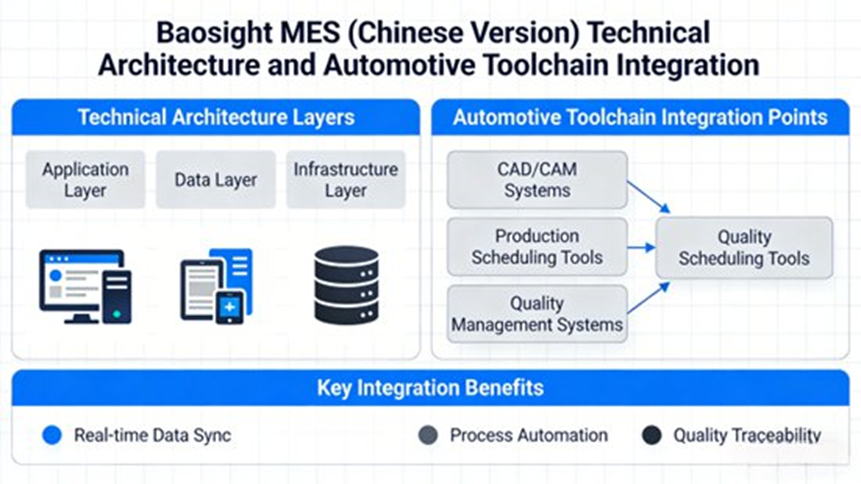
Baosight MES is deeply tied to the automotive lifecycle toolchain. It works with systems above and below it and forms a full collaborative loop across planning, execution, control, and traceability.
It integrates with:
- ERP
- PLM
- PCS
- WMS
- QMS
ERP Integration
Baosight MES receives monthly and weekly production plans from ERP and breaks them down into daily and shift-level operating plans. It also syncs material demand planning so production schedules and material supply stay coordinated.
PLM Integration
Through PLM integration, the system gets:
- product BOM
- process routes
- SOP
- base engineering data
This allows automatic release of process parameters and strong version control. It also helps prevent errors caused by old process documents being used on the shop floor.
WMS Integration
Through WMS integration, Baosight MES supports JIT delivery and SPS set-based material delivery. It can send the exact set of parts needed for one vehicle to the line side in the right sequence, which reduces line-side stock and picking mistakes.
QMS Integration
Baosight MES exchanges data with QMS in both directions. It sends process quality data to QMS and receives quality improvement actions back, forming a complete quality loop.
PCS Integration
At the lower control level, Baosight MES works with PCS so production logic is tied to actual shop-floor execution and equipment behavior.
This creates the full automotive execution loop:
plan → execute → control → trace
Production Planning and Scheduling for Mixed-Model Automotive Production
One of the main problems in automotive manufacturing is mixed-model production scheduling. It gets more difficult when a plant has to handle:
- new energy vehicles and fuel vehicles on the same line
- multiple model configurations at once
- urgent order insertion
- changing equipment conditions
- changing material status
- process switching limits
Baosight MES deals with this through a planning and scheduling module built on an APS advanced scheduling engine.
The scheduling logic takes into account:
- paint color sequence
- welding fixture switching
- equipment capability
- material completeness
- order priority
Based on these constraints, the system generates optimized daily and shift-level work plans. It also supports:
- dynamic urgent order insertion
- rolling rescheduling
- bottleneck warning
This is important in a real automotive plant because a static schedule is not enough. Production plans must react to actual line conditions.
The report gives the example of BAIC Guangzhou Branch, where Baosight MES was used to support multi-platform and multi-model mixed production. The system could receive plans from ERP and then break them down into detailed work tasks for each line and workstation.
When urgent orders or production problems appeared, the system could complete:
- process parameter switching for 200 pieces of equipment
- re-planning of material delivery routes
within 2 minutes.
The system also supports visual monitoring of schedule execution. Managers can use the cockpit to check line-by-line and model-by-model progress in real time, spot bottlenecks, and adjust resource allocation.
The report records major gains:
- production plan execution accuracy increased from 75% to 95%
- order delivery cycle shortened by 23%
Later, in the BAIC case summary, the report also gives a project-level figure showing execution accuracy increasing from 78% to 96% after implementation.
Process Management for Standardized and Digital Execution
Automotive production processes are complex. Across stamping, welding, painting, and final assembly, there are hundreds of operations. Process parameter accuracy and consistency have a direct effect on product quality.
Baosight MES includes a process management module for:
- standardized process modeling
- parameter release
- process monitoring
- version control
This solves common problems found in paper-based process management, such as:
- version confusion
- delayed document transfer
- information silos
- old work instructions being used at the line
Structured Binding of Process Data
The system supports structured binding of:
- PBOM
- SOP
- SIP
- Poka-Yoke logic
Process engineers can build process models through the Chinese-language interface and set upper and lower limits for critical process parameters. The report gives clear examples:
- welding robot current
- welding robot voltage
- welding robot speed
- painting oven temperature and humidity
- spray pressure
These process parameters can be linked directly to:
- equipment
- workstations
- materials
Automatic Parameter Release and Visual Work Guidance
During execution, Baosight MES sends process parameters automatically to the right workstation terminal devices. Frontline workers can read visual work instructions in real time through terminals or AR glasses, instead of carrying paper documents. This cuts down on operator mistakes.
Online Monitoring and Station Locking
The system collects actual process values in real time and compares them with standard values. If there is a deviation, the system can:
- trigger sound and light alarms
- lock the related workstation
- stop the product from moving to the next process step
This keeps process control online during production instead of waiting for later inspection.
Full Lifecycle Version Control
Baosight MES manages process documents across their full lifecycle. Each process change triggers a version update reminder, so the latest approved version is always the one used at the line.
This is important because old versions can cause batch rework and wasted material.
The report includes a parts manufacturing example where:
- drawing update response time was shortened by 70%
- wrong-version usage dropped to zero
- after work instructions were digitized, the new employee training cycle was cut by 50%
Quality Management for Zero-Defect Automotive Production
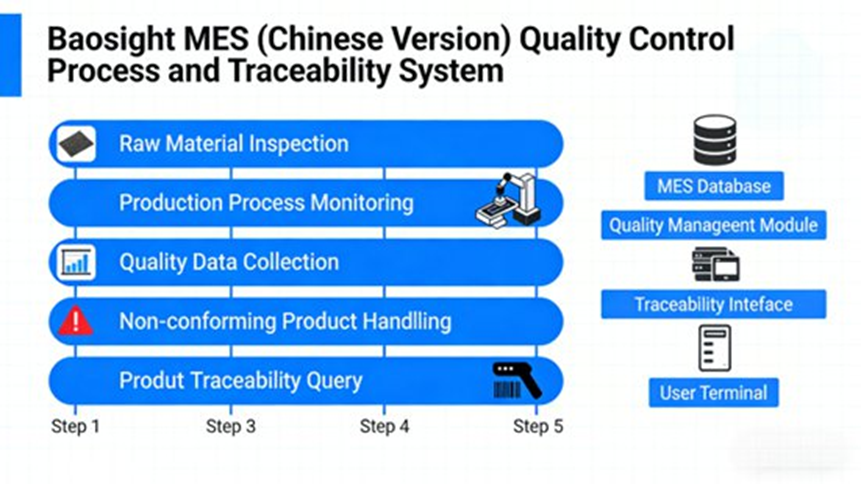
Automotive manufacturing has very strict quality requirements. Plants are expected to meet IATF 16949 requirements and control quality through three connected parts:
- prevention
- inspection
- traceability
Baosight MES includes a quality management module covering:
- incoming inspection
- process inspection
- finished product inspection
It supports:
- real-time quality data collection
- abnormal warning
- closed-loop handling
- full-process traceability
Incoming Inspection
In incoming inspection, the system connects with WMS and scans incoming batches of parts such as:
- engine components
- chassis structural parts
- electronic components
It creates inspection tasks automatically. Inspectors enter results through terminals. Nonconforming materials are isolated automatically and blocked from storage entry, which stops bad material from entering production.
Process Inspection
In process inspection, Baosight MES collects real-time quality data such as:
- welding defects
- painting color difference
- tightening torque deviation
It uses SPC to watch process variation trends. If a parameter goes outside the control limit for three consecutive times, the system can:
- trigger a stop-line alarm
- push process optimization suggestions
The report records that body first-pass yield improved from:
- 88% to 96%
Finished Product Inspection
At the finished product stage, the system connects with final assembly test equipment and captures whole-vehicle test data such as:
- lighting inspection
- braking inspection
- power performance inspection
It then generates finished inspection reports. Unqualified vehicles are routed automatically into repair, and the repair process is fully recorded. This helps make sure every vehicle leaving the line meets quality requirements.
Full-Process Traceability Based on VIN and Unique Part Identification
Baosight MES builds a full-chain traceability system indexed by:
- vehicle VIN
- unique part code
This system supports both forward and backward tracing and can connect:
- order information
- material batches
- process operations
- equipment
- operator information
- inspection results
This makes quality issue tracing much faster and more precise.
The report records a major improvement:
- quality issue traceability time reduced from 2 days to 20 minutes
In the BAIC Guangzhou case, the time was reduced even further to 15 minutes.
This traceability capability supports:
- OEM audits
- compliance checks
- recall investigation
- supplier issue tracing
- higher customer trust
- high-end order support
The report even describes this capability as a kind of trust credential for winning higher-end orders.
Material Management to Support JIT and SPS Delivery
Automotive production uses a huge number of part types. A complete vehicle includes tens of thousands of components. Material delivery accuracy and timing directly affect whether the line keeps running.
Traditional material management often leads to:
- line-side stock buildup
- material shortages
- wrong installation
- missed installation
Baosight MES handles this through a material management module closely tied to:
- WMS
- AGV dispatch systems
Material BOM Lifecycle Management
The system manages the full lifecycle of the material BOM and links production work orders with material requirements automatically. It also checks material completeness in real time.
When material use at a final assembly station reaches safety stock level, the system sends a request automatically to WMS. WMS then dispatches AGVs or conveyor systems to send materials to the line-side warehouse within 15 minutes.
SPS Set-Based Delivery
For final assembly lines using SPS set-based delivery, the system can pick and deliver parts based on the exact requirements of one vehicle. This makes sure the right parts reach the right station and cuts down on both line-side stock and picking errors.
Barcode-Based Material Traceability
The system also uses barcode-based material management. Each component’s:
- batch
- supplier
- storage time
is linked to the vehicle VIN.
That means if a material quality issue appears later, the plant can quickly find the affected vehicles and take recall or rework action.
The report records strong results from a new energy vehicle enterprise:
- line-side inventory reduced from 3 days of use to 0.5 day
- warehouse area reduced by 40%
- material handling cost reduced by 35%
- material delivery accuracy increased to above 99.9%
Equipment Management for Stable and Efficient Production
Automotive production depends heavily on automated equipment such as:
- welding robots
- stamping equipment
- painting equipment
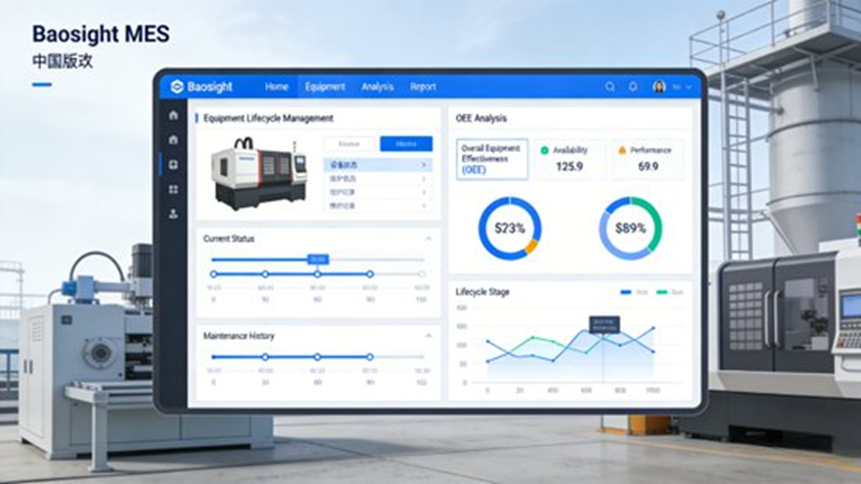
Equipment stability and availability directly affect both production efficiency and product quality. Baosight MES includes an equipment management module covering the full lifecycle of workshop equipment, including:
- equipment master records
- inspection
- maintenance
- repair
- fault warning
- OEE analysis
Equipment Master Records
The system builds detailed equipment records that include:
- model
- parameters
- installation time
- maintenance history
It also supports equipment classification and organized management.
Real-Time Equipment Monitoring
By integrating with PCS, Baosight MES collects real-time equipment status such as:
- running
- standby
- fault
- maintenance
It also records key indicators such as:
- OEE
- MTBF
- MTTR
This allows visual monitoring of equipment conditions and helps managers find bottlenecks.
Automatic Inspection and Maintenance Planning
The system can trigger inspection and maintenance tasks automatically based on running time and production frequency. It generates maintenance plans and reminds maintenance staff to carry them out on time, which helps reduce faults.
Fast Fault Response
When equipment problems happen, the system can:
- send alarms automatically
- push repair work orders to maintenance staff
- adjust the production plan to avoid failed equipment
The report records that:
- equipment fault response time was reduced from 15 minutes to 3 minutes
- unplanned downtime was reduced by 40%
Predictive Maintenance and PHM
Baosight MES also supports predictive maintenance based on PHM. By analyzing equipment operation data, it can detect hidden fault risk early and support preventive maintenance.
In one automotive parts case, this helped improve equipment OEE by:
- 11.3 percentage points
Key Technical Advantages of Baosight MES
Compared with other MES platforms, the report states that Baosight MES (Chinese Version) has strong advantages in system control, automotive fit, practical use, and stability.
1. Full-Stack Control and Domestic Infrastructure Support
Baosight MES is built on Baosight’s own industrial internet platform. Its core software and hardware are under independent control and support containerized deployment in domestic infrastructure environments such as:
- Kylin OS
- Dameng Database
- Huawei Kunpeng CPU
This reduces dependence on foreign systems and supports the move toward domestic replacement in automotive industrial software and hardware.
The system also supports secondary development for specific enterprise needs, including:
- new energy battery assembly control
- hydrogen fuel cell production control
2. Deep Fit for Automotive Production
The system is built around key automotive needs, including:
- the four major automotive processes
- mixed-model production
- JIT delivery
- full-process traceability
It includes built-in automotive process models, quality standards, and management flows. This means it can be deployed faster in automotive plants without heavy secondary development.
Its Chinese interface fits the habits of domestic automotive operators, while the English interface supports international production sites.
3. High Concurrency and High Reliability
Automotive plants include many devices, high-frequency data collection, and complex process flows. Baosight MES uses distributed architecture and microservices to support:
- 1000+ connected devices in one workshop
- 1000+ TPS
- 99.9%+ system availability
That level of reliability is important in large-scale continuous automotive production, where a system outage can stop the line.
4. Data-Driven Management and Smart Decision Support
The system combines big data analysis and AI to analyze:
- production data
- quality data
- equipment data
It can generate reports for:
- production efficiency analysis
- quality trend analysis
- equipment health analysis
This helps plant managers improve process flow, raise product quality, and lower cost. The report gives examples such as:
- finding line bottlenecks through production data
- finding root causes through quality data
- improving maintenance plans through equipment data
Engineering Results and Real Automotive Project Cases
The report states that Baosight MES (Chinese Version) has already been used in many domestic automakers and automotive parts companies, covering:
- conventional fuel vehicles
- battery electric vehicles
- hybrid vehicles
- hydrogen fuel cell vehicles
Its value shows up in production efficiency, quality performance, cost control, and management visibility.
BAIC Guangzhou Plant Case
BAIC Guangzhou Branch has a designed capacity of 300,000 vehicles per year and mainly produces SUVs and MPVs under BAIC’s own passenger vehicle brands.
To build an efficient and high-quality production line, the plant introduced Baosight MES to integrate:
- production control
- MES
- ERP
The report states that the project covered:
- order management
- production management
- quality management
- material management
- AVI
- PMC
- ANDON
- RC
- CCR
The system supported multi-platform and multi-model mixed production.
After implementation, the plant achieved:
- production plan execution accuracy increased from 78% to 96%
- order delivery cycle shortened by 23%
- product defect rate reduced by 17.6%
- quality issue traceability time shortened from 2 days to 15 minutes
- line-side inventory reduced by 40%
- material delivery accuracy increased to 99.8%
- equipment utilization improved by 11.3 percentage points
- unplanned downtime reduced by 40%
The report states that the plant reached digital and transparent control across the full production process and gained clear economic and management value.
Automotive Parts Manufacturer Case
The second case is an automotive parts company working on precision machining and assembly of:
- engine parts
- chassis structural parts
- transmission system parts
Because the company had many product types, frequent batch switching, and frequent drawing changes, the old paper-based drawing management approach caused many problems.
After introducing Baosight MES, the company built a digital closed loop from process design to production execution and achieved fully electronic management of:
- drawings
- process data
- production tasks
The report gives these results:
- drawing update response time shortened by 70%
- wrong-version usage reduced to zero
- training efficiency improved by 30%
- new employee ramp-up time shortened by 50%
- paper printing volume reduced by 90%
- management cost reduced
- process change execution became faster
- workshop communication became smoother
- production efficiency increased by 23%
- defect rate in key processes reduced by 41%
The report describes this as a shift from paper-based production to digital intelligent manufacturing.
Future Outlook for Baosight MES in Smart Automotive Manufacturing
In automotive smart manufacturing, MES remains a core part of the production toolchain. Its technical level directly affects how digital and how data-driven a plant can become.
Baosight MES (Chinese Version) is presented as a full-process digital control platform that helps automotive plants solve major problems such as:
- mixed-model production
- process control
- quality traceability
- equipment coordination
As the automotive industry continues to move through the new four modernizations:
- electrification
- intelligence
- connectivity
- sharing
plants will ask more from MES systems. The next stage will require:
- stronger intelligence
- more flexible execution
- closer cross-system coordination
The report states that Baosight MES will keep developing with deeper use of:
- AI
- big data
- digital twin
The goal is to improve core functions further, raise system fit for changing production needs, and support high-quality growth in the automotive industry.
The manufacturing shift described in the report is clear:
- from experience-driven to data-driven
- from separate control to collaborative autonomy
- from after-the-fact correction to prevention in advance
Top 5 Frequently Asked Questions about Baosight MES in Automotive Manufacturing
1. What exactly does Baosight MES do in an automotive factory?
Short answer: It connects planning, shop-floor execution, quality control, material flow, equipment management, and traceability in one production system.
Baosight MES works as the execution and coordination layer between enterprise planning systems and shop-floor control systems in an automotive factory. In practice, it links ERP-driven production planning with PCS, PLCs, robots, tightening tools, AGV systems, and other workshop devices, so the plant can manage a full loop of plan, execute, monitor, feedback, and trace.
Its role goes far beyond dispatching work orders. Baosight MES supports:
- production scheduling and task breakdown
- process parameter release and execution control
- incoming, in-process, and finished quality management
- material request, JIT delivery, and SPS set-based delivery
- equipment monitoring, maintenance coordination, and OEE analysis
- VIN-based and part-code-based traceability
In that sense, it acts as the central operating system of a smart automotive factory.
2. How does Baosight MES integrate with other manufacturing systems?
Short answer: It connects with ERP, PLM, WMS, QMS, PCS, and shop-floor devices through standard industrial protocols and business interfaces.
Integration is one of the key strengths of Baosight MES. It is built to connect the main layers of the automotive digital toolchain rather than work as an isolated application.
The report shows integration with:
- ERP for monthly, weekly, daily, and shift planning
- PLM for BOM, process route, SOP, and engineering version control
- WMS for material logistics, JIT replenishment, and SPS delivery
- QMS for quality data exchange and corrective-action loops
- PCS for lower-level production control coordination
- workshop assets such as PLCs, robots, sensors, tightening guns, laser measurement devices, and AGV dispatch systems
At the communication level, the system supports:
- OPC UA
- MQTT
- Profinet
This makes Baosight MES the bridge between IT systems and OT systems in the automotive plant.
3. Can Baosight MES support mixed-model automotive production?
Short answer: Yes. Mixed-model production support is one of its core use cases.
Baosight MES is built for plants that produce:
- multiple vehicle models
- different configurations
- EV and ICE vehicles on the same line
- different platform variants in one production setup
It uses an APS-based scheduling engine that considers:
- paint color sequencing
- fixture switching constraints
- equipment capability
- material completeness
- order priority
The system supports:
- urgent order insertion
- rolling rescheduling
- bottleneck warning
- dynamic changes after abnormal conditions
In the BAIC Guangzhou case, it supported multi-platform, multi-model mixed production and could switch process parameters for 200 devices and re-plan material delivery paths in 2 minutes.
4. How does Baosight MES ensure full traceability and quality control?
Short answer: It combines incoming, process, and finished inspection with VIN-based and part-based traceability in one system.
For quality management, Baosight MES covers:
- incoming inspection
- in-process inspection
- finished product inspection
It records and monitors data such as:
- welding defects
- paint color deviation
- tightening torque variation
- lighting inspection data
- braking inspection data
- power performance inspection data
It also uses SPC. If a parameter exceeds the control boundary three times in a row, the system can trigger alarms, stop-line action, and process improvement suggestions.
For traceability, the system builds a full-chain record indexed by:
- vehicle VIN
- unique part code
That record links:
- orders
- material batches
- process steps
- equipment
- operators
- inspection and repair records
The report shows that traceability time was cut from 2 days to 20 minutes, and in one project to 15 minutes.
5. What are the advantages of Baosight MES compared with other MES platforms?
Short answer: Its main strengths are automotive fit, domestic infrastructure support, scalability, and strong data handling.
Baosight MES is often compared with:
- Siemens Opcenter
- Rockwell FactoryTalk
- SAP ME
- Dassault DELMIA Apriso
The report states that Baosight MES stands out in several areas:
- localization for Chinese automotive factories
- deep fit for automotive processes and plant operations
- strong industrial data processing capacity
- scalability for large production lines
- compatibility with domestic IT infrastructure
- support for data-driven and AI-based production improvement
The report specifically points to:
support for smart scheduling, weld defect visual inspection, and predictive maintenance
a Chinese-language interface suited to frontline plant work
support for Kylin OS, Dameng Database, and Huawei Kunpeng CPU
large-scale device connectivity
high concurrency and high availability
