


< Back to Performance Development
Last Updated: March 27, 2026
Author: Johnny Liu, CEO at Dowway Vehicle
Reviewed by: Dowway Vehicle Thermal Engineering Team
- What is a battery thermal management system?
- TL;DR
- Why thermal management matters in modern vehicles
- What does automotive thermal simulation do?
- What physics are behind BTMS and simulation?
- How a thermal simulation model is built
- Why boundary conditions are the hardest part
- Standard thermal simulation workflow
- Battery thermal management system design methods
- Where thermal simulation is used in vehicles
- What engineers analyze in simulation results
- How simulation is validated
- Thermal simulation tools used in the industry
- Current challenges in battery thermal simulation
- Future direction of thermal simulation
- How accurate is automotive thermal simulation compared to testing?
- What is the best cooling method for EV batteries?
- Why is CFD still expensive to run?
- How is AI used in thermal simulation?
- What are the biggest challenges in battery thermal simulation?
What is a battery thermal management system?
A battery thermal management system (BTMS) controls battery temperature and keeps it stable across all cells. It uses air, liquid, or hybrid cooling methods, supported by CFD-based simulation, to manage heat, prevent failure, and keep performance consistent.
TL;DR
- BTMS keeps batteries safe and stable
- CFD predicts temperature and airflow
- Heat transfer includes conduction, convection, radiation
- Workflow follows model → mesh → setup → solve → validate
- AI and digital models are changing how fast we design
Why thermal management matters in modern vehicles
Heat used to be something engineers handled at the end. That’s not the case anymore.
Today, batteries, motors, and electronics all produce a lot of heat in a tight space.
Here’s the short answer:
Modern vehicles depend on thermal control to avoid performance loss, safety risks, and early failure.
I’ve seen battery packs pass electrical tests but fail because one corner runs hotter than the rest. That small difference turns into long-term damage.
Real risks:
- Battery life drops quickly above 60°C
- Temperature differences increase failure risk
- Engines can overheat and limit power
Thermal design is now part of the core system—not an afterthought.
What does automotive thermal simulation do?
Thermal simulation predicts how heat moves through a vehicle before anything is built.
Short answer:
It uses CFD and heat transfer models to calculate temperature, airflow, and pressure under real conditions.
This allows engineers to:
- Test extreme conditions early
- Reduce physical testing
- Improve designs faster
With proper setup, simulation results can stay within about 6% of real testing.
What physics are behind BTMS and simulation?
Every simulation comes down to three heat transfer modes.
Short answer:
Thermal simulation models conduction, convection, and radiation, along with fluid flow using Navier–Stokes equations.
Heat transfer basics
Conduction
Heat moves through solid materials like battery cells and cooling plates.
Convection
Heat transfers between surfaces and fluids like air or coolant.
Radiation
Heat transfers without contact, important in engine bays and enclosed spaces.
Why CFD is required
Heat doesn’t move alone. It follows fluid movement.
So in reality, engineers solve:
- Temperature field
- Flow field
- Pressure field
All at once.
That’s why CFD is used, along with turbulence models like:
- RNG k-ε
- Realizable k-ε
For some systems, multiphase models like VOF are used to simulate coolant behavior.
How a thermal simulation model is built
Short answer:
A model is built by simplifying geometry, creating a mesh, and defining materials and conditions carefully.
Geometry modeling
- Remove small features (<10 mm holes, minor edges)
- Keep key cooling structures (channels, fins, vents)
Too much simplification reduces accuracy. Too much detail slows everything down.
Mesh generation
This step has a big impact on accuracy.
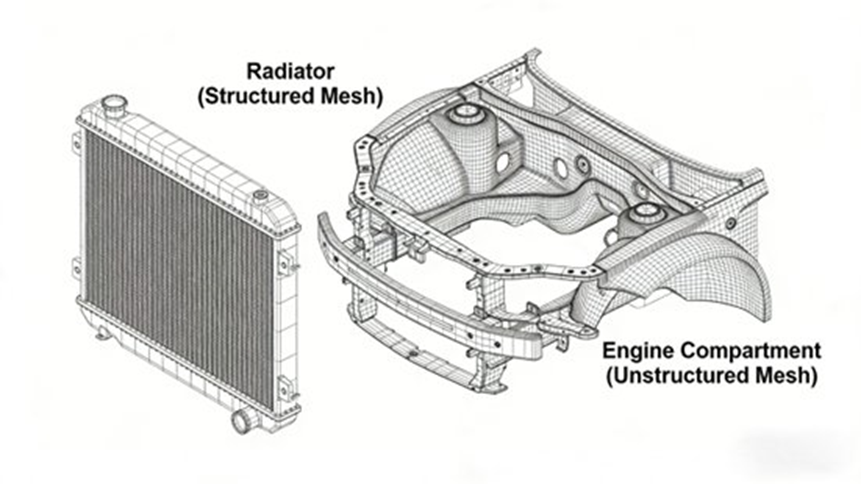
- Structured mesh → simple parts
- Unstructured mesh → complex systems
Key detail:
- Critical regions can be refined down to 0.1 mm
These include:
- Battery gaps
- Brake contact areas
If mesh quality is poor, results won’t be reliable.
Material properties
Each material needs:
- Thermal conductivity
- Specific heat
- Density
- Emissivity
Contact surfaces also need thermal resistance values, which often come from test data.
Why boundary conditions are the hardest part
Short answer:
Boundary conditions define how the system behaves in real life, and small errors here can break the whole simulation.
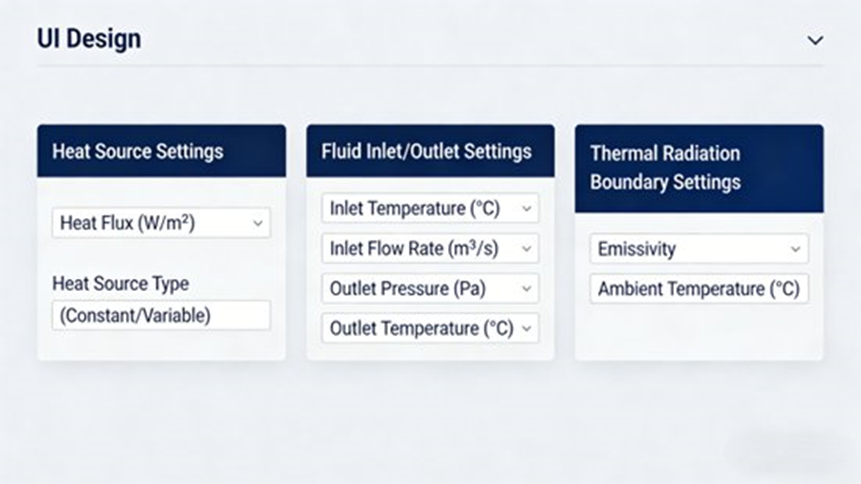
Thermal conditions
- Battery heat (can be calculated using Bernardi equation, ~5% error)
- Engine heat
- Ambient temperature (-40°C to 120°C)
Fluid conditions
- Coolant flow: 0.5–2 m/s
- Airflow depends on vehicle speed
Structural conditions
- Contact resistance between parts
This is where many projects go wrong. One incorrect assumption can shift results significantly.
Standard thermal simulation workflow
Short answer:
Thermal simulation follows a six-step process from setup to optimization.
Full workflow
- Define goals (temperature limits, efficiency)
- Build geometry
- Create mesh and check quality
- Set boundary conditions
- Run simulation
- Analyze and improve
This process follows standards like GB/T 31467-2023.
In real work, it’s always a loop:
You simulate, adjust, and simulate again.
Battery thermal management system design methods
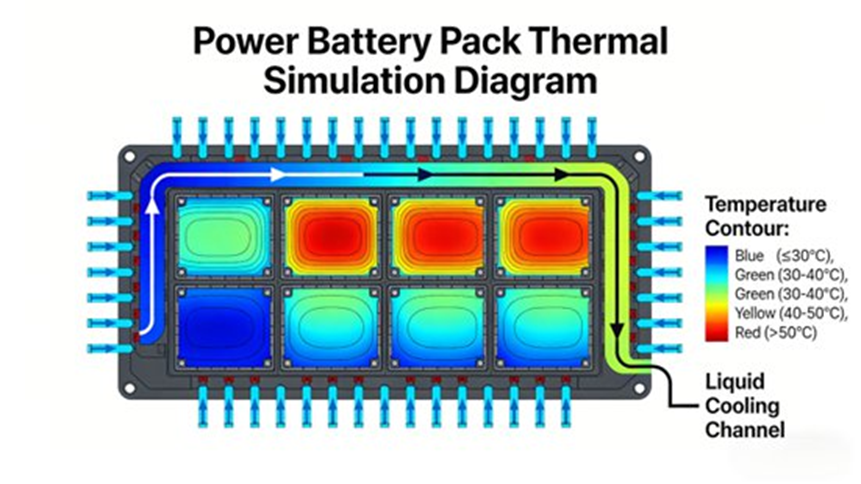
Short answer:
BTMS uses air, liquid, or hybrid cooling depending on performance needs.
Cooling methods
Air cooling
- Simple and low cost
- Limited performance
Liquid cooling
- Most common in EVs
- Strong cooling capability
Phase change materials (PCM)
- Absorb heat during peaks
Hybrid systems
- Combine multiple approaches
Advanced battery modeling
- Equivalent Circuit Models (ECM)
- Coupled electrochemical + thermal models
Example result:
- Temperature difference reduced from ±5°C to ±2°C
Where thermal simulation is used in vehicles
Short answer:
Thermal simulation is applied across engines, batteries, motors, electronics, and cabin systems.
Applications
Engine systems
- Maintain 80–105°C
- Optimize cooling components
Exhaust systems
- Control heat radiation
- Protect nearby parts
Brake systems
- Reduce peak temperature
- Prevent performance loss
Motor and electronics
- Keep motor below 150°C
- Improve chip cooling
Cabin systems
- Improve airflow and comfort
- Use ML models like TRNN
What engineers analyze in simulation results
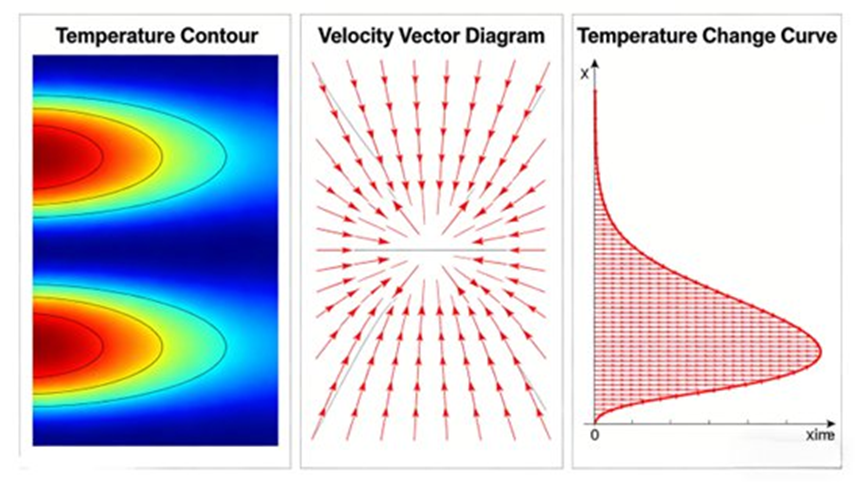
- Temperature maps
- Flow direction and speed
- Pressure distribution
- Time-based temperature change
Hotspots are the main focus.
How simulation is validated
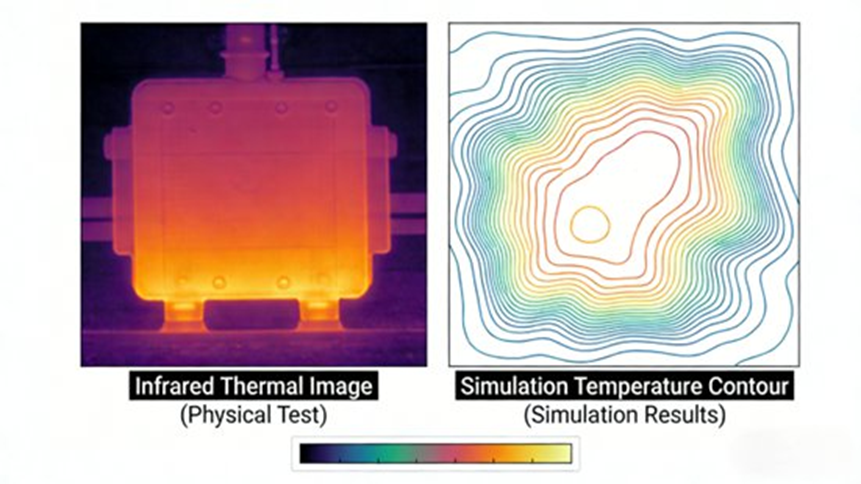
Short answer:
Simulation must be checked against real tests using sensors and imaging.
Methods
- Thermocouples
- Infrared cameras
- Wind tunnel testing
Typical accuracy:
- ≤10% error
- Advanced cases: ±2°C
Thermal simulation tools used in the industry
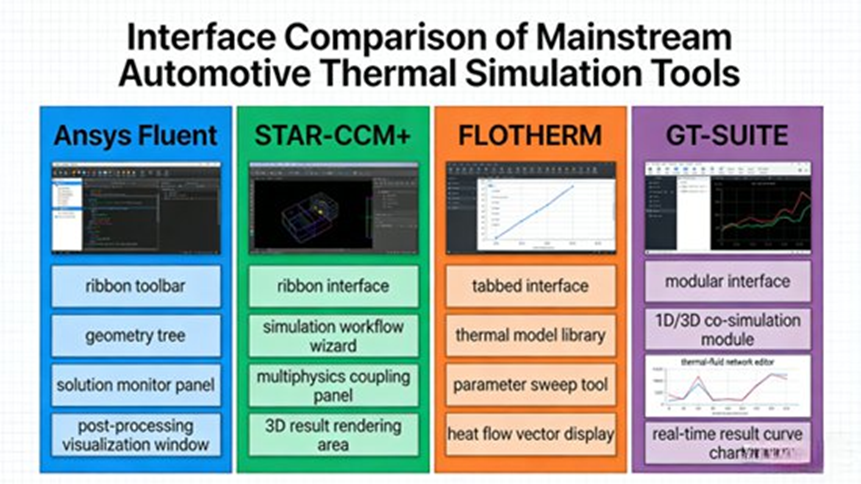
- Ansys Fluent → detailed CFD
- STAR-CCM+ → full workflow integration
- FLOTHERM → electronics cooling
- GT-SUITE → system-level modeling
Current challenges in battery thermal simulation
Short answer:
The biggest challenges are heat prediction, temperature balance, and combining multiple physics models.
Key issues
- Thermal runaway prediction
- Internal heat generation
- Temperature gradients
- Coupling thermal + electrical + chemical models
Simple models are no longer enough.
Future direction of thermal simulation
Short answer:
Thermal simulation is moving toward combined physics models, AI support, and real-time systems.
Trends
Multiphysics simulation
- Combine thermal, electrical, structural effects
AI integration
- Predict temperature faster
- Improve design decisions
Digital twin
- Connect simulation with real data
Reduced testing
- Simulation replacing physical tests
🔥 Trending FAQs
How accurate is automotive thermal simulation compared to testing?
Thermal simulation can stay within about 5–10% error, and even closer when models are well calibrated. The biggest factor is not the solver—it’s how accurate the inputs and boundary conditions are.
What is the best cooling method for EV batteries?
Liquid cooling is the most effective for modern EVs. Air cooling is still used in simple systems, while immersion and hybrid methods are growing for high-performance designs.
Why is CFD still expensive to run?
CFD solves complex 3D physics, which requires time and computing power. Engineers reduce cost by simplifying models, using hybrid approaches, and focusing detail only where needed.
How is AI used in thermal simulation?
AI helps predict temperature, improve designs, and speed up calculations. It works alongside CFD, not as a replacement.
What are the biggest challenges in battery thermal simulation?
The hardest problems are predicting failure, keeping temperatures even, and modeling multiple physical effects together.
Final thought
Thermal problems don’t stay in one place.
They move across the whole vehicle.
That’s why:
A battery thermal management system is not just a component—it’s part of a full system.
And simulation?
It’s how engineers understand that system before anything goes wrong.
