


< Back to Platform Development
By Johnny Liu, CEO at Dowway Vehicle
Published: March 4, 2026
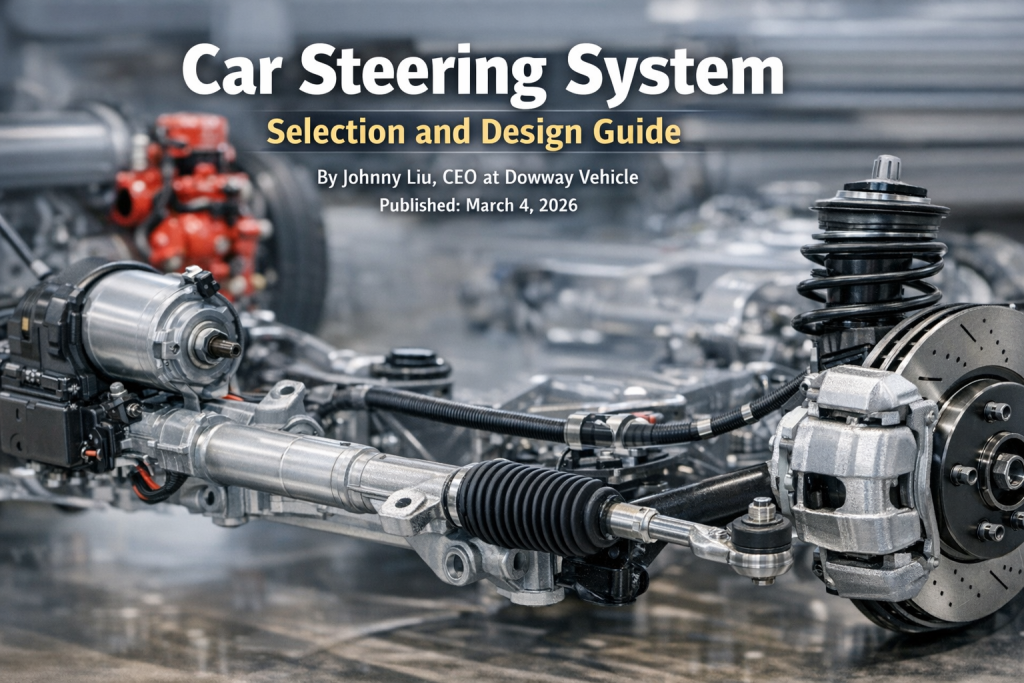
The car industry changes fast, and the steering system is no longer just a mechanical link to change direction. As the CEO of Dowway Vehicle, I see firsthand how steering architectures have grown into highly integrated systems mixing mechanics, electronics, and hydraulics. Whether you engineer a sports EV or a heavy commercial truck, the steering system is the core chassis part that dictates vehicle handling, driving safety, and passenger comfort.
This guide breaks down the engineering rules, selection logic, and design specifics we use to reach our main goal: precise steering, rapid response, lightweight operation, and unwavering reliability.
- 1. Introduction to Modern Steering Systems
- 2. Main Types of Automotive Steering Systems
- 3. Core Selection Principles and Engineering Logic
- 4. Core Design Focus Areas in a Steering System
- 5. Engineering Validation and Optimization
- 6. Engineering Case Study: Steering System for a Compact SUV
- 7. Frequently Asked Questions About Steering Systems (FAQ)
- 8. The Road Ahead for Steering Systems
1. Introduction to Modern Steering Systems
Modern vehicles demand more from their steering setups. Today, these systems must work seamlessly with Advanced Driver Assistance Systems (ADAS), cut down on energy use, and give the driver a better feel of the road.
A poor choice or flawed design leads straight to severe chassis issues: steering lag, numb road feedback, high-speed floating, and exhaustingly heavy low-speed operation. Because of this, matching the steering system to the vehicle’s exact use case, performance goals, and manufacturing budget is a make-or-break step in chassis engineering.
2. Main Types of Automotive Steering Systems
We categorize steering systems into four main types based on their power source. Knowing their unique traits helps engineers make the right choice.
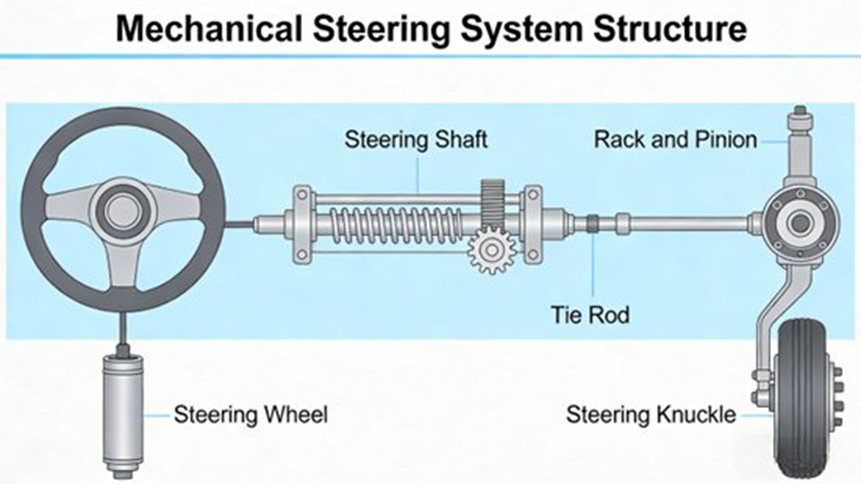
Mechanical Steering System (MS)
- Components: Relies entirely on the driver’s physical force through the steering wheel, shaft, steering gear (rack and pinion or recirculating ball), and transmission linkages (tie rods, knuckle arms).
- Characteristics: It has zero energy loss, high reliability, and low manufacturing costs. But the physical effort required is massive, especially at low speeds. Today, engineers only use MS for low-speed commuter cars or light agricultural vehicles.
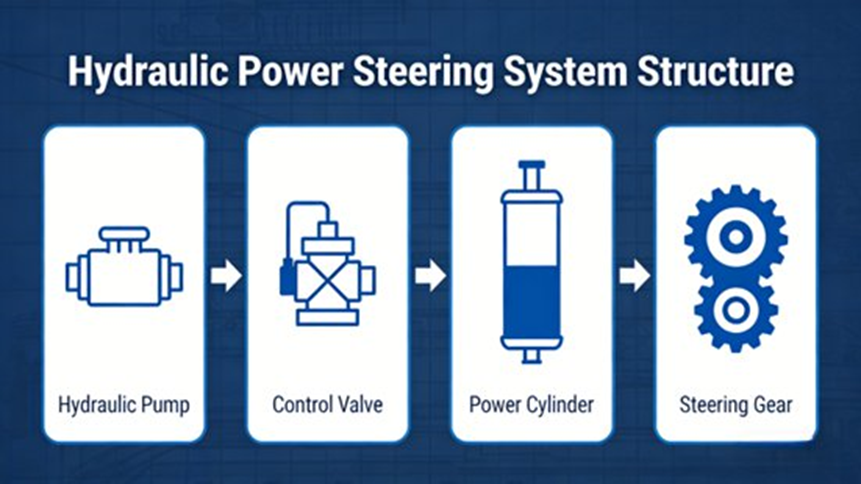
Hydraulic Power Steering (HPS)
- Components: Builds upon MS by adding an engine-driven hydraulic pump, assist cylinder, and control valves.
- Characteristics: HPS delivers smooth and massive assist power, slashing driver fatigue. The downsides are high energy consumption (the pump runs constantly), messy maintenance (fluid replacements), and poor low-temperature start-up assist. It mainly survives in heavy commercial vehicles.
Electro-Hydraulic Power Steering (EHPS)
- Components: An upgrade to HPS. It uses an Electronic Control Unit (ECU) to manage the hydraulic pump’s speed.
- Characteristics: EHPS dynamically adjusts the assist—increasing power at low speeds and dropping it at high speeds. It cuts energy use by over 30% compared to HPS and fits mid-sized sedans, SUVs, and light trucks. But it costs more to make than EPS and still needs hydraulic maintenance.
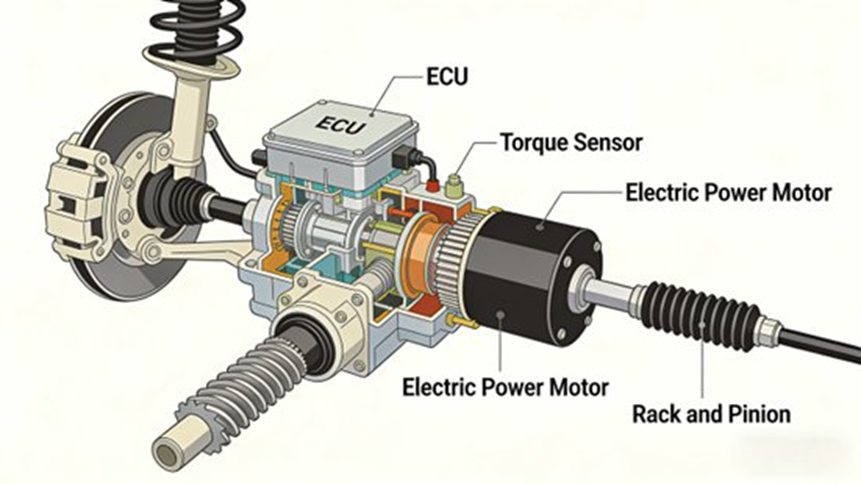
Electric Power Steering (EPS)
- Components: The modern standard. It uses a torque sensor, ECU, and an electric assist motor, completely ditching hydraulic fluids.
- Characteristics: EPS offers ultra-low energy use (the motor only runs during active steering), fast response, and deep electronic integration (linking with ESP and ADAS). While it struggles with the extreme loads of heavy trucks and needs acoustic dampening for motor noise, its versatility makes it the clear choice for passenger cars and New Energy Vehicles (NEVs).
3. Core Selection Principles and Engineering Logic
At Dowway Vehicle, our teams use a simple logic: match the parameters to the demand. We balance performance, cost, reliability, and the driving scenario to avoid under-performance and over-design.
Vehicle Type and Load Adaptation
- Passenger Cars (Sedans, SUVs): EPS is the top choice. Compact cars use Rack-assist EPS (EPS-R) for tight packaging. Mid-to-large SUVs need Column-assist EPS (EPS-C) for higher loads. Sports cars get Variable Gear Ratio EPS (VGR-EPS).
- Commercial Vehicles: Light commercial trucks work well with EHPS. Heavy trucks (Gross weight >10t) still need the raw power of HPS or electro-hydraulic composite systems.
- New Energy Vehicles (NEVs): EPS is a must for low energy use and must sync with regenerative braking. Pure electric heavy trucks use specialized Electric-Hydraulic (E-HPS) systems.
Performance Needs and Driving Conditions
- City Driving (Low speed, frequent turns): Needs light, fast responses suited for dynamic EPS/EHPS.
- High-Speed Highways: Needs a heavy, stable feel. EPS drops the assist level at high speeds, sometimes paired with steering dampers to stop jitter.
- Complex/Off-Road: Needs impact resistance. We choose tough Recirculating Ball gears with HPS/EHPS. For racing (like Formula Student), engineers use an 85% Ackerman steering geometry to balance low-speed precision with high-speed stability while cutting down tire wear.
Cost and Intelligence Adaptation
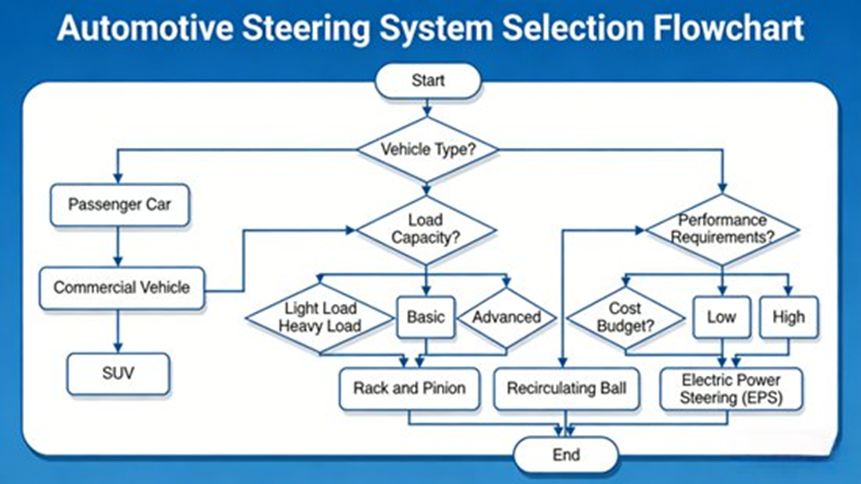
Economy vehicles use basic EPS to keep costs low, while mid-range cars balance performance with EHPS or mid-tier EPS. For L2+ autonomous vehicles, EPS is mandatory to handle automated lane keeping and parking. Future autonomous designs are shifting toward Steer-by-Wire (SBW) to cut out mechanical linkages entirely.
4. Core Design Focus Areas in a Steering System
Once we pick the system type, careful design guarantees precision and durability. Here is how we handle the critical mechanical parts.
Steering Gear Design (The Core Component)
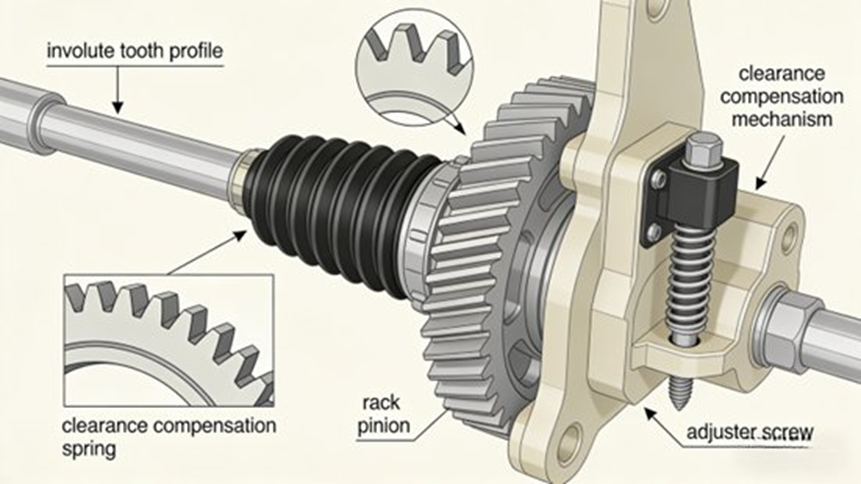
- Rack and Pinion (Efficiency >90%): Very common in passenger cars. We focus on tooth profile optimization using a modified involute design to stop uneven wear. We use 20CrMnTi alloy steel for gears (carburized and quenched) and 45# steel for racks (surface quenched). An automatic clearance compensation mechanism (spring/studs) must keep the gap strictly under 0.5mm to prevent steering dead zones.
- Recirculating Ball (Efficiency 90-95%): Built for heavy commercial loads. This needs high-precision steel balls (diameter error ≤0.001mm, roughly 50 balls total) inside a closed optimized conduit. We use high-strength alloy steel screws (quenched and tempered) with trapezoidal threads, aiming for a transmission ratio between 16 and 32.
Steering Transmission Mechanism Design
- Tie Rods: We swap solid steel for hollow high-strength steel, dropping the weight by over 30%. We galvanize or carburize the surfaces to stop rust. Adjustable front toe settings (recommended 0-2mm) are crucial.
- Ball Joints: Made from bearing steel with strict dust covers. If clearance goes past 0.5mm, you must replace the joint to avoid steering lag.
- Steering Trapezoid: Designed around the Ackerman principle to make sure inner wheels turn sharper than outer wheels, stopping tire scrub.
Power Assist System Design
- EPS Calibration: We spec Brushless DC (BLDC) motors (0.3–1.0kW) to keep assist response times ≤50ms. We tune the ECU PID control heavily: at speeds <30km/h, the assist coefficient is 0.8–1.0; at speeds >80km/h, it drops to 0.2–0.4 with added damping. High-precision torque sensors must have an error of ≤0.5N·m.
- HPS/EHPS Calibration: Pump displacement usually ranges from 10–20mL/r. Rotary control valves and safety valves are mandatory. We specify low-viscosity hydraulic oil to guarantee cold-weather start-ups (-30°C).
- Novel Independent Kingpin Structures: The assist motor can sit directly inside the kingpin axis, using a worm gear and gear reducer to multiply torque and improve transmission stability.
Structural Strength and Lightweighting
Every 100kg saved cuts fuel use by 0.3-0.5L/100km. We run Finite Element Analysis (FEA) for stress checking. Switching to die-cast aluminum alloy knuckle arms and adding collapsible steering columns (for crash energy absorption) are standard safety steps.
5. Engineering Validation and Optimization
Before mass production, strict testing is mandatory to catch design flaws.
- Bench Testing: Verifies EPS assist response (≤50ms), clearance (≤0.5mm), and low-speed torque (≤5N·m). We test durability by simulating 100,000 km of driving. Environmental tests run from -40°C to 85°C. For novel structures, we heavily test the transmission efficiency of worm gears.
- Real-World Testing: Checks handling stability at 120km/h (no floating), keeps cabin steering noise ≤60dB, and validates how the 85% Ackerman geometry impacts tire wear.
- CAE Simulation: We run ADAMS for multi-body kinematic simulations to tweak the steering trapezoid and transmission ratios. We use MATLAB/Simulink to dial in the ECU’s PID control strategies and run slip angle analysis for Ackerman geometry checks.
6. Engineering Case Study: Steering System for a Compact SUV
To show these rules in action, look at a recent Dowway Vehicle project: a 1.5-ton compact SUV (120kW power) needing L2 ADAS compatibility, low energy use, and precise city handling.
- Selection: We dropped MS, HPS, and EHPS. We picked a Rack-assist EPS (EPS-R).
- Design Specifics: We built a 16:1 transmission ratio with automatic gap compensation (clearance kept <0.3mm). We used a 0.5kW BLDC motor and hollow tie rods (1.2m length). By switching to aluminum steering knuckles, we saved 2.5kg. The steering column featured a ≥50mm crash collapse capability.
- Validation Results: Low-speed torque hit ≤4.5N·m with a 35ms response time and 0.25mm clearance. This EPS setup cut energy use by 25% compared to EHPS, giving us flawless 120km/h highway stability with steering precision error ≤0.5°.
7. Frequently Asked Questions About Steering Systems (FAQ)
1. How does a car steering system work?
Short Answer: It changes your steering wheel rotations into the lateral movement of the front tires using gears and linkages.
Details: The motion travels through the steering column to a steering gear mechanism (usually a rack-and-pinion). This gear converts the rotation into linear motion, pushing the tie rods and steering knuckles to turn the wheels. Modern setups use HPS, EHPS, or EPS to reduce the physical force you have to apply.
2. What are the main types of car steering systems?
Short Answer: The four main types are Mechanical (MS), Hydraulic (HPS), Electro-Hydraulic (EHPS), and Electric Power Steering (EPS).
Details: * MS: Purely manual, using gears and linkages.
- HPS: Uses an engine-driven fluid pump for heavy-duty assist.
- EHPS: Uses an electrically controlled hydraulic pump to save fuel.
- EPS: Uses an electric motor and sensors, which is the standard for modern cars and EVs.
3. What are the most common steering system problems?
Short Answer: The most frequent issues are fluid leaks, worn out ball joints, and failing assist motors.
Details: * Power steering fluid leaks: Drops hydraulic pressure in HPS/EHPS systems, making steering stiff.
- Worn steering rack or ball joints: Causes clunking noises or loose steering. In engineering, we keep structural clearance strictly under 0.5mm; anything larger creates a dangerous steering dead zone.
- Faulty sensors or motors: In EPS systems, a dead sensor can shut off the power assist entirely.
4. Why does the steering wheel become hard to turn?
Short Answer: A stiff wheel almost always means you have lost your power assist due to a dead motor or a fluid leak.
Details: For hydraulic systems (HPS/EHPS), this usually comes from low fluid levels, a broken pump, or a snapped serpentine belt. For modern Electric Power Steering (EPS) systems, it points to an ECU fault, a dead assist motor, or a blown fuse. When assist fails, you have to rely totally on your own manual force.
5. How can steering system problems be prevented?
Short Answer: Regular visual inspections and keeping up with fluid changes or alignment checks will stop most failures.
Details: Good routine maintenance extends the life of the steering chassis. You should regularly check EPS sensor alignments, fix wheel alignments, inspect tie rods and dust covers for physical damage, and flush hydraulic fluid (in HPS/EHPS systems) to clean out internal dirt.
8. The Road Ahead for Steering Systems
Automotive steering selection is a tough engineering challenge. It demands strict attention to performance matching, cost control, and rigorous physical and simulated tests to get precise, lightweight, and durable control.
Looking ahead, the industry is moving fast toward total electrification and smart controls. Steer-by-Wire (SBW) systems will soon mature, cutting out mechanical linkages entirely to allow for true digital transmission of steering inputs—a hard requirement for high-level autonomous driving. By bringing in lighter materials and linking the steering setup with the suspension and brakes, we will keep making vehicles safer, more efficient, and better to drive.
