

< Back to Supply chain development
Author: Johnny Liu, CEO at Dowway Vehicle
Published: March 10, 2026
Last Updated: March 10, 2026
Content Type: Cluster Page
Editorial Perspective: This article comes from an automotive engineering, component integration, manufacturing, and supply-chain strategy perspective. We reorganized the user’s full technical report into an English cluster-page format to improve search visibility, readability, and machine extraction.
Author E-E-A-T Note: Johnny Liu is the CEO at Dowway Vehicle. His daily work involves vehicle component systems, supplier development, engineering applications, manufacturing coordination, automotive product strategy, and international supply-chain alignment across conventional, new energy, and intelligent vehicle platforms.
China’s automotive parts industry is moving through a massive structural shift. The sector is growing beyond simple industrial expansion. As global markets push toward electrification, smart driving, connectivity, and lower carbon emissions, Chinese parts suppliers are dropping their old background roles. They are actively building new technology systems, shifting vehicle architecture, controlling costs, and reshaping global supply chains.
In the past, these suppliers mostly focused on basic machining and standard components. Today, they sit at the center of the automotive value chain. Batteries, motors, electronic controls, chassis-by-wire systems, radar, LiDAR, displays, body structures, lightweight materials, and software-linked control systems now form a massive, technology-driven ecosystem.
Even with this rapid growth, the industry runs into hard limits. Weak links remain in high-end chips, premium sensors, advanced bearings, high-performance sealing materials, safety-critical operating systems, AUTOSAR-based middleware, and top-tier engineering toolchains. This article breaks down the industry across five core areas: overall industrial structure, major technology breakthroughs, detailed subsystem status, heavy technical bottlenecks, and where the market is going next.
- What Is China’s Automotive Parts Industry Technology Today?
- Industry Overview and Strategic Positioning
- Electrification: The Strongest Competitive Domain
- Intelligent Components: Perception, Decision, and Execution
- Traditional Parts Technology Keeps Upgrading
- Detailed Status of Key Subsystems
- Technical Bottlenecks and Structural Challenges
- Future Development Trends and Technology Directions
What Is China’s Automotive Parts Industry Technology Today?
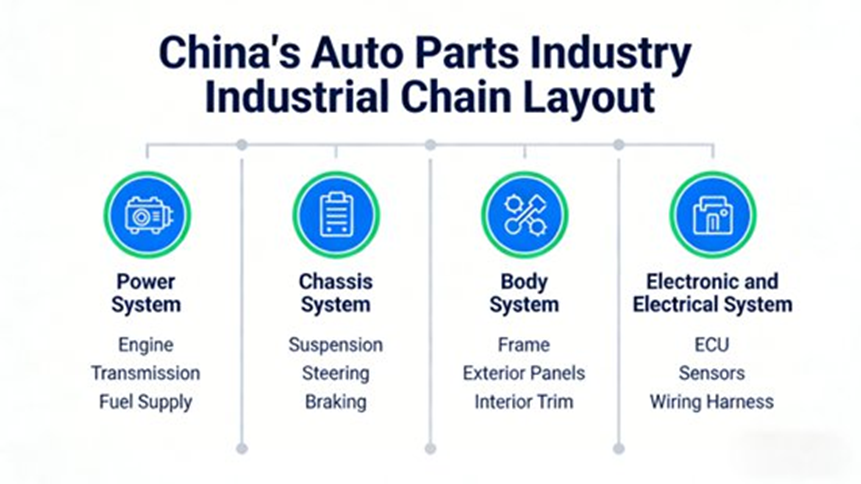
We can define China’s automotive parts industry as a large-scale, rapidly upgrading system covering power, chassis, body, and electronic systems. It blends electronics, software, materials science, functional safety, and system-level engineering. Importantly, it supports traditional internal combustion vehicles, New Energy Vehicles (NEVs), and smart connected vehicles all at once.
By 2025, China housed over 100,000 auto parts enterprises. Revenue from large-scale enterprises (those operating above a designated size) crossed RMB 5 trillion. NEV parts made up more than 35% of the market, driving the sector’s main growth. This matters because this scale is no longer just about cheap manufacturing. It is about engineering speed and supply-chain control.
Industry Overview and Strategic Positioning
A Complete and Layered Industrial System
China built an automotive parts sector with complete categories and mature supporting layers. The industry covers four main systems:
- Power Systems: Conventional engine parts, transmission parts, electric drive systems, power battery systems, and integrated control units.
- Chassis Systems: Suspensions, steering systems, brakes, structural chassis parts, and new x-by-wire technologies.
- Body Systems: Structural components, exterior panels, doors, hoods, tailgates, seating systems, interior trim, standard parts, and wear parts.
- Electronic and Electrical Systems: Automotive chips, displays, communication modules, control units, sensors, smart cockpit parts, domain controllers, and wiring architectures.
The ecosystem relies heavily on supporting capabilities like parts machining, mold manufacturing, testing, validation, and engineering verification. A final part is only as good as the tooling, trial-production capacity, and long-cycle validation process behind it.
Strategic Technology Repositioning
The original data points out three major shifts in how China positions its technology.
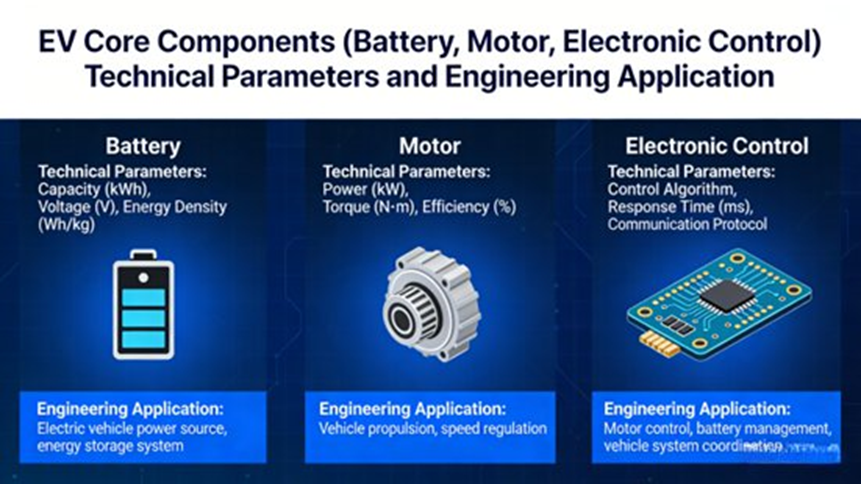
- From Low-End Supply to High-End Breakthrough: Historically, firms competed on scale and cheap labor. Now, they are pushing to break foreign dominance in higher-value areas like the core EV powertrain (often called the “three-electric” system in China: battery, motor, and electronic control), smart driving hardware, and integrated electronics.
- From Mechanical Manufacturing to Mechatronic Integration: Parts are rarely just mechanical anymore. They blend power electronics, embedded control, software algorithms, communication modules, thermal management, and materials engineering.
- From Single-Part Supply to System Integration: The market demands modular solutions that fit OEM architectures. We see this in multi-in-one electric drive systems, integrated cockpit systems, battery-pack structural integration, and domain control platforms.
Global Expansion Beyond Trade
China’s global strategy no longer relies on simply exporting boxes of parts. The industry uses a mixed approach: trade + overseas plant construction + mergers and acquisitions. Opening production bases in Mexico and Southeast Asia helps suppliers stay close to OEM assembly lines and dodge trade barriers and certification friction.
Electrification: The Strongest Competitive Domain
Electrification stands out as China’s most globally competitive technical field. The fastest progress happens right inside the EV powertrain.
Power Battery Technology
China controls the full industrial chain for both ternary lithium and lithium iron phosphate (LFP) batteries.
Mainstream LFP batteries hit energy densities of 180–220 Wh/kg. Mainstream ternary lithium batteries reach 280–320 Wh/kg. These numbers support the range needs of A-class vehicles and above, reliably delivering 400–700 km of driving range depending on the car’s size and packaging.
One major engineering win is module-free battery pack design. CATL’s CTP 3.0 battery pack completely removes the old module structure, integrating cells directly into the pack. This design cuts the number of parts by 40% and pushes battery pack volume utilization to 67%. For vehicle engineers, this means packing more cells into the same physical space, directly improving range. Brands like Tesla and BYD already use these setups.
Battery chemistry keeps diversifying. Semi-solid-state batteries recently started entering batch production for passenger cars. Solid-state batteries will likely see large-scale commercialization around 2027. Meanwhile, sodium-ion batteries are taking market share in the A00 vehicle segment (micro and city cars), creating a fresh option for low-cost urban driving.
Drive Motor Technology
Local suppliers independently develop and mass-produce permanent magnet synchronous motors and AC induction motors. Performance indicators match the best in the world.
Mainstream permanent magnet synchronous motors hit 3.0–4.5 kW/kg in power density, with peak efficiency climbing past 97.5%. These specs directly influence a car’s acceleration, package size, thermal load, and energy use.
Take the third-generation silicon carbide e-drive module in the NIO ET5 as an example. It reaches 97.2% energy conversion efficiency. Next to older IGBT modules, power loss drops by 15%, and module power density hits 1315 kW/L. This leads to lighter packaging and better range.
The market also heavily adopts hairpin motors and oil-cooled motors. Next to standard round-wire motors, hairpin motors cut copper loss by 15–20% and bump power density by 20–30%. You can find them in major vehicle programs from BYD and XPeng.
Electronic Control Systems
Domestic suppliers made huge steps forward in motor controllers, battery management systems (BMS), and vehicle control units (VCU).
Motor controllers running SiC power devices push switching frequencies to 10–20 kHz, dropping energy consumption by 10–15% and perfectly matching 800V high-voltage platforms.
Modern BMS setups monitor cell voltage and temperature with a precision of ±5 mV. This allows incredibly accurate cell balancing and thermal management. This level of control can stretch battery service life by over 30%.
For hybrid models, BYD’s DM-i hybrid system ECU runs a high-performance dual-core processor. Computing power jumped five times compared to older units, shrinking the response handoff time between the engine and motor to just 0.2 seconds. The result is seamless power delivery.
Intelligent Components: Perception, Decision, and Execution
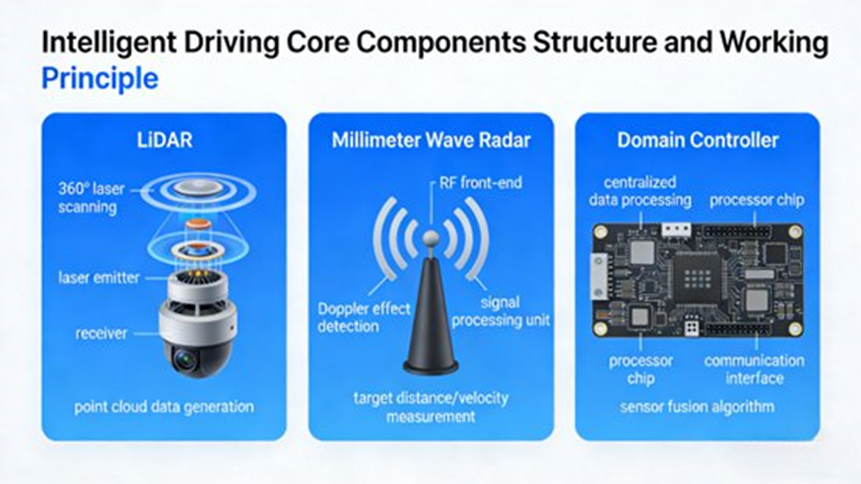
As smart connected vehicles fill the roads, Chinese companies are moving fast across the whole smart driving chain.
Perception Components
LiDAR: LiDAR units evolved from 16-line to 128-line models. Costs plummeted below RMB 3,000, speeding up vehicle adoption. Higher-level smart driving functions will likely jump from a 15% penetration rate in 2025 to 30% in 2026. Local companies like RoboSense and Hesai build units with 0.1 m ranging accuracy and a 120° × 25° field of view, ideal for L2+ functions. Li Auto, NIO, and XPeng equip these on their production lines.
Millimeter-Wave Radar: The local market mass-produces 24 GHz and 77 GHz radar. A 77 GHz radar hits a detection range of 150 m and a speed measurement accuracy of ±1 km/h. They drive adaptive cruise control (ACC) and automatic emergency braking (AEB). Domestic localization easily clears 60%.
HD Cameras: Cameras with 1080P and above resolution carry ISP image processors. They manage object detection with an accuracy above 99%. Working alongside LiDAR and radar, they create fusion perception systems that make smart driving highly reliable.
Decision Components
Domain controllers act as the “brain” of the car. We see aggressive integration across the cockpit, driving, and body domains. Local suppliers are pushing hard on SoC integration, operating systems, and custom algorithms. Horizon Journey 6, expected to grab about 18% market share by 2026, pushes out more than 200 TOPS of computing power. This handles complex, higher-level smart-driving decisions. These controllers use modular designs, accept different sensor interfaces, and allow OTA upgrades.
The software-defined vehicle (SDV) trend forces parts companies to become hardware plus software providers. By 2031, roughly 28 million vehicles might run generative AI-driven chatbots. Software’s share of a vehicle’s system cost could jump from 15% to 60%.
Execution Components
Electronic shifters rely on mechatronic integration, offering manual, automatic, and sport modes with 0.1 mm shift precision. Domestic localization sits above 80%.
For braking, i-Booster and One-Box brake-by-wire systems rule the execution space. They react within 100 milliseconds and cut braking distances by 5–10% compared to old mechanical links. The BYD Han and XPeng P7 use these systems daily.
Traditional Parts Technology Keeps Upgrading
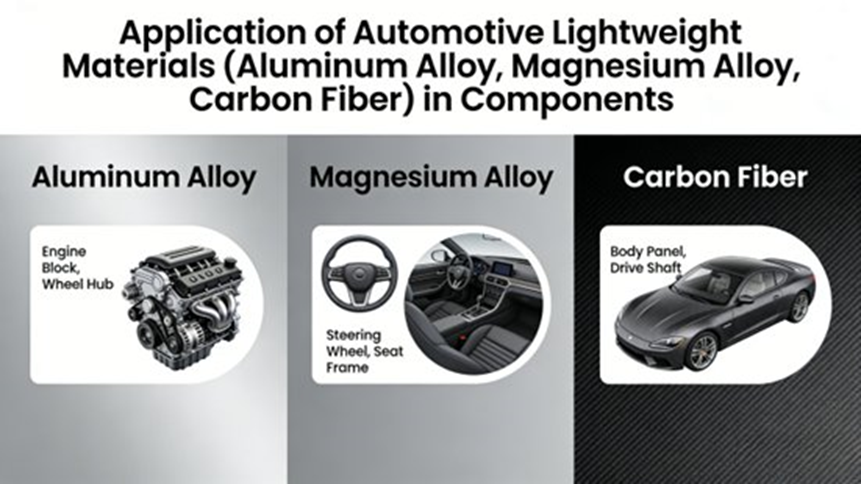
Even as batteries take the spotlight, traditional internal combustion parts keep getting better, focusing heavily on lightweighting, energy savings, and reliability.
Lightweighting Technologies
Engineers use more aluminum alloys, magnesium alloys, and carbon-fiber composites for engine blocks, steering wheels, and body frames. Integrated die casting now covers larger structural parts. China leads in magnesium thixomolding. Forged lightweight aluminum and magnesium parts will likely pass 60% market share soon.
One local car model switched to an aluminum body, cutting vehicle mass by 150–200 kg and dropping fuel consumption by 0.5–1.0 L/100 km. A carbon-fiber driveshaft cuts weight by half. Ceramic brake discs handle temperatures up to 1650°C for high-performance cars. New organic seals resist aging about three times better than older materials.
Energy-Saving Upgrades in ICE Components
Variable valve timing (VVT) and variable compression (VC) systems keep engine efficiency high. The Volkswagen EA211 turbocharger optimizes blade geometry and integrates the exhaust manifold. It delivers peak torque at 1750 rpm, hits 110 kW (150 hp), and pushes fuel consumption down to 5.6 L/100 km.
Dual-clutch transmissions (DCT) run better shift logic, wiping out shift shock and reaching efficiency above 95%. CVT steel belts now easily last over 300,000 km.
Reliability Improvements
High-strength aluminum engine pistons with ceramic coatings boost wear resistance by 50%, lasting 200,000 km. Suspension parts made of high-strength steel handle tensile strength above 1500 MPa, dropping fatigue rates by 30% and eliminating weird suspension noises.
Many old-school parts suppliers are restructuring. Several global parts giants sold off turbocharger and interior businesses to chase EV and smart tech money instead.
Detailed Status of Key Subsystems
Chassis System Components
The chassis dictates stability, handling, and safety. Chinese suppliers mass-produce key chassis parts that rival international standards.
Local firms build parts for MacPherson and multi-link setups. Dampers, springs, and control arms meet strict global rules. Electronically controlled adaptive dampers adjust on the fly based on road conditions. Air suspension systems, mostly for SUVs and NEVs, see localization rates pass 50%.
Engineers follow strict maintenance lines for these parts:
- Clutch friction plate wear limit: 2 mm
- Damper oil leakage: immediate replacement required
- Brake pad replacement threshold: 3 mm
Electric power steering (EPS) systems own the market, offering 10–30 N·m of assist torque with a sub-50-millisecond response time. Steer-by-wire (SBW) left the lab and entered pilot testing. By removing the steering column, this tech perfectly matches future unmanned driving designs.
For brakes, electronic parking brake (EPB) systems boast localization above 90%. One-Box brake-by-wire systems are rapidly pushing out older vacuum brake boosters.
Electronic and Electrical System Components
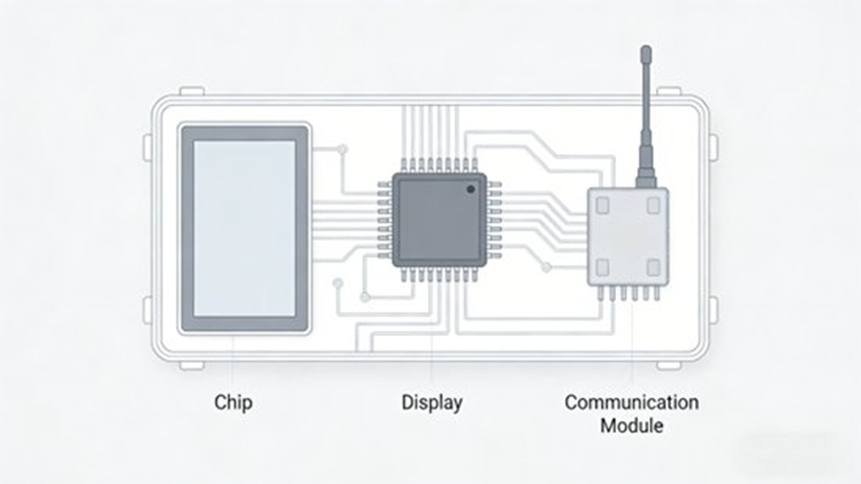
This system moves all the data. It covers chips, displays, communications, and body control.
Automotive Chips: China mass-produces body-control MCUs and IGBT power devices. Memory chip localization grew from 5% in 2023 to 20%. But here is the catch: high-end chips like smart driving SoCs and premium MCUs come almost entirely from outside the country. Infineon and NXP own over 90% of the high-end space. Local IGBTs cover 200V to 1200V ranges, hitting 40% localization. However, in ASIL-D safety-critical systems (like steering or brake controllers), local chips account for less than 5% of installations.
Vehicle Displays: Local factories pump out LCD clusters and center screens from 3.5 to 15.6 inches in 1080P to 4K resolution. OLED displays add higher contrast and bendable shapes for curved dashboards. HUD systems project data 2–5 m ahead of the driver, with localization passing 60%.
In-Vehicle Communication: 5G telematics modules handle latency under 10 milliseconds and bandwidth over 10 Gbps, making OTA updates and remote control instant. Automotive Ethernet, running at 1000 Mbps, is steadily replacing the old CAN bus to handle heavy data from multiple sensors.
Body System Components
High-strength and ultra-high-strength steel make up over 70% of modern body structures. Laser welding hits 0.1 mm precision. In domestic crash tests, cars easily maintain passenger cabin integrity and hit C-NCAP five-star ratings. Topology optimization shaves 10–15% off the body weight without losing stiffness.
Inside the cabin, suppliers use water-based leather and recycled plastics to kill VOC emissions. Seat frames use high-strength steel. Polyester fiber insulation blocks 20–30% more road noise than older materials. Standard parts use universal ISO numbers, while wear parts like wiper strips require yearly replacement.
Technical Bottlenecks and Structural Challenges
Despite the massive wins, the industry fights severe structural problems.
Weak Control Over Core Technologies
China relies heavily on imported smart driving SoCs, premium MCUs, LiDAR core chips, millimeter-wave radar RF chips, high-end bearings, and advanced rubber seals. In the premium AI-chip market, NVIDIA holds over 80% market share with Orin and Thor chips. This creates massive supply-chain risk.
Fragile Software Ecosystems
Foreign real-time operating systems like QNX and Linux own 90% of the market in safety-critical driving and chassis control domains. Local operating systems mostly stick to the smart cockpit. They struggle to pass strict functional safety certifications for actual driving controls. Furthermore, AUTOSAR-compliant basic software stacks and advanced toolchains still belong mostly to European and American vendors.
Low R&D and Missing Talent
The average R&D intensity of local parts clusters in 2025 hovered around 3.2%. Bosch spent 8.5%; Denso spent 7.2%. Worse, local companies spend only about 15% of that money on basic research. The rest goes into quick product tweaks.
There is a massive talent hole. The industry needs 5,000–8,000 more specialists in chip architecture, complex embedded software, and functional safety engineering. Aggressive hiring from international competitors pushes the annual talent loss rate to 10–15%.
Supply-Chain Resilience and Cost Pressure
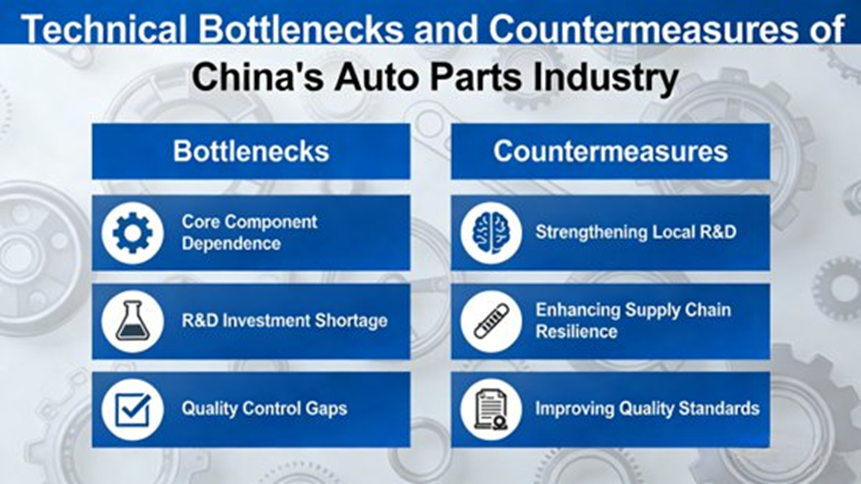
Raw materials like lithium, cobalt, nickel, rare earths, and chip wafers swing wildly in price. Lithium prices can jump or crash by 30% in a single year. The Congo supplies 80% of the cobalt needed for ternary batteries, bringing geopolitical risk right to the factory floor. Because raw materials make up 50–70% of a part’s cost, these swings destroy profit margins.
Note: We must also separate raw material risks from trade issues. Overseas trade and certification barriers actively block exports. Meanwhile, pure supply chain breaks—like the massive semiconductor shortages seen recently—can wipe out 5–8% of vehicle production capacity in a matter of months. Both issues hurt, but they require different solutions.
Future Development Trends and Technology Directions
1. High Voltage and High Integration
800V high-voltage platforms will move from luxury cars to everyday commuters. SiC and GaN semiconductors will handle this power efficiently. Solid-state and sodium-ion batteries will push energy densities past 400 Wh/kg. Electric drives will merge the motor, controller, reducer, and DC/DC converter into one box. Fast charging will drop wait times to 10–15 minutes.
2. AI and High-Level Automated Driving
LiDAR prices will drop below RMB 1,000 as units get smaller and solid-state. Automotive chips will cross 1000 TOPS of computing power. By 2026, the auto industry, embodied robotics, and the low-altitude economy will share about 70% of their supply chains. Parts suppliers will build one sensor that works for a car, a robot, or a drone.
3. Deep Lightweighting and Low-Carbon Manufacturing
Carbon fiber composites and magnesium alloys will push vehicle weight down by another 30% by 2030. Laser welding and 3D printing will lower factory pollution. Battery and motor recycling will become massive standalone industries.
4. Global Layout and Local Resilience
Suppliers will keep buying or building factories overseas to lock down a “global R&D, global production” system. Modular parts will lower costs. Finally, the aftermarket is exploding. NEV maintenance value will pass RMB 80 billion, but the industry is short 824,000 trained EV technicians.
Frequently Asked Questions
1. What is the current technological level of China’s automotive parts industry?
Short Answer: China is now globally competitive in electric vehicle components, batteries, and smart tech, though it still relies heavily on imports for high-end chips and safety software.
Detail: The industry has made massive jumps in digital manufacturing, software-defined vehicle architectures, and supply-chain integration. However, it still lags behind leading countries in several high-end core technologies, including advanced automotive chips, high-performance sensors, safety-critical software, premium materials, and precision manufacturing capability. China wins in fast-growing product domains but needs better control over the most technically demanding layers of the value chain.
2. What major engineering breakthroughs have Chinese automotive parts companies achieved?
Short Answer: Major engineering wins include module-free battery packs, high-efficiency silicon carbide electric drives, and affordable LiDAR for smart driving.
Detail: Chinese companies have delivered major breakthroughs in LFP and ternary lithium systems, integrated e-drive and e-axle platforms, and battery management systems. They also scaled intelligent driving systems, including LiDAR, millimeter-wave radar, cameras, and domain controllers. The speed of engineering industrialization allows companies like BYD to integrate battery, motor, and electronic control technologies rapidly, cutting costs and improving performance.
3. What are the main technological bottlenecks facing China’s automotive parts industry?
Short Answer: The industry struggles with a heavy reliance on imported high-end chips, weak core software ecosystems, and unstable raw material supply chains.
Detail: Major bottlenecks include a dependence on imported automotive semiconductors, gaps in high-precision manufacturing, and limited ownership of core intellectual property in safety-critical areas. Supply-chain vulnerabilities tied to lithium, cobalt, and nickel create massive cost risks. These issues are especially harsh in high-end intelligent vehicles, which depend entirely on AI chips, real-time operating systems, and functional safety logic.
4. How do government policies influence the technological development of the automotive parts industry?
Short Answer: Government policies accelerate growth through R&D funding, tax breaks, and strategic planning, shifting the focus from cheap production to technology innovation.
Detail: Industrial policy shapes the development roadmap. Programs provide R&D subsidies, tax incentives, and infrastructure investment. These tools accelerated the shift toward electric vehicles, advanced manufacturing, robotics, and intelligent systems. The long-term challenge is balancing this support with strong commercial competitiveness, ensuring companies do not rely solely on policy to survive.
5. What are the future technological trends in China’s automotive parts industry?
Short Answer: The industry is moving rapidly toward 800V high-voltage platforms, integrated multi-in-one electric drives, and AI-driven smart vehicle systems.
Detail: Future trends focus heavily on next-generation EV components, autonomous driving, software-defined vehicles, and smart manufacturing. We will see greater global supply-chain integration, widespread use of low-carbon materials, and greener production processes. Future success will depend on how well the industry merges hardware scale with software depth and domestic resilience with global reach.
Looking Ahead
China’s automotive parts industry has moved completely past its old manufacturing-only reputation. System integration, engineering speed, and industrial-chain coordination define the sector today. The strongest progress sits in the EV powertrain, lightweight materials, and smart-driving hardware.
The hardest stage is happening now. High-end chips, safety-critical software, operating systems, and long-cycle innovation remain massive hurdles. The next winners will be the companies that combine hardware scale with software depth, functional safety with rapid execution, and local resilience with global reach. China moved from a follower to a challenger. The next step is proving it can be a true global technology leader.
