

< Back to Electrical & Electronic Toolchain
By Johnny Liu, CEO at Dowway Vehicle
Published on March 18, 2026
- 1. Introduction
- 2. What is a Cloud-Native Automotive Development Toolchain?
- 3. Key Features of the BCZYUN Automotive Toolchain
- 4. BCZYUN Toolchain Architecture and Components
- 5. Core Modules of BCZYUN Toolchain
- 6. How BCZYUN Toolchain Enhances Development Efficiency
- 7. The Role of Functional Safety and Compliance in Automotive Development
- 8. BCZYUN in Real-World Automotive Applications
- 9. The Future of Cloud-Based Automotive Development Tools
- 10. Conclusion
- 1. What is a cloud-native automotive development toolchain and why is it important for SDVs?
- 2. How does a full automotive toolchain support the shift-left testing in SDV development?
- 3. What standards and integrations should an automotive toolchain comply with?
- 4. How do cloud toolchains handle virtual testing, simulation, and validation compared to traditional methods?
- 5. What are the benefits and challenges of integrating CI/CD automation into automotive software development?
1. Introduction
The automotive industry is changing rapidly with the rise of Software-Defined Vehicles (SDVs). As vehicles become smarter and more connected, traditional development tools are becoming less effective. To meet the growing needs, cloud-based automotive development tools have emerged, offering a more efficient way to build and test software for SDVs.
This article explores BCZYUN, a cloud-based toolchain designed to support the entire automotive software lifecycle. BCZYUN incorporates key standards like AUTOSAR and ISO 26262 to address the challenges automotive developers face. It’s built to help companies streamline development, cut costs, and improve quality in the creation of SDV systems.
2. What is a Cloud-Native Automotive Development Toolchain?
A cloud-native automotive development toolchain is a set of software tools hosted in the cloud. These tools help in the development of automotive systems, enabling tasks like virtual ECU creation, automated testing, CI/CD, and fleet validation. Cloud-based toolchains enable:
- Collaboration: Teams across multiple locations can collaborate easily and in real-time.
- Scalability: Cloud resources can be expanded or reduced as needed, allowing teams to run simulations and tests faster.
- Virtual Testing: Tools in the cloud allow testing to be done before hardware is even available, cutting down on costs and speeding up development.
3. Key Features of the BCZYUN Automotive Toolchain
BCZYUN’s toolchain integrates many essential features for automotive software development:
- Modular Design: The architecture allows for flexible integration of various tools to meet the specific needs of automotive developers.
- Cloud-Native: Built on cloud infrastructure, BCZYUN facilitates collaboration and scalability, supporting teams across the globe.
- End-to-End Support: From requirement management to deployment, BCZYUN covers every step in the automotive software lifecycle.
4. BCZYUN Toolchain Architecture and Components
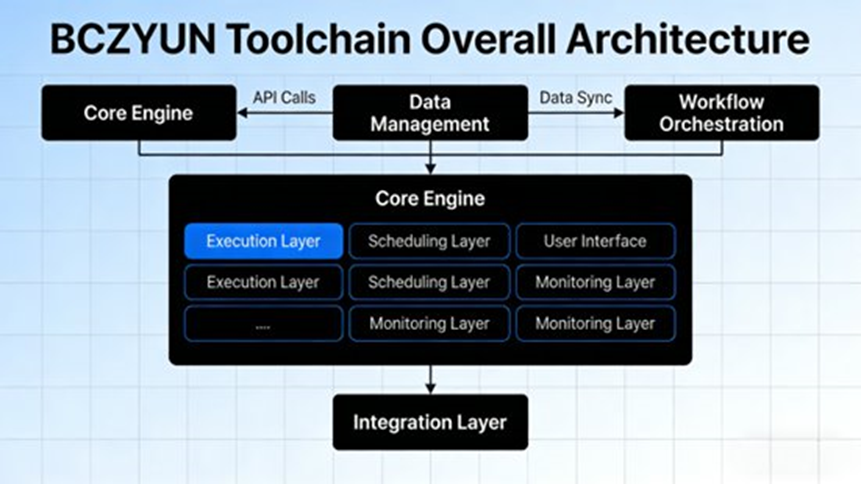
BCZYUN is built on a four-layer architecture, ensuring seamless integration and efficient development workflows.
4.1 Infrastructure Layer
This foundational layer supports all toolchain processes:
- Virtual ECUs (vECUs) and Virtual HPCs (vHPCs): These virtualized environments allow software development and testing without physical hardware.
- Scalable Cloud Resources: Provides on-demand resources to handle large-scale simulations and tests.
- Global Access: Enables teams worldwide to access the platform at any time, facilitating collaboration.
4.2 Core Tool Layer
The core tools are responsible for key development tasks:
- Requirement Management: BCZYUN helps manage and trace requirements, ensuring compliance with ISO 26262 functional safety standards.
- Model Development and Code Generation: BCZYUN integrates with tools like MATLAB/Simulink to automate code generation compliant with AUTOSAR.
- Virtual Testing Tools: Includes MIL, SIL, HIL, and VIL testing to simulate software in different environments.
- CI/CD Pipelines: Automates the build, test, and deployment process, enabling continuous validation.
4.3 Application Service Layer
This layer includes services tailored to specific development needs:
- Functional Safety Services: Ensures that software development meets ISO 26262 safety standards.
- Compliance and Analytics: Offers analysis tools for improving software quality and ensuring regulatory compliance.
4.4 User Interaction Layer
The interface is designed to be intuitive and accessible on web, client, and mobile devices. Users can easily customize the interface to fit their specific needs.
5. Core Modules of BCZYUN Toolchain
BCZYUN’s core modules simplify key stages of automotive software development.
5.1 Model Development and Code Generation
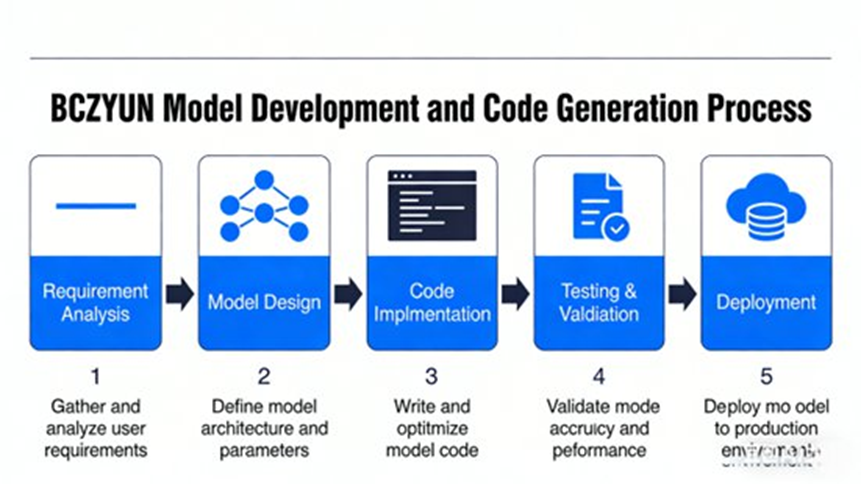
BCZYUN integrates Model-Based Development (MBD), automating code generation from functional models built in MATLAB/Simulink. This reduces manual coding errors and ensures compliance with MISRA C and AUTOSAR standards.
- Automated Code Generation: Eliminates the need for manual coding, ensuring faster development.
- Model-to-Code Traceability: Helps maintain a clear connection between the model and the generated code for easier debugging and updates.
5.2 Virtual Simulation and Testing
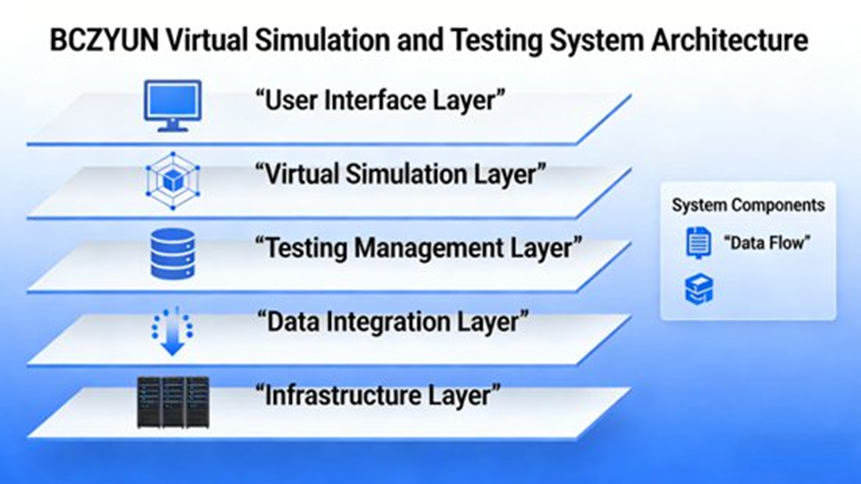
BCZYUN provides comprehensive virtual testing capabilities:
- MIL and SIL testing to validate software in a virtual environment.
- HIL and VIL testing to simulate real-world conditions with physical hardware and vehicle models.
5.3 CI/CD Pipeline Automation
With CI/CD automation, BCZYUN helps developers automate testing, code compilation, and software deployment, improving efficiency and consistency.
- Automated Testing: Continuous testing ensures that software is validated after every change, reducing the risk of defects.
- Traceability: All CI/CD processes are logged for easy tracking and troubleshooting.
6. How BCZYUN Toolchain Enhances Development Efficiency
BCZYUN’s features help speed up development and reduce costs:
- Faster Development Cycles: By automating key processes and conducting virtual testing early on, BCZYUN shortens development times.
- Lower Hardware Costs: Virtual environments reduce the need for physical hardware during early stages of development.
- Improved Team Collaboration: BCZYUN’s cloud-based platform enables real-time collaboration, helping teams work more efficiently.
Example: In a Body Control Module (BCM) project, BCZYUN reduced code generation time by 60% and lowered errors by 80%, increasing the efficiency of implementing changes by 50%.
7. The Role of Functional Safety and Compliance in Automotive Development
Functional safety is crucial for automotive systems, and BCZYUN ensures that development aligns with ISO 26262 standards. This includes supporting safety goal definitions, risk analysis, and the implementation of safety mechanisms throughout the development process.
8. BCZYUN in Real-World Automotive Applications
BCZYUN has been successfully used in various automotive applications:
- Body Control Modules (BCM): BCZYUN’s automation tools helped reduce code generation time by 60% and errors by 80%.
- ADAS Development: In ADAS systems like ACC and AEB, BCZYUN helped reduce testing costs by 70% and cut testing time by 60%.
9. The Future of Cloud-Based Automotive Development Tools
With the evolution of SDVs, AI and big data will enhance BCZYUN’s capabilities. These technologies can help automate test case generation, optimize code, and identify defects faster. BCZYUN will continue to expand its support for complex systems like autonomous driving and advanced driver assistance systems (ADAS).
10. Conclusion
BCZYUN is transforming automotive software development with its cloud-based toolchain. By integrating cloud infrastructure, CI/CD automation, and functional safety standards, BCZYUN speeds up development, reduces costs, and ensures software quality. As SDV systems become more complex, BCZYUN will continue to help engineers deliver innovative, safe, and reliable software.
🔎 Top 5 Most Discussed FAQs (Last Month) — Automotive Cloud Toolchains & SDV Development
1. What is a cloud-native automotive development toolchain and why is it important for SDVs?
Answer:
A cloud-native toolchain is a set of software tools hosted in the cloud that enables virtual testing, automated validation, and real-time collaboration for SDVs. It reduces development time and costs by using scalable cloud resources.
(Microsoft Learn)
2. How does a full automotive toolchain support the shift-left testing in SDV development?
Answer:
A cloud toolchain enables Model-Based Development (MBD), virtual simulations like MIL and SIL, and automated testing earlier in the development lifecycle, allowing issues to be detected sooner and reducing costly corrections.
(Microsoft Learn)
3. What standards and integrations should an automotive toolchain comply with?
Answer:
Automotive toolchains should comply with AUTOSAR, ISO 26262 for safety, MISRA C for coding standards, and DevOps principles for version control and integration. These ensure the software is safe, reliable, and meets regulatory requirements.
(Microsoft Learn)
4. How do cloud toolchains handle virtual testing, simulation, and validation compared to traditional methods?
Answer:
Cloud-based toolchains enable testing in virtual environments, using scalable resources to simulate real-world scenarios. This accelerates testing and reduces the need for physical hardware during early development stages.
(Microsoft Learn)
5. What are the benefits and challenges of integrating CI/CD automation into automotive software development?
Answer:
CI/CD pipelines automate code testing, compilation, and deployment, speeding up iterations. Challenges include adapting pipelines for embedded systems and ensuring compliance with security and traceability standards.
(Microsoft Learn)
