


< Back to Performance Development
Author: Johnny Liu, CEO at Dowway Vehicle
Published: March 3, 2026
Hi, I’m Johnny Liu. At Dowway Vehicle, we know the braking system is the absolute core of vehicle safety. If your brakes cannot handle heat, you put passengers and other drivers at serious risk. This guide breaks down brake thermal analysis. We examine how heat builds up, what causes brakes to fade, and how we test and fix these issues using basic thermodynamics and automotive engineering.
📌 Key Takeaways for Brake Thermal Analysis:
- Energy Conversion: Friction components absorb over 90% of a vehicle’s kinetic energy as heat during a stop.
- Safety Impact: About 30% of car accidents tie back to braking failures, and thermal fade is a major trigger.
- Critical Threshold: Thermal fade usually starts when component temperatures pass 150°C–200°C.
- Friction Drop: At temperatures over 300°C, the friction coefficient can drop by more than 50%, extending braking distances to dangerous levels.
1. How Brake Thermal Fade Happens
Cars are getting faster and heavier. Mountain roads and traffic jams are normal for most drivers today. This puts heavy, frequent friction loads on your brakes.
When you step on the pedal, the friction pair (the brake disc and pads, or the drum and shoes) turns kinetic energy into thermal energy. The temperature of these parts spikes rapidly. When the heat passes a critical point, the mechanical grip drops. Engineers call this brake thermal fade.
Think about a long downhill drive. A driver constantly riding the brakes can push disc temperatures to 300°C–400°C or higher. At this extreme heat, the braking torque drops. The car takes much longer to stop, and the risk of rear-end crashes goes up fast.
2. Core Mechanisms of Heat Failure
Heat buildup damages structures and degrades performance. This breakdown happens through four main physical changes.
2.1 Friction Material Breakdown
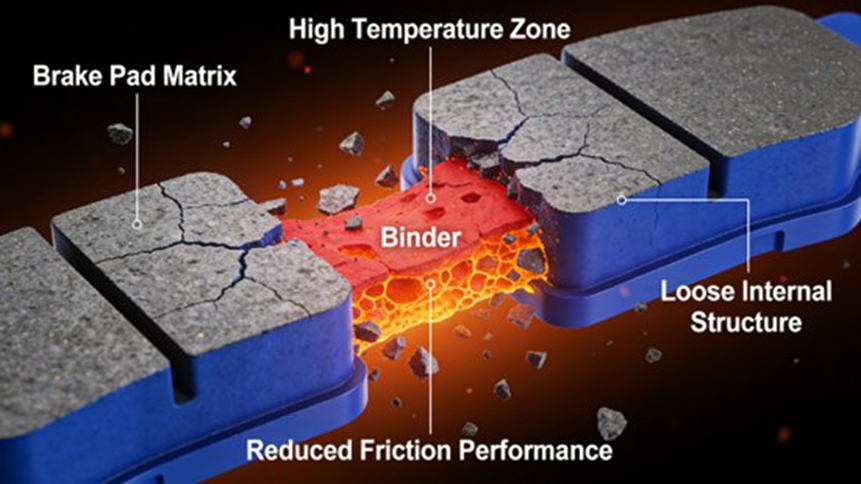
Brake pads use base fibers, binders (like resins or rubber), and friction modifiers. The binder is usually the weak link.
- At 200°C–300°C: Binders soften and break down, releasing gases like CO, CO₂, and organics.
- Past 350°C: The binders burn into carbon and lose their grip. The inside of the pad loosens and flakes apart.
At the same time, friction modifiers oxidize and melt. They form a slick film that ruins the grip between the pad and the disc. Uneven heat expansion also cracks the pad surface.
2.2 Thermal Deformation
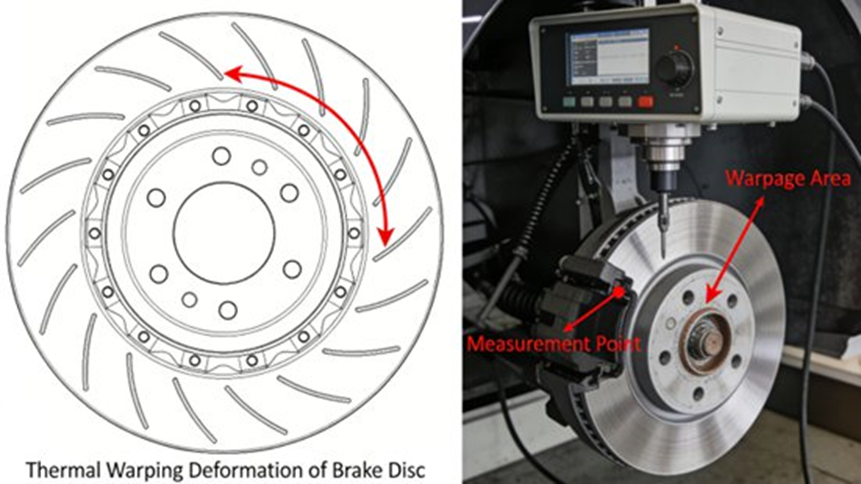
Brake parts rarely heat up evenly. This creates uneven stress. Once that stress passes the material’s limits, the parts bend out of shape.
- Disc Brakes: Ventilated discs expand in different directions at high heat. This causes warping. The brake pad no longer sits flat against the metal. Instead, it hits high spots, causing uneven pressure, low friction, and heavy steering wheel judder.
- Drum Brakes: Drums expand outward as they heat up. The gap between the drum and the brake shoe gets wider. You have to push the pedal closer to the floor just to get the same stopping power.
2.3 Friction Coefficient Decay
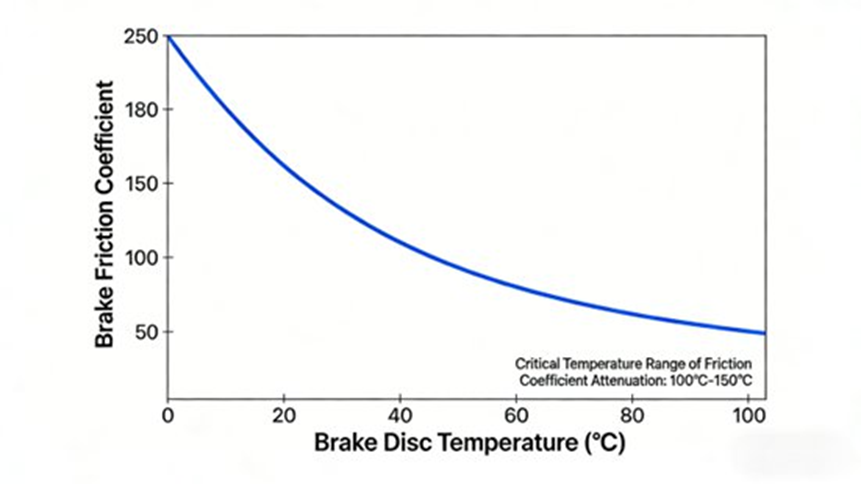
Your stopping power relies on the friction coefficient. This number changes wildly based on heat.
- Below 100°C: Friction stays stable. Brakes feel great.
- 100°C–150°C: Grip starts a slow decline.
- Over 150°C: The system enters a rapid decay phase.
- Over 300°C: The friction coefficient drops by over 50%.
Let’s look at a specific test. At a normal 30°C, braking efficiency hits 75%. But when the parts reach 200°C, efficiency falls to just 35%. High heat thickens oxide layers on the metal, softens the pad, and traps hot gases that push the pad away from the rotor.
2.4 Lubrication and Seal Failure
- Lubrication Loss: The grease inside caliper guide pins melts and degrades above 150°C. The pins stick, preventing the pad from clamping the disc tightly.
- Vapor Lock: Standard brake fluid boils near 200°C. Boiling creates gas bubbles in the brake lines. Since gas compresses (and liquid does not), your pedal feels spongy, or the brakes fail entirely.
- Seal Damage: High heat bakes the rubber seals, causing cracks and fluid leaks.
3. Key Factors That Change Thermal Performance
3.1 Brake System Parts
Friction Material Types:
- NAO (Non-Asbestos Organic): Works from room temp to 350°C. It handles heat poorly and fades easily. You see this on basic passenger cars.
- Semi-Metallic: Works well between 100°C and 600°C. It resists heat better with moderate fade.
- Ceramic: Handles 150°C to 500°C. It stays stable across all temps with very little fade.
- Sintered/Full Metal: Built for 300°C to 800°C+. It barely fades at all, making it perfect for race cars and heavy trucks.
Structural Design:
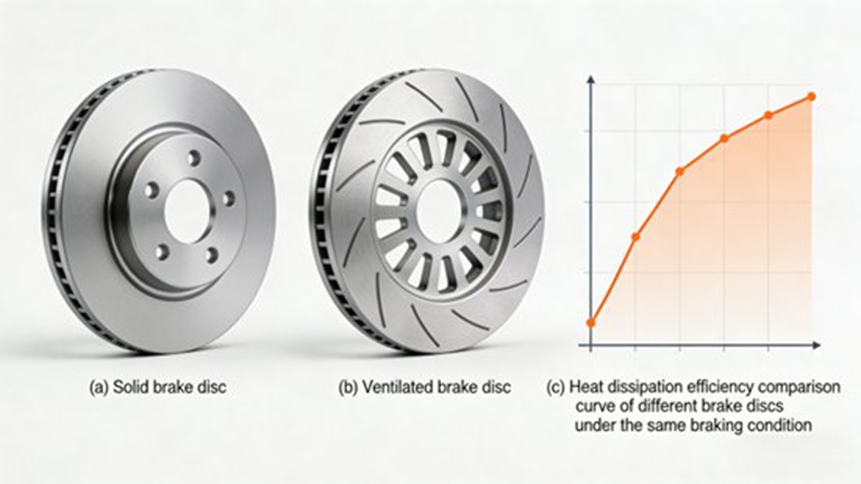
Disc brakes shed heat much faster than closed drum brakes. If you upgrade to ventilated brake discs, you increase the cooling surface area by 30%–50% over solid metal discs.
Brake Fluid:
The boiling point decides your vapor lock resistance. A basic DOT3 fluid boils around 205°C, while a high-performance DOT5.1 fluid handles over 260°C.
3.2 Driving Conditions
- Intensity and Frequency: We tested 10 consecutive emergency stops (100km/h down to 0 in 40m). Disc temps hit ~350°C, causing a 40% drop in stopping force. But when we added a 30-second cooling gap between stops, the force only dropped by 15%.
- Vehicle Load: A heavy truck hauling 120% of its rated limit down a mountain can push disc temps past 400°C. This causes a massive >50% force drop.
- Vehicle Speed: Stopping from 120km/h generates 4 times more heat than stopping from 60km/h. This speeds up thermal fade by about 30%.
- Road Conditions: Wet or icy roads offer less grip. Drivers press the pedal harder, creating sliding friction that builds excess heat.
3.3 Environmental Variables
- Outside Temperature: On a hot 35°C+ summer day, your cold brake discs already sit at 50°C–60°C. You will hit that dangerous 200°C fade limit much faster. Winter weather naturally cools the brakes and delays fade.
- Wind Speed: Driving at highway speeds improves air cooling by about ~40%, keeping heat from building up in the wheel wells.
4. Detection Methods and Evaluation Metrics
4.1 Testing Methods
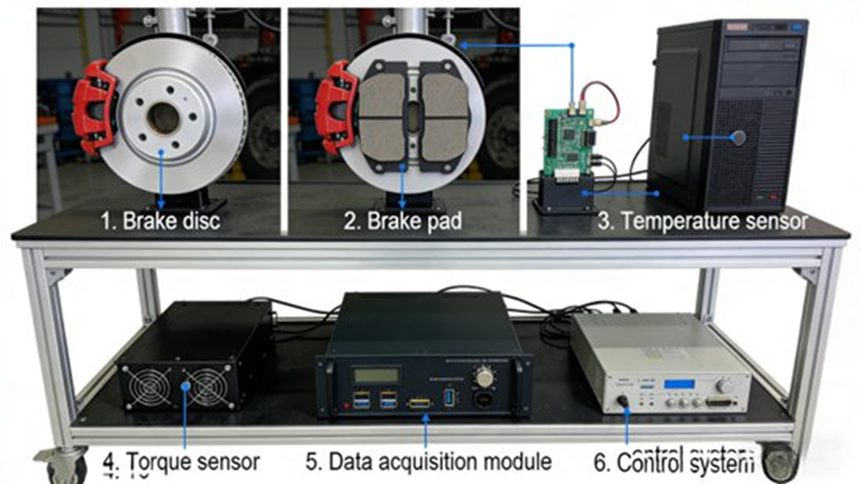
- Bench Testing: Engineers use Electrical Inertia Dynamometers in labs. These machines perfectly simulate vehicle weights and stopping speeds.
- Road Testing: We drive cars down real mountains (6%-10% grade, >5km long) at a steady speed (like 60km/h) to measure real-world pedal feel.
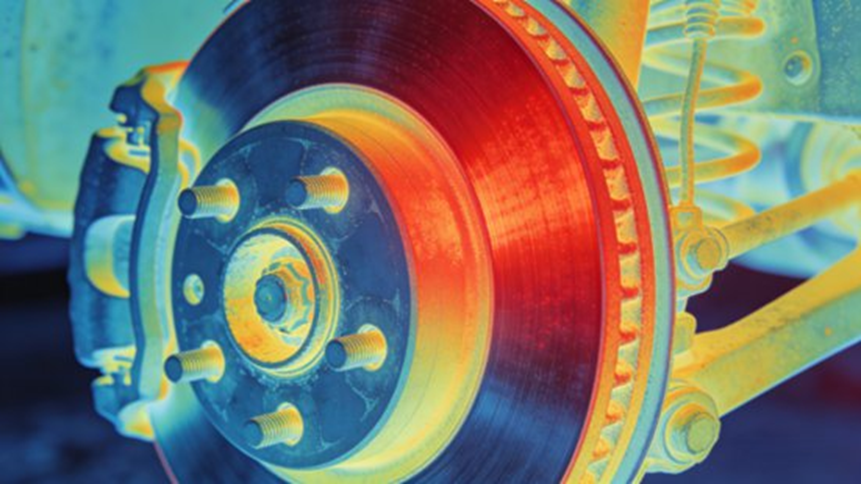
- Infrared Thermal Imaging: This camera setup shows exact temperature patterns without touching the car. It instantly highlights uneven hot spots.
4.2 Key Evaluation Metrics
- Thermal Fade Rate: (Post-fade force / Pre-fade force) × 100%. If this number drops below 70%, the brakes suffer from severe fade and need immediate fixing.
- Critical Fade Temperature: The exact point where friction drops by 15%. Expect 150°C–200°C for normal cars, and >250°C for heavy trucks.
- Braking Distance Growth Rate: The stopping distance should never grow by more than 30% when hot.
- Thermal Recovery Time: How fast the brakes cool down below the critical temp and regain 80% of their original stopping power.
5. How to Fix Thermal Fade
At Dowway Vehicle, we use a mix of specific upgrades to stop heat failure:
- Better Friction Pairs: We switch to high-thermal-conductivity discs (carbon-ceramic or aluminum alloy) and ceramic pads. We use polyimide resins and graphite/molybdenum sulfide modifiers to handle higher temps.
- Smarter Structures: We install ventilated discs with spiral cooling vanes and multi-piston aluminum calipers. We add cooling fins to drum brakes.
- Active Cooling: We use temperature-sensing fans that turn on at 150°C and turn off below 100°C. We also shape the car bumper to push cold air directly onto the wheels.
- Software Controls: We write ECU software that watches brake temps and changes pressure bias automatically. For electric vehicles, we rely heavily on regenerative engine braking to keep friction parts cool.
- Strict Maintenance: Change pads when they wear down to 3mm. Swap old fluid for DOT5.1. Keep guide pins greased and clean dirt off the rotors regularly.
6. Real-World Case Study: Testing a Compact Car
We wanted to prove these upgrades work. Our engineering team ran a dynamometer test on a standard compact car.
The setup: 1400kg rated load, solid cast iron front discs, rear drums, NAO pads, DOT4 fluid.
The test: 100km/h initial speed, 0.8g deceleration, 15 continuous stops with zero resting time.
The Baseline Results (Severe Fade)
- Temperatures: The disc shot from 25°C to a massive 385°C. The pads hit 320°C.
- Torque: Dropped from 2800 N·m to 1680 N·m. Fade Rate: 60% (Anything under 70% is a failure).
- Friction: Tanked from 0.42 to 0.18 (A huge 57.1% decrease).
- Distance: Grew from 42m to 63m (A 50% increase, well over the safe 30% limit).
- IR Imaging: Massive uneven heat spots with an 85°C difference across the disc surface.
The Optimized Results (Safe and Stable)
We changed the parts. We installed ventilated aluminum composite discs, ceramic pads, DOT5.1 fluid, and an active cooling fan. We ran the exact same 15-stop test.
- Temperatures: The disc only reached 265°C (a 31.2% drop). The pads hit 210°C (a 34.4% drop).
- Torque: Dropped from 2950 N·m to a safe 2419 N·m. Fade Rate: 82% (Well above the 70% pass mark).
- Friction: Only dropped from 0.45 to 0.33 (A manageable 26.7% decrease).
- Distance: Extended from 40m to 48m (A 20% increase, keeping it safely under the 30% limit).
- IR Imaging: Smooth, even heat. The hottest and coldest spots only differed by 35°C.
7. The Bottom Line
Heat drives brake fade. The danger zone usually starts between 150°C and 200°C. When you understand how materials break down, metal warps, and fluid boils, you can fix the problem. As our lab data shows, swapping out basic parts for ventilated discs, ceramic pads, and high-temp fluid keeps vehicles safe.
Looking forward, engineers will lean on AI to predict heat limits in real time. We will see more 3D-printed composite brakes and software that links mechanical brakes tightly with EV motors.
8. Frequently Asked Questions (FAQ)
Q: What is brake thermal analysis and why do we need it?
A: This analysis tracks how brake systems generate heat and how that heat escapes into the air. Brakes stop cars by turning motion into heat. Too much heat ruins performance, melts parts, and causes brake fade. We use this data to pick better materials and design safer cars.
Q: What methods do engineers use to analyze brake heat?
A: We use a few main tools:
- Finite Element Analysis (FEA): Maps exact temperatures and stress points on digital brake models.
- Computational Fluid Dynamics (CFD): Tracks how air flows around the wheel to cool the brakes.
- Transient Simulation Tools: Calculates heat buildup over time during repeated stops.
- Lumped-Parameter Models: Quick math formulas used early in the design phase.
Q: What physical events happen during this analysis?
A: We track four main events:
- Heat Generation: The exact moment the pad grabs the spinning disc.
- Transient Heat Transfer: How heat travels deep into the metal parts over time.
- Heat Dissipation: How the metal throws heat outward into the air.
- Thermal Deformation: How the metal bends and expands when it gets hot.
Q: What causes brake fade and how does testing stop it?
A: Brake fade happens when hot pads lose their physical grip on the disc, or when boiling brake fluid fills your brake lines with gas. Lab testing predicts exact temperature spikes. Once we know when the brakes will get too hot, we change the design to keep the temperature below that breaking point.
Q: How do different materials change heat behavior?
A: The metal and pads you choose change everything:
- Material Properties: High conductivity materials push heat away from the friction surface fast, dropping peak temperatures.
- Ventilated Rotors: Adding holes or vanes pulls cold air through the metal.
- Ceramic Materials: These resist high heat incredibly well but require special cooling setups because they handle heat transfer differently than iron.
