


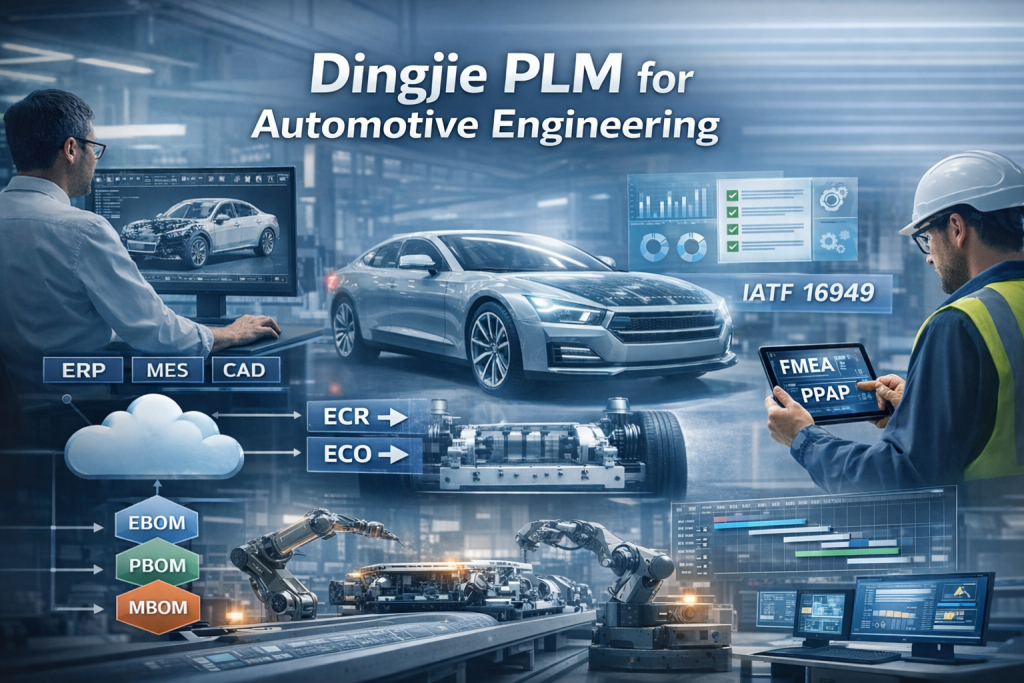
< Back to Data Management System
Author: Johnny Liu, CEO at Dowway Vehicle
Published: March 11, 2026
Content Type: Cluster page
Content Goal: Explain how Dingjie PLM (Chinese Version) supports automotive engineering from requirements and design to process planning, production coordination, compliance control, and long-term digital management.
Author Note
Johnny Liu is the CEO at Dowway Vehicle. His work focuses on vehicle programs, manufacturing coordination, digital engineering systems, and practical ways to connect product development with factory execution. This article is written from an industry operator’s point of view, with close attention to how PLM tools are used in real automotive engineering environments.
Table of Contents
Why This Topic Matters
Automotive companies are under heavy pressure. Product updates move faster. Customer demand is more varied. Quality rules are stricter. Supply chains are more complex. Electric, smart, and connected vehicles also add new layers of design and software work.
A single intelligent electric vehicle can contain more than 30,000 parts. That level of complexity puts pressure on engineering teams, process teams, quality teams, and suppliers. When data is split across folders, systems, and departments, the result is usually delay, rework, and weak traceability.
That is where PLM comes in. PLM is not only a document vault. In automotive work, it serves as the data center and the process engine for the product lifecycle. It links concept work, engineering development, pilot runs, mass production, and product retirement. In this article, the focus is Dingjie PLM for Automotive Engineering, with close attention to its architecture, modules, automotive fit, and field results.
Introduction to Dingjie PLM in the Automotive Toolchain
The automotive sector is changing fast. Electrification, intelligence, and connectivity are changing vehicle design, supply chain planning, and validation work. At the same time, product cycles are shorter, custom variants are growing, and customers expect higher quality with lower delay.
Traditional automotive R&D models often struggle in this environment. Common problems include:
- scattered data storage
- disconnected processes
- slow information transfer
- weak change closure
- version confusion
- limited cross-team transparency
These issues cut efficiency and push up rework. They also raise compliance risk. For electric vehicles and smart connected vehicles, the old way of managing product data and process flow no longer works well enough.
PLM, or Product Lifecycle Management, sits at the center of the automotive toolchain. It carries two jobs at once. First, it acts as a data hub for product structures, files, records, and versions. Second, it acts as a workflow engine for approvals, handoffs, reviews, and traceability across the full lifecycle.
Dingjie PLM (Chinese Version) was built with this reality in mind. The report describes it as a system that is not overloaded with generic PLM features that do not match automotive work. Instead, it is tuned to automotive pain points and gives companies a more standardized, digital, and integrated way to manage product work. This is especially clear in the auto parts sector, where market fit and delivery results are strong. In practice, the platform helps companies move from experience-led decisions to data-led decisions.
What Is Dingjie PLM (Chinese Version)?
Dingjie PLM (Chinese Version) is a product lifecycle management platform built on Dingjie’s long manufacturing background. The report states that this background covers more than forty years of industrial work. That matters because automotive companies do not need a PLM system that only looks good on paper. They need a system that matches the daily reality of engineering, process planning, production, supplier coordination, and quality control.
The platform is deeply adapted to IATF 16949 requirements and connects major automotive business processes such as APQP, PPAP, and FMEA. It links the full chain from:
- requirement definition
- R&D and design
- process planning
- production work
- supply chain collaboration
That gives automotive teams one connected management framework rather than a collection of isolated tools.
The report also presents Dingjie PLM as a tool that supports automotive digital transformation in a practical way. It focuses on standardizing development data, speeding up collaboration, and keeping compliance work active in day-to-day operations instead of treating it as a separate audit task.
Core Technical Architecture of Dingjie PLM
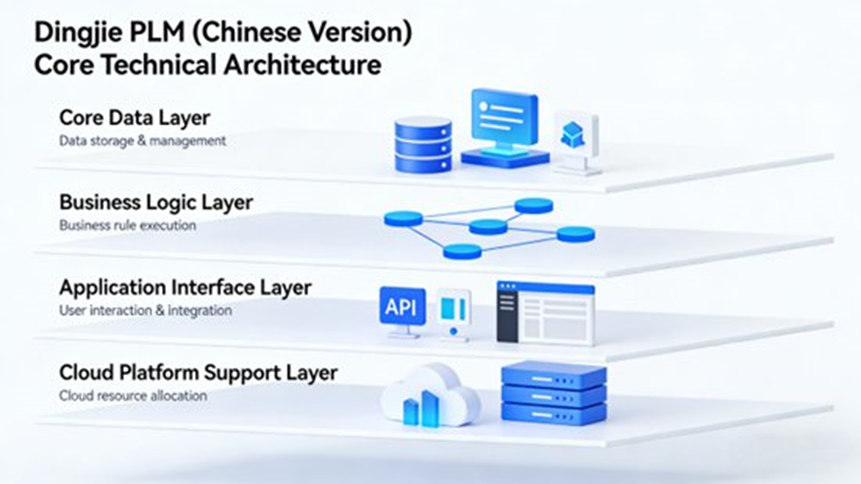
Dingjie PLM uses a cloud-native and microservices-based architecture built on an industrial internet platform. The report names three core technical traits:
- high availability
- strong scalability
- flexible customization
These traits matter because automotive companies often run across multiple sites, multiple engineering teams, and multiple supply chain partners. A single product program may involve design teams, process planners, production units, quality groups, and outside suppliers working at the same time.
The system also supports integration with:
- ERP
- MES
- SRM
- APS
This makes it possible to build one digital environment that links R&D, production, and supply chain. According to the report, the architecture is organized into four layers. Each layer supports the next and keeps data movement fast, secure, and traceable.
Infrastructure Layer
The infrastructure layer supports the whole system. It includes hardware resources, the operating system, the database, and middleware. It uses a distributed deployment model, which lets companies support users across regions and devices.
Automotive development creates a huge amount of data, including:
- 3D models
- engineering drawings
- process files
- test reports
To store this data, Dingjie PLM uses a Distributed File System (DFS). DFS makes distributed storage and backup possible, which supports both data safety and access speed.
The system supports both Oracle and MySQL databases. This dual adaptation helps with high-volume queries and transaction handling. It is also suited to high concurrency, which is common in automotive R&D where many users may work at once. The report notes that transmission delay is controlled at the second level, supporting timely data exchange during engineering work.
Core Technology Layer
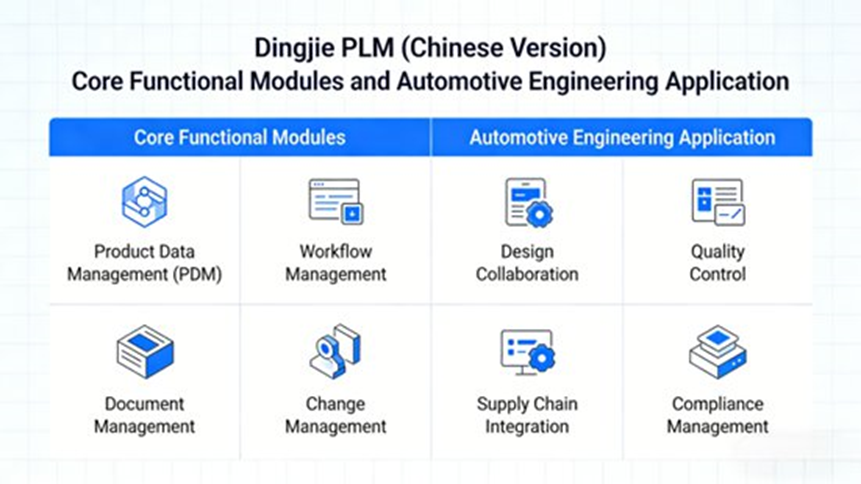
The core technology layer contains the main technical strengths of the platform. The report highlights four areas.
1. Data Modeling Technology
This supports multi-dimensional modeling of automotive products and processes, including:
- product structure modeling such as BOM
- workflow modeling
- permission modeling
This makes it possible to map the full automotive development and manufacturing flow in a detailed way. It is also well suited to modular design and large-scale custom production in auto parts and vehicle programs. Another point in the report is that this layer helps move material reuse and preferred material selection earlier into the process.
2. Collaboration Technology
Dingjie PLM uses WebDAV protocol and real-time communication technology for cross-team collaboration. It supports online preview, markup, and revision of design files. This is useful in automotive programs where mechanical, electronic, and software teams need to work together. The report states that it can reduce cross-discipline coordination time by more than 50%.
3. Change Management Technology
The system uses a closed-loop change management mechanism and includes ECR and ECO management modules. It controls the full process of:
- change request
- review
- execution
- validation
- archiving
This helps keep change information accurate, timely, and traceable. It also reduces rework and production loss caused by uncontrolled changes.
4. Interface Integration Technology
The platform provides standardized APIs and supports integration with major automotive toolchain software, including:
- CATIA
- UG
- AutoCAD
- ANSYS
- ABAQUS
- ERP systems
- MES systems
This supports common data and connected workflows from design through production operations, which cuts down information silos.
Functional Application Layer
The functional application layer is built around the full automotive lifecycle. It includes modules for:
- requirements management
- R&D and design management
- process management
- production collaboration
- compliance management
These modules can be deployed on their own or combined as needed. That makes the system suitable for different sizes of automotive company, including OEMs and parts manufacturers. The report also notes that this layer is tuned to automotive standards and practices, especially IATF 16949, PPAP, and FMEA, so business flow is more standardized and more digital.
Presentation Layer
The presentation layer uses a Chinese-language visual interface designed for local automotive users. It supports:
- web access
- client access
- mobile access
It also supports custom dashboards that show:
- R&D progress
- process status
- data statistics
This helps managers track project status in real time and helps engineers find needed data faster. The report also points out support for paperless workshop management, where engineering drawings and process documents are issued electronically and viewed through scanning. That lowers operating cost and improves work on the shopfloor.
Core Functional Modules and Automotive Engineering Applications
The report groups the main business functions around four core scenarios in automotive work:
- R&D
- process planning
- production
- compliance
Below is a detailed review of each major module and its engineering use.
Product Structure and BOM Management Module
Automotive products are structurally complex. A vehicle includes body, chassis, powertrain, electronic and electrical systems, and many connected sub-systems. Because there are so many parts, BOM accuracy and consistency affect the whole chain from design to purchasing to manufacturing.
Dingjie PLM’s product structure and BOM management module is optimized for this reality.
Multi-View BOM Management
The system supports linked management of:
- Engineering BOM (EBOM)
- Process BOM (PBOM)
- Manufacturing BOM (MBOM)
It can automatically convert EBOM into PBOM and MBOM, which reduces manual entry errors and keeps data consistent. The report gives a vehicle body development example. After the design team builds the EBOM, the system sends it to process planning. The process team then builds PBOM based on the EBOM and defines processing steps and assembly order. That information is then sent to production to create MBOM for material picking and assembly. The report states that this can cut the BOM preparation cycle from three days to one hour.
BOM Version Management
The system supports creation, revision, archiving, and rollback of BOM versions. It records each change with:
- reason for change
- changed content
- responsible person
This helps teams trace version history and compare revisions during vehicle facelift projects or component redesign. The report notes that this reduces version confusion and can lower wrong-drawing use by more than 5%.
Parts Standardization Management
Dingjie PLM supports a standardized parts library that includes:
- common parts
- standard parts
- special-purpose parts
Engineers can search, reuse, and select preferred parts more easily. This improves design stability and lowers both design and production cost. The module also supports part substitution management, which helps companies respond when materials are short or supply problems appear.
R&D Design Collaboration Management Module
Automotive development requires many disciplines to work together. Traditional methods such as email or shared folders usually create delay, weak version control, and poor visibility.
Dingjie PLM provides one collaboration platform for cross-team and cross-discipline work.
Online Collaborative Design
The system supports integration with major CAD tools such as CATIA and UG. Engineers can open and edit design files through the PLM environment. Multiple engineers can mark up and revise the same design dataset, and the system records who changed what.
The report uses a new energy vehicle three-electric system example. Electrical and mechanical engineers can work together on battery pack, motor, and electronic control data in real time. This solves many coordination problems and can improve derivative design efficiency by more than 60%.
Design Review Management
The platform includes a standardized design review flow. It supports:
- review task assignment
- review notification
- review execution
- online comment submission
- progress tracking
- archiving of records
In automotive parts development, this lets design, process, and quality teams review work together and catch defects earlier before they flow into later stages.
Document Management
The system stores and manages all major engineering documents in one place, including:
- 3D models
- 2D drawings
- technical specifications
- test reports
It supports classification, permission control, and preview of more than 100 file formats. This supports both safety and easy access. It also supports electronic issue and QR-code lookup of documents so production staff can scan and retrieve the latest drawings. The report states that this improves drawing query and distribution efficiency on the production floor by more than 50%.
Engineering Change Management Module
Automotive development includes frequent changes. Customer requests change. Design defects are found. Processes are adjusted. Parts are replaced. Without strict control, these changes create delay, rework, scrap, and production confusion.
Dingjie PLM uses a closed-loop engineering change management approach built for strict automotive needs.
Change Initiation and Review
The process starts with online creation of an Engineering Change Request (ECR). The request records:
- reason for change
- change content
- scope of influence
The system then sends the ECR to related departments such as design, process, production, and purchasing for review. Reviewers submit comments online, and the system collects the results to decide whether the change should proceed.
Change Execution and Tracking
After approval, the system generates an Engineering Change Order (ECO). The ECO is sent to responsible people with clear execution tasks and deadlines. After work is completed, results are submitted through the system. Progress is tracked in real time.
The report gives an example from engine component development. A design defect triggers a change request. After review and approval, the platform sends updated change information to process and production teams so the shopfloor uses the latest design data. In that example, change processing time drops from 3–5 working days to 0.5–1 working day.
Change Traceability
The system records the full change history, including:
- initiation time
- review comments
- execution result
- responsible people
This helps with later audits and problem checks and also supports IATF 16949 expectations for controlled change records.
Compliance Management and FMEA Module
Automotive quality control is strict. Companies need to meet IATF 16949, support PPAP, and carry out FMEA in a structured way. Dingjie PLM includes a built-in compliance module to support this work inside daily operations.
IATF 16949 System Support
The system includes process templates and form templates based on IATF 16949 requirements. It supports management of audits, audit results, and corrective actions so companies can keep engineering and production work in line with the quality system.
FMEA Management
The platform integrates:
- DFMEA for design failure mode analysis
- PFMEA for process failure mode analysis
This helps teams identify possible failure modes early in development and define preventive and corrective actions. The report gives an automotive electronics example where DFMEA helps identify possible failure risks in electronic components and supports design improvements for better product reliability.
PPAP Management
The system supports preparation, submission, review, and archiving of PPAP files. The report states that it covers all 18 PPAP requirements. This makes PPAP flow more standardized and helps parts suppliers meet OEM approval rules for production parts.
Project Management Module
Automotive development projects are long, complex, and resource-heavy. Project control affects both schedule and cost. Dingjie PLM includes a project management module built around the IPD method.
Project Plan Management
The system supports:
- project planning
- plan breakdown
- execution control
- tracking
- milestone definition
- role assignment
- schedule control
It can warn users about delayed tasks and help keep programs moving on time. The report gives a new vehicle development example where the project is divided into concept design, engineering development, trial production, and mass production stages, with tasks and owners defined for each stage. According to the report, this can shorten new vehicle development cycle time by more than 25%.
Resource Load Analysis
The platform supports load analysis for:
- personnel
- equipment
- materials
This helps companies distribute resources more reasonably and avoid both idle capacity and overload.
Deliverable Management
The system also controls deliverables for each stage, such as:
- design files
- test reports
- review records
It tracks completion and completeness so programs do not move forward with missing outputs. The report states that this can raise development document completeness to 96%.
Adaptation Advantages of Dingjie PLM in Automotive Engineering
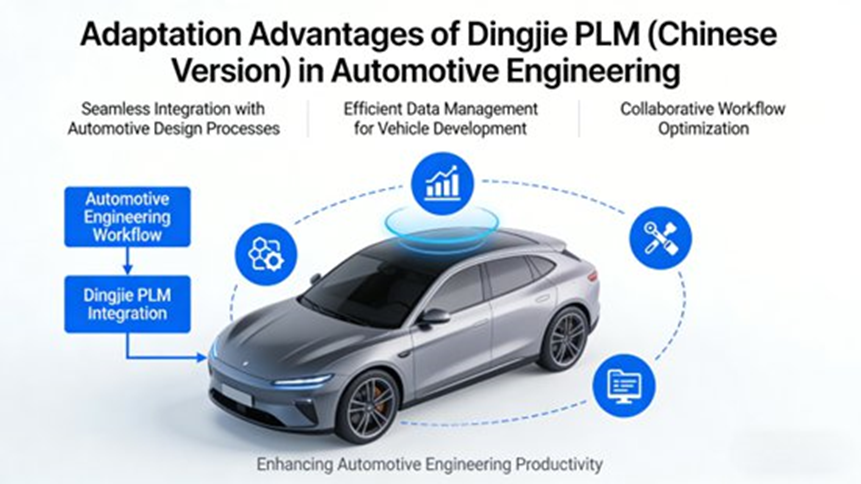
Compared with generic PLM systems, Dingjie PLM is described in the report as having stronger automotive fit in three areas:
- technical fit
- functional fit
- industry fit
Technical Adaptation Advantages
Dingjie PLM uses a cloud-native architecture and distributed deployment, which suits multiple sites and multiple engineering teams. It handles large amounts of engineering data quickly and supports many concurrent users during R&D work.
The platform’s standardized APIs also support smooth integration with automotive toolchain software such as CAD, CAE, ERP, and MES. This supports common data, linked processes, and an integrated digital environment across R&D, production, and supply chain.
The report also notes support for local trusted IT ecosystem adaptation, which is important for some higher-end automotive enterprises with localization requirements. The system is expandable and can be tailored as business needs grow.
Functional Adaptation Advantages
Dingjie PLM focuses on the real pain points of automotive engineering instead of filling the system with functions that do not see daily use. The report points to several examples:
- multi-view BOM linkage solves BOM inconsistency
- closed-loop engineering change solves uncontrolled change flow
- FMEA and PPAP modules support compliance work
- paperless workshop management lowers operating cost and improves floor execution
The Chinese-language interface also matches local user habits. That lowers training burden and helps raise user adoption. Daily work can be handled without relying on a large internal IT team.
Industry Adaptation Advantages
Dingjie PLM is deeply adapted to IATF 16949 and includes built-in process templates and forms for automotive work. Its function set covers both complete vehicle programs and parts development projects, so it is useful for both OEMs and component suppliers.
The report also states that Dingjie has more than forty years of manufacturing background and that in 2024 it held 7.9% market share and ranked first in the IDC PLM market share for the equipment manufacturing segment. The company has worked with many automotive parts enterprises and has built up strong practical experience, which helps it respond quickly to customer-specific needs and deliver custom work and technical support.
Practical Automotive Engineering Case
The report includes a case from a domestic mid-sized automotive parts company. The company mainly supplied:
- engine parts
- chassis parts
It faced several problems before the PLM project began:
- scattered R&D data
- low collaboration efficiency
- uncontrolled engineering changes
- weak compliance management
- long development cycles
- high rework rate
- high operating cost
To fix these problems, the company introduced Dingjie PLM (Chinese Version) and built one unified product lifecycle management platform. After six months of implementation and improvement, the company moved to digital control across R&D, process planning, production, and compliance work.
Measured Results
R&D efficiency improved
The collaboration module reduced problems in multi-discipline coordination. Average R&D cycle time fell by 23%, and derivative product development improved even more. Parts reuse rose by 71%, which cut repeat design work and lowered development cost.
Data consistency improved
The linked management of EBOM, PBOM, and MBOM raised BOM accuracy from 85% to 99.5%. Production rework caused by BOM errors fell, and workshop error rate dropped by more than 50%.
Change management became more controlled
With closed-loop engineering change management, change execution rate rose from 70% to 98%, and change traceability reached 100%. This reduced production loss caused by uncontrolled changes and raised change handling efficiency by more than 70%.
Compliance reached target level
The compliance module standardized IATF 16949, FMEA, and PPAP management, and the company passed OEM compliance review successfully.
Operating cost dropped
Through parts standardization and paperless workshop management, material waste and office cost went down. IQC incoming inspection efficiency rose by 20%, and reporting and warehousing efficiency rose by 50%. Overall operating cost dropped by more than 15%.
This case shows that Dingjie PLM can solve the core pain points of automotive parts suppliers and raise efficiency, cut cost, and protect quality in practical settings.
Business Value of Dingjie PLM in Automotive Digital Transformation
When the report is viewed as a whole, the business value is clear.
Dingjie PLM helps companies shorten development cycles by reducing manual transfer, repeated entry, and waiting between departments. It improves data consistency through structured BOM linkage and centralized file control. It keeps change flow disciplined through full ECR and ECO tracking. It supports quality system work by turning IATF 16949, FMEA, and PPAP into daily controlled processes. It also lowers operating cost through standardization, reuse, and paperless management.
For automotive OEMs and parts suppliers, these gains matter because digital transformation is not only about installing software. It is about making engineering work faster, cleaner, more traceable, and easier to control at scale.
Future Outlook for Dingjie PLM in the Automotive Industry
The report closes with a forward view of where automotive PLM is heading. As electrification, intelligence, and connectivity continue to grow, vehicle development will become more complex. That means PLM systems will also need to do more.
Dingjie PLM is expected to keep growing with newer technologies such as:
- artificial intelligence
- big data
- industrial internet technologies
The report also points to deeper application in key automotive areas such as:
- new energy vehicle three-electric systems
- smart cockpit development
The direction is toward smarter collaboration, tighter data control, more routine compliance work, and deeper integration with the automotive toolchain. This gives the platform room to support the next stage of digital engineering in the vehicle industry.
Top 5 Automotive PLM FAQs (Based on Dingjie PLM Engineering Applications)
1. How does the PLM system handle complex automotive BOMs (EBOM, PBOM, MBOM) to ensure cross-departmental data consistency?
Short answer: It links EBOM, PBOM, and MBOM inside one multi-view BOM structure and automates the handoff between them.
Modern vehicles can contain more than 30,000 parts, so moving from engineering structure to process structure and then to manufacturing structure is difficult if teams work in separate systems. Dingjie PLM handles this through its multi-view BOM management module. It supports automatic conversion from EBOM to PBOM and MBOM, which cuts manual re-entry and lowers the chance of version mismatch.
This linked method gives design, process, and production teams one connected data chain. The report states that this can reduce BOM preparation time from several days to about one hour, while also improving consistency across departments.
2. What is the best way to integrate a PLM system with CAD tools and ERP/MES platforms to remove information silos?
Short answer: Use a PLM platform with standard APIs, direct CAD support, and live online collaboration tools.
Cross-team coordination often breaks down when design files, process records, and production data are stored in separate systems. Dingjie PLM uses a cloud-native and microservices architecture plus standardized APIs to connect with major CAD and CAE tools such as CATIA, UG, ANSYS, and ABAQUS, along with business systems such as ERP and MES.
It also uses WebDAV and real-time communication for online preview, markup, and revision. Engineers from different functions can work on shared data in the same environment, and the report says this can reduce cross-department communication time by more than 50%.
3. How can an automotive company automate Engineering Change Management to reduce delay and rework?
Short answer: Put ECR and ECO into one closed-loop digital workflow with review, execution, and traceability built in.
Changes happen often in automotive engineering. They can come from customer requests, design corrections, process updates, or material replacement. Dingjie PLM manages this through a closed-loop engineering change management system. It digitizes the full path from Engineering Change Request (ECR) to Engineering Change Order (ECO).
The system records the reason, scope, review comments, execution work, result, and owner of each change. It also pushes approved updates to the right departments so production does not continue with outdated data. In the report, this reduced change handling time from 3–5 working days to less than one working day.
4. Does the PLM software support automotive compliance standards such as IATF 16949, FMEA, and PPAP right away?
Short answer: Yes. Dingjie PLM includes built-in templates and workflows for these automotive quality requirements.
Compliance is a daily operating need in the automotive supply chain. Dingjie PLM includes a dedicated compliance module adapted to IATF 16949. It supports audit records, corrective actions, and standard process control.
It also includes management support for:
- DFMEA
- PFMEA
- PPAP
The report states that the PPAP module covers all 18 PPAP requirements, which helps tier suppliers prepare files, submit them, complete reviews, and meet OEM production approval rules more smoothly.
5. Is a cloud-native PLM architecture fast and secure enough for multi-site automotive engineering and supply chain work?
Short answer: Yes. Dingjie PLM is built for distributed deployment, large engineering files, and concurrent users across sites.
Automotive enterprises often run across several R&D centers, plants, and suppliers. Dingjie PLM supports this with a Distributed File System (DFS) and dual database support for Oracle and MySQL. This setup is suited to high-volume files such as 3D models, drawings, process files, and test reports.
The report states that the system can handle large-scale data and multi-user concurrency while keeping transmission delay at the second level. That makes it suitable for geographically distributed engineering and manufacturing teams.
Conclusion
Dingjie PLM (Chinese Version) is presented in the report as a practical automotive PLM platform built around the actual needs of vehicle and parts development. Its value comes from the full combination of architecture, function, and industry fit.
Across the report, the main strengths are clear:
- cloud-native and microservices architecture
- four-layer technical structure
- distributed storage and Oracle/MySQL support
- detailed data modeling and permission control
- WebDAV-based collaboration
- standard API integration with CAD, CAE, ERP, MES, SRM, and APS
- full product lifecycle application support
- localized visual interface and paperless workshop access
- linked EBOM, PBOM, and MBOM control
- BOM version traceability
- parts standardization and substitution management
- collaborative design and structured design review
- centralized multi-format document management
- closed-loop ECR and ECO control
- built-in IATF 16949, DFMEA, PFMEA, and PPAP support
- IPD-based project planning, resource analysis, and deliverable control
- technical, functional, and industry adaptation for automotive use
- a measured implementation case with clear gains in cycle time, BOM accuracy, traceability, compliance, and cost
The report also makes it clear that Dingjie PLM is not limited to current workflows. It is positioned to grow with AI, big data, industrial internet technologies, new energy vehicle systems, and smart cockpit development.
For companies that need stronger product data control, faster engineering collaboration, cleaner change flow, and more reliable automotive compliance, Dingjie PLM is a serious topic worth close attention.
