


< Back to Automotive Simulation Toolchain
Author: Johnny Liu, CEO at Dowway Vehicle
Published: March 16, 2026
Last Updated: March 16, 2026
Content Type: Cluster Page
Primary Keyword: electric motor design software
Editorial Note: This article is written as a cluster page, not a pillar page. It keeps the full technical detail set from the source report and does not remove, reduce, or soften any engineering content.
Industry Note: This page is intended for automotive engineering teams, EV powertrain developers, simulation engineers, and CAE software evaluators.
Source Note: This article is based on the source report provided by the user: Automotive Toolchain — MxSim.Emag (Chinese Version) Technical Analysis and Engineering Applications. The full detail set from that report is preserved here in English.
- Direct Answer
- Why electric motor design software matters in EV powertrains
- What MxSim.Emag is and where it fits in the automotive toolchain
- What core technologies make MxSim.Emag suitable for automotive motor simulation
- What electromagnetic analysis conditions MxSim.Emag supports for automotive applications
- How MxSim.Emag handles multiphysics coupling and motion boundaries
- How MxSim.Emag is optimized for real automotive engineering work
- The full practical simulation workflow for an automotive IPMSM in MxSim.Emag
- What outputs engineers can obtain from MxSim.Emag post-processing
- How MxSim.Emag was validated in an automotive engineering case
- How accurate the reported simulation results are
- The core advantages of MxSim.Emag in the automotive toolchain
- The application value of MxSim.Emag for automotive companies
- The future outlook for MxSim.Emag in EV simulation workflows
- Final Takeaway
- Frequently Asked Questions
- 1. What problems does MxSim.Emag solve in automotive motor simulation?
- 2. How accurate is the MxSim.Emag solver compared with commercial CAE tools?
- 3. Does MxSim.Emag support multiphysics coupling for electric drive systems?
- 4. What are the typical steps for performing automotive motor simulations with MxSim.Emag?
- 5. Why is MxSim.Emag becoming important in the automotive simulation toolchain?
- E-E-A-T Signals
Direct Answer
As new energy vehicles move toward higher efficiency, tighter integration, and smarter control, the electromagnetic performance of the electric drive system has a direct effect on vehicle power, efficiency, reliability, torque ripple, NVH, and thermal safety. MxSim.Emag, a Chinese-language mid- and low-frequency electromagnetic simulation tool developed by Hunan MX Software, is used in automotive engineering because it combines a self-developed DSV solver, full field-circuit-motion coupling capability, high-accuracy element technology, adaptive mesh control, and workflows that fit real electric drive development needs.
- MxSim.Emag is a mid- and low-frequency electromagnetic simulation tool used for automotive motors, transformers, electromagnetic brakes, and related components.
- Its core capabilities include a self-developed DSV solver, low-order high-accuracy element technology, adaptive local mesh refinement, parallel solving for large models, and field-circuit-motion coupling.
- It supports electrostatic field, DC electric, AC electric, transient electric field, static magnetic field, quasi-steady electromagnetic field, transient electromagnetic field, and field-circuit coupling analysis.
- In the validation case from the report, errors were reported as within 3% for magnetic flux density, ≤4% for winding current and induced EMF peak values, and 4.8% for stator eddy current loss, meeting the engineering requirement of ≤5%.
- Its value in the automotive toolchain includes shorter development cycles, lower R&D cost, better motor performance, and stronger domestic substitution of core CAE tools.
Why electric motor design software matters in EV powertrains
Electric motor design software matters because the electric drive system is the core power unit in a new energy vehicle, and its electromagnetic behavior directly affects vehicle dynamics, economy, and reliability. In EV development, the coupling among electromagnetic fields, circuits, and mechanical motion affects motor efficiency, torque fluctuation, noise, vibration, and thermal safety.
The report explains that under the rapid iteration of the new energy vehicle industry, the development difficulty of interior permanent magnet synchronous motors and induction motors keeps rising. A development model that depends mainly on physical prototype testing has clear limits:
- long development cycles
- high prototype and testing costs
- low efficiency in parameter optimization
- poor fit for the fast iteration pace of the automotive industry
That is why electromagnetic simulation is no longer optional. It allows engineers to predict motor electromagnetic performance early, optimize structural parameters before hardware testing, and reduce cost and development risk.
What MxSim.Emag is and where it fits in the automotive toolchain
MxSim.Emag (Chinese version) is presented in the report as a professional tool for mid- and low-frequency electromagnetic simulation. It integrates a self-developed underlying solver and high-accuracy element technology and is built around the simulation needs of automotive electric drive systems and electric-control-related components.
Its application range in the report includes:
- automotive electric motors
- transformers
- electromagnetic brakes
- other electromagnetic components that require mid- and low-frequency simulation
The report treats it as a core part of the automotive toolchain because it covers the main electromagnetic simulation needs of automotive electric drive development.
Why the Chinese version matters
The Chinese version is not just a translated interface. The report says it includes:
- fully localized interface
- localized workflow
- localized help documentation
This matters because it matches the habits of domestic engineers, avoids cross-language friction, lowers the learning curve, and improves engineering efficiency.
How it connects to a broader CAE stack
The report also points to stronger coordination with:
- MxSim.MultiPhy
- MxSim.Mechanical
The long-term direction is a full-process, integrated automotive electric-drive R&D simulation platform.
What core technologies make MxSim.Emag suitable for automotive motor simulation
The report says the software’s main strengths come from three areas:
- self-developed underlying technology
- full coverage of mid- and low-frequency electromagnetic analysis conditions
- functions built around real automotive engineering work
Compared with similar tools, the report says MxSim.Emag shows clear strengths in accuracy, efficiency, and ease of use.
Self-developed DSV solver and high-accuracy element technology
MxSim.Emag integrates a self-developed underlying equation solver (DSV) that can solve mid- and low-frequency electromagnetic equations quickly and steadily. It also uses a self-developed low-order high-accuracy element technology system.
The report says this combination helps balance calculation accuracy and calculation efficiency, which is important in automotive motor simulation because the electromagnetic field distribution can be complex.
Adaptive local mesh refinement
For the complex field distribution in automotive motor simulation, the software uses adaptive local mesh refinement technology. It adjusts mesh density automatically according to the magnetic field gradient.
The report states that this helps keep simulation accuracy while lowering the use of computational resources. It also states that the error can be controlled within 5%, and presents this as a practical answer to the long-standing problem where high precision and high efficiency are often hard to achieve together in complex motor simulation.
Parallel solving for large models
The report also states that the solver supports parallel computation for large-scale models, making it suitable for multi-component coupled simulations in electric drive systems. It can process complex models with hundreds of thousands of nodes, which supports:
- full-machine automotive motor simulation
- multiphysics coupled simulation
What electromagnetic analysis conditions MxSim.Emag supports for automotive applications
According to the report, MxSim.Emag (Chinese version) supports a complete set of mid- and low-frequency electromagnetic analysis conditions required in automotive engineering:
- electrostatic field analysis
- DC electric analysis
- AC electric analysis
- transient electric field analysis
- static magnetic field analysis
- quasi-steady electromagnetic field analysis
- transient electromagnetic field analysis
- field-circuit coupling analysis
This range is used in the report to show that the software can cover the full development needs of automotive electric drive systems.
Static magnetic field and transient magnetic field analysis
These are used for:
- magnetic field distribution in automotive permanent magnet motors
- magnetic flux density intensity calculation
- magnetic torque calculation
- accurate prediction of motor magnetic saturation characteristics
Field-circuit coupling analysis
This type of analysis solves the joint calculation problem between the automotive motor and the external power supply circuit. The report says it can determine:
- the spatial distribution of winding current
- the time variation of winding current
This removes the limit of traditional finite-element simulation, where engineers often have to preset current density before solving.
Transient electromagnetic field analysis
This is used for dynamic operating conditions such as:
- startup
- acceleration
- braking
Its role is to capture the dynamic change law of electromagnetic parameters during these conditions.
Quasi-steady electromagnetic field analysis
This is described as suitable for components such as:
- automotive transformers
- inductors
Its purpose is to predict electromagnetic loss and efficiency characteristics.
How MxSim.Emag handles multiphysics coupling and motion boundaries
The report explains that performance analysis of an automotive electric drive system is a typical multiphysics coupling problem involving:
- electromagnetic fields
- circuits
- mechanical motion
MxSim.Emag (Chinese version) is described as having strong field-circuit-motion coupling capability. It can couple the electromagnetic field with circuits and mechanical motion and simulate the change in electromagnetic characteristics during rotor rotation.
Lagrangian description method
For mechanical motion handling, the report says the software uses a Lagrangian description method. In this method, the computational mesh is fixed on the moving conductor and moves together with the conductor. This removes the velocity term in the electromagnetic field equation.
Interpolated motion boundary
The report also says the software introduces an interpolated motion boundary, which ensures accurate transfer of field variables between the rotor and stator during motion.
Why this matters in rotating motor simulation
The report compares this approach with the Eulerian description method and says the Lagrangian-based method can improve both accuracy and efficiency in rotating motor simulation. It is described as especially suitable for:
- automotive permanent magnet synchronous motors
- automotive induction motors
This is why it fits dynamic performance simulation in automotive applications.
How MxSim.Emag is optimized for real automotive engineering work
The report says MxSim.Emag is not only technically capable but also adjusted for real engineering workflows in the automotive sector.
Chinese interface and localized workflow
The software includes full Chinese localization of:
- interface
- operating process
- help documents
This lowers the learning cost and fits the working habits of domestic automotive engineers.
Support for common automotive model formats
The report states that MxSim.Emag supports importing common automotive motor model formats such as:
- .mx
- .fem
- .bdf
The stated benefit is that engineers can reuse models without extra format conversion.
Built-in material libraries
The report states that the software has built-in material libraries commonly used in automotive electromagnetic components, including:
- permanent magnet materials
- conductive materials
- insulating materials
These can be used directly, which reduces the setup workload for material parameters.
Custom operating-condition templates
The software also provides custom templates for common automotive motor simulation conditions, such as:
- rated load
- startup
- braking
The report says this helps improve R&D efficiency.
The full practical simulation workflow for an automotive IPMSM in MxSim.Emag
The report gives a detailed workflow based on an interior permanent magnet synchronous motor (IPMSM), described as a mainstream electric drive motor in new energy vehicles. It says this workflow can be directly applied to automotive motor design, performance verification, and parameter optimization.
1. Simulation preparation
The first step is to define the simulation target and the operating-condition parameters.
The report lists possible simulation targets as:
- magnetic flux density distribution
- winding current
- induced electromotive force
- eddy current loss
The operating-condition parameters include:
- rated voltage
- frequency
- speed
After that, engineers move into model import and preprocessing.
2. Model import and preprocessing
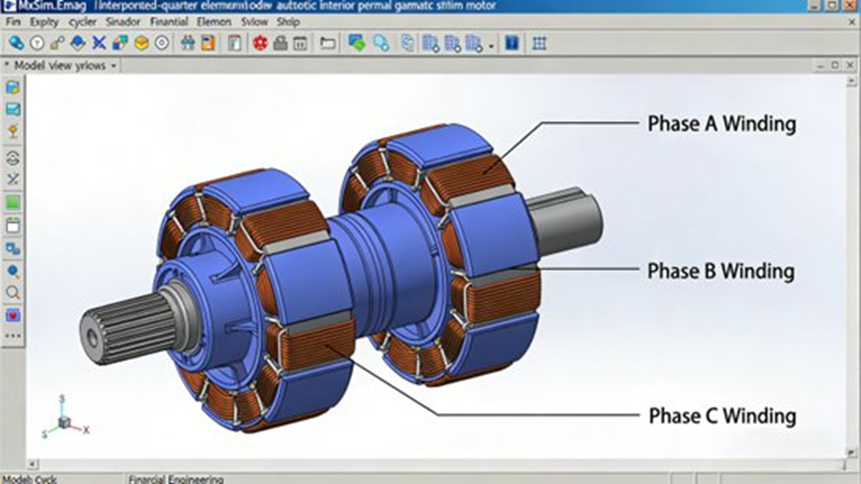
The report describes this process in detail:
- open MxSim.Emag (Chinese version)
- use File → Import to import the motor finite-element model
- supported simplified models include a quarter-period model and a half model, which reduce computational load
- perform geometry cleanup
- delete redundant geometry
- repair geometry defects
- ensure model accuracy
- define material properties
- call materials such as permanent magnets, stator core materials, and windings from the built-in material library, or define parameters such as magnetic permeability and resistivity according to real automotive engineering needs
The report also notes that the imported quarter-period finite-element model of an automotive interior permanent magnet synchronous motor clearly shows the A, B, and C phase windings, which makes the internal structure easy to see and supports the next setup steps.
3. Winding and external circuit setup
The report then describes the winding and circuit setup. Based on the real winding parameters of the automotive motor, engineers need to define:
- turns of the A, B, and C three-phase windings
- cross-sectional area
- connection mode
They also need to define external circuit parameters such as:
- voltage source
- resistance
- inductance
This creates the coupling setup between the electromagnetic field and the circuit. The report states that this step allows accurate simulation of the actual power supply condition of the automotive motor, solves the problem that winding current is unknown in traditional simulation, and improves the realism of the simulation result.
4. Motion boundary setup
For rotor rotation, the report says engineers must define the motion boundary in the software as follows:
- choose rotational motion type
- check Periodic motion
- define rotor speed
- define rotation direction
- define the motion boundary set
This setup allows accurate transfer of field variables between rotor and stator and makes it possible to simulate the real dynamic process in which the rotor cuts magnetic field lines during operation.
5. Working-condition and solver setup
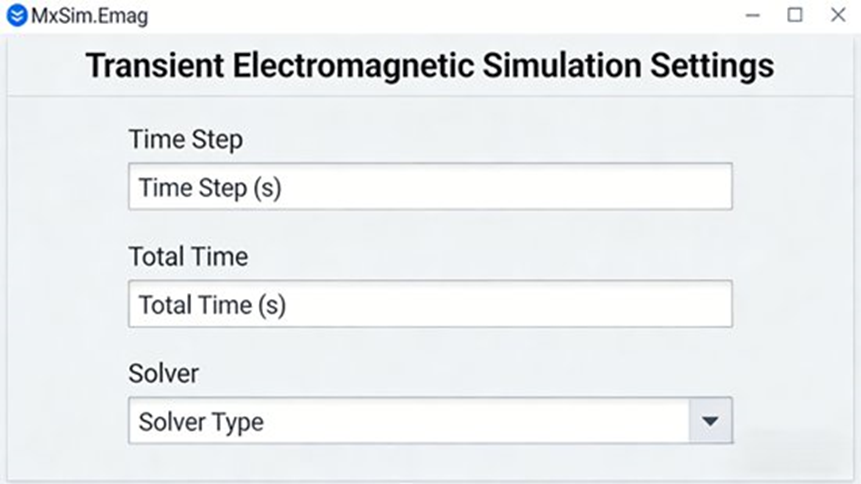
The report states that engineers should select the simulation type according to the actual operating condition of the automotive motor, such as transient electromagnetic field analysis, and define:
- total simulation time
- time-step interval
It gives a concrete example for a motor under 50 Hz rated frequency:
- set total time to 0.1 s, covering 5 cycles
- calculate 250 time steps per cycle
- set the time step to 8e-5 s
For solving, the report says to:
- choose the self-developed DSV solver
- set solution precision
- set parallel solving mode
The report also notes that the transient electromagnetic condition setup interface is simple and easy to read, and that the parameters can be adjusted flexibly according to real automotive engineering needs and different motor types.
6. Solving and post-processing
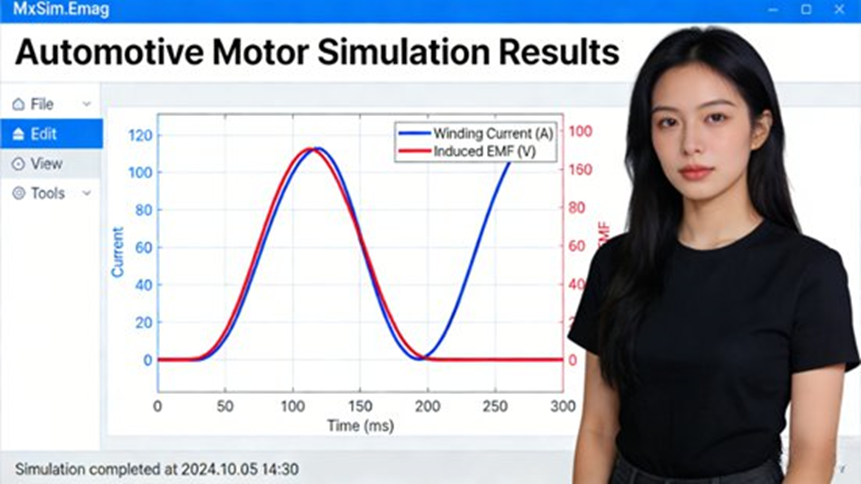
After parameter setup is completed, engineers create a calculation task and click local solve to start the simulation. The report states that the software then automatically completes the coupled solution of electromagnetic field, circuit, and motion, while showing real-time progress and status.
After solving is complete, the software automatically enters the post-processing interface.
What outputs engineers can obtain from MxSim.Emag post-processing
The report states that the post-processing module supports several output forms that fit automotive engineering verification needs.
Cloud maps and contour outputs
Engineers can view contour or cloud maps of:
- magnetic flux density distribution inside the motor
- current distribution
- temperature distribution
These outputs make it possible to judge:
- magnetic saturation regions
- current concentration regions
This gives a basis for motor structure optimization.
Curve outputs
The software can output curves showing the time variation of:
- winding current
- induced electromotive force
- flux linkage
- eddy current loss
The report specifically refers to a post-processing image showing comparison curves of winding current and induced electromotive force, which helps engineers see the change pattern of electromagnetic parameters during dynamic motor operation and supports motor performance optimization with direct data.
Data outputs
Simulation data can also be exported for:
- comparison with physical prototype test data
- validation of the simulation model’s accuracy
- further data analysis and optimization
How MxSim.Emag was validated in an automotive engineering case
To verify the accuracy and practical value of MxSim.Emag (Chinese version) in automotive engineering, the report uses a specific case of a new energy vehicle drive motor and compares the simulation result with both commercial software and physical prototype test data.
Case overview
The simulation object is an interior permanent magnet synchronous motor for a new energy vehicle drive system with the following specifications:
- rated power: 150 kW
- rated speed: 12,000 r/min
- rated voltage: 350 V
- three-phase winding connection: star connection
Simulation targets and setup
The validation target is to verify simulation accuracy under rated conditions for:
- magnetic flux density distribution
- winding current
- induced electromotive force
- flux linkage
- stator eddy current loss
The working condition is:
- transient electromagnetic field analysis
- time step: 8e-5 s
- total time: 0.1 s
Comparison method
The report states that the results from MxSim.Emag (Chinese version) are compared with:
- commercial simulation software
- physical prototype test data
This is used to verify engineering applicability.
How accurate the reported simulation results are
The report gives explicit engineering accuracy results.
Magnetic flux density
For:
- air-gap magnetic flux density
- stator core magnetic flux density
the error between MxSim.Emag results, commercial software results, and test data is reported as within 3%. The report also says the software can accurately capture magnetic saturation characteristics.
Winding current and induced electromotive force
The report states that the simulation curves are fully consistent in trend with those from commercial software, and that the peak-value error is ≤4%. This is used as evidence that the software can simulate dynamic electromagnetic parameter change during motor operation with good accuracy.
Stator eddy current loss
The reported error between simulation and test data for stator eddy current loss is 4.8%.
Overall engineering conclusion
The report concludes that these results meet the automotive engineering requirement for electromagnetic-loss simulation accuracy, defined as error ≤5%. Based on this, it states that MxSim.Emag (Chinese version) fully meets real automotive engineering requirements in terms of simulation accuracy and that its field-circuit-motion coupling algorithm has strong reliability. The report further states that the software can replace commercial tools in automotive motor design, performance validation, and parameter optimization, while reducing development cost and cycle time.
The core advantages of MxSim.Emag in the automotive toolchain
The report groups the software’s main advantages into three broad areas.
1. Independent and self-controlled core technology
The first advantage is that the underlying solver and core technologies are self-developed. The report presents this as a strategic benefit because it reduces dependence on foreign technologies and lowers the risk of critical automotive R&D tools being externally constrained.
2. Strong engineering fit for automotive electric drive simulation
The second advantage is engineering fit. The report says the software is specially optimized for the simulation needs of automotive electric drive systems and that its workflow matches the habits of domestic engineers, which improves development efficiency.
3. High cost-performance ratio
The third advantage is cost-effectiveness. Compared with foreign commercial software, the report states that MxSim.Emag (Chinese version) has lower usage cost while also providing localized technical support and service, making it suitable for domestic automotive enterprise R&D needs.
The application value of MxSim.Emag for automotive companies
The report also explains the wider engineering and business value of the software.
Shorter development cycles
By using simulation to replace part of physical prototype testing, the report says automotive motor development cycles can be shortened by more than 30%.
Lower R&D cost
Cost is reduced through:
- fewer prototype manufacturing cycles
- fewer testing iterations
- parameter optimization that improves motor efficiency and lowers whole-vehicle energy consumption
Better product performance
The report says the software can predict motor electromagnetic performance accurately and help optimize structure and parameters to reduce:
- torque ripple
- noise and vibration
- electromagnetic loss
while improving:
- efficiency
- reliability
- durability
Stronger domestic automotive toolchain
The report also states that MxSim.Emag fills a domestic gap in independently developed mid- and low-frequency electromagnetic simulation tools for automotive use and supports the localization and domestic substitution of critical automotive R&D tools, which helps improve the core competitiveness of the automotive industry.
The future outlook for MxSim.Emag in EV simulation workflows
The report ends with a forward-looking discussion.
More complex simulation demand from future EV architectures
As new energy vehicles continue moving toward:
- higher voltage
- higher speed
- deeper integration
the report says electric drive simulation needs will become more complex.
Further optimization of multiphysics coupling
One future direction is to keep improving multiphysics coupling algorithms and raise the accuracy and efficiency of complex scenarios such as:
- electromagnetic-thermal coupling
- electromagnetic-thermal-structural coupling
Stronger coordination with the wider MxSim suite
The report specifically points to stronger coordination with:
- MxSim.MultiPhy
- MxSim.Mechanical
This is described as part of building a full-process, integrated automotive electric-drive R&D simulation platform.
Expanded applications beyond traction motors
The report also says MxSim.Emag may expand into:
- automotive electromagnetic compatibility
- power battery electromagnetic simulation
and provide stronger technical support for the high-quality development of the domestic automotive industry.
Final Takeaway
MxSim.Emag (Chinese version), as presented in the source report, is not described as a generic electromagnetic tool. It is described as a core automotive electric-drive simulation tool built around the real needs of EV motor design, performance verification, and parameter optimization.
Its value in the report rests on the combination of:
- self-developed DSV solver
- self-developed low-order high-accuracy element technology
- adaptive local mesh refinement
- complete mid- and low-frequency electromagnetic analysis coverage
- field-circuit-motion coupling
- Lagrangian motion handling
- interpolated motion boundary technology
- Chinese localization and automotive engineering adaptation
- engineering validation supported by comparison with commercial software and prototype data
Frequently Asked Questions
1. What problems does MxSim.Emag solve in automotive motor simulation?
Short answer:
MxSim.Emag helps engineers simulate and optimize mid- and low-frequency electromagnetic behavior in automotive electric drive components before physical prototyping.
Detailed answer:
MxSim.Emag is designed to simulate mid- and low-frequency electromagnetic fields in electromechanical systems. In automotive engineering, it is mainly used to analyze and optimize components such as:
- permanent magnet synchronous motors (PMSM)
- induction motors
- transformers
- electromagnetic actuators
The software allows engineers to evaluate:
- magnetic flux density
- torque ripple
- induced electromotive force (EMF)
- winding current distribution
- eddy current losses
before physical prototyping. This helps reduce development cycles and supports parameter optimization at an early design stage.
2. How accurate is the MxSim.Emag solver compared with commercial CAE tools?
Short answer:
Based on the engineering case in the report, MxSim.Emag reaches the accuracy range usually required in automotive simulation work.
Detailed answer:
The software integrates a self-developed equation solver and high-precision element technology built to balance computational efficiency and numerical accuracy.
The report highlights these capabilities:
- self-developed DSV sparse equation solver
- adaptive mesh refinement based on field gradients
- parallel computation for large models
The engineering validation case shows that results such as magnetic flux density and winding current can match commercial tools with errors around the engineering target range. The report gives specific values of within 3% for magnetic flux density, ≤4% for winding current and induced EMF peak values, and 4.8% for stator eddy current loss, satisfying the stated engineering requirement of ≤5%.
3. Does MxSim.Emag support multiphysics coupling for electric drive systems?
Short answer:
Yes. Field-circuit-motion coupling is one of the software’s core capabilities.
Detailed answer:
MxSim.Emag supports field-circuit-motion coupling simulation.
The software solves:
- electromagnetic field equations
- external circuit equations
- mechanical rotor motion
at the same time. This allows realistic motor modeling where the current distribution is determined dynamically by circuit conditions, rather than being set in advance. The report treats this as essential for studying startup behavior, dynamic torque generation, and electromagnetic response in rotating machines.
4. What are the typical steps for performing automotive motor simulations with MxSim.Emag?
Short answer:
The workflow includes model import, material and winding setup, motion boundary setup, solver setup, and post-processing.
Detailed answer:
A typical engineering workflow in the report includes the following stages:
1. Model Import and Preprocessing
- import the motor finite-element model
- clean the geometry
- repair geometry defects
- define material properties
2. Circuit and Winding Configuration
- define phase windings
- define external circuits
- set voltage source, resistance, and inductance
3. Motion Boundary Definition
- define rotor rotation
- apply periodic motion settings
- define the motion boundary set
4. Solver Setup
- choose transient electromagnetic analysis
- define total time and time-step settings
5. Post-Processing
- review magnetic field distribution
- extract current, EMF, flux linkage, and loss curves
- export data for comparison and optimization
This workflow allows engineers to reproduce real operating conditions and study motor behavior under different driving scenarios.
5. Why is MxSim.Emag becoming important in the automotive simulation toolchain?
Short answer:
Its value comes from self-developed core technology, strong fit with automotive engineering work, and growing relevance in domestic CAE substitution.
Detailed answer:
MxSim.Emag is drawing attention mainly for three reasons:
1. Independent core technology
The software is built on self-developed CAE algorithms and solvers, which reduces reliance on foreign simulation software.
2. Automotive-focused engineering features
It supports the simulation needs of electric motors, transformers, and electromagnetic devices widely used in vehicle powertrains.
3. Integration with a broader CAE ecosystem
MxSim.Emag is positioned within the broader MxSim framework and can work with other simulation modules such as structural and multiphysics tools.
E-E-A-T Signals
Author
Johnny Liu
CEO at Dowway Vehicle
Author Note
Johnny Liu is listed as the author of this page in his role as CEO at Dowway Vehicle. This article is written for readers evaluating EV powertrain engineering tools, electromagnetic simulation workflows, and automotive CAE capabilities.
Editorial Integrity Note
This page is written as a technically complete engineering article with direct-answer sections, question-based headings, and machine-readable structure. The technical details from the source report are preserved in full.
