
< Back to Performance Development
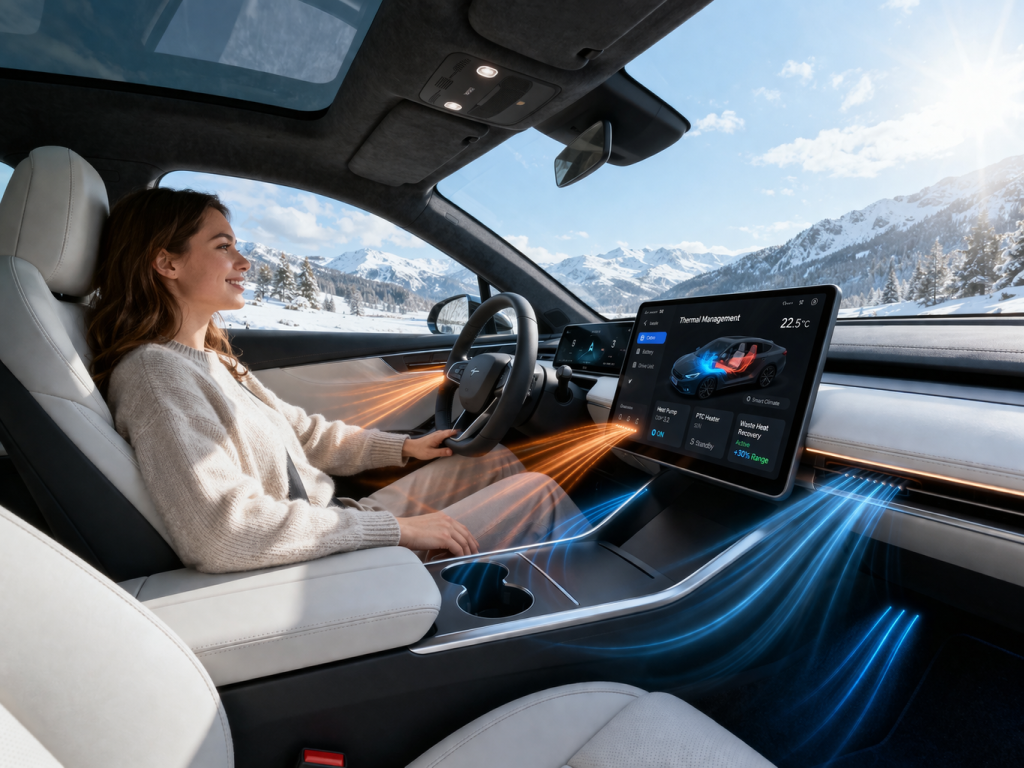
EV cabin thermal systems matter because they directly affect:
- Driving range
- Energy efficiency
- Passenger comfort
Without engine heat:
- Heating must be generated using electricity
- Cooling depends on compressor systems
In extreme cold, HVAC can use 20–40% of total energy.
That’s why this system is now treated as a core engineering problem, not just a comfort feature.
- What Are the Core Components of an EV Cabin Thermal Management System?
- How Does EV Cabin Thermal Management Architecture Work?
- What Are the Key Differences Between ICE and EV Systems?
- What Technologies Are Used in EV Cabin Thermal Management?
- How Does Waste Heat Recovery Improve Efficiency?
- What Are the Main Challenges?
- Future Trends in EV Cabin Thermal Management
- Real-World Example
What Are the Core Components of an EV Cabin Thermal Management System?
The system has four main parts:
- Heat supply
- Thermal control
- Air and heat distribution
- Control system
All of these are connected through pipes, valves, and software.
Heat Supply Components (Cooling & Heating)
These parts provide cooling or heating.
Cooling system:
- Electric compressor
- Condenser
- Evaporator
- Electronic expansion valve
Heating system:
- PTC heater (fast, but uses more energy)
- Heat pump (efficient, but affected by cold weather)
A heat pump moves heat instead of creating it. That’s why it can reach a COP of 2–4, while PTC heaters are closer to 1.
Thermal Control and Distribution Components
These parts manage how heat moves inside the system.
Key components:
- Multi-way valves (8-way, 12-way)
- Air ducts
- Air flaps for zoned airflow
- Heat exchangers (chiller, cooling plates)
Multi-way valves are especially important in EVs. They allow quick switching between different thermal loops.
For example, Tesla uses an octovalve system to manage multiple heat paths with fewer parts.
Control System (ECU and Sensors)
This is the system’s brain.
It collects data from:
- Cabin temperature sensors
- Humidity sensors
- Sunlight sensors
- Battery temperature sensors
Then it adjusts:
- Airflow
- Heating and cooling power
- Heat distribution
Newer systems can:
- Learn driver habits
- Adjust settings automatically
- Update through software (OTA)
How Does EV Cabin Thermal Management Architecture Work?
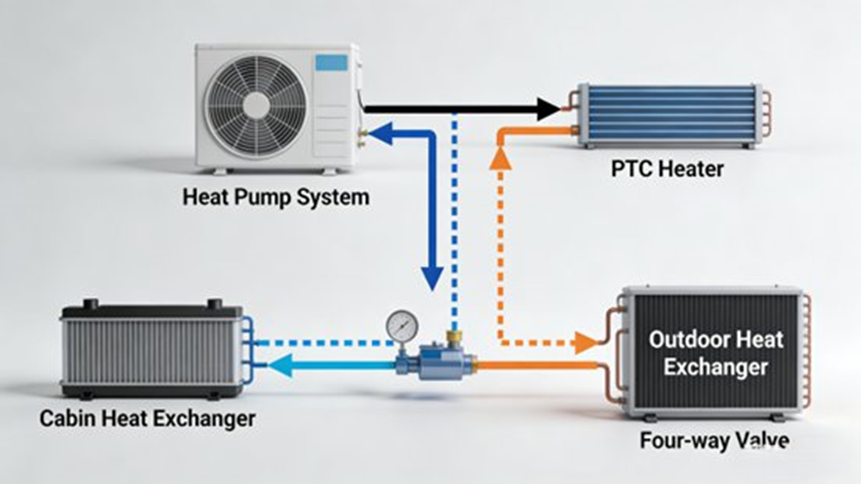
EV systems use integrated thermal architectures, not separate systems.
Single-Loop vs Multi-Loop Systems
- Traditional vehicles: separate systems
- EVs: connected systems
EVs link:
- Cabin
- Battery
- Motor
- Electronics
This allows heat to move where it’s needed.
Energy Flow in EV Systems
Heat is shared across components:
- Battery heat can warm the cabin
- Motor heat can be reused
- Cabin cooling can help cool the battery
This is called thermal coupling.
It’s one of the biggest reasons EV systems can be efficient.
What Are the Key Differences Between ICE and EV Systems?
- ICE vehicles use engine heat
- EVs generate or move heat using electricity
EV systems are:
- More complex
- More flexible
- More dependent on energy efficiency
Their biggest challenge is cold-weather performance.
What Technologies Are Used in EV Cabin Thermal Management?
Heat Pump Technology
Short answer:
Heat pumps are the main heating method in EVs because they use less energy.
They:
- Pull heat from outside air
- Move it into the cabin
Efficiency:
- COP 2–4
Challenges:
- Lower efficiency in cold weather
Solutions include:
- CO₂ refrigerants
- Vapor injection
- Wide-temperature designs
Some systems can work from -30°C to 50°C.
Tesla’s system improves winter range by around 15% using this approach.
PTC Heating System
Short answer:
PTC heaters provide fast heating but use more energy.
They:
- Convert electricity directly into heat
- Work well in cold conditions
Most EVs combine:
- Heat pump (efficiency)
- PTC heater (backup)
Waste Heat Recovery Technology
Short answer:
Waste heat recovery reuses heat from other parts of the vehicle.
Sources include:
- Motor
- Power electronics
- Battery
This heat can be redirected to:
- Cabin heating
- Battery warming
Benefits:
- Energy use drops by about 30%
- Range can increase by around 50 km
Zoned Climate Control Systems
Short answer:
Zoned systems control temperature in different parts of the cabin.
They allow:
- Driver and passenger to set different temperatures
- Better comfort
- Lower energy use
Intelligent Thermal Control Systems
Short answer:
Smart control systems adjust temperature automatically using data.
They use:
- Multiple sensors
- Driver habits
- Environmental conditions
Advanced systems can:
- Predict user needs
- Adjust before you enter the car
- Keep temperature stable within ±0.5°C
How Does Waste Heat Recovery Improve Efficiency?
Short answer:
It reduces the need to generate new heat.
Instead of using battery power, the system reuses existing heat.
This leads to:
- Lower energy use
- Better winter performance
- Less load on heating systems
What Are the Main Challenges?
Short answer:
EV thermal systems still face trade-offs.
Main issues:
- Heat pump performance in cold weather
- High energy use
- System complexity
- Cost
These are the areas engineers are still working on.
Future Trends in EV Cabin Thermal Management
Short answer:
The focus is on efficiency, integration, and smarter control.
Wide-Temperature Heat Pumps
- Work in extreme cold (down to -40°C)
- Better efficiency
Integrated Thermal Systems
- One system for the whole vehicle
- Better energy use
Smart Climate Control
- Personalized settings
- Predictive adjustments
Eco-Friendly Refrigerants
- CO₂
- R1234yf
- Lower environmental impact
Real-World Example
Companies like Tesla, BYD, and NIO are already using:
- Multi-loop systems
- Multi-way valves
- Waste heat reuse
These designs improve:
- Efficiency
- Range
- System performance
🔥 Trending FAQs (2026)
Why does cabin heating in EVs use so much energy?
Short answer:
Because EVs don’t have engine heat.
They must generate heat using battery power, which can use 20–40% of total energy in extreme conditions.
Are heat pumps now standard in EVs?
Short answer:
Yes, most EVs now use heat pumps.
By 2026, about 92% of EVs include them because they are more efficient than PTC heaters.
How do integrated thermal systems improve efficiency?
Short answer:
They allow heat sharing between systems.
This means heat from the battery or motor can be reused, reducing total energy use.
Do heat pumps work in very cold weather?
Short answer:
Yes, but less efficiently.
That’s why EVs use:
- Heat pumps
- PTC heaters
- Waste heat recovery together
How does thermal management affect EV range?
Short answer:
It directly affects range and battery health.
Poor thermal control can reduce performance and increase energy use, while good systems improve range and stability.
Author & Trust Signals
Author: Johnny Liu
Title: CEO, Dowway Vehicle
Experience: 15+ years in automotive thermal systems
Last Updated: March 2026
