



< Back to Performance Development
Author: Johnny Liu, CEO at Dowway Vehicle
Published Date: February 26, 2026
Reading Time: Approx. 18 minutes
Hi, I’m Johnny. I’ve spent years working with vehicle chassis, and today I want to walk you through how engineers make cars handle safely and predictably. Let’s look at the science behind the drive.
Key Takeaways
- Core Definition: Handling means a vehicle does exactly what the driver asks, keeping passengers safe and making the drive enjoyable.
- New Paradigm: The industry shifted from just turning wrenches to blending mechanical parts with smart electronics, especially for heavy electric vehicles.
- Development Loop: Engineers run virtual software simulations before turning a single bolt on a physical prototype to meet tough safety standards.
- Future Trends: AI tuning, digital models, and new chassis layouts for battery packs will rule the next ten years of vehicle dynamics.
1. Introduction to Automotive Handling Performance
Automotive handling performance sits at the heart of vehicle dynamics. It decides how safe you are and how connected you feel to the road. As cars get faster and road conditions change, good handling separates great cars from average ones.
What is handling performance? Simply put, it is how well a vehicle follows your steering inputs without wearing you out. It actively fights off crosswinds or bumpy roads to keep you on a safe, steady path.
For older gas-powered cars, we mostly tuned physical chassis parts. Now, heavy battery packs in pure electric vehicles (NEVs) change the center of gravity entirely. We also rely on electronic systems like Steer-by-Wire and Electronic Stability Programs (ESP). This forces engineers to blend mechanical design with software control. At the same time, updated national testing standards (like GB/T 6323) force manufacturers to hit much stricter technical targets.
2. Core Evaluation Indicators of Automotive Handling Performance
Good handling comes from how the driver, the car, and the road work together. Three main elements control this: the car’s physical parts (suspension, steering, tires), electronic strategies (ESP, EPS), and the outside environment.
Based on global standards, we look at several main indicators:
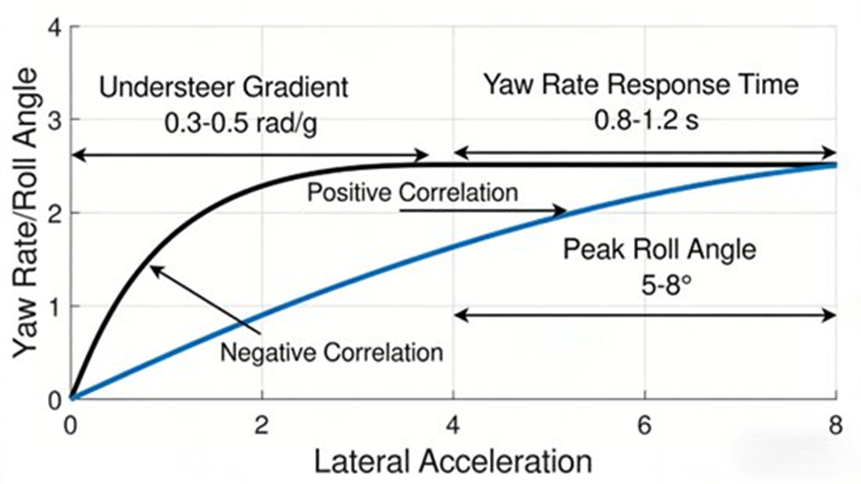
- Steady-State: Understeer Gradient: This measures steady turning. A positive number means the car turns predictably and safely. Too much oversteer, however, can make the car spin out.
- Steady-State: Maximum Lateral Acceleration: This shows the highest cornering force the car can manage. It ties directly to tire grip and suspension stiffness. Standard passenger cars should hit at least 0.8g.
- Steady-State: Steering Returnability: We check how well the steering wheel snaps back to the center at low speeds, high speeds, and pushed to the limit.
- Transient: Yaw Rate Response Time: This counts the fractions of a second it takes for the car to react after you turn the wheel. A time under 0.3 seconds usually means sharp, agile steering.
- Transient: Steering Response Characteristics: We test this with step, pulse, and sweep inputs. The sweep test captures frequency data, matching well with ESP design needs.
- Transient: Roll Angle Peak and Attenuation: We keep the peak body roll under 8° so passengers stay comfortable.
- Subjective Evaluation Metrics: Professional drivers test the cars and score things data cannot easily measure, like steering feel and cornering confidence.
These metrics connect deeply to each other. Stiffening the suspension reduces body roll but might make the steering feel too heavy. Finding the right balance is the real challenge.
3. The Full-Process Development System for Automotive Handling Performance
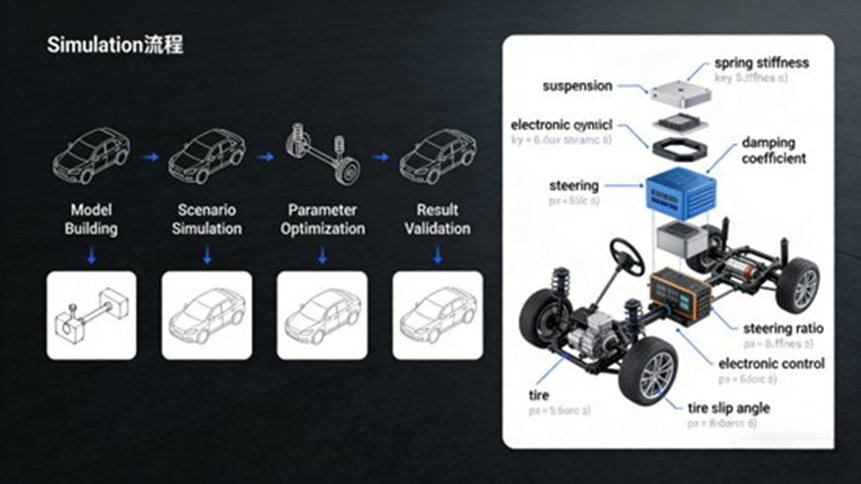
Building great handling requires a strict, closed-loop process. We set targets, run computer simulations, build physical prototypes, tune them on the track, and finally verify the results.
3.1 Development Target Setting
We define targets based on the car type, user needs, and competitors. A family passenger car focuses on stability (Understeer Gradient: 0.05 to 0.1 rad/g; Max Roll Angle: under 7°). A sports sedan leans toward agility (Understeer Gradient: 0.03 to 0.08 rad/g; Max Lateral Acceleration: over 0.9g).
3.2 Virtual Simulation Development (Pre-Optimization Core)
Before we build a physical car, engineers use software like CarSim, ADAMS, or Saber to do about 80% of the early optimization.
- Suspension Modeling: We plug in stiffness, damping, and roll steer numbers.
- Steering (EPS) Modeling: We map out ratios and assist curves, looking closely at center-zone stiffness.
- Tire Modeling: We use professional formulas like Pacejka 52/68 to simulate cornering stiffness.
- Body and Center of Gravity Modeling: For EVs, we must model exactly where the battery sits and how much it weighs under different loads.
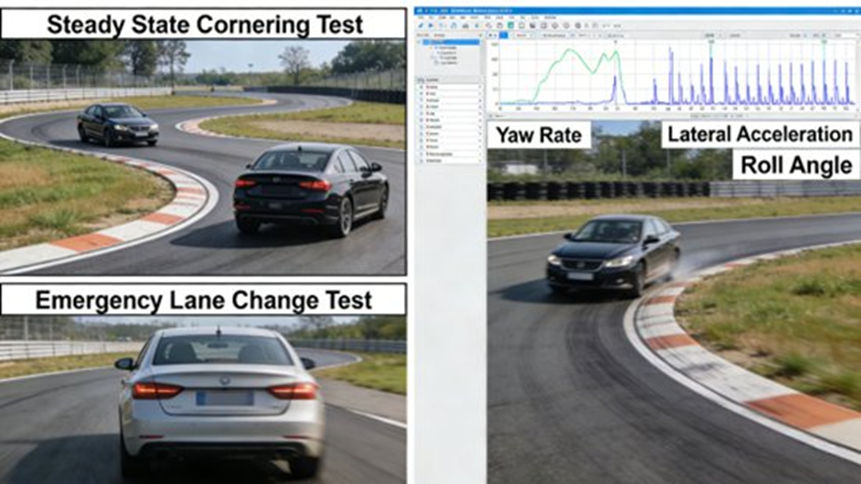
- Simulation Conditions: We run virtual tests for steady cornering, quick lane changes (ISO 3888-2), and sudden crosswinds.
3.3 Prototype Production and Real Vehicle Tuning
Once we build physical prototypes, track testing bridges the gap between software and reality. Preparation requires broken-in tires (over 150km) and specific tread depths (over 1.6mm).
- Suspension Tuning: We tweak dampers, springs, anti-roll bars, and wheel alignment (toe, camber).
- Steering Tuning: We refine the EPS software to balance lightness with good road feedback.
- Tire and Electronic Tuning: We pick the right tires and calibrate the ESP slip thresholds to work smoothly with the EPS.
3.4 Verification and Acceptance Testing
We run a final round of tests to make sure the car meets all ISO and national standards. This involves checking objective data, getting scores over 8/10 from professional test drivers, and running 100,000 km road tests to check long-term reliability.
4. Key Technologies in Automotive Handling Performance Development
To master how the car reacts, modern engineers rely on several breakthrough methods.
- Virtual-Physical Joint Identification: Instead of guessing and checking, optimization algorithms match simulation data with track data. This gets us over 90% accuracy.
- Mechanical-Electronic Collaborative Optimization: We link the electric power steering with suspension traits, and coordinate the ESP with tire grip to stop skidding.
- Multi-Objective Collaborative Optimization: We use Genetic Algorithm-Neural Network fusion models to balance conflicting goals, such as ride comfort versus sharp agility.
- Data-Based Adaptive Tuning: We use connected car data to adjust systems on the fly. The car can tweak its ESP for snow or change steering weight based on how aggressively you drive.
5. Current Challenges and Future Trends
5.1 Current Challenges
- NEV Weight Distribution: Heavy, central battery packs lower the center of gravity but alter the car’s overall dynamics.
- Autonomous Integration: Self-driving software needs to handle emergency maneuvers safely, requiring tight integration with chassis controls.
- Stricter Standards: Upcoming national tests demand tighter environmental conditions and sharper instrument precision.
- Complex Synergies: Balancing handling against noise, vibration, harshness (NVH), and ride comfort gets harder every year.
5.2 Future Trends
- Intelligent Tuning: AI and machine learning will soon automate parameter adjustments and mimic human test drivers.
- Digital Twins: Using a digital twin to map the car’s entire lifecycle lets us fix handling issues predictively.
- Deep System Synergy: The lines between mechanical chassis parts, steer-by-wire, and self-driving brains will soon disappear.
- Torque Vectoring for NEVs: EVs will use independent motors to send different amounts of power to each wheel, vastly improving cornering grip.
6. Frequently Asked Questions (FAQ)
- What exactly is automotive handling performance?
Handling refers to how a car responds to your steering, throttle, and braking. It covers stability, cornering grip, and the balance between understeer and oversteer. Handling determines both your safety and how much fun you have driving. - What factors most influence a car’s handling?
Multiple parts affect handling. Tires matter most because they are the only parts touching the road. Suspension geometry and dampers control weight transfer. A lower center of gravity improves stability. Steering precision and aerodynamics also help keep the car planted at speed. - How can you improve a vehicle’s handling performance?
You can upgrade suspension springs and shocks to reduce body lean. Installing performance tires increases grip. Adjusting alignment angles (camber, toe) helps the tires contact the road better during turns. You have to balance these changes carefully so you do not ruin the ride quality. - Why do some cars understeer or oversteer, and how does that relate to handling?
Understeer and oversteer describe how a car acts in a turn. Understeer happens when front tires lose grip first, making the car turn wider than you want. Oversteer happens when rear tires lose grip, making the car turn sharply and risk a spin. Engineers design mild understeer into most cars because it is safer for daily driving. - Is there a trade-off between ride comfort and handling performance?
Yes, they often conflict. Soft suspension absorbs bumps well but causes body roll and slow steering. Stiff suspension sharpens cornering but transmits bumps straight to the seats. Adaptive suspension tries to solve this by adjusting the stiffness in real-time.
7. Final Thoughts
Handling sits at the core of vehicle dynamics. It affects your safety and how much you enjoy the drive. Building a great chassis today means combining mechanical parts, smart electronics, and accurate virtual simulations. As the industry shifts toward electric and smart vehicles, mastering EV tuning and adaptive controls will separate the winners from the rest. By following a strict target-simulate-tune-verify loop and keeping up with new testing standards, car makers can give drivers safer and more exciting vehicles.
