


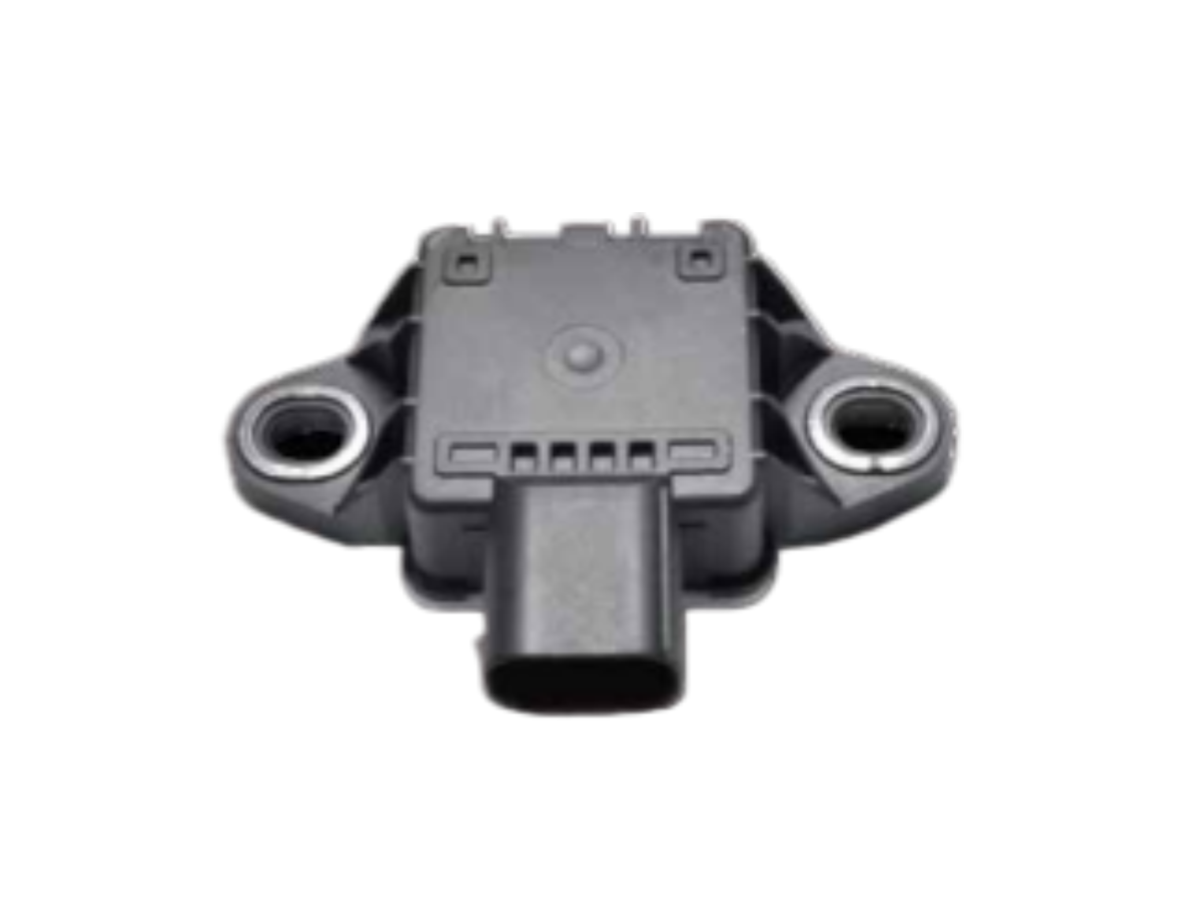
| Parameter | Specification |
|---|---|
| Sensor Type | 3-Axis Accelerometer + Gyroscope |
| Technology | MEMS-based sensing |
| Measurement Axes | Longitudinal (Ax), Lateral (Ay), Yaw Rate (Wz) |
| Communication Interface | High-speed CAN 2.0B |
| Operating Voltage | 8–16 VDC |
| Operating Temperature | -40°C to +125°C |
| Storage Temperature | -40°C to +130°C |
| Supply Current | <15 mA |
| Data Transmission Speed | High-speed CAN bus |
| EMC Performance | Meets automotive-grade standards |
| On-Chip Features | Digital low-pass filter, self-diagnostic |
| Programming | Supports online OBD upgrade |
| Protection | Overvoltage, reverse polarity |
| Housing Material | PBT+30%GF (Polybutylene Terephthalate with Glass Fiber) |
| Mounting Method | Bracket-mounted, optimized for CG alignment |
| Dimensions | Compact rectangular design, suitable for chassis integration |
| Compliance | RoHS, REACH, ISO 7637-2, AEC-Q100 Grade 1 |
The Automotive Body Yaw Rate Sensor is a critical component in modern vehicle safety and stability control systems, designed to monitor dynamic changes in vehicle motion by simultaneously measuring longitudinal acceleration (Ax), lateral acceleration (Ay), and yaw rate around the Z-axis (Wz). Installed as close as possible to the vehicle’s center of gravity—typically on the chassis or body frame—this sensor provides essential data for integrated braking and stability control systems such as Electronic Stability Control (ESC), Anti-lock Braking System (ABS), and Traction Control System (TCS). The high-resolution signals from this sensor allow the vehicle’s electronic control unit (ECU) to detect potential skidding, oversteer, understeer, or rollover conditions in real time, enabling rapid corrective actions like selective wheel braking or torque modulation to maintain vehicle stability and prevent loss of control.
Utilizing advanced MEMS (Micro-Electro-Mechanical Systems) technology, this sensor delivers exceptional performance with wide measurement ranges, high sensitivity, and long-term reliability under harsh operating conditions. It features low output noise, ensuring accurate detection of subtle changes in vehicle dynamics even at low speeds or during complex maneuvers. The built-in digital low-pass filters effectively reduce high-frequency vibrations and electromagnetic interference, providing clean, stable signals for precise control algorithms. With excellent EMC (Electromagnetic Compatibility) performance, it resists electrical noise common in automotive environments, maintaining signal integrity across all driving scenarios.
The sensor supports online OBD (On-Board Diagnostics) upgrades via CAN 2.0B interface, allowing OEMs to update firmware, recalibrate sensitivity thresholds, or reconfigure diagnostic parameters without hardware replacement. This feature enhances system flexibility and serviceability throughout the vehicle lifecycle. It includes comprehensive protection mechanisms such as overvoltage protection and reverse polarity immunity, ensuring durability during engine start-up, load transients, or accidental wiring errors. The compact, rugged design allows for easy integration into tight spaces within the vehicle structure, with mounting brackets optimized for vibration damping and thermal management.

Reviews
There are no reviews yet.