

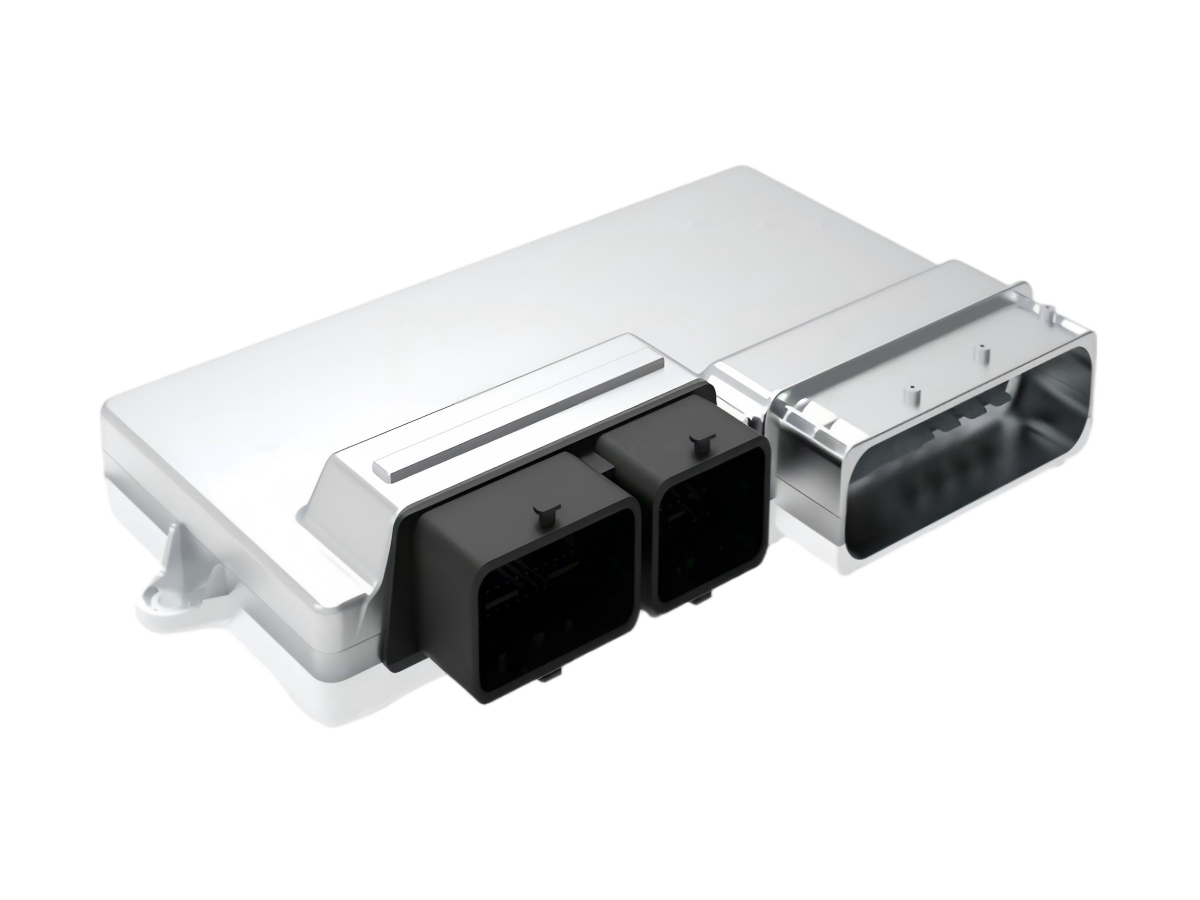
| Parameter Category | Specific Parameters | Parameter Value/Description |
| Core Chip | High-performance MCU, main frequency ≥1GHz | |
| Power Consumption | Normal operation ≤25W | |
| Hardware Parameters | Motor Drive Channels | ≥8 channels,maximum drive current ≥10A |
| Functional Safety Level | ISO 26262 ASIL |
1. Development Background
With the rapid popularization of new energy vehicles and Advanced Driver Assistance Systems (ADAS), the distributed ECU control architecture adopted by traditional automotive chassis can no longer meet the needs of industry development. In the traditional architecture, subsystems such as braking, steering, and suspension are controlled independently, resulting in problems such as communication delay, obvious data silos, high system complexity, and difficult cost control. Against this background, chassis domain control, as a core component of the centralized electronic and electrical architecture, has emerged. By integrating the control functions of multiple subsystems, it realizes efficient data interaction and collaborative decision-making, and has become a key carrier to ensure the safe execution of high-level autonomous driving and improve vehicle handling and comfort. At the same time, the trend of software-defined vehicles is forcing the industry to break down software and hardware barriers. As a core scenario of “software empowering machinery”, the development demand for chassis domain control continues to rise with the landing of L3 and above autonomous driving technologies. From the market-driven perspective, the global intelligent chassis market size exceeded 80 billion yuan in 2024, with China accounting for 38%, providing a broad industrial foundation for chassis domain control development.
2. Development Trends
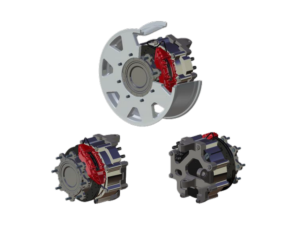
The development of chassis domain control presents three core trends: first, integration upgrading, evolving from single domain control to multi-domain integration. In the future, it is expected to realize the “five-domain integration” of chassis domain, intelligent driving domain, body domain, power domain, and cockpit domain, reducing system complexity and improving collaboration efficiency through a unified computing platform and algorithm model; second, in-depth intelligence, AI technology will be deeply integrated into dynamic control to achieve adaptive adjustment based on driving habits and road conditions, transforming from “fixed parameter calibration” to “self-evolving control system”. At the same time, virtual calibration and digital twin technology will greatly shorten the development cycle; third, popularization of wire control, brake-by-wire upgrades along the path of “EHB scaling → EMB mass production”, steer-by-wire accelerates mass production, and integrated configurations such as corner modules integrate “drive, brake, steer, and suspension” functions into the wheel end, promoting the reshaping of the chassis architecture. In addition, 5G and Internet of Vehicles technologies will promote in-depth collaboration between chassis domain controllers and cloud platforms, realizing real-time data interaction and continuous OTA optimization.
3. Application Status
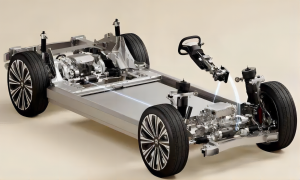
Currently, chassis domain control technology has entered the large-scale landing stage. In 2024, more than 70 new energy vehicle models with intelligent chassis configurations have been launched in China, and functions such as rear-wheel steering, active suspension, and brake-by-wire are widely used on-board. Vehicle manufacturers have successively built independent intelligent chassis brands, such as BYD’s DiSus system, NIO’s Skyline Chassis, and Chery’s Flying Fish Intelligent Chassis, all of which realize multi-subsystem collaborative control with chassis domain control as the core. Among them, the E platform of Chery’s Flying Fish Intelligent Chassis has integrated technologies such as steer-by-wire and active suspension, supporting scenarios such as in-place steering and lateral movement; international suppliers such as ZF have launched Chassis 2.0 solutions to achieve multi-actuator collaborative optimization through “software upward migration and software-hardware decoupling”, and Bosch’s VDC system has become the industry benchmark for collaborative control between the body and chassis. In the commercial vehicle and special vehicle fields, unmanned delivery vehicles and autonomous driving logistics vehicles based on chassis domain control have been applied in parks and other scenarios, improving traffic efficiency and operational safety.
4. Technical Characteristics
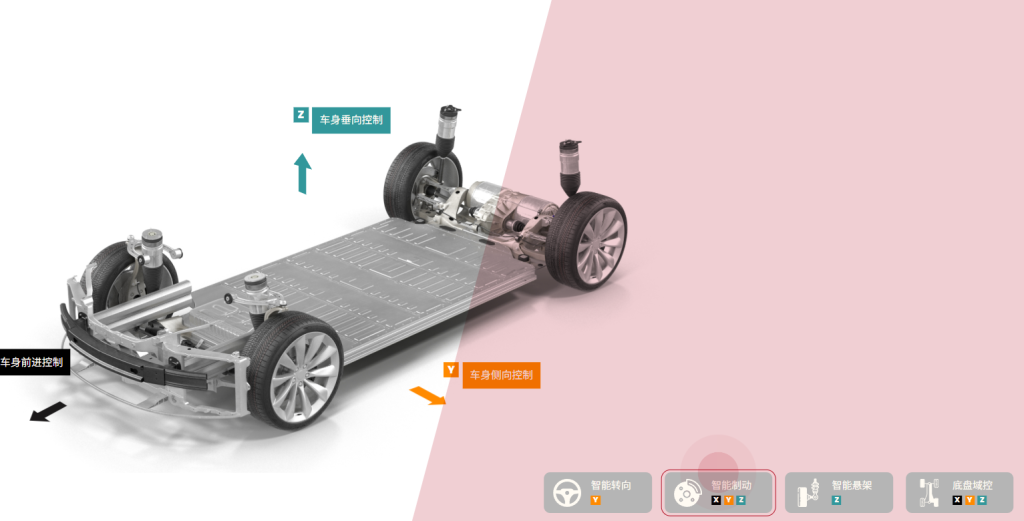
The core technical characteristics of chassis domain control development are reflected in three aspects: hardware level, adopting high-performance MCU chips and multi-sensor fusion technology, integrating multi-channel motor drive, data acquisition and other modules to achieve lightweight and miniaturized design, and meeting ISO 26262 functional safety ASIL D requirements through redundant architectures such as “dual motor + dual ECU”; software level, based on Model-Based Systems Engineering (MBSE) and distributed control strategies, using Model Predictive Control (MPC), fuzzy control and other algorithms to achieve millisecond-level precise regulation of yaw rate, roll angle and other indicators, supporting OTA upgrades to optimize control parameters; system level, building a “perception-decision-execution” closed loop, real-time collecting data through IMU, wheel speed, acceleration and other sensors, constructing a six-degree-of-freedom dynamic model of the vehicle, and realizing collaborative actions of steering, braking, suspension and electric drive torque. In addition, software-hardware decoupling has become a key feature, which can improve development efficiency, reduce hardware costs, and provide flexibility for function expansion.
5. Dowway’s Core Capabilities
Dowway Company has comprehensive software R&D and hardware development capabilities, which can deeply adapt to the full-process development needs of chassis domain control. In terms of software R&D, it has a control algorithm R&D team proficient in core algorithms such as MPC and fuzzy control, which can realize the design of collaborative control strategies for multiple chassis subsystems, the development of OTA upgrade solutions, and at the same time have MBSE-based systems engineering design capabilities to ensure the reliability and scalability of the software architecture. In terms of hardware development, it has the capabilities of chassis domain controller hardware architecture design, core chip selection, and sensor fusion module development, which can realize multi-function module integration and safety redundancy design, meeting the industry requirements of high reliability and stability. Relying on the advantage of software-hardware collaboration, Dowway can provide an integrated solution from system architecture planning, core component development to vehicle integration verification, helping customers quickly realize the productization of chassis domain control technology.
Reviews
There are no reviews yet.