


| Parameter | Specification |
|---|---|
| Sensor Type | GPF/DPF Differential Pressure Sensor |
| Technology | MEMS-based pressure transducer |
| Pressure Range | 0–35 kPa (customizable) |
| Accuracy | ±1.0% FS (-40°C to +150°C) |
| Operating Temperature | -40°C to +150°C |
| Storage Temperature | -40°C to +150°C |
| Output Signal | 0.4–4.65V or 0.5–4.5V (configurable) |
| Supply Voltage | 4.75–5.25 VDC |
| Overvoltage Protection | 18 VDC |
| Reverse Polarity Protection | -14 VDC |
| Burst Pressure | 3×P max |
| Overpressure Tolerance | 2×P max |
| Output Load (Capacitive) | Max 470nF |
| Output Load (Resistive) | Min 4.7kΩ |
| Short Circuit Protection | Yes |
| Supply Current | ≤10 mA |
| Cycling Test | 200,000 cycles |
| Housing Material | PBT+30%GF (Polybutylene Terephthalate with Glass Fiber) |
| Protection Rating | IP69 |
| Mounting Interface | Threaded connection, custom connector available |
| Dimensions | Compact design, optimized for tight exhaust spaces |
| Compliance | RoHS, REACH, ISO 7637-2, China National VI Emission Standard |
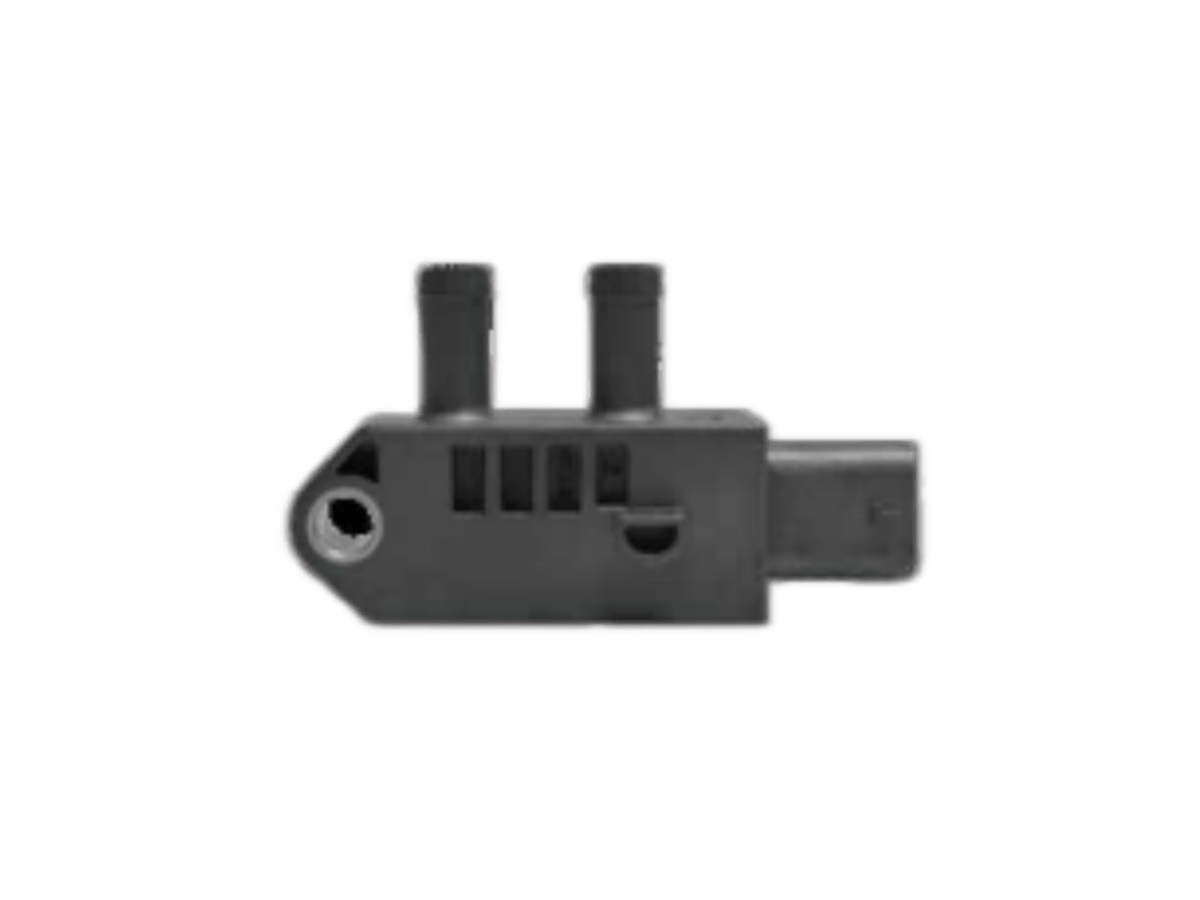
The GPF/DPF Differential Pressure Sensor is a critical component in modern diesel and gasoline-powered vehicles equipped with particulate filters, specifically designed to meet the stringent requirements of China’s National VI emission standards. Installed at both upstream and downstream ends of the gasoline particulate filter (GPF) or diesel particulate filter (DPF), this sensor measures the differential pressure across the filter media, providing essential data to the vehicle’s electronic control unit (ECU). By continuously monitoring the pressure drop, the system can accurately determine when the filter is approaching saturation due to soot accumulation, triggering active regeneration cycles to burn off trapped particles and maintain optimal engine performance and emissions compliance.
This sensor utilizes advanced MEMS (Micro-Electro-Mechanical Systems) technology to deliver high accuracy, long-term stability, and exceptional reliability in harsh exhaust environments. It features intelligent zero-point and temperature compensation algorithms that minimize drift over time, ensuring consistent performance even under extreme thermal cycling conditions typical of diesel engines. The sensor maintains ±1.0% full-scale accuracy across a wide operating temperature range (-40°C to +150°C), making it suitable for use in diverse climatic zones. Its robust design includes comprehensive protection mechanisms: overvoltage (18V DC), reverse polarity (-14V DC), short-circuit resistance, and burst pressure tolerance of 3×P max, ensuring durability in high-vibration and corrosive exhaust systems.
With an IP69-rated housing, the sensor provides complete sealing against moisture, dust, and chemical exposure from exhaust gases, including sulfuric acid and other byproducts of combustion. This makes it ideal for applications where long-term reliability is critical. The compact size and modular configuration allow for easy integration into existing exhaust architectures, while customizable options for pressure range, output signal (0.4–4.65V or 0.5–4.5V), and physical dimensions support OEM-specific requirements. The sensor supports CAN bus communication and integrates seamlessly into OBD-II diagnostic systems, enabling accurate detection of filter blockage, catalyst degradation, or structural damage.
As a leading Chinese manufacturer specializing in automotive sensors and intelligent vehicle components, we provide comprehensive R&D and customization services for emission-compliant technologies. Our engineering team collaborates with global automotive clients to develop tailored solutions that meet regional regulatory standards such as China National VI, Euro 7, and U.S. EPA Tier 3. With ISO 9001 and IATF 16949 certifications, our production facility ensures strict quality control through automated calibration, environmental stress testing, and full traceability from raw material to final product. We offer end-to-end support—from concept validation to mass production—with technical documentation, FMEA reports, and compliance certification to accelerate your time-to-market.

Reviews
There are no reviews yet.