

| Category | Specific Specifications |
| Dimensions | Thickness: 25mm; |
| Field of View | 120°×25° (Urban Wide-Angle Mode) |
| Ranging Capability | Maximum up to 200m |
| Scanning Lines | 126 lines, equivalent 251 lines in ROI area |
| Angular Resolution | 0.1°×0.1° (ROI Area in Highway Telephoto Mode) |
| Core Chip | Self-developed SoC chip M-Core |
| Scanning Technology | 2D Scanning MEMS Chip Technology |
| Power Consumption | Below 10W |
| ROI Function | Globally Adjustable |
| Weak Echo Detection Capability | 4x improvement compared to previous generations |
| Equivalent Distance Resolution | 32x improvement compared to previous generations |
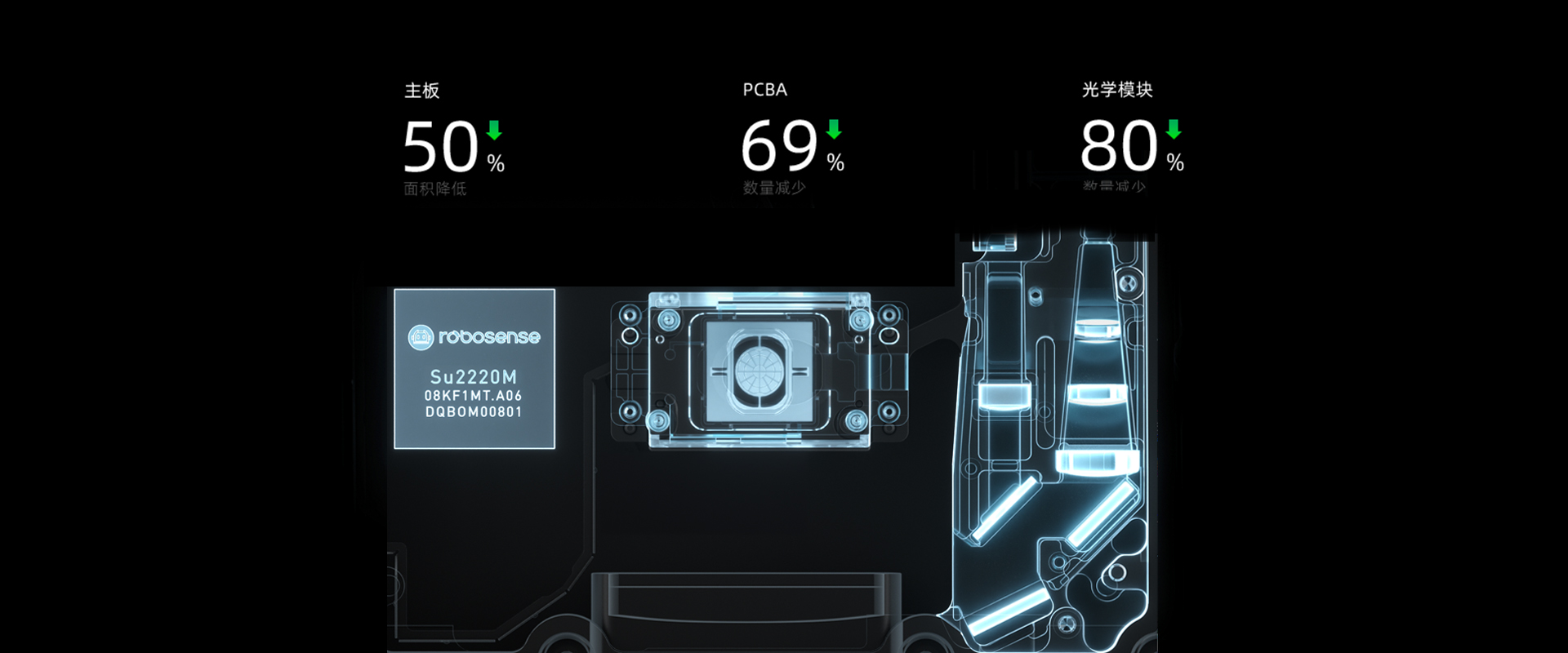
| Motherboard Area | Reduced by 50% compared to previous generations |
| PCBA Count | Reduced by 69% compared to M1 Plus |
| Optical Component Count | Reduced by 80% compared to M1 Plus |
| Deployment Methods | In-cabin (behind windshield, etc.); |
| NVH Performance | NVH-free, operating noise close to background noise |
Product Technical Features
(I) Chip-Integration: Balancing Performance and Cost
- Equipped with RoboSense’s fully self-developed SoC chip M-Core, integrating a quad-core 64bit APU + dual-core MCU, with a main frequency of 1GHz and 8MByte on-chip storage unit, delivering powerful computing and processing capabilities.
- Integrates multi-threshold TDC (Time-to-Digital Converter), increasing weak echo detection capability by 4x and equivalent distance resolution by 32x.
- Breakthrough integration of the entire backend circuit into a single chip, reducing motherboard area by 50%, power consumption by 40%, and significantly lowering costs.
- Adopts the mature 2D scanning MEMS chip from the M platform, realizing chipization of the scanning module. No mechanical motor vibration inside ensures stable operation throughout the entire lifecycle.
- Upgrades the transceiver system of the M platform, optimizing the performance of transceiver chips to further improve perception accuracy and reliability.
(II) Extreme Design: Ultra-Slim, Flexible, and Easy to Deploy
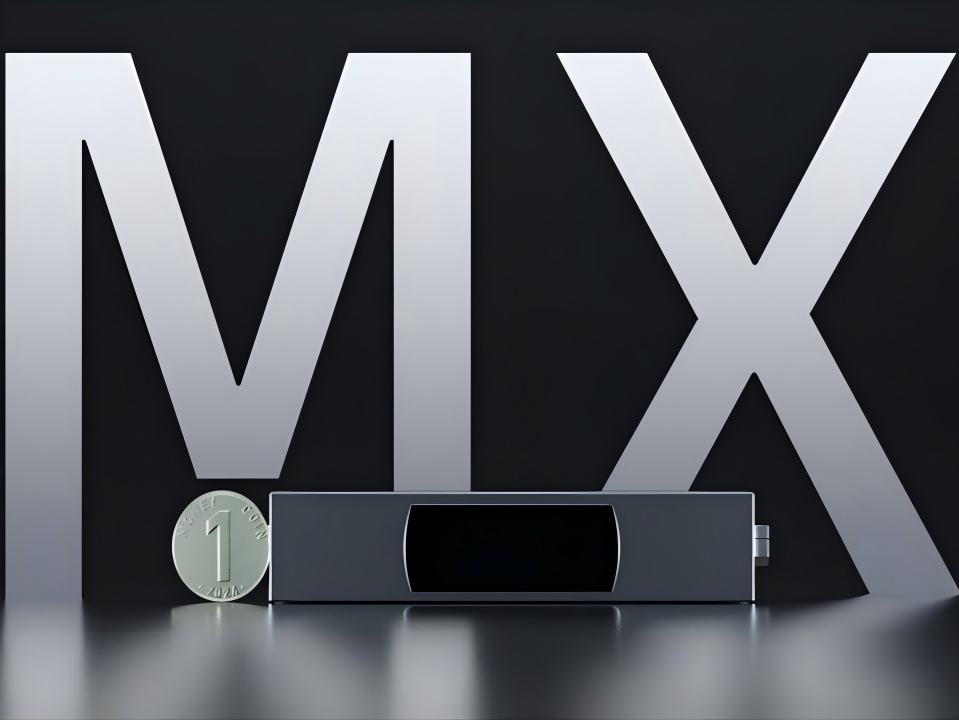
- Redefines the main LiDAR standard with an ultra-slim 25mm thickness. Compared with M1/M1 Plus/M2, the volume is reduced by 40%, thickness by 44%, and the exposed window area by 80%.
- Extreme architectural integration: PCBA count reduced by 69%, optical component count by 80%. Highly compatible with the overall vehicle design, it can be flexibly installed behind the windshield, on the roof, in the headlights, and in the grille.
- Exterior deployment enables integrated roof integration with ultra-low wind resistance; in-cabin deployment requires only a minimal KOZ (Keep Out Zone: the space occupied by sensors integrated on the windshield), ensuring “zero” obstruction to the driver’s view.
- Operating power consumption is below 10W, featuring energy-saving and long-lasting advantages, with significantly improved manufacturability.
(III) Intelligent Perception: Full-Scenario Adaptation for Enhanced Safety
- The ROI function achieves a leap from “single-dimensional adjustable” to “globally adjustable”, adapting to diverse driving scenarios such as urban areas and highways.
- Urban wide-angle mode offers a 120°×25° wide field of view, enabling insight into surrounding traffic dynamics and smoothly handling complex scenarios such as unprotected left turns, U-turns, and lane changes at busy urban intersections.
- In highway telephoto mode, the ROI area has an equivalent 251 lines and an angular resolution of 0.1°×0.1°, which can focus on scanning the distant front of the road. The maximum ranging distance of 200m allows the vehicle to detect distant obstacles in advance.
- NVH-free (Noise, Vibration, and Harshness) design, with operating noise extremely close to background noise, maintaining a quiet and premium driving experience.
(IV) Platform-Based Iteration: Seamless Upgrade with Low Cost
- 100% inherits the 2D scanning architecture, core optical path, and optoelectronic components of the M platform, reusing M platform production line equipment, resulting in high product maturity and an extremely short development cycle.
- Continues the platform-based and modular design. Subsequent iterative products can achieve pin-to-pin upgrades of core components, maintaining consistent point cloud scanning patterns and data interfaces.
- The secondary development cost is nearly “zero”, helping customers continuously optimize the intelligent driving performance of new vehicle models, realizing generational performance upgrades and cost reductions.
Reviews
There are no reviews yet.