


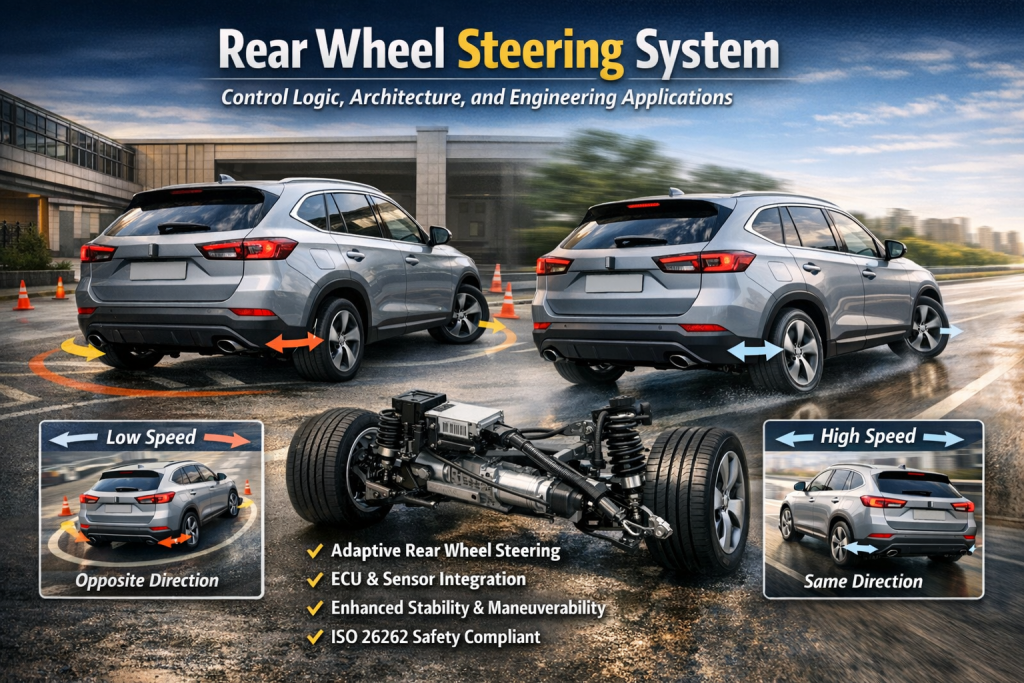
A rear wheel steering system (RWS) adjusts the rear wheel angle based on speed and driving conditions. At low speed, it helps the car turn tighter. At high speed, it keeps the vehicle stable. It’s now a key part of modern vehicle motion control systems.
- Why This Matters Now
- What Is the Core Control Logic Behind RWS?
- What Happens at Low Speeds? (≤30–40 km/h)
- What Happens at High Speeds? (≥80 km/h)
- How Does the Transition Phase Work? (30–80 km/h)
- Sensor Layer (Perception System)
- Control Unit (ECU)
- Actuation System
- Redundancy and Safety System
- High-Precision Steering Control
- Smooth Mode Switching
- Multi-System Integration
- Environmental Robustness
- Cost and Lightweight Design
- Functional Safety
- Case Study 1 – Electric SUV
- Case Study 2 – High-Performance Vehicles
- What are the real benefits of rear-wheel steering (RWS) in modern vehicles?
- How does RWS work differently at low speed vs high speed?
- Why is RWS becoming more important for electric vehicles (EVs)?
- What are the biggest challenges in implementing RWS systems?
- Is rear-wheel steering safe and reliable for mass production?
- Opposite rear steering at low speed improves turning
- Same-direction steering at high speed improves stability
- Controlled by sensors, ECU, and electric actuators
- Built with safety redundancy (ISO 26262 compliant)
- Important for EVs, SUVs, and autonomous systems
Why This Matters Now
Let me be blunt — modern vehicles are getting harder to control the old way.
EVs are heavier. Wheelbases are longer. And once you start working with large SUVs or electric platforms, tight turns become a real problem.
I’ve seen engineers struggle with this — adding more steering assist doesn’t fix geometry.
Rear wheel steering does.
Why Is Rear Wheel Steering Becoming Essential in Modern Vehicles?
Rear wheel steering helps solve a basic problem: you want a car that is easy to handle in tight spaces but also stable at high speed.
Without RWS, improving one usually makes the other worse.
With RWS, you get both.
What changes in practice:
- Low speed → smaller turning circle
- High speed → smoother, more stable driving
- System level → better coordination with braking and suspension
This is why RWS is now part of Vehicle Motion Control (VMC) systems.
How Does a Rear Wheel Steering System Work?
RWS works by adjusting the rear wheel angle in real time based on driving conditions.
What Is the Core Control Logic Behind RWS?
The system reads:
- Vehicle speed
- Steering wheel angle
- Yaw rate
- Lateral acceleration
The ECU then calculates how much the rear wheels should turn.
What Happens at Low Speeds? (≤30–40 km/h)
Rear wheels turn in the opposite direction of the front wheels.
- Max angle: about 10°
- Turning radius reduced by more than 1 meter
This makes a big difference in:
- Parking
- Narrow streets
- U-turns
What Happens at High Speeds? (≥80 km/h)
Rear wheels turn in the same direction as the front wheels.
- Angle: 1–3°
This helps:
- Keep the car stable
- Reduce unwanted yaw movement
- Improve lane change behavior
How Does the Transition Phase Work? (30–80 km/h)
Between low and high speed, the system switches direction smoothly.
- Time: 0.5–1 second
- No sudden movement
- Keeps the vehicle predictable
This part is tricky — poor tuning here leads to uncomfortable driving feel.
What Are the Vehicle Dynamics Principles Behind RWS?
RWS directly affects how a vehicle moves laterally.
Main factors:
- Yaw rate (how the car rotates)
- Side slip angle (how much it drifts sideways)
- Understeer and oversteer balance
Other important inputs:
- Tire lateral stiffness
- Road friction
- Braking force distribution
If these are not handled correctly, the system can do more harm than good.
What Are the Main Components of a Rear Wheel Steering System?
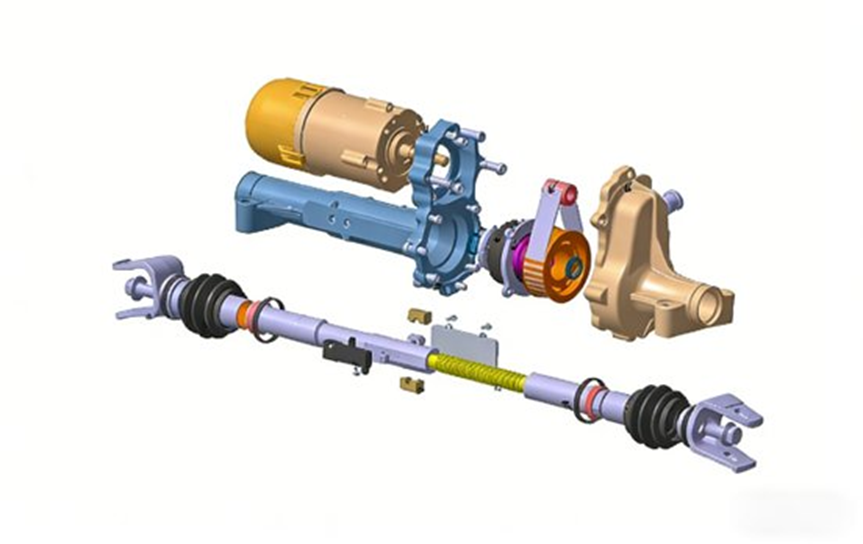
RWS systems are built from four main parts.
Sensor Layer (Perception System)
- Wheel speed sensor (accuracy ≤ ±1 km/h)
- Steering angle sensor (≤0.1° resolution)
- Yaw rate sensor (±500°/s)
- Lateral acceleration sensor
- Rear wheel angle sensor (≤±0.05° accuracy)
Control Unit (ECU)
- MCU ≥100 MHz
- Response time ≤10 ms
- Algorithms:
- PID
- Model Predictive Control (MPC)
- Communication:
- CAN
- LIN
- Ethernet
Actuation System
- BLDC motor (500W–1500W)
- Ball screw (efficiency ≥90%)
- Steering linkage
- Mechanical locking system
Redundancy and Safety System
To meet ISO 26262 (ASIL-B or higher):
- Power redundancy
- Sensor redundancy
- Controller redundancy
- Mechanical fail-safe lock
What Are the Key Technologies Behind High-Performance RWS?
High-Precision Steering Control
- Accuracy: ≤±0.1°
- Control: PID + adaptive methods
Smooth Mode Switching
- Transition: 0.5–1 second
- No jerky behavior
Multi-System Integration
RWS works together with:
- ESP
- Brake-by-wire
- Active suspension
This creates a unified chassis control system.
What Are the Engineering Challenges in RWS Development?
Environmental Robustness
- IP67 protection
- EMC resistance
- Lifetime: ≥1 million km
Cost and Lightweight Design
- Aluminum structures
- Integrated design
- Manufacturing optimization
Functional Safety
- Fault detection ≥99%
- Multi-layer fail-safe strategy
Real-World Applications of Rear Wheel Steering Systems
Case Study 1 – Electric SUV
- Turning radius: 6.2m → 5.0m
- Yaw fluctuation reduced by 30%
- Body roll reduced by 25%
Case Study 2 – High-Performance Vehicles
- Supports crab mode
- Improves cornering performance
How Are RWS Systems Tested and Validated?
- Bench testing (accuracy and durability)
- Vehicle testing (different road conditions)
- Safety testing (fault injection scenarios)
How Does RWS Integrate with Vehicle Motion Control (VMC)?
RWS works together with:
- Brake systems
- Suspension systems
- Stability control
The goal is simple:
all systems act together, not separately.
What Are the Future Trends of Rear Wheel Steering Systems?
- Integration with autonomous driving (L3+)
- AI-based control improvement
- Lower cost for wider adoption
- Use in commercial vehicles
- Deeper integration into vehicle platforms
FAQs (Trending in 2026)
What are the real benefits of rear-wheel steering (RWS) in modern vehicles?
Short answer: It improves turning at low speed and stability at high speed.
RWS reduces turning radius, making parking easier, and improves control during lane changes and emergency maneuvers. It also improves comfort and driver confidence. This is why more EVs and SUVs are starting to use it.
How does RWS work differently at low speed vs high speed?
Short answer: Opposite direction at low speed, same direction at high speed.
At low speed, rear wheels turn opposite to reduce turning radius. At high speed, they turn in the same direction to improve stability. The system switches automatically based on speed.
Why is RWS becoming more important for electric vehicles (EVs)?
Short answer: EVs are longer and heavier, so they need help turning.
Battery placement increases wheelbase, which reduces maneuverability. RWS helps by making the car feel shorter at low speed and more stable at high speed. This is especially useful for large electric SUVs.
What are the biggest challenges in implementing RWS systems?
Short answer: Cost, integration, and safety requirements.
RWS must meet strict safety standards (ISO 26262), work with ADAS systems, and remain reliable over long usage. Keeping the system affordable while maintaining performance is still a challenge.
Is rear-wheel steering safe and reliable for mass production?
Short answer: Yes, with proper redundancy and safety design.
Modern systems include backup mechanisms, fault detection, and fail-safe modes. In some setups, RWS can even support steer-by-wire systems. It is already used in production vehicles with proven reliability.
Author & Trust Signals
Author: Johnny Liu
Title: CEO at Dowway Vehicle
Johnny Liu has hands-on experience in intelligent chassis systems and vehicle control technologies, working closely with real-world RWS implementations and system integration challenges.
Last Updated: March 24, 2026
Company: Dowway Vehicle
Focus: rear wheel steering systems, intelligent chassis, EV platform integration
