

< Back to Automotive Simulation Toolchain
By Johnny Liu, CEO at Dowway Vehicle
Published: March 17, 2026
- The Automotive Industry’s Shift to MDO: Why It’s Essential Now
- Core Capabilities of Simcenter HEEDS in Automotive Engineering
- Real-World Applications: Case Studies from Automotive R&D
- The Strategic Value of Simcenter HEEDS for Automakers
- FAQs About Simcenter HEEDS
- Conclusion: A Future-Proof Solution for Automotive R&D
The Automotive Industry’s Shift to MDO: Why It’s Essential Now
The automotive industry is transforming rapidly with key trends like electrification, automation, and lightweighting. Traditional “experience-driven” R&D methods can’t keep up with the speed of innovation required. Automotive engineers are often stuck balancing complex systems like vehicle dynamics, NVH (Noise, Vibration, and Harshness), aerodynamics, battery thermal management, and structural strength. These systems are interconnected, so optimizing them under tight timelines and budgets is a major challenge.
Enter Simcenter HEEDS, a powerful optimization tool within the Siemens Xcelerator suite. It integrates seamlessly with CAD and CAE tools, automating workflows, exploring design spaces, and making the decision-making process faster and more efficient. With its localized Chinese interface, it’s helping automotive engineers in China and beyond adopt cutting-edge optimization technologies.
Core Capabilities of Simcenter HEEDS in Automotive Engineering
Seamless Process Automation: Reducing Development Time
In automotive design, the process involves steps like CAD modeling, meshing, solving, and post-processing. Traditionally, engineers had to manually switch between tools, which led to inefficiencies and errors. Simcenter HEEDS removes that bottleneck. It integrates with leading CAE and CAD tools such as Simcenter 3D, NX, Abaqus, Fluent, and MATLAB/Simulink. This allows the software to automate the entire design workflow, from “Parametric CAD Modeling -> Meshing -> Structural Simulation -> NVH Simulation -> Results Evaluation.” The system automatically iterates design variables like arm thickness and weld size, reducing optimization cycles from weeks to just days or hours.
Advanced Design Space Exploration with SHERPA Algorithm
Automotive design often involves multiple interdependent variables. Traditional optimization methods can’t explore the entire design space, resulting in local optima. Simcenter HEEDS uses the SHERPA (Systematic Hybrid Exploration that is Robust, Progressive, and Adaptive) algorithm to dynamically adjust its search strategy, ensuring a broader and more efficient search for global optima. Whether optimizing a single discipline or handling coupled systems, SHERPA ensures the best solutions. For instance, it can explore variables like front face styling, spoiler angles, and deflector sizes to improve aerodynamics while maintaining vehicle aesthetics.
Multidisciplinary Design Optimization (MDO): Balancing Trade-offs
Automotive systems are highly coupled. For example, reducing weight in a vehicle body might reduce its structural strength or NVH performance. Simcenter HEEDS uses MDO to handle these trade-offs globally. There are two key modes:
- Sequential Co-optimization: When disciplines depend on one another (e.g., running a structural simulation followed by NVH optimization).
- Parallel Co-optimization: When simulations can be run independently (e.g., running aerodynamics and battery thermal simulations at the same time), maximizing hardware utilization and efficiency.
Modular Architecture and Results Visualization
Simcenter HEEDS has a modular architecture with three main components:
- Process Automation Module: Automates the workflow by managing tool interfaces and execution.
- Design Space Exploration & Optimization Module: Uses advanced algorithms like SHERPA to process data, check constraints, and optimize the design.
- Results Visualization & Reporting Module: Offers easy-to-understand charts and heatmaps to visualize design variables and performance metrics. It can also auto-generate reports for design reviews.
Additionally, its integration with other Siemens tools like Simcenter Testlab and Simcenter Amesim ensures a complete “Simulation-Test-Optimization” workflow, enhancing cross-team collaboration.
Real-World Applications: Case Studies from Automotive R&D
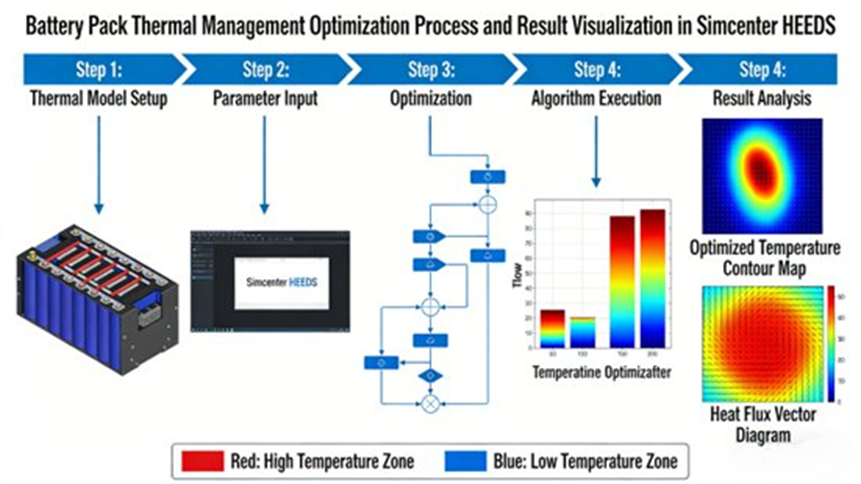
Case Study 1: EV Battery Pack Thermal Management Optimization
Challenge: A new energy vehicle manufacturer struggled to balance cooling efficiency, weight, cost, and space for an EV battery pack. R&D cycles were long, and uneven internal flow led to hotspots, while the cooling system consumed too much energy.
Optimization Setup:
- Variables: Cooling channel width (8-15mm), fin thickness (1-3mm), coolant velocity, and cell spacing.
- Constraints: Max temperature <= 45°C, uniformity <= 5°C, total weight <= 200kg, system power consumption <= 500W.
- Objectives: Minimize temperature, weight, and power consumption.
Results: Using SHERPA, the optimal design was found in 28 iterations, reducing the max temperature to 42°C, improving uniformity to 3.2°C, and reducing weight by 12kg. The R&D cycle was shortened from 45 days to just 12 days—a 73% time-saving.
Case Study 2: Chassis NVH and Structural Strength Co-Optimization
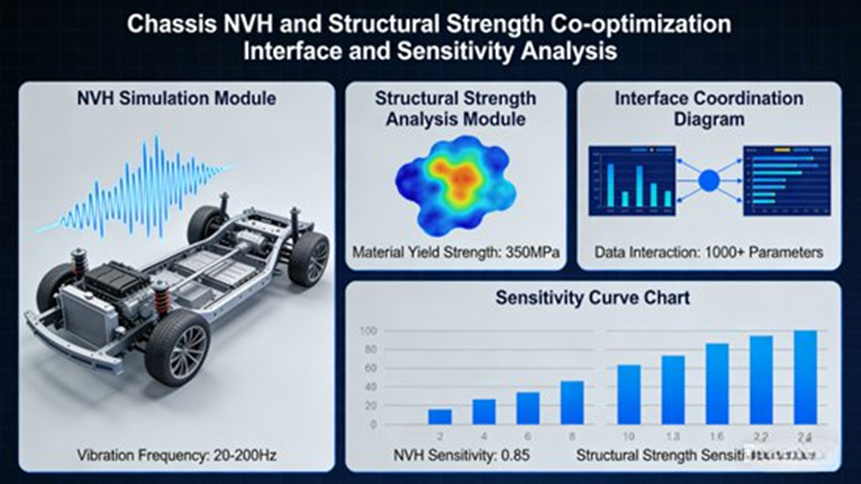
Challenge: A passenger vehicle chassis experienced stress concentration under complex road conditions and generated excessive noise/vibration. Traditional methods failed to balance structural strength and NVH performance.
Optimization Setup:
- Variables: Chassis arm cross-section, weld thickness, material choice (high-strength steel vs. aluminum alloy), joint stiffness.
- Constraints: Stress <= yield strength, deformation <= 0.5mm, vibration acceleration <= 0.3g, noise <= 60dB(A).
- Objectives: Minimize weight, vibration, and noise.
Results: After 32 iterations, the optimal solution reduced stress to 320MPa, deformation to 0.35mm, vibration to 0.22g, and noise to 57dB(A), saving 25% in costs and reducing prototype testing.
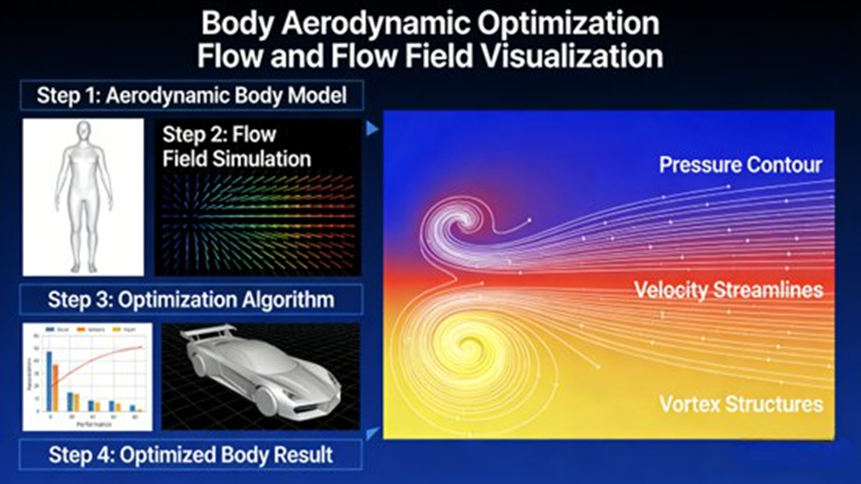
Case Study 3: Aerodynamics and Drag Coefficient Reduction for EV Body
Challenge: The initial EV body design had a drag coefficient of 0.32, missing the target of <= 0.28 for optimal range.
Optimization Setup:
- Variables: Grille angle, hood angle, roof curvature, and spoiler settings.
- Constraints: Maintain styling, drag coefficient <= 0.28, aerodynamic lift coefficient <= 0.05.
- Objectives: Minimize drag and lift.
Results: The drag coefficient dropped to 0.272, with a 40% reduction in R&D time and a range increase of about 8%.
The Strategic Value of Simcenter HEEDS for Automakers
Simcenter HEEDS brings significant advantages:
- Accelerated R&D: Reduces optimization cycles by over 60%, speeding up time-to-market.
- Cost Reduction: Cuts reliance on physical prototypes, reducing development costs by 20-40%.
- Enhanced Performance: Solves trade-offs to optimize comprehensive vehicle performance.
- Fostering Innovation: Encourages engineers to discover new, competitive designs through advanced optimization.
FAQs About Simcenter HEEDS
1. What is Simcenter HEEDS and why is it used in automotive engineering?
Simcenter HEEDS is a design optimization tool by Siemens. It helps engineers automate simulations, explore design alternatives, and find optimal solutions, which reduces R&D cycles and enhances multidisciplinary optimization in automotive design.
2. What algorithms does Simcenter HEEDS use?
Simcenter HEEDS uses the SHERPA algorithm, which adapts its search strategy in real-time to find global optima efficiently. It also integrates AI-enhanced predictors for faster optimization.
3. How does Simcenter HEEDS integrate with other tools?
Simcenter HEEDS integrates with CAE and CAD tools like Simcenter 3D, NX, Abaqus, and Fluent, creating a seamless, automated workflow for automotive R&D.
4. What are the main benefits of using Simcenter HEEDS for automotive design projects?
Simcenter HEEDS helps engineers automate repetitive tasks, explore design spaces efficiently, reduce R&D time and costs, and balance multidisciplinary objectives like aerodynamics, thermal management, and structural strength.
Conclusion: A Future-Proof Solution for Automotive R&D
Simcenter HEEDS is proving to be essential for modern automotive design. From battery thermal management to aerodynamics, it saves time, cuts costs, and enhances overall vehicle performance. As vehicles become more complex, the integration of AI and digital twin technologies with Simcenter HEEDS will continue to drive the evolution of R&D in the automotive industry.
