


< Back to Automotive Simulation Toolchain
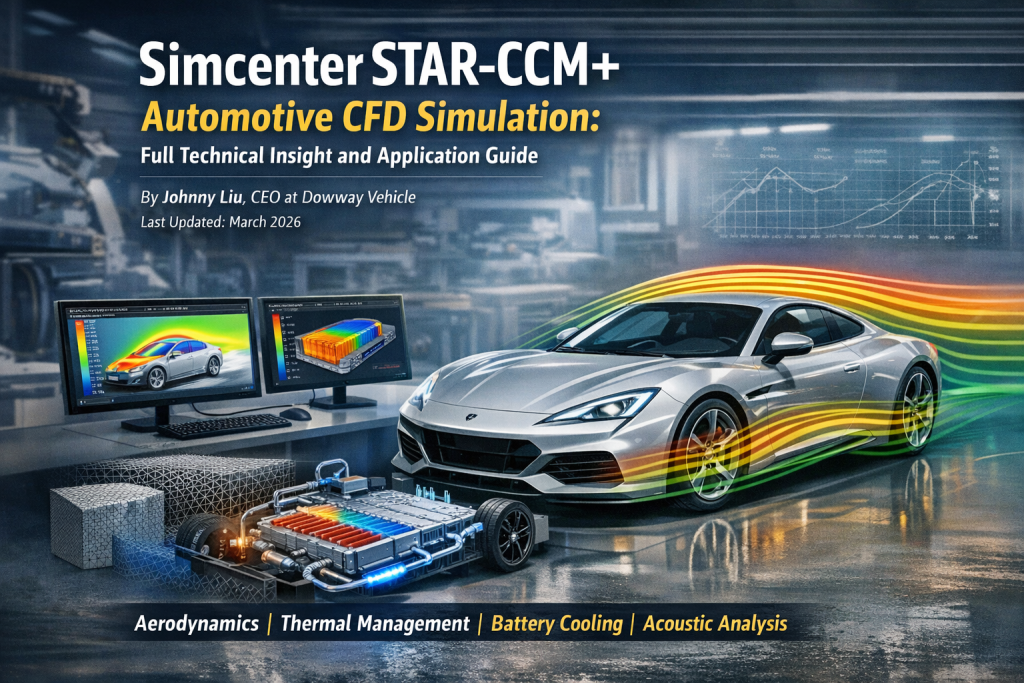
Author: Johnny Liu, CEO at Dowway Vehicle
Last Updated: March 2026
- 1. Introduction: Transforming Automotive R&D with Simcenter STAR CCM+
- 2. Simcenter STAR CCM+ Automotive CFD Simulation — Core Positioning & Technical Advantages
- 3. Core Automotive Engineering Applications
- 4. Engineering Workflow & Practical Execution
- 5. Engineering Value & Industry Impact
- 6. Future Development Trends in Automotive CFD
- 7. Conclusion: Harnessing the Power of Simcenter STAR CCM+ for Automotive Innovation
- Top 5 Frequently Asked Questions (FAQs) about Simcenter STAR‑CCM+
- 1. How do I access and use the official documentation and help resources?
- 2. What are the common license and installation troubleshooting questions?
- 3. How to handle simulation setup issues (meshing, boundary conditions, solver divergence)?
- 4. What new features or improvements are in the latest STAR‑CCM+ releases?
- 5. How to troubleshoot runtime and setup issues on HPC / parallel environments?
1. Introduction: Transforming Automotive R&D with Simcenter STAR CCM+
In the automotive industry, the pressure to innovate and improve vehicle performance is always increasing. One of the tools that helps engineers meet this demand is Simcenter STAR CCM+, a computational fluid dynamics (CFD) simulation software. It’s become indispensable for engineers seeking to optimize vehicle designs, reduce costs, and accelerate product development.
Simcenter STAR CCM+ isn’t just another CFD tool; it integrates multiple physical models, enabling engineers to tackle complex automotive challenges like aerodynamics, thermal management, and noise control. This article covers the core features, real-world applications, and best practices for using Simcenter STAR CCM+ in the automotive sector.
2. Simcenter STAR CCM+ Automotive CFD Simulation — Core Positioning & Technical Advantages
2.1 Full Chinese Localization for Automotive Engineering
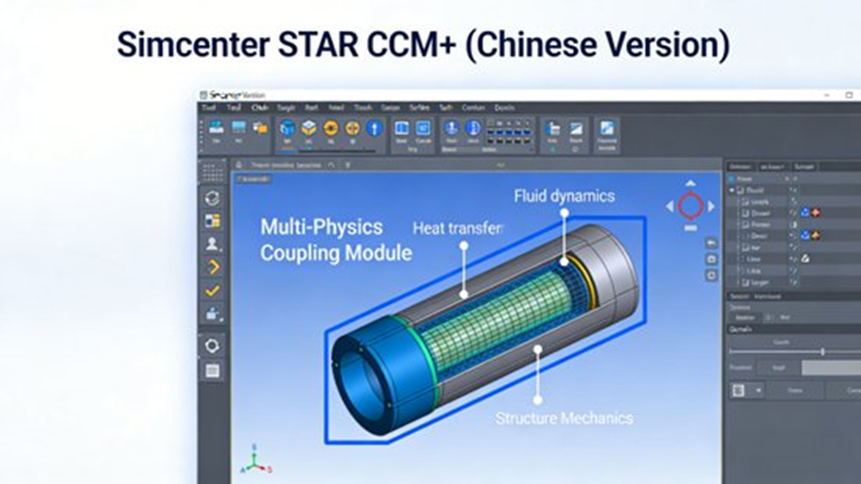
Simcenter STAR CCM+ (Chinese Version) is fully localized, making it easy for Chinese engineers to work without language barriers. The interface supports seamless switching between Chinese and English, providing complete menu translations, parameter settings, and help documentation. This localization reduces confusion and enhances productivity for local teams, allowing for smoother integration of international standards into Chinese operations.
2.2 Multi‑Physics Coupling for Complex Automotive Conditions
Simcenter STAR CCM+ allows engineers to simulate a variety of complex phenomena including fluid flow, heat transfer, structural mechanics, and aerodynamics. This multi-physics coupling is particularly valuable in the automotive industry, where different systems interact in unpredictable ways. Whether you’re working on airflow around a car body, heat distribution in an engine, or noise generated by tires, Simcenter STAR CCM+ covers all these areas without requiring additional plugins.
In the electric vehicle (EV) market, for instance, the software’s electrochemical-thermal model allows engineers to simulate battery behavior under various conditions, optimizing cooling systems and enhancing overall vehicle safety.
2.3 Efficient Meshing Technology — Precision + Speed
Meshing is a critical aspect of CFD simulations, and Simcenter STAR CCM+ provides powerful meshing tools that balance accuracy with computational efficiency. The software supports a variety of mesh types such as Trimmer, Tetrahedral, and Polyhedral, allowing engineers to handle complex geometries with ease. Its automatic mesh refinement capabilities ensure that important regions (e.g., car surfaces and cooling ducts) are captured with high precision, without overloading the system.
2.4 Solver Performance & Parallel Computing
The software’s finite volume method (FV) solver handles both compressible and incompressible flows, as well as laminar and turbulent flows. Simcenter STAR CCM+ supports multiple turbulence models like SST k-ω, DES, and LES, which are essential for automotive applications.
To optimize simulation performance, the software uses algebraic multigrid (AMG) methods, which speed up solver convergence. With support for GPU, CPU, and ARM parallel computing, engineers can run simulations faster, reducing total computation time by up to 50%.
3. Core Automotive Engineering Applications
3.1 Automotive External Aerodynamics & Drag Optimization
Aerodynamic drag is a major factor in vehicle fuel efficiency, range, and stability. By simulating airflow around vehicle surfaces, Simcenter STAR CCM+ helps engineers optimize the drag coefficient (Cd). This optimization leads to more efficient designs, reduced fuel consumption, and better performance.
For instance, in a side mirror design project for an SUV, simulations revealed that uneven pressure distribution caused drag and noise. By adjusting the design based on these insights, the drag coefficient dropped by 6%, resulting in better fuel efficiency and reduced noise.
3.2 Electric Vehicle Thermal Management
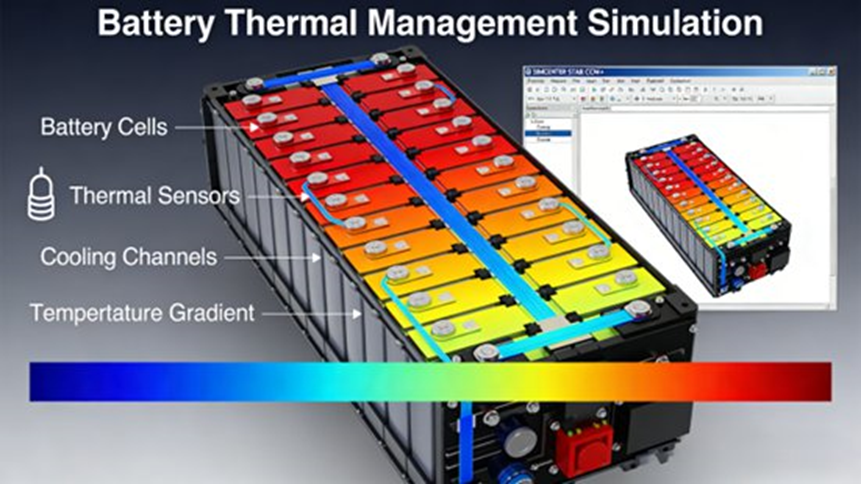
Thermal management in electric vehicles, especially concerning the battery and motor systems, is crucial for performance and safety. Simcenter STAR CCM+ provides advanced thermal simulations that allow engineers to design better cooling systems. Using its electrochemical-thermal coupling model, the software helps optimize battery cooling and prevent overheating—critical for EV battery performance and longevity.
Simcenter STAR CCM+ simulations can reduce battery temperature variations, for example, from ±5°C to ±2°C, lowering the risk of thermal issues and increasing battery lifespan.
3.3 Automotive Aero‑Acoustic & Vibration Control
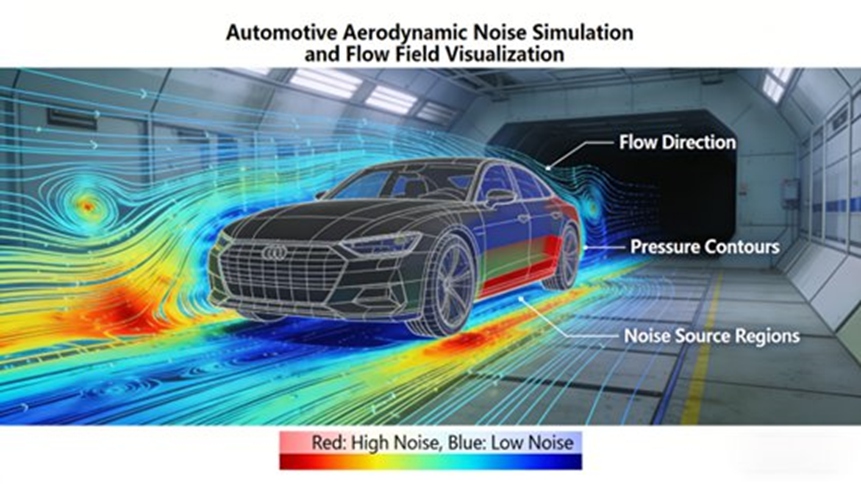
Noise, vibration, and harshness (NVH) are key factors that influence the driving experience. Simcenter STAR CCM+ integrates aero-acoustic simulations to identify the sources of noise and vibration, helping engineers improve the vehicle’s acoustic comfort. The software combines fluid-structure interaction (FSI) with acoustic models to predict how pressure changes affect vehicle noise levels.
In one sedan project, simulations revealed that airflow separation near the window edges generated significant wind noise. By optimizing the window sealing, noise levels were reduced by 8 dB, enhancing the driving experience.
3.4 Special Automotive Scenarios
Simcenter STAR CCM+ is also useful for simulating complex scenarios like water ingestion or fog formation in car lights. With multi-phase flow models, it simulates water flow over the car’s underbody, checking for potential water ingress points. In lighting systems, the software simulates condensation and humidity, helping prevent fogging issues that can impact visibility.
4. Engineering Workflow & Practical Execution
4.1 Geometry Pre‑Processing for Automotive CAD
Simcenter STAR CCM+ offers a range of geometry pre-processing tools that allow engineers to clean up and prepare CAD models for simulation. The software automatically detects and repairs common geometry issues such as redundant surfaces or gaps, ensuring that simulations are set up accurately from the start.
4.2 Meshing Strategies Specific to Automotive Cases
For automotive applications, Simcenter STAR CCM+ uses polyhedral meshes for external aerodynamics and tetrahedral meshes for more complex internal components. Mesh refinement is applied in regions of high flow complexity, like around car surfaces or in cooling ducts, ensuring accuracy without overburdening the system.
4.3 Physical Models & Boundary Conditions
Simcenter STAR CCM+ provides robust tools to define boundary conditions, including inlet speed, temperature, and pressure for external aerodynamics, as well as heat generation rates and coolant flow for thermal simulations. These physical models are critical to ensure simulations match real-world conditions.
4.4 Solving & Post‑Processing Automotive Data
Simcenter STAR CCM+ allows engineers to process large volumes of simulation data in parallel, significantly reducing the time needed for completion. The software’s post-processing capabilities offer visualizations such as pressure contours, velocity vectors, and temperature profiles, helping engineers extract key performance metrics to guide design improvements.
5. Engineering Value & Industry Impact
Simcenter STAR CCM+ reduces development time and costs by enabling digital testing and optimization. By simulating real-world conditions, engineers can eliminate the need for physical prototypes, saving both time and money. As a result, manufacturers can bring products to market faster, with higher performance and better reliability.
6. Future Development Trends in Automotive CFD
As automotive engineering moves toward electric, autonomous, and lightweight vehicles, Simcenter STAR CCM+ will continue to evolve to meet these needs. Future developments will likely include AI-driven optimization, integrated design workflows, and even more advanced simulation techniques to handle increasingly complex automotive systems.
7. Conclusion: Harnessing the Power of Simcenter STAR CCM+ for Automotive Innovation
Simcenter STAR CCM+ empowers automotive engineers to solve complex design challenges in aerodynamics, thermal management, and noise control. By using its multi-physics simulation capabilities, manufacturers can achieve optimized designs, reduce development costs, and speed up time-to-market.
Top 5 Frequently Asked Questions (FAQs) about Simcenter STAR‑CCM+
1. How do I access and use the official documentation and help resources?
Answer: Official guides and tutorials are available via the help menu (<F1>) in the software. Additional resources, including PDFs and online knowledge bases, are available on the Siemens website.
2. What are the common license and installation troubleshooting questions?
Answer: Common issues include license server errors or missing licenses. Check the STAR‑CCM+ knowledge base for troubleshooting tips, and ensure your network licenses are correctly configured.
3. How to handle simulation setup issues (meshing, boundary conditions, solver divergence)?
Answer: Issues like mesh quality problems and solver divergence can often be resolved by adjusting boundary conditions and using the appropriate physical models for the simulation.
4. What new features or improvements are in the latest STAR‑CCM+ releases?
Answer: New versions bring improvements in GPU performance, multiphase modeling, and mesh refinement, as well as updated turbulence models and enhanced thermal simulation capabilities.
5. How to troubleshoot runtime and setup issues on HPC / parallel environments?
Answer: Ensure that your parallel environments are configured correctly, including MPI flags and licensing. The software’s parallel setup guides help ensure that simulations run efficiently on multi-node systems.
Keywords:
Simcenter STAR CCM+, Automotive CFD Simulation, Vehicle Performance Optimization, Aerodynamics, Thermal Management, Battery Cooling Systems, Multi-Physics Simulation, Fluid-Structure Interaction, Electric Vehicle Thermal Management, Noise Control, Meshing Technology, Solver Performance
