


< Back to Platform Development
Author: Johnny Liu, CEO at Dowway Vehicle
Date: March 4, 2026
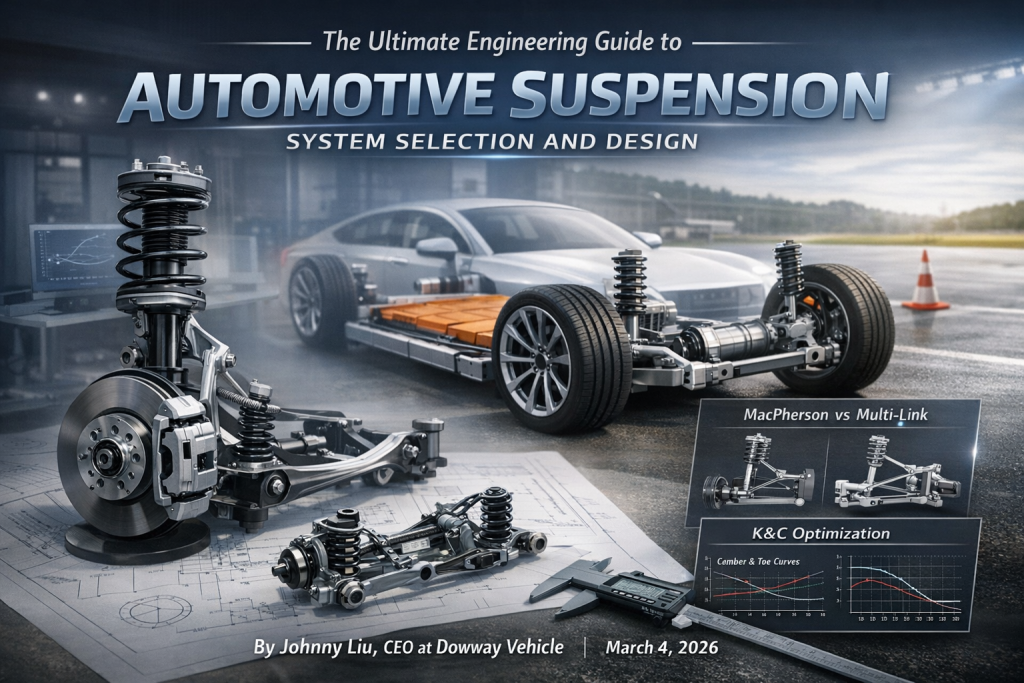
Suspension systems are the core of a car’s chassis. They connect the body to the wheels to handle force and dampen vibrations. A well-designed system sets how a car handles, stays quiet (NVH), and lasts over time. This guide covers how we choose structures, set design targets, and check our work through engineering trials.
1. How Modern Vehicles Change the Game
Electric cars and smart tech are changing how we look at the chassis. We can’t just look at parts in a vacuum. Engineers have to work around heavy battery packs and a lower center of gravity. This makes matching spring stiffness and cutting weight even more vital than it was for gas cars.
2. Main Goals and Real-World Limits
What the System Must Do
- Handle Force: Carry loads from braking, turning, and bumps. It keeps tires on the road so the car doesn’t lose grip.
- Stop Vibrations: Springs and dampers work together to keep the body moving at a steady 1.0~1.6Hz. This is the sweet spot for human comfort.
- Control Body Lean: Keep the car from leaning more than 4° during sharp turns (at 0.4g) and keep the nose from dipping more than 50mm when braking.
- Fit the Space: It has to leave room for the motor, battery, and steering while keeping enough ground clearance.
Real-World Boundaries
- Budget: Parts and materials must fit the car’s price bracket.
- Room: High-end setups like Double Wishbone take up a lot of lateral space, which is hard to find in small cars.
- Performance Balance: You often have to trade a bit of comfort to get better handling.
3. Choosing the Right Structure
MacPherson Strut
This is the go-to for front wheels on most cars, like the VW Lavida or BYD Qin PLUS.
- The Logic: It’s light, cheap, and doesn’t take much side-to-side room.
- The Trade-off: It’s not as stiff when cornering, and the wheel angles change quite a bit as the suspension moves up and down.
Double Wishbone
You’ll find this on performance cars like the Tesla Model S or BMW 3 Series.
- The Logic: It uses two A-arms to keep the wheel stable. It offers great grip and keeps the car flat in corners.
- The Trade-off: It’s pricey, heavy, and hard to package.
Multi-Link
The best way to balance comfort and speed. Used on the rear of cars like the Audi A6L or Xpeng P7.
- The Logic: With 3 to 5 separate arms, engineers can fine-tune every movement. It’s great for blocking out road noise.
- The Trade-off: It’s complex and needs lightweight parts (like aluminum) to work well.
Torsion Beam and Air Tech
- Torsion Beam: A simple, tough, and cheap choice for the rear of small cars like the Honda Fit.
- Air Suspension + CDC: High-end tech that changes height and stiffness on the fly. It has to work in tough spots, from -40°C to 80°C.
4. Setting the Design Numbers
We use math and simulations to hit our targets before we ever build a physical part.
Springs and Dampers
- Ride Frequency: We aim for 1.0~1.4Hz in the front and 1.2~1.6Hz in the back.
- Damping: We look for a ratio of 0.25~0.4. The force when the shock extends (rebound) should be 2.5 to 3 times higher than when it squishes (compression).
Wheel Angles and K&C (Kinematics & Compliance)
- Camber: We usually set this between -0.5° and -1.5°.
- Toe: We keep this at 0° ± 0.2° to stop tires from wearing out early.
- Movement Limits: As the wheel moves 100mm, the angle shouldn’t change more than 0.5°. Under side force, it shouldn’t flex more than 0.2° per kN.
5. Materials and Making Parts
For electric cars, every gram counts. If we take 1kg off the wheels or arms (unsprung mass), it feels like taking 10kg off the body.
- Steel (Q355/Q460): Strong and cheap. Good for basic arms and frames.
- Aluminum (6061/7075): Cuts weight by 30% or more. We use this for high-end arms and knuckles.
- New Methods: We are moving away from welding small steel pieces and toward one-piece cast aluminum frames to save weight and add strength.
6. Testing and Proof
We follow a strict path: Set Goals → Design → Computer Sim → Bench Test → Road Test. * Computer Sims: We use ADAMS/Car to see how the car will handle.
- Bench Tests: Springs have to survive being squashed 1 million times without breaking.
- Road Tests: Drivers take the car through slaloms and rough roads to dial in the final feel.
7. Fixing Common Problems
- Car Pulls to One Side: Check the wheel angles (Caster/Toe) and make sure the parts are symmetrical.
- Nose Dives on Braking: Stiffen the front springs or turn up the shock absorber’s compression force.
- Tires Wear Fast: Usually means the Camber or Toe is off, or the rubber bushings are too soft.
- EV Comfort Issues: Lower the spring stiffness and use lighter aluminum parts to handle the heavy battery weight.
FAQ: Top Questions About Suspension
1. Why does my car need a suspension?
It keeps your tires on the road so you can steer and brake. It also stops you from feeling every single bump in the road.
2. How do the parts work?
The spring takes the hit from a bump. The shock absorber (damper) stops the spring from bouncing up and down forever.
3. What is the difference between independent and dependent suspension?
In an independent setup, one wheel can hit a bump without moving the other wheel. In a dependent (solid axle) setup, they are linked. Independent is better for comfort and speed.
4. When do I know my suspension is failing?
Look for oil leaks on the shocks, uneven tire wear, or if the car keeps bouncing after a bump.
5. Why are EV suspensions different?
EVs are heavy. They need stronger parts and better tuning to keep that weight from making the car feel sluggish or bumpy.
Final Word
Design is about balance. You start with the right structure, hit your math targets, and then spend hours on the road tuning the feel. In the future, we will see more smart systems that “read” the road and change settings in a heartbeat to keep the car stable.
