

< Back to Performance Development
By Johnny Liu, CEO at Dowway Vehicle March 3, 2026
Key Takeaways
- Main Infrastructure: Testing grounds are the “quality hubs” for R&D and meeting legal rules.
- Bench vs. Road: Bench tests isolate parts for repeat runs; road tests check how the whole car works in the real world.
- Exact Specs: High-speed tracks need a surface flatness of 3mm or less and data tools that track 100Hz.
- The Future: Moving toward Digital Twins, automated tests, and new setups for EVs and smart cars.
1. The Role of Bench and Road Testing
As cars become electric and smart, checking how they work is much harder. Professional proving grounds—the main spots for R&D—get past the limits of normal street driving. By building set, repeatable, and measurable spaces, they cover everything: power, fuel use, safety, comfort, and how long parts last.
Bench and road testing give more control than public streets. They get rid of traffic and changing weather, making sure results for gas cars, EVs, and self-driving systems stay reliable and easy to compare.
2. How Testing Centers are Grouped
These centers do three main things:
- Help R&D: Speed up work and cut costs by mimicking real life.
- Check Quality: Find flaws in early car versions and parts.
- Legal Passing: Make sure cars follow country and world rules (like GB 1495 for noise and GB 20071 for safety).
Types of Facilities:
- Company Tracks: Built for private R&D (examples: VW in Germany, Toyota in Japan, BYD in China).
- Independent Labs: Trusted third-party spots (examples: CAERI in Chongqing, CATARC in Tianjin).
- Government Grounds: Focused on setting the rules for everyone (example: JARI in Japan).
- Special Spots: Only for one thing, like Tesla’s site for self-driving and EV tech.
3. Testing Areas and Technical Setups
3.1 High-Speed Circuit (HSC)
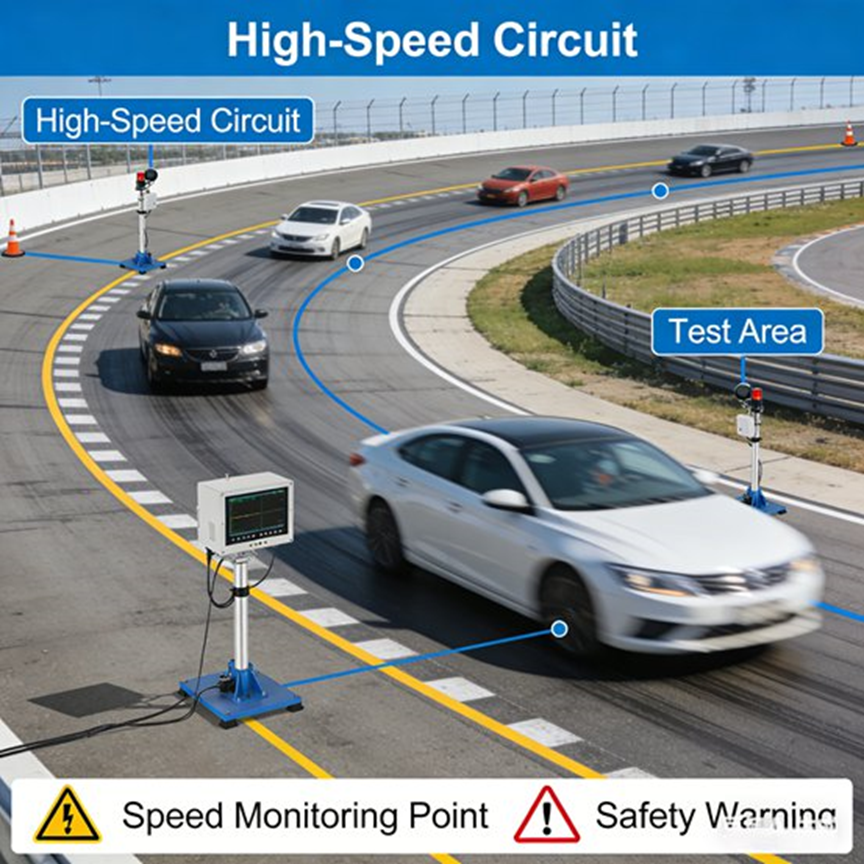
The HSC is the most important part of the grounds. It checks if a car stays steady at high speeds and how much fuel or power it uses.
- Design: A loop with a 1-2km width. Speeds go from 160 to 300 km/h (the best tracks go over 400 km/h).
- Accuracy: The road surface height stays within a 3mm error range.
- Safety: The curves are tilted to stop the car from sliding out at high speeds.
3.2 Performance Area
- Straight Tracks: 500-1000m long to check 0-100/200 km/h times and top speed.
- Braking Tracks: 300-500m long with different grips (dry, wet, or fake rain).
- Handling: Areas for zig-zag driving, circles, and seeing how the steering snaps back.
3.3 Durability (Rough Roads)
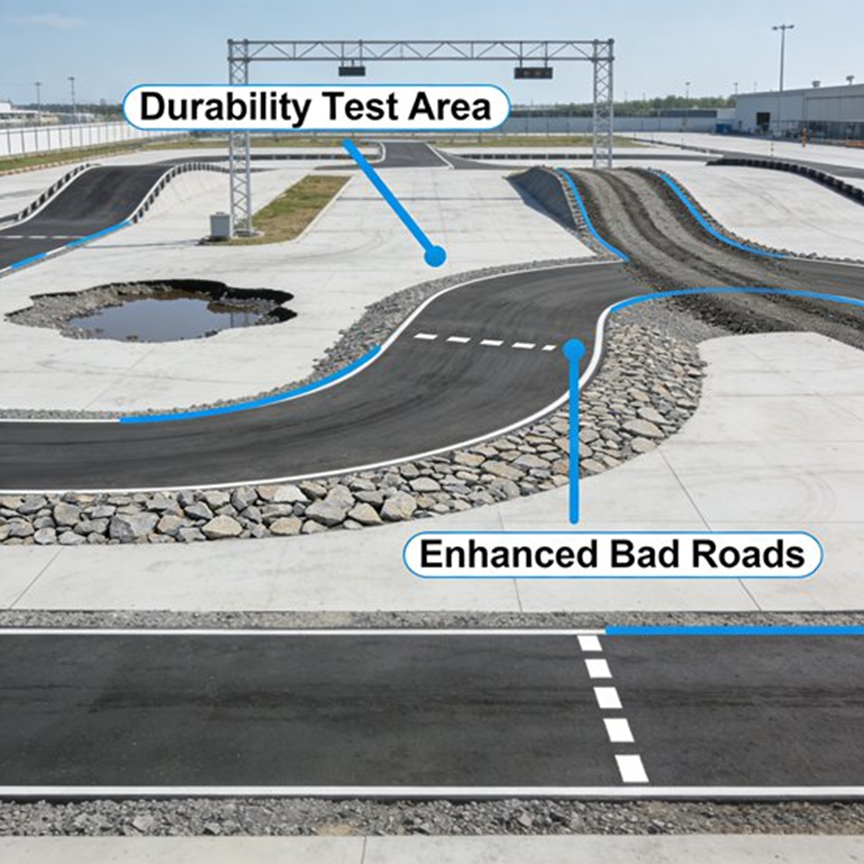
To wear out a car fast, these tracks mimic a full car’s life in 1/10 to 1/5 of the normal time.
- Roads: Bumpy roads, pebbles, holes, dirt, and salt paths.
- Weather Rooms: Mimicking heat, cold, high moisture, and thin air at high altitudes.
3.4 EV and Smart Driving Areas
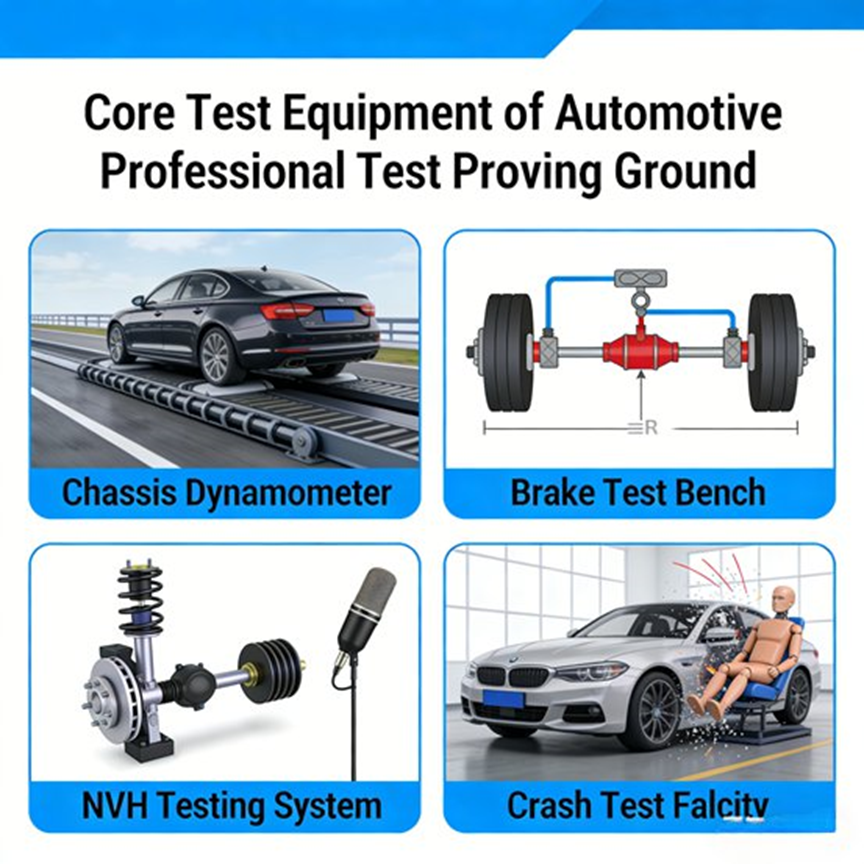
- EV Bench Testing: Checking battery charging, poking batteries with needles, and testing motors and chargers (plug-in or wireless).
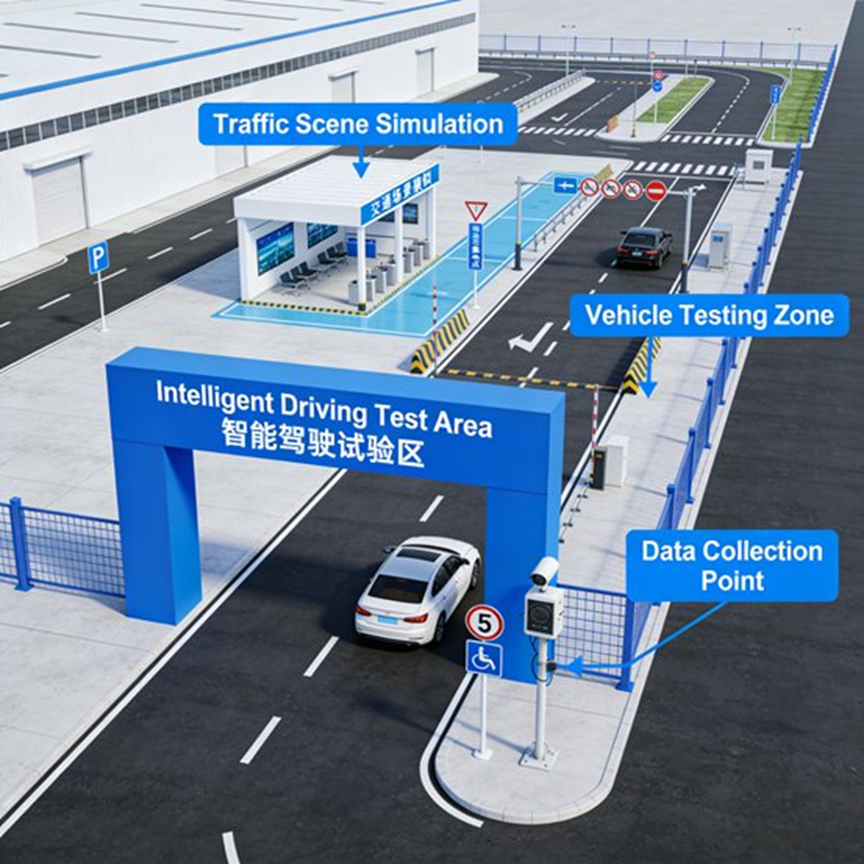
- Smart Driving: Checking L2-L5 systems with high-end GPS. These tracks use fake walkers and other cars in city-like setups.
4. Tech and Tools
- Data Gear: Recording at 100Hz (100 times a second) with less than 1% error. Tools like Siemens LMS or HBK QuantumX are common.
- Smart Analysis: Using AI and “Digital Twins” to guess how a car will act later.
- No-Touch Tools: Using lasers, high-speed cameras, and LiDAR to watch the car without touching or slowing it down.
5. Standard Work Steps
Professional tests follow a set 6-step path:
- Needs: Checking what GB or ISO rules must be met.
- Plan: Picking the right spots and tools.
- Prep: Checking tire pressure, oil, and putting on sensors.
- Testing: Running the car while watching for any weird data.
- Data: Cleaning up the numbers and making a model.
- Report: Writing the final results for the R&D team or the government.
6. Where the Industry is Going
- Smarter Tests: Tests that run themselves, cars with no drivers, and instant data over 5G.
- Cleaner Sites: Using green energy for the centers and tools that use less power.
- Home-Grown Tools: Making more high-end data gear locally instead of buying it from other countries.
❓ Common Questions (FAQ)
Q1: What is bench testing for cars?
A: This is when you test one part (like a computer chip, engine, or brakes) on a stand instead of in a car. It lets engineers fix problems and tune things in a lab before the part goes into a real vehicle.
Q2: How is road testing different?
A: Bench testing happens in a lab. Road testing happens on a track or street with a full car. Road tests show how the car acts with things like wind, hills, and rain. (Source: ATESTEO)
Q3: Why do we need both?
A: They work together. Bench tests find small bugs in a lab. Road tests make sure all the parts work well together when a person is actually driving. (Source: Patsnap Eureka)
Q4: What parts do people bench test?
A: Mostly engines (to check power), EV motors, car computers (ECUs), wires, and the dashboard screens. (Source: Wikipedia)
Q5: How do road tests get their data?A: Engineers put sensors on the car to track things like speed, shaking, and fuel use. This data tells them if the car is tough enough for years of use. (Source: ATESTEO)
